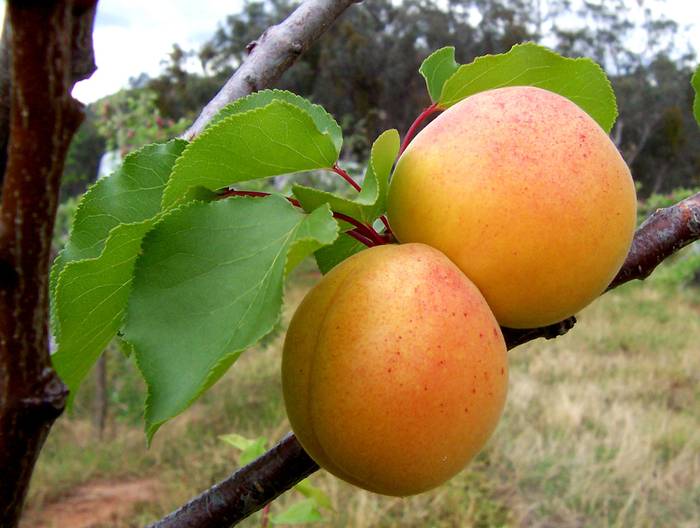
Fir0002 · CC BY-SA 3.0
Abrikos
Træ·Prunus armeniaca
Halvskygge til fuld sol
Sol
Fugtig jord
Vand
Veldrænet jord
Dræning
Zoner 4–8
Hårdførhed
Dækning · 138 felter
Ingen åbenlyse uoverensstemmelser fundet.
Vækst og størrelse11 felter
Plantetype
Løvfældende træ“Prunus armeniaca is a deciduous Tree growing to 9 m (29ft) by 6 m (19ft) at a medium rate.”
Højde
900 cm · andre kilder: 800 cm, 1.200 cm“Prunus armeniaca is a deciduous Tree growing to 9 m (29ft) by 6 m (19ft) at a medium rate.”Wikipedia“Prunus armeniaca is a small tree, 8–12 m (26–39 ft) tall, with a trunk up to 40 cm (16 in) in diameter and a dense, spreading canopy.”
Bredde
600 cm“Prunus armeniaca is a deciduous Tree growing to 9 m (29ft) by 6 m (19ft) at a medium rate.”
Højde ved alder
—
tomt
Grundstammeforsøg
Haggith (apricot seedling): 4,41 m efter 10 år · M800 (P. besseyi x P. sibirica): 3,95 m efter 10 år · Yuksa (P. besseyi x P. armeniaca): 3,96 m efter 10 år“1 published rootstock trials (Haggith (apricot seedling), M800 (P. besseyi x P. sibirica), Yuksa (P. besseyi x P. armeniaca)) measured height and crown width at known years after planting.”
Grundstammeforsøg
Planteafstand
600 cm (mindst 450 cm)
AI-estimat55 % enig
Vækstrate
Middel“Prunus armeniaca is a deciduous Tree growing to 9 m (29ft) by 6 m (19ft) at a medium rate.”
Vækstform
Bredt udbredt“Prunus armeniaca is a small tree, 8–12 m (26–39 ft) tall, with a trunk up to 40 cm (16 in) in diameter and a dense, spreading canopy.”
Roddybde
Lav“Most members of this genus are shallow-rooted and will produce suckers if the roots are damaged.”
Skovhavelag
Lavt trælag
AI-estimat90 % enig
Levetid
~40 år
AI-estimatikke målt endnu
Rødder6 felter
Rodform
Fladrodet (skiverod)“Most genus members are shallow-rooted, forming a plate near the soil surface, and will produce suckers if the roots are damaged.”
Lagerorgan
—
tomt
Breder sig
Nej“The plant growth habit is a standard with a non-suckering single trunk [1-2].”
PFAFdelvist
Breder sig sideværts i cm
—
tomt
Roddybde i cm
—
tomt
Mykorrhiza
Arbuskulær (AM)
AI-estimatikke målt endnu
Lys, vand og jord9 felter
Sol
Fuld sol, let skygge, halvskygge · bedst: fuld sol“It can grow in semi-shade (light woodland) or no shade.”
Timer sol
6–12 t
AI-estimatikke målt endnu
Tørketålende
—
tomt
Tåler vandlidende jord
—
tomt
Jordtype
Sand, muld · bedst: muld“Thrives in a loamy soil, doing well on limestone.”PFAF“Suitable for: light (sandy) and medium (loamy) soils and prefers well-drained soil.”
pH
5–8 · bedst 6,5–7,5“Prefers a pH in the range 6.5 to 7.5.”PFAF“Suitable pH: mildly acid, neutral and basic (mildly alkaline) soils.”
Dræning
Veldrænet“Suitable for: light (sandy) and medium (loamy) soils and prefers well-drained soil.”
Komprimeret jord
Tåler det dårligt
AI-estimatikke målt endnu
Klima5 felter
Hårdførhed
Zone 4–8
AI-estimatikke målt endnu
Dræbende frost
-1 °C“Killing temp. early growth: -1”EcoCrops tal er frost under tidlig vækst (forårsfrost på nye skud), ikke vinterkulde.
Vækst-temperatur
7–40 °C · optimal 14–35 °C“Temperature absolute min: 7 · Temperature absolute max: 40 · Temperature optimal min: 14 · Temperature optimal max: 35”
Kuldetimer
700 t
AI-estimatikke målt endnu
Pleje (bliver til opgaver i Manage)7 felter
Beskæring
Juni · varer 90 dage“Any pruning should be carried out in the summer to allow rapid healing and therefore less risk of infection.”
PFAFdelvist
Beskyttelse
Efter forrige fase · varer 30 dage · frost“However, if given the benefit of a south or west facing wall and some protection from frosts when it is in flower, reasonable crops can usually be produced in southern England.”
PFAFdelvist
Udplantning
Maj · varer 60 dage“Grow them on in a greenhouse or cold frame for their first winter and plant them out in late spring or early summer of the following year.”
PFAFdelvist
Gødning
Marts · varer 30 dage · a balanced granular fertiliser or well-rotted compost
AI-estimatikke målt endnu
Jorddække
April · varer 30 dage
AI-estimatikke målt endnu
Vanding
Juni · varer 90 dage
AI-estimatikke målt endnu
Beskyttelse
Marts · varer 30 dage · frost
AI-estimatikke målt endnu
Året rundt7 felter
Spring ud
Efter forrige fase · varer 30 dage“they are produced singly or in pairs in early spring before the leaves.”
Wikipediadelvist
Blomstring
Marts · varer 60 dage“It is in flower from March to April, and the seeds ripen from July to September.”
Dvale
Efter første frost · varer 150 dage“Prunus armeniaca is a deciduous Tree growing to 9 m (29ft) by 6 m (19ft) at a medium rate.”
PFAFdelvist
Går i dvale
Efter første frost · Styret af daglængden · varer 30 dage
AI-estimatikke målt endnu
Første høst
4 år efter plantningFrom Cornell Cooperative Extension's Table 2 ('Planting and harvesting guidelines for various fruit crops'), the apricot row's 'Bearing Age (years)' column reads 4. The guide does not state whether this counts from seed or from planting a nursery tree, but the table is titled 'Planting and harvesting guidelines' and sits alongside apple rows (e.g. 'bear fruit the second or third year after planting' elsewhere in the same document for nursery stock), so it is read here as years after planting a nursery tree.
Spiselige dele og bestøvning7 felter
Frugterne
Raw, cooked or dried for later use · juli–september“Fruit - raw, cooked or dried for later use.”PFAFdelvist“The fruit is available from mid to late summer.”
Frøene
Raw or cooked“Bitter seeds should be eaten in strict moderation, but sweet ones can be eaten freely.”PFAF“Seed - raw or cooked.”
Oil
Pressed from the seed as an edible semi-drying cooking oil“Consume in small quantities if it tastes strongly of bitter almonds.”PFAF“The pressed seed contains up to 50% of an edible semi-drying cooking oil known as the oil of almond.”
Bestøvning
Selvbestøvende · tvekønnet“The species is hermaphrodite (has both male and female organs) and is pollinated by Insects.”PFAF“The plant is self-fertile.”PFAF“The plants are self-fertile, but hand pollination would be advisable since they are normally flowering before many pollinating insects are active.”
Bestøves af
Insekter“The species is hermaphrodite (has both male and female organs) and is pollinated by Insects.”
Økologi5 felter
Tiltrækker
Insects, dyreliv“The species is hermaphrodite (has both male and female organs) and is pollinated by Insects.”PFAF“It is noted for attracting wildlife.”
Skadedyr
Bladlus, snudebiller, glasvinger
AI-estimatikke målt endnu
Sygdomme
Honningsvamp, grenkræft“Plants in this genus are notably susceptible to honey fungus.”PFAFdelvist“‘Alfred’ is less prone to canker.”
Optager
Kalium, calcium
AI-estimatikke målt endnu
Fikserer kvælstof
Nej
AI-estimatikke målt endnu
Formering og navne4 felter
Metoder
Frø, half-ripe cuttings, grønne stiklinger, aflægning“Seed - requires 2 - 3 months cold stratification and is best sown in a cold frame as soon as it is ripe.”PFAF“Cuttings of half-ripe wood with a heel, July/August in a frame. Difficult.”PFAF“Softwood cuttings from strongly growing plants in spring to early summer in a frame. Difficult.”PFAF“Layering in spring.”
Sværhedsgrad
2 / 5
AI-estimatikke målt endnu
Frø
2 - 3 months cold stratification“Seed - requires 2 - 3 months cold stratification and is best sown in a cold frame as soon as it is ripe.”
Ikke sorteret endnu77 felter
Felter som parseren gemmer, men som siden ikke har en række til endnu. De vises her automatisk, så intet er skjult.
forage.DK.local_name
Abrikos
AI-estimatikke målt endnu
forage.DK.prep_cautions
Any very bitter seed or fruit should not be eaten., The species produces hydrogen cyanide, a poison that gives almonds their characteristic flavour.“Usually present in too small a quantity to do any harm, any very bitter seed or fruit should not be eaten.”PFAF“This species produces hydrogen cyanide, a poison that gives almonds their characteristic flavour.”
forage.DK.edibility_basis
inferred
AI-estimatikke målt endnu
forage.DK.foraging_months.notes
Harvest late summer into autumn.“Harvest late summer into autumn.”
forage.DK.foraging_months.year_round
false
AI-estimatikke målt endnu
forage.DK.habitat_affinity
disturbed_ground
AI-estimatikke målt endnu
forage.US.local_name
Apricot
AI-estimatikke målt endnu
forage.US.edible_parts
[{"part":"fruit","caution":null,"preparation":"raw, cooked or dried for later use","season_months":[7,8,9]},{"part":"seed","caution":"Bitter seeds should be eaten in strict moderation; sweet seeds can be eaten freely.…“Bitter seeds should be eaten in strict moderation, but sweet ones can be eaten freely.”PFAF“Consume in small quantities if it tastes strongly of bitter almonds.”PFAF“Fruit - raw, cooked or dried for later use.”PFAF“Seed - raw or cooked.”PFAF“The pressed seed contains up to 50% of an edible semi-drying cooking oil known as the oil of almond.”PFAF“An edible gum is obtained from the trunk.”PFAFdelvist“The fruit is available from mid to late summer.”
forage.US.prep_cautions
Any very bitter seed or fruit should not be eaten., The species produces hydrogen cyanide, a poison that gives almonds their characteristic flavour.“Usually present in too small a quantity to do any harm, any very bitter seed or fruit should not be eaten.”PFAF“This species produces hydrogen cyanide, a poison that gives almonds their characteristic flavour.”
forage.US.edibility_basis
inferred
AI-estimatikke målt endnu
forage.US.foraging_months.notes
Harvest late summer into autumn.“Harvest late summer into autumn.”
forage.US.foraging_months.year_round
false
AI-estimatikke målt endnu
forage.US.habitat_affinity
disturbed_ground
AI-estimatikke målt endnu
forage.TROPICAL.local_name
Apricot
AI-estimatikke målt endnu
forage.TROPICAL.edible_parts
[{"part":"fruit","caution":null,"preparation":"raw or cooked","season_months":[5,6,7]}]
AI-estimatikke målt endnu
forage.TROPICAL.prep_cautions
Seeds (kernels) contain cyanogenic glycosides and should be consumed in very small quantities, especially bitter varieties.
AI-estimatikke målt endnu
forage.TROPICAL.edibility_basis
inferred
AI-estimatikke målt endnu
forage.TROPICAL.foraging_months.notes
Apricots are typically grown in temperate regions, but in some subtropical or high-altitude tropical areas, they may fruit earlier or over a longer season.
AI-estimatikke målt endnu
forage.TROPICAL.foraging_months.months
5, 6, 7
AI-estimatikke målt endnu
forage.TROPICAL.foraging_months.year_round
false
AI-estimatikke målt endnu
forage.TROPICAL.habitat_affinity
disturbed_ground
AI-estimatikke målt endnu
ornamental.basis
documented
AI-estimatikke målt endnu
ornamental.fragrance.source
flower“Apricot (P. armeniaca) is a dwarf to medium tree with attractive fragrant flowers.”
ornamental.fragrance.intensity
subtle
AI-estimatikke målt endnu
ornamental.confidence
high
AI-estimatikke målt endnu
ornamental.fall_interest
true
AI-estimatikke målt endnu
ornamental.flower_colour
pink, white“Bloom Color: Pink.”Wikipedia“The flowers are 2–4.5 cm (0.8–1.8 in) in diameter, with five white to pinkish petals; they are produced singly or in pairs in early spring before the leaves.”
ornamental.evidence_quote
The flowers are white to pink, appearing in early spring before the leaves. The foliage is green, turning yellow-green to yellow in autumn. The bark is ornamental, providing winter interest. Flowers have a subtle fragrance.
AI-estimatikke målt endnu
ornamental.foliage_colour
green
AI-estimat82 % enig
ornamental.foliage_texture
medium
AI-estimatikke målt endnu
ornamental.winter_structure
ornamental_bark
AI-estimatikke målt endnu
ornamental.autumn_foliage_colour
yellow_green, yellow_green
AI-estimatikke målt endnu
care_regime
routine
AI-estimatikke målt endnu
propagation.self_seeding
none
AI-estimat20 % enig
propagation.division_season
not applicable
AI-estimatikke målt endnu
propagation.establishment_years
3
AI-estimat40 % enig
size_at_age.v
1
AI-estimatikke målt endnu
size_at_age.basis
years_after_planting
AI-estimatikke målt endnu
spatial_profile.canopy_density
dense“Prunus armeniaca is a small tree, 8–12 m (26–39 ft) tall, with a trunk up to 40 cm (16 in) in diameter and a dense, spreading canopy.”
forage_proposals.DK.edibility_tier.tier
choice
AI-estimatikke målt endnu
forage_proposals.DK.edibility_tier.confidence
high
AI-estimatikke målt endnu
forage_proposals.DK.edibility_tier.evidence_quote
The fruit of Prunus armeniaca, commonly known as apricot, is widely consumed fresh, dried, or in various cooked preparations such as jams and desserts. It is highly valued for its sweet flavor and nutritional content.
AI-estimatikke målt endnu
forage_proposals.US.edibility_tier.tier
choice
AI-estimatikke målt endnu
forage_proposals.US.edibility_tier.confidence
high
AI-estimatikke målt endnu
forage_proposals.US.edibility_tier.evidence_quote
Apricot fruit is a popular and safe food item, enjoyed globally for its taste and versatility in culinary applications. It is considered a choice edible fruit.
AI-estimatikke målt endnu
forage_proposals.TROPICAL.edibility_tier.tier
choice
AI-estimatikke målt endnu
forage_proposals.TROPICAL.edibility_tier.confidence
high
AI-estimatikke målt endnu
forage_proposals.TROPICAL.edibility_tier.evidence_quote
In tropical and subtropical regions where apricots are cultivated, the fruit is a well-established and highly regarded edible, consumed in many forms.
AI-estimatikke målt endnu
function_profile.biomass_return.confidence
medium
AI-estimatikke målt endnu
function_profile.nutrient_flows.consumes
[{"basis":"documented","demand":"high","nutrient":"nitrogen","confidence":"high"},{"basis":"documented","demand":"moderate","nutrient":"phosphorus","confidence":"high"},{"basis":"documented","demand":"high","nutrient"…
AI-estimatikke målt endnu
function_profile.nutrient_flows.provides
[{"basis":"inferred","nutrient":"potassium","mechanism":"biomass_return","confidence":"low"},{"basis":"inferred","nutrient":"calcium","mechanism":"biomass_return","confidence":"low"}]
AI-estimatikke målt endnu
function_profile.biotic_interactions
[{"taxa":["insects"],"basis":"documented","valence":"beneficial","relation":"attracts","confidence":"high","evidence_quote":"The species is hermaphrodite (has both male and female organs) and is pollinated by Insects.…“The species is hermaphrodite (has both male and female organs) and is pollinated by Insects.”PFAF“It is noted for attracting wildlife.”PFAF“Plants in this genus are notably susceptible to honey fungus.”PFAFdelvist“‘Alfred’ is less prone to canker.”
function_profile.aromatic_pest_effect.value
false
AI-estimat80 % enig
function_profile.aromatic_pest_effect.confidence
high
AI-estimatikke målt endnu
function_profile.structural_interfaces.provides_shelter.basis
taxonomic
AI-estimatikke målt endnu
function_profile.structural_interfaces.provides_shelter.kinds
shade
AI-estimatikke målt endnu
function_profile.structural_interfaces.provides_shelter.confidence
high
AI-estimatikke målt endnu
function_profile.structural_interfaces.requires_shelter.basis
documented
AI-estimatikke målt endnu
function_profile.structural_interfaces.requires_shelter.kinds
frost“The tree is perfectly hardy in Britain but it usually flowers very early in the spring and the flowers are then liable to be destroyed by frosts.”
function_profile.structural_interfaces.requires_shelter.stage
establishment
AI-estimatikke målt endnu
function_profile.structural_interfaces.requires_shelter.confidence
high
AI-estimatikke målt endnu
function_profile.structural_interfaces.requires_shelter.evidence_quote
The tree is perfectly hardy in Britain but it usually flowers very early in the spring and the flowers are then liable to be destroyed by frosts.
AI-estimatikke målt endnu
function_profile.structural_interfaces.provides_physical_support.form
trunk“The plant growth habit is a standard with a non-suckering single trunk [1-2].”
function_profile.structural_interfaces.provides_physical_support.basis
taxonomic
AI-estimatikke målt endnu
function_profile.structural_interfaces.provides_physical_support.confidence
high
AI-estimatikke målt endnu
function_profile.structural_interfaces.provides_physical_support.evidence_quote
The plant growth habit is a standard with a non-suckering single trunk [1-2].
AI-estimatikke målt endnu
function_profile.structural_interfaces.requires_physical_support.basis
taxonomic
AI-estimatikke målt endnu
function_profile.structural_interfaces.requires_physical_support.confidence
high
AI-estimatikke målt endnu
climate_tolerance.photoperiod_response
day_neutral
AI-estimatikke målt endnu
soil_interactions.organic_matter_contribution
medium
AI-estimatikke målt endnu
component_metadata.growth_cycle
perennial
AI-estimat100 % enig
resource_interfaces.inputs
[{"resource":"light","quantity_description":"full sun preferred; succeeds in light shade but fruits better in sun"},{"resource":"water","quantity_description":"prefers moist soil; drops fruit buds in summer drought"},…“Requires a well-drained moisture-retentive fertile soil in a warm sunny position.”PFAF“The species is hermaphrodite (has both male and female organs) and is pollinated by Insects.”PFAFdelvist“It prefers moist soil.”
resource_interfaces.outputs
[{"resource":"fruit","quantity_description":"up to 55 kg from larger trees"},{"resource":"seeds","quantity_description":"pressed kernels yield up to 50% edible oil"},{"resource":"timber","quantity_description":"wood l…“Yields up to 55kg (120lb) from larger trees are possible.”PFAF“The pressed seed contains up to 50% of an edible semi-drying cooking oil known as the oil of almond.”PFAF“Prunus armeniaca is a deciduous Tree growing to 9 m (29ft) by 6 m (19ft) at a medium rate.”PFAF“It is noted for attracting wildlife.”PFAFdelvist“Adhesive Dye Gum Oil Oil Wood”