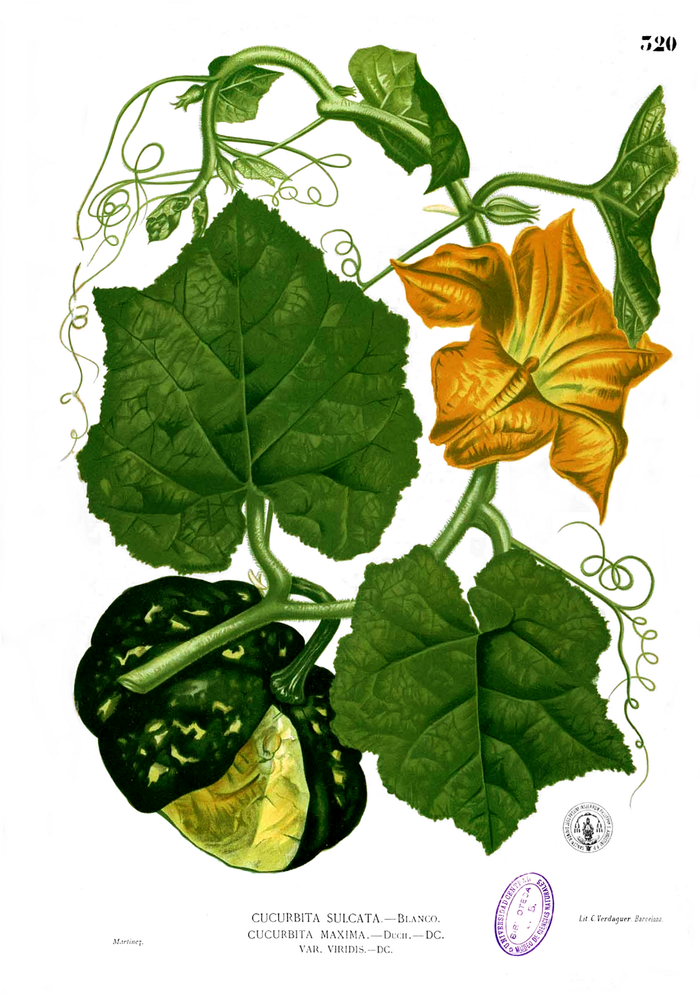
Centnergræskar
Plante·Cucurbita maxima
Halvskygge til fuld sol
Sol
Fugtig jord
Vand
Ikke registreret
Dræning
Zoner 2–11
Hårdførhed
Dækning · 132 felter
Vækst og størrelse10 felter
Plantetype
Plante
AI-estimat100 % enig
Højde
60 cm“Cucurbita maxima is a ANNUAL CLIMBER growing to 0.6 m (2ft) by 5 m (16ft 5in) at a fast rate.”
Bredde
500 cm“Cucurbita maxima is a ANNUAL CLIMBER growing to 0.6 m (2ft) by 5 m (16ft 5in) at a fast rate.”
Højde ved alder
—
tomt
Planteafstand
150 cm (mindst 90 cm)“Recommended spacing varies depending on the variety, generally, plants are spaced around 90–150 cm (3–5 ft) apart in rows that are approximately 180–300 cm (6–10 ft) apart.”
Vækstrate
Hurtig“Cucurbita maxima is a ANNUAL CLIMBER growing to 0.6 m (2ft) by 5 m (16ft 5in) at a fast rate.”
Vækstform
Klatrende“Cucurbita maxima is a ANNUAL CLIMBER growing to 0.6 m (2ft) by 5 m (16ft 5in) at a fast rate.”
Roddybde
Middel
AI-estimat63 % enig
Skovhavelag
Klatrelag“Cucurbita maxima is a ANNUAL CLIMBER growing to 0.6 m (2ft) by 5 m (16ft 5in) at a fast rate.”
Levetid
~1 år
AI-estimatikke målt endnu
Rødder6 felter
Rodform
Trævlerødder
AI-estimat43 % enig
Lagerorgan
Intet
AI-estimat100 % enig
Breder sig
Nej
AI-estimat75 % enig
Breder sig sideværts i cm
—
tomt
Roddybde i cm
—
tomt
Mykorrhiza
Arbuskulær (AM)
AI-estimatikke målt endnu
Lys, vand og jord9 felter
Sol
Fuld sol, let skygge, halvskygge · bedst: fuld sol“It can grow in semi-shade (light woodland) or no shade.”
Timer sol
6–12 t
AI-estimatikke målt endnu
Tørketålende
—
tomt
Tåler vandlidende jord
—
tomt
Jordtype
Sand, muld, ler“Suitable for: light (sandy), medium (loamy) and heavy (clay) soils and prefers well-drained soil.”
pH
Dræning
Well-drained, moisture retentive“Requires a rich, well-drained moisture retentive soil and a very warm, sunny and sheltered position.”
Komprimeret jord
Tåler det dårligt
AI-estimatikke målt endnu
Klima5 felter
Hårdførhed
Zone 2–11
AI-estimatikke målt endnu
Dræbende frost
-1 °C
AI-estimatikke målt endnu
Vækst-temperatur
9–38 °C · optimal 20–30 °C“Temperature absolute min: 9 · Temperature absolute max: 38 · Temperature optimal min: 20 · Temperature optimal max: 30”PFAFdelvist“Many forms require a temperature range of 20 - 27°c during the growing season”
Kuldetimer
0 t
AI-estimatikke målt endnu
Pleje (bliver til opgaver i Manage)10 felter
Forspiring
Marts“Seed - sow early to mid spring in a greenhouse in a rich soil.”
Forspiring står 2 gange med forskellig timing.
PFAFdelvist
Beskyttelse
Efter sidste frost · varer 21 dage · frost“giving them cloche or frame protection for at least their first few weeks”
PFAFdelvist
Såning
Efter sidste frost“Planting depth of around 3–5 cm (1–2 in).”Wikipedia“plants are spaced around 90–150 cm (3–5 ft) apart in rows that are approximately 180–300 cm (6–10 ft) apart”
Gødning
Efter sidste frost“Fertilization should be carried out based on soil test results and specific crop nutrient requirements.”
Gødning står 2 gange med forskellig timing.
Wikipediadelvist
Forspiring
Efter sidste frost · -28 dage efter · varer 7 dage
Forspiring står 2 gange med forskellig timing.
AI-estimatikke målt endnu
Vanding
Efter forrige fase · varer 150 dage
AI-estimatikke målt endnu
Gødning
Efter forrige fase · varer 30 dage · balanced fertiliser
Gødning står 2 gange med forskellig timing.
AI-estimatikke målt endnu
Jorddække
Efter forrige fase · 14 dage efter · varer 30 dage
AI-estimatikke målt endnu
Beskyttelse
Efter første frost · -7 dage efter · varer 7 dage · frost
AI-estimatikke målt endnu
Året rundt5 felter
Blomstring
Juli · varer 92 dage“It is in flower from July to September, and the seeds ripen from August to October.”
Frugt
August · varer 92 dage“It is in flower from July to September, and the seeds ripen from August to October.”
Høst
Efter første frost · varer 30 dage
AI-estimatikke målt endnu
Spiselige dele og bestøvning7 felter
Frøene
Young flowers
Raw or cooked · juli–september“Young flowers - raw or cooked.”PFAF“It is in flower from July to September, and the seeds ripen from August to October.”
Økologi5 felter
Tiltrækker
Insects“The species is monoecious (individual flowers are either male or female, but both sexes can be found on the same plant) and is pollinated by Insects.”
Skadedyr
Tæger, bladbiller, glasvinger
AI-estimatikke målt endnu
Sygdomme
Meldug, falsk meldug, bakterievisnesyge
AI-estimatikke målt endnu
Optager
—
tomt
Fikserer kvælstof
Nej
AI-estimatikke målt endnu
Formering og navne4 felter
Sværhedsgrad
1 / 5
AI-estimatikke målt endnu
Frø
—
tomt
Ikke sorteret endnu71 felter
Felter som parseren gemmer, men som siden ikke har en række til endnu. De vises her automatisk, så intet er skjult.
forage.DK.local_name
Vintergræskar
AI-estimatikke målt endnu
forage.DK.warnings_da
Undgå at spise hvis planten har en bitter smag., Spirende frø er giftige.
AI-estimatikke målt endnu
forage.DK.warnings_en
If it tastes bitter, don't eat it., Sprouting seeds are poisonous.
AI-estimatikke målt endnu
forage.DK.prep_cautions
The sprouting seed produces a toxic substance in its embryo.“The sprouting seed produces a toxic substance in its embryo.”
forage.DK.edibility_basis
inferred
AI-estimatikke målt endnu
forage.DK.foraging_months.notes
Cultivated, not typically foraged in the wild in Denmark.
AI-estimatikke målt endnu
forage.DK.foraging_months.months
7, 8, 9, 10“It is in flower from July to September, and the seeds ripen from August to October.”
forage.DK.foraging_months.year_round
false
AI-estimatikke målt endnu
forage.DK.habitat_affinity
disturbed_ground
AI-estimatikke målt endnu
forage.US.local_name
Winter squash
AI-estimatikke målt endnu
forage.US.edible_parts
[{"part":"Fruit","preparation":"cooked"},{"part":"Seed","caution":"Small seed covered with a fibrous coat, so fiddly to use","preparation":"raw or cooked","season_months":[8,9,10]},{"part":"Young flowers","preparation…“Rich in oil with a very pleasant nutty flavour but very fiddly to use because the seed is small and covered with a fibrous coat[K].”PFAF“Fruit - cooked.”PFAF“Seed - raw or cooked.”PFAF“Young flowers - raw or cooked.”PFAF“Young leaves and stems - cooked.”PFAF“An oil is obtained from the seed.”PFAFdelvist“It is in flower from July to September, and the seeds ripen from August to October.”
forage.US.prep_cautions
The sprouting seed produces a toxic substance in its embryo.“The sprouting seed produces a toxic substance in its embryo.”
forage.US.edibility_basis
inferred
AI-estimatikke målt endnu
forage.US.foraging_months.notes
Cultivated, not typically foraged in the wild in the US.
AI-estimatikke målt endnu
forage.US.foraging_months.months
7, 8, 9, 10“It is in flower from July to September, and the seeds ripen from August to October.”
forage.US.foraging_months.year_round
false
AI-estimatikke målt endnu
forage.US.habitat_affinity
disturbed_ground
AI-estimatikke målt endnu
forage.TROPICAL.local_name
Calabaza
AI-estimatikke målt endnu
forage.TROPICAL.edible_parts
[{"part":"Fruit","preparation":"cooked"},{"part":"Seed","caution":"Small seed covered with a fibrous coat, so fiddly to use","preparation":"raw or cooked"},{"part":"Young flowers","preparation":"raw or cooked"},{"part…“A frost-tender annual plant, it is widely cultivated in tropical and temperate zones for its edible fruit, there are very many named varieties differing considerably in their fruits.”PFAF“Rich in oil with a very pleasant nutty flavour but very fiddly to use because the seed is small and covered with a fibrous coat[K].”PFAF“Fruit - cooked.”PFAF“Seed - raw or cooked.”PFAF“Young flowers - raw or cooked.”PFAF“Young leaves and stems - cooked.”PFAF“An oil is obtained from the seed.”
forage.TROPICAL.prep_cautions
The sprouting seed produces a toxic substance in its embryo.“The sprouting seed produces a toxic substance in its embryo.”
forage.TROPICAL.edibility_basis
inferred
AI-estimatikke målt endnu
forage.TROPICAL.foraging_months.notes
Cultivated in tropical regions, can be harvested year-round depending on climate and variety.
AI-estimatikke målt endnu
forage.TROPICAL.foraging_months.year_round
true
AI-estimatikke målt endnu
forage.TROPICAL.habitat_affinity
disturbed_ground
AI-estimatikke målt endnu
ornamental.basis
documented
AI-estimatikke målt endnu
ornamental.fragrance.source
none
AI-estimat100 % enig
ornamental.confidence
high
AI-estimatikke målt endnu
ornamental.fall_interest
true
AI-estimatikke målt endnu
ornamental.flower_colour
yellow, orange
AI-estimat67 % enig
ornamental.evidence_quote
Winter squash (Cucurbita maxima) typically produces large yellow to orange flowers. The foliage is green and does not exhibit significant autumn color change. The plant is an annual vine and does not possess winter structure like persistent fruit or ornamental bark.
AI-estimatikke målt endnu
ornamental.foliage_colour
green
AI-estimat82 % enig
ornamental.foliage_texture
medium
AI-estimatikke målt endnu
ornamental.winter_structure
none
AI-estimatikke målt endnu
ornamental.autumn_foliage_colour
none
AI-estimatikke målt endnu
care_regime
routine
AI-estimatikke målt endnu
propagation.self_seeding
none
AI-estimat20 % enig
propagation.establishment_years
0
AI-estimat40 % enig
spatial_profile.canopy_density
dense
AI-estimatikke målt endnu
sun_requirement.best
full_sun“Requires a rich, well-drained moisture retentive soil and a very warm, sunny and sheltered position.”
forage_proposals.DK.edibility_tier.confidence
high
AI-estimatikke målt endnu
forage_proposals.DK.edibility_tier.evidence_quote
The fruits, seeds, and flowers of Cucurbita maxima are widely consumed and considered choice edibles. The fruit is versatile in cooking, seeds are nutritious when roasted, and flowers can be fried.
AI-estimatikke målt endnu
forage_proposals.US.edibility_tier.confidence
high
AI-estimatikke målt endnu
forage_proposals.US.edibility_tier.evidence_quote
Cucurbita maxima, commonly known as winter squash, is a popular and widely cultivated food crop. Its fruits, seeds, and flowers are all edible and highly regarded for culinary use.
AI-estimatikke målt endnu
forage_proposals.TROPICAL.edibility_tier.confidence
high
AI-estimatikke målt endnu
forage_proposals.TROPICAL.edibility_tier.evidence_quote
In tropical regions, Cucurbita maxima is a staple food, with all parts (fruit, seeds, flowers) being edible and frequently used in local cuisine.
AI-estimatikke målt endnu
function_profile.biomass_return.confidence
high
AI-estimatikke målt endnu
function_profile.nutrient_flows.consumes
[{"basis":"documented","demand":"heavy","nutrient":"nitrogen","confidence":"high"},{"basis":"documented","demand":"high","nutrient":"phosphorus","confidence":"high"},{"basis":"documented","demand":"high","nutrient":"p…
AI-estimatikke målt endnu
function_profile.biotic_interactions
[{"taxa":["insects"],"basis":"documented","valence":"beneficial","relation":"attracts","confidence":"high","evidence_quote":"The species is monoecious (individual flowers are either male or female, but both sexes can …“The species is monoecious (individual flowers are either male or female, but both sexes can be found on the same plant) and is pollinated by Insects.”
function_profile.aromatic_pest_effect.value
false
AI-estimat80 % enig
function_profile.aromatic_pest_effect.confidence
high
AI-estimatikke målt endnu
function_profile.structural_interfaces.provides_shelter.basis
inferred
AI-estimatikke målt endnu
function_profile.structural_interfaces.provides_shelter.kinds
shade
AI-estimatikke målt endnu
function_profile.structural_interfaces.provides_shelter.confidence
medium
AI-estimatikke målt endnu
function_profile.structural_interfaces.provides_shelter.evidence_quote
The large leaves of winter squash can provide shade to the soil, helping to suppress weeds and retain moisture.
AI-estimatikke målt endnu
function_profile.structural_interfaces.requires_shelter.basis
documented
AI-estimatikke målt endnu
function_profile.structural_interfaces.requires_shelter.kinds
wind, frost
AI-estimatikke målt endnu
function_profile.structural_interfaces.requires_shelter.stage
establishment
AI-estimatikke målt endnu
function_profile.structural_interfaces.requires_shelter.confidence
medium
AI-estimatikke målt endnu
function_profile.structural_interfaces.requires_shelter.evidence_quote
Grow them on fast and plant out after the last expected frosts, giving them cloche or frame protection for at least their first few weeks if you are trying them outdoors.
AI-estimatikke målt endnu
function_profile.structural_interfaces.requires_physical_support.basis
taxonomic
AI-estimatikke målt endnu
function_profile.structural_interfaces.requires_physical_support.mechanism
tendril
AI-estimatikke målt endnu
function_profile.structural_interfaces.requires_physical_support.confidence
medium
AI-estimatikke målt endnu
function_profile.structural_interfaces.requires_physical_support.evidence_quote
Cucurbita maxima is a ANNUAL CLIMBER growing to 0.6 m (2ft) by 5 m (16ft 5in) at a fast rate.
AI-estimatikke målt endnu
climate_tolerance.photoperiod_response
day_neutral“Most cultivars are relatively insensitive to day-length.”
soil_interactions.organic_matter_contribution
medium
AI-estimatikke målt endnu
component_metadata.growth_cycle
annual“Cucurbita maxima is a ANNUAL CLIMBER growing to 0.6 m (2ft) by 5 m (16ft 5in) at a fast rate.”
resource_interfaces.inputs
[{"resource":"light","quantity_description":"a very warm, sunny and sheltered position"},{"resource":"water","quantity_description":"moist soil"},{"resource":"space","quantity_description":"plants spaced around 90–150…“Requires a rich, well-drained moisture retentive soil and a very warm, sunny and sheltered position.”PFAF“It prefers moist soil.”Wikipedia“Recommended spacing varies depending on the variety, generally, plants are spaced around 90–150 cm (3–5 ft) apart in rows that are approximately 180–300 cm (6–10 ft) apart.”PFAFdelvist“The species is monoecious (individual flowers are either male or female, but both sexes can be found on the same plant) and is pollinated by Insects.”
resource_interfaces.outputs
[{"resource":"fruit","quantity_description":"edible fruit"},{"resource":"seeds","quantity_description":"seed containing 34 - 54% semi-drying oil"}]“A frost-tender annual plant, it is widely cultivated in tropical and temperate zones for its edible fruit, there are very many named varieties differing considerably in their fruits.”PFAF“The seed contains 34 - 54% of a semi-drying oil.”