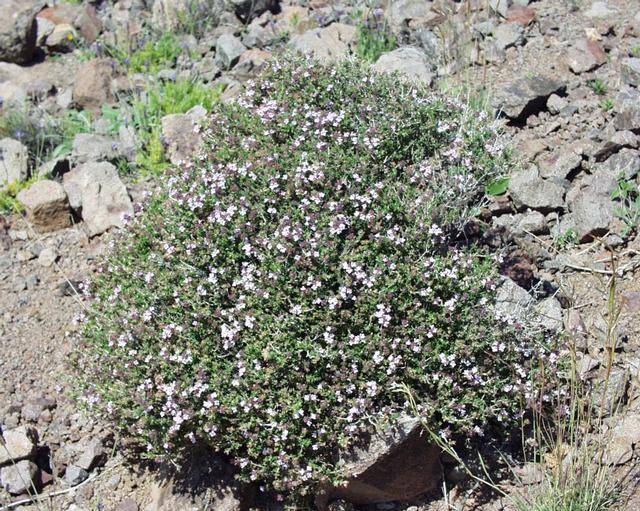
Henry Brisse (upload by user:Abalg ) · CC BY-SA 3.0
Havetimian
Plante·Thymus vulgaris
Fuld sol
Sol
Tør til fugtig jord
Vand
Veldrænet jord
Dræning
Zoner 5–9
Hårdførhed
Dækning · 117 felter
Vækst og størrelse10 felter
Plantetype
Stedsegrøn plante“Thymus vulgaris is an evergreen Shrub growing to 0.2 m (0ft 8in) by 0.3 m (1ft) at a medium rate.”
Højde
20 cm · andre kilder: 15 cm, 30 cm“Thymus vulgaris is an evergreen Shrub growing to 0.2 m (0ft 8in) by 0.3 m (1ft) at a medium rate.”Wikipedia“The plant grows to 15–30 centimetres (6–12 in) tall and 40 cm (16 in) wide”
Bredde
30 cm · andre kilder: 40 cm“Thymus vulgaris is an evergreen Shrub growing to 0.2 m (0ft 8in) by 0.3 m (1ft) at a medium rate.”Wikipedia“The plant grows to 15–30 centimetres (6–12 in) tall and 40 cm (16 in) wide”
Højde ved alder
—
tomt
Vækstrate
Middel“Thymus vulgaris is an evergreen Shrub growing to 0.2 m (0ft 8in) by 0.3 m (1ft) at a medium rate.”
Skovhavelag
Bunddække“It is a low-growing shrubby evergreen herb popular in the kitchen and sometimes used as ground cover.”
Levetid
~5 år
AI-estimatikke målt endnu
Rødder6 felter
Lagerorgan
Intet“It does not multiply vegetatively: it has no rhizomes, runners, suckers or offspring bulbs or tubers.”
Breder sig
Nej“It does not multiply vegetatively: it has no rhizomes, runners, suckers or offspring bulbs or tubers.”
Breder sig sideværts i cm
—
tomt
Roddybde i cm
—
tomt
Mykorrhiza
—
tomt
Lys, vand og jord9 felter
Timer sol
6–12 t
AI-estimatikke målt endnu
Jordtype
Sand, muld, ler“Suitable for: light (sandy) and medium (loamy) soils, prefers well-drained soil and can grow in nutritionally poor soil.”
Dræning
Veldrænet“Suitable for: light (sandy) and medium (loamy) soils, prefers well-drained soil and can grow in nutritionally poor soil.”
Komprimeret jord
Tåler det nogenlunde
AI-estimatikke målt endnu
Klima5 felter
Hårdførhed
Zone 5–9
AI-estimatikke målt endnu
Vækst-temperatur
4–30 °C · optimal 16–25 °C“Temperature absolute min: 4 · Temperature absolute max: 30 · Temperature optimal min: 16 · Temperature optimal max: 25”
Kuldetimer
0 t
AI-estimatikke målt endnu
Pleje (bliver til opgaver i Manage)5 felter
Udplantning
Efter sidste frost“Plant them out into their permanent positions in late spring or early summer, after the last expected frosts.”
Jorddække
Efter første frost“A layer of gravel on the soil around them will help protect the foliage from wet soils.”
Jorddække står 2 gange med forskellig timing.
PFAFdelvist
Beskæring
April · varer 30 dage · woody stems
AI-estimatikke målt endnu
Jorddække
Marts · varer 30 dage
Jorddække står 2 gange med forskellig timing.
AI-estimatikke målt endnu
Vanding
Efter regn
AI-estimatikke målt endnu
Året rundt4 felter
Høst
Efter forrige fase“Thyme is typically harvested in late spring to early summer, just before the plant flowers for the best flavor.”
Spring ud
Efter sidste frost · Over 5 °C · varer 30 dage
AI-estimatikke målt endnu
Dvale
Efter første frost · Over -5 °C · varer 150 dage
AI-estimatikke målt endnu
Spiselige dele og bestøvning6 felter
Bladene
Raw in salads, as a garnish, or added to cooked foods“Edible Parts: Leaves Flowers Shoots”PFAF“Leaves and flowering tops - raw in salads, used as a garnish or added as a flavouring to cooked foods, going especially well with mushrooms and courgettes.”
Bladene
Steeped as an aromatic tea, fresh or dried“Edible Parts: Leaves Flowers Shoots”PFAF“An aromatic tea is made from the fresh or dried leaves.”
Blomsterne
Flowering tops raw in salads, as a garnish, or added to cooked foods · juni–august“Edible Parts: Leaves Flowers Shoots”PFAF“Leaves and flowering tops - raw in salads, used as a garnish or added as a flavouring to cooked foods, going especially well with mushrooms and courgettes.”PFAF“It is in leaf all year, in flower from June to August.”
Økologi6 felter
Tiltrækker
Honey bees, bier, flies, moths and butterflies, dyreliv“The flowers are rich in nectar and are very attractive to honey bees.”PFAF“The species is hermaphrodite (has both male and female organs) and is pollinated by Bees, flies, Lepidoptera (Moths & Butterflies).”PFAF“It is noted for attracting wildlife.”
Skadedyr
—
tomt
Sygdomme
—
tomt
Optager
—
tomt
Fikserer kvælstof
Nej
AI-estimatikke målt endnu
Mykorrhiza
Ja
AI-estimatikke målt endnu
Formering og navne4 felter
Metoder
Sværhedsgrad
2 / 5
AI-estimatikke målt endnu
Frø
none
AI-estimatikke målt endnu
Ikke sorteret endnu62 felter
Felter som parseren gemmer, men som siden ikke har en række til endnu. De vises her automatisk, så intet er skjult.
forage.DK.local_name
Timian
AI-estimatikke målt endnu
forage.DK.warnings_da
Bør ikke spises under graviditet.
AI-estimatikke målt endnu
forage.DK.warnings_en
Don't eat during pregnancy.
AI-estimatikke målt endnu
forage.DK.prep_cautions
Avoid if inflammatory disease of the gastrointestinal tract., Internal use contraindicated especially in pregnancy., Caution if sensitive to grasses., Dilute essential oil in carrier oil before topical use., Essential oils can be harmful in large doses.“Avoid if inflammatory disease of the gastrointestinal tract.”PFAF“Internal use contraindicated especially in pregnancy.”PFAF“Caution if sensitive to grasses”PFAF“Dilute oil in carrier oil before topical use.”PFAF“All essential oils, since they are so concentrated, can be harmful in large doses[K].”
forage.DK.edibility_basis
inferred
AI-estimatikke målt endnu
forage.DK.foraging_months.notes
Best flavour just before flowering, late spring to early summer.“Thyme is typically harvested in late spring to early summer, just before the plant flowers for the best flavor.”
forage.DK.habitat_affinity
disturbed_ground
AI-estimatikke målt endnu
forage.US.local_name
Common Thyme
AI-estimatikke målt endnu
forage.US.edible_parts
[{"part":"Leaves","caution":null,"preparation":"raw in salads, as a garnish, or added to cooked foods"},{"part":"Leaves","caution":null,"preparation":"steeped as an aromatic tea, fresh or dried"},{"part":"Flowers","ca…“Edible Parts: Leaves Flowers Shoots”PFAF“Leaves and flowering tops - raw in salads, used as a garnish or added as a flavouring to cooked foods, going especially well with mushrooms and courgettes.”PFAF“An aromatic tea is made from the fresh or dried leaves.”PFAF“It is in leaf all year, in flower from June to August.”
forage.US.prep_cautions
Avoid if inflammatory disease of the gastrointestinal tract., Internal use contraindicated especially in pregnancy., Caution if sensitive to grasses., Dilute essential oil in carrier oil before topical use., Essential oils can be harmful in large doses.“Avoid if inflammatory disease of the gastrointestinal tract.”PFAF“Internal use contraindicated especially in pregnancy.”PFAF“Caution if sensitive to grasses”PFAF“Dilute oil in carrier oil before topical use.”PFAF“All essential oils, since they are so concentrated, can be harmful in large doses[K].”
forage.US.edibility_basis
inferred
AI-estimatikke målt endnu
forage.US.foraging_months.notes
Best flavor just before flowering, late spring to early summer.“Thyme is typically harvested in late spring to early summer, just before the plant flowers for the best flavor.”
forage.US.habitat_affinity
disturbed_ground
AI-estimatikke målt endnu
forage.TROPICAL.local_name
Thyme
AI-estimatikke målt endnu
forage.TROPICAL.edible_parts
[{"part":"leaves","caution":null,"preparation":"raw","season_months":[1,2,3,4,5,6,7,8,9,10,11,12]},{"part":"flowers","caution":null,"preparation":"raw","season_months":[5,6,7,8]}]
AI-estimatikke målt endnu
forage.TROPICAL.edibility_basis
inferred
AI-estimatikke målt endnu
forage.TROPICAL.foraging_months.notes
Leaves can be harvested year-round, flowers in summer.
AI-estimatikke målt endnu
forage.TROPICAL.foraging_months.year_round
true
AI-estimatikke målt endnu
forage.TROPICAL.habitat_affinity
disturbed_ground
AI-estimatikke målt endnu
ornamental.basis
documented
AI-estimatikke målt endnu
ornamental.confidence
high
AI-estimatikke målt endnu
ornamental.fall_interest
false
AI-estimatikke målt endnu
ornamental.evidence_quote
Common thyme has small, pale purple to pink flowers and fine, grey-green foliage. It is an evergreen subshrub, providing winter interest through its form and strongly aromatic foliage.
AI-estimatikke målt endnu
ornamental.foliage_texture
fine
AI-estimatikke målt endnu
ornamental.autumn_foliage_colour
none
AI-estimatikke målt endnu
care_regime
light
AI-estimatikke målt endnu
propagation.self_seeding
light
AI-estimat20 % enig
propagation.establishment_years
2“Thyme is considered a slow to moderate grower, reaching maturity in about 1 to 2 years under optimal conditions.”
spatial_profile.canopy_density
dense
AI-estimatikke målt endnu
forage_proposals.DK.edibility_tier.tier
edible
AI-estimatikke målt endnu
forage_proposals.DK.edibility_tier.confidence
high
AI-estimatikke målt endnu
forage_proposals.DK.edibility_tier.evidence_quote
Thyme is a widely used culinary herb, with its leaves used fresh or dried to flavor various dishes.
AI-estimatikke målt endnu
forage_proposals.US.edibility_tier.tier
edible
AI-estimatikke målt endnu
forage_proposals.US.edibility_tier.confidence
high
AI-estimatikke målt endnu
forage_proposals.US.edibility_tier.evidence_quote
Common Thyme is a popular herb in American cuisine, used for its aromatic leaves in cooking.
AI-estimatikke målt endnu
forage_proposals.TROPICAL.edibility_tier.tier
edible
AI-estimatikke målt endnu
forage_proposals.TROPICAL.edibility_tier.confidence
medium
AI-estimatikke målt endnu
forage_proposals.TROPICAL.edibility_tier.evidence_quote
Thyme is cultivated and used as a culinary herb in many tropical regions, though it prefers temperate climates.
AI-estimatikke målt endnu
function_profile.biomass_return.confidence
low
AI-estimatikke målt endnu
function_profile.nutrient_flows.consumes
[{"basis":"documented","demand":"low","nutrient":"nitrogen","confidence":"high"},{"basis":"documented","demand":"low","nutrient":"phosphorus","confidence":"high"},{"basis":"documented","demand":"low","nutrient":"potas…“Suitable for: light (sandy) and medium (loamy) soils, prefers well-drained soil and can grow in nutritionally poor soil.”
PFAFdelvist
function_profile.biotic_interactions
[{"taxa":["honey bees","bees"],"basis":"documented","valence":"beneficial","relation":"attracts","confidence":"high","evidence_quote":"The flowers are rich in nectar and are very attractive to honey bees.","organism_g…“The flowers are rich in nectar and are very attractive to honey bees.”PFAF“The species is hermaphrodite (has both male and female organs) and is pollinated by Bees, flies, Lepidoptera (Moths & Butterflies).”PFAF“It is noted for attracting wildlife.”PFAF“Thyme can offer shelter for beneficial insects, and its groundcover can protect invertebrates during the winter months.”PFAF“Thyme is a good companion for most plants, it is said to repel cabbage root flies when grown near brassicas.”PFAF“The dried flowers are used to repel moths from clothing whilst the growing plant is said to repel cabbage root fly.”
function_profile.aromatic_pest_effect.value
true“Its aromatic properties may also repel certain pests, making it a useful companion plant in gardens.”
function_profile.aromatic_pest_effect.confidence
high
AI-estimatikke målt endnu
function_profile.structural_interfaces.provides_shelter.basis
inferred
AI-estimatikke målt endnu
function_profile.structural_interfaces.provides_shelter.kinds
shade
AI-estimatikke målt endnu
function_profile.structural_interfaces.provides_shelter.confidence
low
AI-estimatikke målt endnu
function_profile.structural_interfaces.provides_shelter.evidence_quote
Low-growing ground cover can provide minimal shade to soil and small organisms.
AI-estimatikke målt endnu
climate_tolerance.photoperiod_response
day_neutral
AI-estimatikke målt endnu
soil_interactions.organic_matter_contribution
low
AI-estimatikke målt endnu
component_metadata.growth_cycle
perennial
AI-estimat100 % enig
resource_interfaces.inputs
[{"resource":"light","quantity_description":"a sunny position"},{"resource":"water","quantity_description":"tolerates drought once established; prefers dry or moist soil"},{"resource":"space","quantity_description":"a…“Prefers a light, dry calcareous soil and a sunny position.”PFAF“Succeeds in dry soils, poor soils and tolerates drought once it is established.”PFAF“Plants are best spaced about 30cm apart each way.”
resource_interfaces.outputs
[{"resource":"nectar","quantity_description":"flowers rich in nectar"},{"resource":"pollen","quantity_description":"flowers rich in pollen"},{"resource":"pollinator_services","quantity_description":"attracts pollinato…“The flowers are rich in nectar and are very attractive to honey bees.”PFAF“Yes – Thyme flowers are rich in nectar and pollen, making them attractive to pollinators like bees and butterflies.”PFAF“Thyme can be used as a ground cover and is beneficial for attracting pollinators.”PFAF“An essential oil from the leaves is frequently used in perfumery, soaps, toothpastes, mouthwashes, medicinally etc.”PFAF“The plant makes an attractive ground cover for a sunny position.”PFAF“Thyme can offer shelter for beneficial insects, and its groundcover can protect invertebrates during the winter months.”