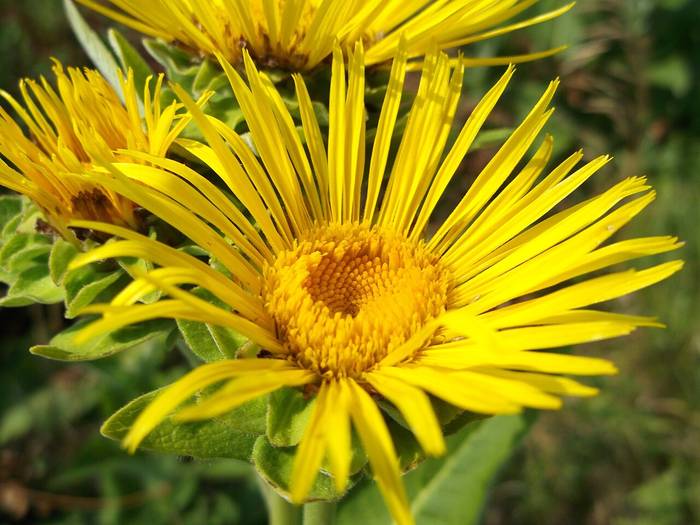
Natthager · CC BY-SA 4.0
Lægealant
Plante·Inula helenium
Fuld sol
Sol
Mellem
Vand
Fugtig jord
Dræning
Zoner 3–8
Hårdførhed
Dækning · 113 felter
Ingen åbenlyse uoverensstemmelser fundet.
Vækst og størrelse10 felter
Højde
120 cm · kilden giver 90–150 cm“Elecampane is a rather rigid herb, the stem of which attains a height of about 90–150 cm (35–59 in).”
Bredde
90 cm
AI-estimat58 % enig
Højde ved alder
—
tomt
Planteafstand
90 cm (mindst 60 cm)
AI-estimat55 % enig
Vækstrate
—
tomt
Vækstform
Vaseformet
AI-estimat50 % enig
Roddybde
Dyb
AI-estimat63 % enig
Skovhavelag
Urtelag“Elecampane is a rather rigid herb, the stem of which attains a height of about 90–150 cm (35–59 in).”
Wikipediadelvist
Levetid
~5 år
AI-estimatikke målt endnu
Rødder6 felter
Rodform
Hjerterod
AI-estimat43 % enig
Lagerorgan
Jordstængel“Its storage organ is a rhizome formed at the surface and pulled into the soil; it spreads by this rhizome slowly.”
Breder sig
Med jordstængler“Its storage organ is a rhizome formed at the surface and pulled into the soil; it spreads by this rhizome slowly.”
Breder sig sideværts i cm
0,5 cm“Its clonal growth organs spread 0.5 cm sideways.”
Roddybde i cm
—
tomt
Mykorrhiza
Arbuskulær (AM)
AI-estimatikke målt endnu
Lys, vand og jord9 felter
Sol
Fuld sol
AI-estimat71 % enig
Timer sol
6–12 t
AI-estimatikke målt endnu
Vand
Middel · 2–4 l/dag
AI-estimat74 % enig
Tørketålende
—
tomt
Tåler vandlidende jord
—
tomt
Dræning
Fugtig, men veldrænet
AI-estimatikke målt endnu
Komprimeret jord
Tåler det nogenlunde
AI-estimatikke målt endnu
Klima5 felter
Hårdførhed
Zone 3–8
AI-estimatikke målt endnu
Dræbende frost
-25 °C
AI-estimatikke målt endnu
Vækst-temperatur
5–30 °C · optimal 15–25 °C
AI-estimatikke målt endnu
Kuldetimer
0 t
AI-estimatikke målt endnu
Hjemsted
AL, AM, AZ, BA, BG, CN, GE, GR, HR, IQ, IR, IT, KG, KZ, MD, ME, MK, RS, RU, SE, SI, SM, TJ, TR, UZ, VA, XK
Pleje (bliver til opgaver i Manage)3 felter
Jorddække
Marts · varer 14 dage
AI-estimatikke målt endnu
Vanding
Efter regn · varer 180 dage
AI-estimatikke målt endnu
Deling
Marts · varer 30 dage · lift and split the rootstock
AI-estimatikke målt endnu
Året rundt4 felter
Spring ud
Efter sidste frost · Over 5 °C · varer 30 dage
AI-estimatikke målt endnu
Blomstring
Juli · Styret af daglængden · varer 60 dage
AI-estimatikke målt endnu
Går i dvale
Efter første frost · varer 30 dage
AI-estimatikke målt endnu
Dvale
Efter første frost · 30 dage efter · varer 150 dage
AI-estimatikke målt endnu
Spiselige dele og bestøvning4 felter
Rødderne
Candied, eaten as confectionery“In Medieval Europe, the roots were candied and eaten as confectionery.”
Rødderne
Condiment“The root was mentioned by Pliny in his Natural History both as a medicine and as a condiment.”
Bestøves af
—
tomt
Økologi5 felter
Tiltrækker
Bier, sommerfugle, nyttedyr
AI-estimatikke målt endnu
Skadedyr
—
tomt
Sygdomme
—
tomt
Optager
Kalium, calcium, magnesium, sulfur
AI-estimatikke målt endnu
Fikserer kvælstof
Nej
AI-estimatikke målt endnu
Formering og navne4 felter
Metoder
Clonal spread by rhizome, frø“Its storage organ is a rhizome formed at the surface and pulled into the soil; it spreads by this rhizome slowly.”
Sværhedsgrad
2 / 5
AI-estimatikke målt endnu
Frø
cold stratification for 4-6 weeks
AI-estimatikke målt endnu
Ikke sorteret endnu63 felter
Felter som parseren gemmer, men som siden ikke har en række til endnu. De vises her automatisk, så intet er skjult.
forage.DK.local_name
Alantrod
AI-estimatikke målt endnu
forage.DK.warnings_da
Vær sikker på artens identitet, for der findes forvekslinger.
AI-estimatikke målt endnu
forage.DK.warnings_en
Be sure of the identification, as lookalikes exist.
AI-estimatikke målt endnu
forage.DK.prep_cautions
Ensure proper identification as some lookalikes exist., Avoid harvesting from polluted areas.
AI-estimatikke målt endnu
forage.DK.edibility_basis
inferred
AI-estimatikke målt endnu
forage.DK.foraging_months.notes
Roots are best harvested in autumn of the second year.
AI-estimatikke målt endnu
forage.DK.foraging_months.months
4, 5, 6, 9, 10
AI-estimatikke målt endnu
forage.DK.foraging_months.year_round
false
AI-estimatikke målt endnu
forage.DK.habitat_affinity
disturbed_ground, verge, woodland
AI-estimatikke målt endnu
forage.US.local_name
Elecampane
AI-estimatikke målt endnu
forage.US.edible_parts
[{"part":"root","caution":"May cause allergic reactions in sensitive individuals.","preparation":"cooked, candied","season_months":[9,10]},{"part":"leaves","caution":"Best used when young.","preparation":"cooked","sea…
AI-estimatikke målt endnu
forage.US.prep_cautions
Ensure proper identification as some lookalikes exist., Avoid harvesting from polluted areas.
AI-estimatikke målt endnu
forage.US.edibility_basis
inferred
AI-estimatikke målt endnu
forage.US.foraging_months.notes
Roots are best harvested in autumn of the second year.
AI-estimatikke målt endnu
forage.US.foraging_months.months
4, 5, 6, 9, 10
AI-estimatikke målt endnu
forage.US.foraging_months.year_round
false
AI-estimatikke målt endnu
forage.US.habitat_affinity
disturbed_ground, verge, woodland
AI-estimatikke målt endnu
forage.TROPICAL.edibility_basis
inferred
AI-estimatikke målt endnu
forage.TROPICAL.foraging_months.notes
Not typically found in tropical climates.
AI-estimatikke målt endnu
forage.TROPICAL.foraging_months.year_round
false
AI-estimatikke målt endnu
ornamental.basis
documented
AI-estimatikke målt endnu
ornamental.fragrance.source
flower
AI-estimat100 % enig
ornamental.fragrance.intensity
subtle
AI-estimatikke målt endnu
ornamental.confidence
high
AI-estimatikke målt endnu
ornamental.fall_interest
true
AI-estimatikke målt endnu
ornamental.flower_colour
yellow“The flower heads up to 5 cm (2 inches) broad, each head containing 50-100 yellow ray flowers and 100-250 yellow disc flowers.”
ornamental.evidence_quote
Elecampane produces large, daisy-like yellow flowers in summer, followed by prominent seed heads. The foliage is green and has a medium texture, but it does not typically display significant autumn color.
AI-estimatikke målt endnu
ornamental.foliage_colour
green“Leaves are green on the upper side with light, scattered hairs, but whitish on the underside because of a thick layer of wool.”
ornamental.foliage_texture
medium
AI-estimatikke målt endnu
ornamental.winter_structure
seed_heads
AI-estimatikke målt endnu
ornamental.autumn_foliage_colour
none
AI-estimatikke målt endnu
care_regime
none
AI-estimatikke målt endnu
propagation.self_seeding
moderate
AI-estimat20 % enig
propagation.division_season
spring_or_autumn
AI-estimatikke målt endnu
propagation.establishment_years
1
AI-estimat40 % enig
spatial_profile.canopy_density
medium
AI-estimatikke målt endnu
forage_proposals.DK.edibility_tier.tier
caution
AI-estimatikke målt endnu
forage_proposals.DK.edibility_tier.confidence
high
AI-estimatikke målt endnu
forage_proposals.DK.edibility_tier.evidence_quote
The root of Elecampane is traditionally used as a medicinal herb and can be consumed, but it may cause allergic reactions in some individuals, particularly those sensitive to the Asteraceae family. It is also advised to consult a healthcare professional before use.
AI-estimatikke målt endnu
forage_proposals.US.edibility_tier.tier
caution
AI-estimatikke målt endnu
forage_proposals.US.edibility_tier.confidence
high
AI-estimatikke målt endnu
forage_proposals.US.edibility_tier.evidence_quote
Elecampane root is used medicinally and can be eaten, but caution is advised due to potential allergic reactions, especially for those with sensitivities to the daisy family. Medical consultation is recommended.
AI-estimatikke målt endnu
forage_proposals.TROPICAL.edibility_tier.confidence
low
AI-estimatikke målt endnu
function_profile.biomass_return.confidence
high
AI-estimatikke målt endnu
function_profile.nutrient_flows.consumes
[{"basis":"inferred","demand":"moderate","nutrient":"nitrogen","confidence":"medium"},{"basis":"inferred","demand":"moderate","nutrient":"phosphorus","confidence":"medium"},{"basis":"inferred","demand":"moderate","nut…
AI-estimatikke målt endnu
function_profile.nutrient_flows.provides
[{"basis":"documented","nutrient":"potassium","mechanism":"mineral_extraction","confidence":"high"},{"basis":"documented","nutrient":"calcium","mechanism":"mineral_extraction","confidence":"high"},{"basis":"inferred",…
AI-estimatikke målt endnu
function_profile.biotic_interactions
[{"taxa":["bees","butterflies"],"basis":"documented","valence":"beneficial","relation":"attracts","confidence":"high","organism_group":"pollinator","ecological_function":"pollination"},{"taxa":[],"basis":"inferred","v…
AI-estimatikke målt endnu
function_profile.aromatic_pest_effect.value
false
AI-estimat80 % enig
function_profile.aromatic_pest_effect.confidence
low
AI-estimatikke målt endnu
function_profile.structural_interfaces.provides_shelter.basis
inferred
AI-estimatikke målt endnu
function_profile.structural_interfaces.provides_shelter.kinds
shade
AI-estimatikke målt endnu
function_profile.structural_interfaces.provides_shelter.confidence
low
AI-estimatikke målt endnu
function_profile.structural_interfaces.requires_shelter.basis
inferred
AI-estimatikke målt endnu
function_profile.structural_interfaces.requires_shelter.confidence
low
AI-estimatikke målt endnu
function_profile.structural_interfaces.provides_physical_support.basis
inferred
AI-estimatikke målt endnu
function_profile.structural_interfaces.provides_physical_support.confidence
low
AI-estimatikke målt endnu
function_profile.structural_interfaces.requires_physical_support.basis
inferred
AI-estimatikke målt endnu
function_profile.structural_interfaces.requires_physical_support.confidence
low
AI-estimatikke målt endnu
climate_tolerance.photoperiod_response
long_day
AI-estimatikke målt endnu
soil_interactions.organic_matter_contribution
high
AI-estimatikke målt endnu
component_metadata.growth_cycle
perennial
AI-estimat100 % enig
resource_interfaces.inputs
[{"resource":"light","quantity_description":"full sun to light shade"},{"resource":"water","quantity_description":"moist soil"},{"resource":"space","quantity_description":"clonal organs spread 0.5 cm sideways"}]“Its clonal growth organs spread 0.5 cm sideways.”
resource_interfaces.outputs
[{"resource":"ground_cover","quantity_description":"clump of large leaves at the base"},{"resource":"leaf_litter","quantity_description":"foliage dies back each year"},{"resource":"nectar","quantity_description":"yell…“The root is thick, branching and mucilaginous, and has a bitter taste and a camphoraceous odour with sweet floral (similar to violet) undertones.”