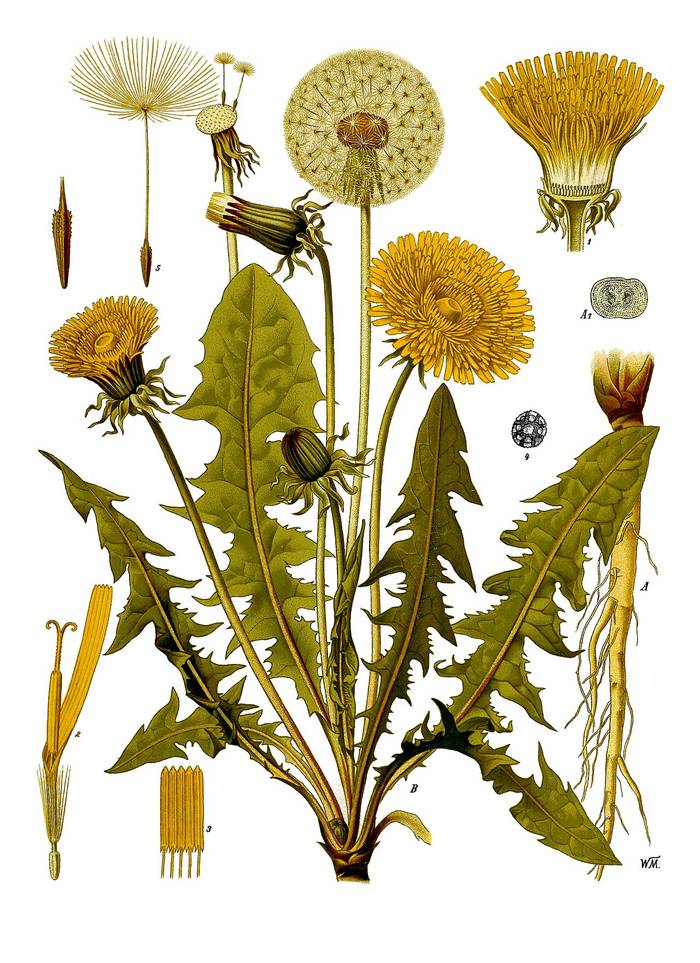
Mælkebøtte
Plante·Taraxacum officinale
Halvskygge til fuld sol
Sol
Tør til fugtig jord
Vand
Veldrænet jord
Dræning
Zoner 3–10
Hårdførhed
Dækning · 113 felter
Ingen åbenlyse uoverensstemmelser fundet.
Vækst og størrelse10 felter
Plantetype
Plante“Taraxacum officinale, the dandelion or common dandelion, is a herbaceous perennial flowering plant in the daisy family, Asteraceae.”
Højde
50 cm · andre kilder: 70 cm“Taraxacum officinale is a PERENNIAL growing to 0.5 m (1ft 8in) by 0.3 m (1ft) at a fast rate.”Wikipedia“Taraxacum officinale grows from a (generally unbranched) taproot and produces several hollow, leafless flower stems, typically 5–40 centimetres (2–15+3⁄4 inches) tall, but occasionally reaching up to 70 cm (28 in) tall.”
Bredde
30 cm“Taraxacum officinale is a PERENNIAL growing to 0.5 m (1ft 8in) by 0.3 m (1ft) at a fast rate.”
Højde ved alder
—
tomt
Planteafstand
15 cm (mindst 10 cm)
AI-estimat55 % enig
Vækstrate
Hurtig“Taraxacum officinale is a PERENNIAL growing to 0.5 m (1ft 8in) by 0.3 m (1ft) at a fast rate.”
Skovhavelag
Urtelag
AI-estimat90 % enig
Levetid
~3 år
AI-estimatikke målt endnu
Rødder6 felter
Lagerorgan
Intet
AI-estimat100 % enig
Breder sig
Nej
AI-estimat75 % enig
Breder sig sideværts i cm
—
tomt
Roddybde i cm
Dybest 100 cm“A deep rooting plant, it has roots up to 1 metre long and brings up nutrients from lower levels of the soil.”
Mykorrhiza
—
tomt
Lys, vand og jord9 felter
Sol
Fuld sol, let skygge, halvskygge · bedst: fuld sol“A very easily grown plant, it succeeds in most soils, though it prefers a well-drained humus-rich neutral to alkaline soil in full sun or light shade.”PFAF“It can grow in semi-shade (light woodland) or no shade.”
Timer sol
6–12 t
AI-estimatikke målt endnu
Vand
Tør, fugtig · bedst: fugtig · Middel · 1–3 l/dag“It prefers moist soil.”Wikipediadelvist“They are very hardy plants, able to grow in a variety of environments, and are tolerant of crowding, extremes of temperature, and low moisture.”
Tørketålende
Ja“They are very hardy plants, able to grow in a variety of environments, and are tolerant of crowding, extremes of temperature, and low moisture.”
Tåler vandlidende jord
—
tomt
Jordtype
Sand, muld, ler“Suitable for: light (sandy), medium (loamy) and heavy (clay) soils and prefers well-drained soil.”
pH
4,5–8,3 · bedst 5–6,5“Suitable pH: mildly acid, neutral and basic (mildly alkaline) soils and can grow in very alkaline soils.”
Dræning
Veldrænet“Suitable for: light (sandy), medium (loamy) and heavy (clay) soils and prefers well-drained soil.”
Komprimeret jord
Tåler det godt
AI-estimatikke målt endnu
Klima5 felter
Hårdførhed
Zone 3–10
AI-estimatikke målt endnu
Dræbende frost
0 °C“Killing temp. early growth: 0”EcoCrops tal er frost under tidlig vækst (forårsfrost på nye skud), ikke vinterkulde.
Vækst-temperatur
5–26 °C · optimal 14–22 °C“Temperature absolute min: 5 · Temperature absolute max: 26 · Temperature optimal min: 14 · Temperature optimal max: 22”
Året rundt7 felter
Spring ud
Efter sidste frost“Dandelions grow rapidly and can establish themselves within a few weeks, often appearing shortly after the last frost in spring.”
Blomstring
April · varer 61 dage“It is in flower from April to May, and the seeds ripen from May to June.”
Frugt
Maj · varer 61 dage“It is in flower from April to May, and the seeds ripen from May to June.”
Høst
Marts · varer 245 dage“The leaves can be harvested in early spring to late autumn (March to November, Northern Hemisphere)”
Høst
September · varer 61 dage“the roots are typically harvested in late autumn (September to November)”
Går i dvale
Efter første frost · Styret af daglængden · varer 30 dage
AI-estimatikke målt endnu
Dvale
Efter første frost · Over 0 °C · 15 dage efter · varer 150 dage
AI-estimatikke målt endnu
Spiselige dele og bestøvning5 felter
Bladene
Raw or cooked · marts–november“Leaves - raw or cooked.”PFAF“When used in salads, they are rather bitter, though less so in the winter.”PFAF“The leaves can be harvested in early spring to late autumn (March to November, Northern Hemisphere), while the roots are typically harvested in late autumn (September to November).”
Rødderne
Raw or cooked; dried and roasted as a coffee substitute · september–november“Root - raw or cooked. Bitter. A turnip-like flavour.”PFAF“The leaves can be harvested in early spring to late autumn (March to November, Northern Hemisphere), while the roots are typically harvested in late autumn (September to November).”PFAFdelvist“Root - raw or cooked.”
Blomsterne
Bestøvning
Selvbestøvende · tvekønnet“The species is hermaphrodite (has both male and female organs) and is pollinated by Insects, Apomictic (reproduce by seeds formed without sexual fusion).”PFAF“The plant is self-fertile.”
Bestøves af
Insekter“The species is hermaphrodite (has both male and female organs) and is pollinated by Insects, Apomictic (reproduce by seeds formed without sexual fusion).”
Økologi6 felter
Tiltrækker
Pollinating insects, bier, fugle, dyreliv“They attract pollinators and beneficial insects.”PFAF“A valuable bee plant and an important food plant for the caterpillars of many butterfly and moth species, it grows well in a spring meadow.”Wikipedia“It is increasingly being recognised in its native regions as an excellent wildflower for attracting pollinating insects and birds that feed on the seeds.”PFAF“It is noted for attracting wildlife.”
Skadedyr
Sommerfuglelarver“T. officinale is food for the caterpillars of several Lepidoptera (butterflies and moths), such as the tortrix moth Celypha rufana.”
Sygdomme
—
tomt
Optager
Kalium, calcium, iron, magnesium
AI-estimatikke målt endnu
Fikserer kvælstof
Nej
AI-estimatikke målt endnu
Mykorrhiza
Nej
AI-estimatikke målt endnu
Formering og navne4 felter
Metoder
Seed sown in a cold frame in spring, division in early spring“Seed - sow spring in a cold frame and either surface-sow or only just cover the seed.”PFAF“Division in early spring as the plant comes into growth.”
Frø
2 weeks cold stratification may improve germination“Germination should take place within 2 weeks, though 2 weeks cold stratification may improve germination.”
Ikke sorteret endnu61 felter
Felter som parseren gemmer, men som siden ikke har en række til endnu. De vises her automatisk, så intet er skjult.
forage.DK.local_name
Mælkebøtte
AI-estimatikke målt endnu
forage.DK.warnings_da
Det kan give udslæt på huden at røre ved planten.
AI-estimatikke målt endnu
forage.DK.warnings_en
Touching the plant may cause a skin rash.
AI-estimatikke målt endnu
forage.DK.prep_cautions
Blanching reduces bitterness but also decreases vitamin and mineral content, Handling the plant may cause dermatitis, probably from the latex in the leaves and stems“Blanching the leaves (covering the plant to exclude light) can reduce the bitterness, though it also decreases their vitamin and mineral content.”PFAF“There are reports that some people have suffered dermatitis as a result of touching the plant, this is probably caused by the latex in the leaves and stems.”
forage.DK.edibility_basis
inferred
AI-estimatikke målt endnu
forage.DK.foraging_months.notes
Leaves are best before flowering for less bitterness.
AI-estimatikke målt endnu
forage.DK.foraging_months.months
3, 4, 5, 6, 7, 8, 9, 10, 11“The leaves can be harvested in early spring to late autumn (March to November, Northern Hemisphere), while the roots are typically harvested in late autumn (September to November).”
forage.DK.foraging_months.year_round
false
AI-estimatikke målt endnu
forage.DK.habitat_affinity
verge, riverbank, disturbed_ground“The dandelion is a common colonist of disturbed habitats, both from wind blown seeds and seed germination from the seed bank.”Wikipediadelvist“The plant grows in temperate regions of the world in lawns, on roadsides, disturbed banks, shores of waterways, and other areas with moist soils.”
forage.US.local_name
Dandelion
AI-estimatikke målt endnu
forage.US.edible_parts
[{"part":"leaves","caution":"Rather bitter in salads, less so in winter; blanching reduces bitterness but also lowers vitamin and mineral content","preparation":"raw or cooked","season_months":[3,4,5,6,7,8,9,10,11]},{…“Leaves - raw or cooked.”PFAF“Root - raw or cooked. Bitter. A turnip-like flavour.”PFAF“Flowers - raw or cooked.”PFAF“When used in salads, they are rather bitter, though less so in the winter.”PFAF“They are also used to make wine - all green parts should be removed when making wine to prevent a bitter flavour.”PFAF“The leaves can be harvested in early spring to late autumn (March to November, Northern Hemisphere), while the roots are typically harvested in late autumn (September to November).”PFAF“Dandelions typically flower from early spring to early summer (April to June, Northern Hemisphere).”PFAFdelvist“Root - raw or cooked.”
forage.US.prep_cautions
Blanching reduces bitterness but also decreases vitamin and mineral content, Handling the plant may cause dermatitis, probably from the latex in the leaves and stems“Blanching the leaves (covering the plant to exclude light) can reduce the bitterness, though it also decreases their vitamin and mineral content.”PFAF“There are reports that some people have suffered dermatitis as a result of touching the plant, this is probably caused by the latex in the leaves and stems.”
forage.US.edibility_basis
inferred
AI-estimatikke målt endnu
forage.US.foraging_months.notes
Leaves are best before flowering for less bitterness.
AI-estimatikke målt endnu
forage.US.foraging_months.months
3, 4, 5, 6, 7, 8, 9, 10, 11“The leaves can be harvested in early spring to late autumn (March to November, Northern Hemisphere), while the roots are typically harvested in late autumn (September to November).”
forage.US.foraging_months.year_round
false
AI-estimatikke målt endnu
forage.US.habitat_affinity
verge, riverbank, disturbed_ground“The dandelion is a common colonist of disturbed habitats, both from wind blown seeds and seed germination from the seed bank.”Wikipediadelvist“The plant grows in temperate regions of the world in lawns, on roadsides, disturbed banks, shores of waterways, and other areas with moist soils.”
forage.TROPICAL.edible_parts
[{"part":"leaves","caution":null,"preparation":"raw, cooked","season_months":[1,2,3,4,5,6,7,8,9,10,11,12]},{"part":"flowers","caution":null,"preparation":"raw, fried","season_months":[1,2,3,4,5,6,7,8,9,10,11,12]},{"pa…
AI-estimatikke målt endnu
forage.TROPICAL.prep_cautions
wash thoroughly to remove dirt and insects, leaves can be bitter, especially older ones
AI-estimatikke målt endnu
forage.TROPICAL.edibility_basis
inferred
AI-estimatikke målt endnu
forage.TROPICAL.foraging_months.notes
Dandelion can grow year-round in tropical climates, but may be less common.
AI-estimatikke målt endnu
forage.TROPICAL.foraging_months.year_round
true
AI-estimatikke målt endnu
forage.TROPICAL.habitat_affinity
disturbed_ground, verge
AI-estimatikke målt endnu
ornamental.basis
documented
AI-estimatikke målt endnu
ornamental.fragrance.source
none
AI-estimat100 % enig
ornamental.confidence
high
AI-estimatikke målt endnu
ornamental.evidence_quote
Dandelion flowers are typically bright yellow. The foliage remains green throughout the growing season and does not exhibit significant autumn color change. The plant dies back to the ground in winter, offering no structural interest.
AI-estimatikke målt endnu
ornamental.foliage_colour
green
AI-estimat82 % enig
ornamental.foliage_texture
medium
AI-estimatikke målt endnu
ornamental.winter_structure
none
AI-estimatikke målt endnu
ornamental.autumn_foliage_colour
none
AI-estimatikke målt endnu
care_regime
none
AI-estimatikke målt endnu
propagation.self_seeding
aggressive“This species is a somewhat prolific seed producer, with 54 to 172 seeds produced per head, and a single plant can produce more than 5,000 seeds a year.”
Wikipediadelvist
propagation.division_season
early spring as the plant comes into growth“Division in early spring as the plant comes into growth.”
propagation.establishment_years
1
AI-estimat40 % enig
spatial_profile.canopy_density
light
AI-estimatikke målt endnu
forage_proposals.DK.edibility_tier.tier
choice
AI-estimatikke målt endnu
forage_proposals.DK.edibility_tier.confidence
high
AI-estimatikke målt endnu
forage_proposals.DK.edibility_tier.evidence_quote
All parts of the dandelion are edible and highly nutritious, often used in salads, cooked greens, and beverages.
AI-estimatikke målt endnu
forage_proposals.US.edibility_tier.tier
choice
AI-estimatikke målt endnu
forage_proposals.US.edibility_tier.confidence
high
AI-estimatikke målt endnu
forage_proposals.US.edibility_tier.evidence_quote
Dandelion is a well-known edible wild plant, with leaves, flowers, and roots all consumed for their nutritional and medicinal properties.
AI-estimatikke målt endnu
forage_proposals.TROPICAL.edibility_tier.tier
edible
AI-estimatikke målt endnu
forage_proposals.TROPICAL.edibility_tier.confidence
medium
AI-estimatikke målt endnu
forage_proposals.TROPICAL.edibility_tier.evidence_quote
While less common in tropical cuisines, dandelion is edible and can be found in disturbed grounds, offering a bitter green for culinary use.
AI-estimatikke målt endnu
function_profile.biomass_return.confidence
high
AI-estimatikke målt endnu
function_profile.nutrient_flows.consumes
[{"basis":"inferred","demand":"moderate","nutrient":"nitrogen","confidence":"medium"},{"basis":"inferred","demand":"moderate","nutrient":"phosphorus","confidence":"medium"},{"basis":"inferred","demand":"moderate","nut…
AI-estimatikke målt endnu
function_profile.nutrient_flows.provides
[{"basis":"documented","nutrient":"potassium","mechanism":"mineral_extraction","confidence":"high"},{"basis":"documented","nutrient":"calcium","mechanism":"mineral_extraction","confidence":"high"},{"basis":"documented…“A deep rooting plant, it has roots up to 1 metre long and brings up nutrients from lower levels of the soil.”
PFAFdelvist
function_profile.biotic_interactions
[{"taxa":["insects"],"basis":"documented","valence":"beneficial","relation":"attracts","confidence":"high","evidence_quote":"They attract pollinators and beneficial insects.","organism_group":"pollinator","ecological_…“They attract pollinators and beneficial insects.”PFAF“A valuable bee plant and an important food plant for the caterpillars of many butterfly and moth species, it grows well in a spring meadow.”Wikipedia“Although dandelion pollen is considered to be an early food resource for some emerging pollinators in spring, it has also been found to lack certain essential nutrients and can lead to declining brood health for bees.”Wikipedia“It is increasingly being recognised in its native regions as an excellent wildflower for attracting pollinating insects and birds that feed on the seeds.”PFAF“It is noted for attracting wildlife.”Wikipedia“T. officinale is food for the caterpillars of several Lepidoptera (butterflies and moths), such as the tortrix moth Celypha rufana.”
function_profile.aromatic_pest_effect.value
false
AI-estimat80 % enig
function_profile.aromatic_pest_effect.confidence
low
AI-estimatikke målt endnu
function_profile.structural_interfaces.provides_shelter.basis
inferred
AI-estimatikke målt endnu
function_profile.structural_interfaces.provides_shelter.kinds
shade
AI-estimatikke målt endnu
function_profile.structural_interfaces.provides_shelter.confidence
low
AI-estimatikke målt endnu
function_profile.structural_interfaces.provides_shelter.evidence_quote
The rosette growth habit can provide some ground shade.
AI-estimatikke målt endnu
climate_tolerance.photoperiod_response
day_neutral
AI-estimatikke målt endnu
soil_interactions.organic_matter_contribution
medium
AI-estimatikke målt endnu
component_metadata.growth_cycle
perennial“Taraxacum officinale, the dandelion or common dandelion, is a herbaceous perennial flowering plant in the daisy family, Asteraceae.”
resource_interfaces.inputs
[{"resource":"light","quantity_description":"full sun or light shade"},{"resource":"shade","quantity_description":"semi-shade or no shade"},{"resource":"water","quantity_description":"prefers moist soil"}]“A very easily grown plant, it succeeds in most soils, though it prefers a well-drained humus-rich neutral to alkaline soil in full sun or light shade.”PFAF“It can grow in semi-shade (light woodland) or no shade.”PFAF“It prefers moist soil.”
resource_interfaces.outputs
[{"resource":"pollinator_services","quantity_description":"attracts pollinators and beneficial insects"},{"resource":"pollen","quantity_description":"ranked fourth most important source of pollen in one study"},{"reso…“They attract pollinators and beneficial insects.”Wikipedia“In one study, it ranked as the fourth most important source of pollen.”PFAF“It is noted for attracting wildlife.”PFAF“Dandelions are valuable for soil improvement and can serve as a ground cover.”Wikipedia“This species is a somewhat prolific seed producer, with 54 to 172 seeds produced per head, and a single plant can produce more than 5,000 seeds a year.”