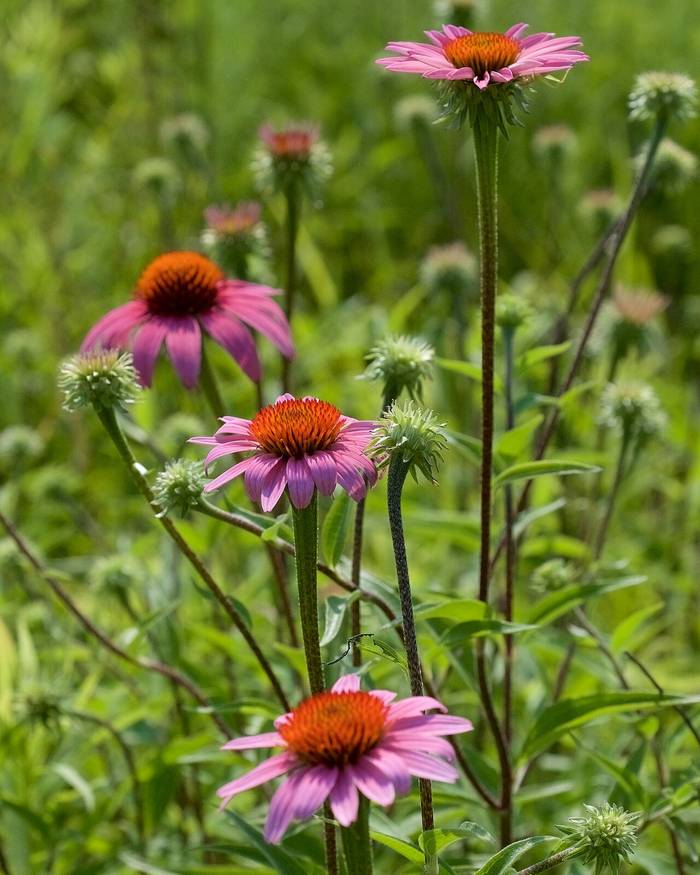
Eric Hunt · CC BY-SA 4.0
Purpursolhat
Plante·Echinacea purpurea
Halvskygge til fuld sol
Sol
Tør til fugtig jord
Vand
Veldrænet jord
Dræning
Zoner 3–9
Hårdførhed
Dækning · 118 felter
Vækst og størrelse10 felter
Højde
120 cm“Echinacea purpurea is a PERENNIAL growing to 1.2 m (4ft) by 0.5 m (1ft 8in) at a medium rate.”
Bredde
50 cm · andre kilder: 25 cm“Echinacea purpurea is a PERENNIAL growing to 1.2 m (4ft) by 0.5 m (1ft 8in) at a medium rate.”Wikipedia“Echinacea purpurea is an herbaceous perennial up to 120 centimeters (47 inches) tall by 25 cm (10 in) wide at maturity.”
Højde ved alder
—
tomt
Planteafstand
45 cm (mindst 30 cm)
AI-estimat55 % enig
Vækstrate
Middel“Echinacea purpurea is a PERENNIAL growing to 1.2 m (4ft) by 0.5 m (1ft 8in) at a medium rate.”
Vækstform
Vaseformet
AI-estimat50 % enig
Skovhavelag
Urtelag“Echinacea purpurea is an herbaceous perennial up to 120 centimeters (47 inches) tall by 25 cm (10 in) wide at maturity.”
Levetid
~10 år
AI-estimatikke målt endnu
Rødder6 felter
Lagerorgan
Intet
AI-estimat100 % enig
Breder sig sideværts i cm
—
tomt
Roddybde i cm
—
tomt
Mykorrhiza
Arbuskulær (AM)
AI-estimatikke målt endnu
Lys, vand og jord9 felter
Sol
Fuld sol, halvskygge, let skygge · bedst: fuld sol“The plant prefers well-drained soils in full sun.”Wikipedia“The plant grows in sun or light shade.”
Timer sol
6–12 t
AI-estimatikke målt endnu
Vand
Tør, fugtig · Lavt · 2–4 l/dag“It prefers dry or moist soil and can tolerate drought.”Wikipedia“It thrives in either dry or moist soil and can tolerate drought once established.”
Tåler vandlidende jord
—
tomt
Jordtype
Sand, muld · bedst: muld“Prefers a deep rich loam with plenty of leafmold and a sunny position.”PFAF“Suitable for: light (sandy) and medium (loamy) soils and prefers well-drained soil.”
Komprimeret jord
Tåler det nogenlunde
AI-estimatikke målt endnu
Klima5 felter
Hårdførhed
Zone 3–9
AI-estimatikke målt endnu
Dræbende frost
0 °C“Killing temp. early growth: 0”EcoCrops tal er frost under tidlig vækst (forårsfrost på nye skud), ikke vinterkulde.
Vækst-temperatur
10–36 °C · optimal 18–24 °C“Temperature absolute min: 10 · Temperature absolute max: 36 · Temperature optimal min: 18 · Temperature optimal max: 24”
Kuldetimer
0 t
AI-estimatikke målt endnu
Pleje (bliver til opgaver i Manage)9 felter
Beskyttelse
Efter sidste frost · varer 365 dage · slugs“give them some protection from slugs at least until they are established”
PFAFdelvist
Forspiring
Marts · varer 61 dage
AI-estimatikke målt endnu
Udplantning
Efter sidste frost
AI-estimatikke målt endnu
Beskyttelse
Efter forrige fase · slugs
AI-estimatikke målt endnu
Deling
Efter sidste frost · Efter første frost · break clumps into smaller bunches
Deling står 2 gange med forskellig timing.
AI-estimatikke målt endnu
Vanding
Juli · varer 60 dage
AI-estimatikke målt endnu
Gødning
April · varer 30 dage · compost
AI-estimatikke målt endnu
Beskæring
Efter forrige fase · 60 dage efter · varer 30 dage
AI-estimatikke målt endnu
Deling
Marts · varer 30 dage · lift and split with a spade
Deling står 2 gange med forskellig timing.
AI-estimatikke målt endnu
Året rundt5 felter
Høst
September · varer 91 dage“Echinacea roots are typically harvested in late autumn (September to November)”
Høst
Efter forrige fase · varer 62 dage“the flowers can be harvested in summer when they are fully open”
Spring ud
Efter sidste frost · varer 30 dage
AI-estimatikke målt endnu
Går i dvale
Efter første frost · varer 30 dage
AI-estimatikke målt endnu
Spiselige dele og bestøvning3 felter
Rødderne
Tea, tincture · september–oktober
AI-estimatikke målt endnu
Økologi5 felter
Tiltrækker
Bier, sommerfugle, nyttedyr, parasitic wasps, finches“Bees that are attracted to the flowers include bumblebees, sweat bees, honey bees, the sunflower leafcutter bee, and the mining bee Andrena helianthiformis.”Wikipedia“Butterflies that visit include monarchs, swallowtail butterflies, and sulphur butterflies.”Wikipedia“Birds, particularly finches, eat the seeds and disperse them through their droppings.”PFAFdelvist“Echinacea attracts butterflies and beneficial insects, including parasitic wasps.”
Skadedyr
Snegle, kaniner, gnavere“Slugs and rabbits will also eat the foliage when young, or shortly after emerging in the spring.”Wikipedia“Additionally, roots can be damaged and eaten by gophers.”
Sygdomme
Fytoplasmer, meldug
AI-estimatikke målt endnu
Optager
Kalium, calcium
AI-estimatikke målt endnu
Fikserer kvælstof
Nej
AI-estimatikke målt endnu
Formering og navne4 felter
Metoder
Frø, deling, rodstiklinger, basal cuttings“Seed - sow March/April in a greenhouse and only just cover the seed”PFAF“Division in spring or autumn.”PFAF“Root cuttings, October in a frame.”Wikipedia“Cuttings of basal shoots in the spring may be rooted when treated with rooting hormones, such as IBA at 1000 ppm.”
Sværhedsgrad
2 / 5
AI-estimatikke målt endnu
Frø
daily temperature fluctuations or stratification“Seed germination occurs best with daily temperature fluctuations or after stratification, which help to end dormancy.”
Ikke sorteret endnu62 felter
Felter som parseren gemmer, men som siden ikke har en række til endnu. De vises her automatisk, så intet er skjult.
forage.DK.local_name
Purpur solhat
AI-estimatikke målt endnu
forage.DK.warnings_da
Vær sikker på artsbestemmelsen, da der findes lignende planter.
AI-estimatikke målt endnu
forage.DK.warnings_en
Be sure of the identification, as there are lookalike plants.
AI-estimatikke målt endnu
forage.DK.prep_cautions
Avoid harvesting from polluted areas., Ensure positive identification as lookalikes may exist.
AI-estimatikke målt endnu
forage.DK.edibility_basis
inferred
AI-estimatikke målt endnu
forage.DK.foraging_months.notes
Roots are best harvested in autumn after the plant has flowered.
AI-estimatikke målt endnu
forage.DK.foraging_months.months
9, 10
AI-estimatikke målt endnu
forage.DK.foraging_months.year_round
false
AI-estimatikke målt endnu
forage.DK.habitat_affinity
woodland, verge, disturbed_ground
AI-estimatikke målt endnu
forage.US.local_name
Purple coneflower
AI-estimatikke målt endnu
forage.US.prep_cautions
Possible suppression of immunity with habitual use., High doses over 1000 mg may cause dizziness., Use of herb for 10-14 days recommended followed by a short break.“Possible suppression of immunity with habitual use.”PFAF“High doses over 1000 mg may cause dizziness.”PFAF“Use of herb for 10-14 days recommended followed by a short break.”
forage.US.edibility_basis
inferred
AI-estimatikke målt endnu
forage.US.foraging_months.notes
Leaves and flowers are best in spring and summer, roots in fall.
AI-estimatikke målt endnu
forage.US.foraging_months.months
4, 5, 6, 7, 8, 9, 10
AI-estimatikke målt endnu
forage.US.foraging_months.year_round
false
AI-estimatikke målt endnu
forage.US.habitat_affinity
woodland“Its habitats include dry open woods, prairies, and barrens.”
forage.TROPICAL.edibility_basis
inferred
AI-estimatikke målt endnu
forage.TROPICAL.foraging_months.notes
Echinacea purpurea is not native to tropical regions and typically does not thrive there.
AI-estimatikke målt endnu
forage.TROPICAL.foraging_months.year_round
false
AI-estimatikke målt endnu
ornamental.basis
documented
AI-estimatikke målt endnu
ornamental.fragrance.source
flower
AI-estimat100 % enig
ornamental.fragrance.intensity
subtle
AI-estimatikke målt endnu
ornamental.confidence
high
AI-estimatikke målt endnu
ornamental.fall_interest
true“Depending on the climate, it blooms throughout summer into autumn.”
Wikipediadelvist
ornamental.flower_colour
pink, purple, red, white, yellow“These are surrounded by a ring of pink or purple ligulate florets.”PFAF“Bloom Color: Pink, Purple, Red, White.”Wikipediadelvist“The inflorescence is a capitulum, 7 to 15 cm (3 to 6 in) in diameter, formed by a prominent domed central protuberance consisting of multiple small yellow florets.”
ornamental.evidence_quote
Echinacea purpurea, commonly known as purple coneflower, features prominent purple to pink ray flowers and a central cone. Its foliage is green, and it does not typically display significant autumn color. The plant retains attractive seed heads through winter, providing architectural interest. The flowers have a subtle fragrance.
AI-estimatikke målt endnu
ornamental.foliage_colour
green
AI-estimat82 % enig
ornamental.foliage_texture
medium
AI-estimatikke målt endnu
ornamental.winter_structure
seed_heads, architectural_skeleton
AI-estimatikke målt endnu
ornamental.autumn_foliage_colour
none
AI-estimatikke målt endnu
care_regime
light
AI-estimatikke målt endnu
propagation.self_seeding
moderate
AI-estimat20 % enig
propagation.establishment_years
1
AI-estimat40 % enig
forage_proposals.DK.edibility_tier.tier
caution
AI-estimatikke målt endnu
forage_proposals.DK.edibility_tier.confidence
high
AI-estimatikke målt endnu
forage_proposals.DK.edibility_tier.evidence_quote
Echinacea purpurea is widely used in herbal medicine, with roots, leaves, and flowers being utilized. However, some sources advise caution for pregnant or breastfeeding individuals, and those with autoimmune conditions.
AI-estimatikke målt endnu
forage_proposals.US.edibility_tier.confidence
high
AI-estimatikke målt endnu
forage_proposals.US.edibility_tier.evidence_quote
All parts of Echinacea purpurea are traditionally used for medicinal purposes, particularly for immune support. While generally considered safe, allergic reactions can occur, and caution is advised for certain health conditions.
AI-estimatikke målt endnu
forage_proposals.TROPICAL.edibility_tier.confidence
low
AI-estimatikke målt endnu
function_profile.biomass_return.confidence
medium
AI-estimatikke målt endnu
function_profile.nutrient_flows.consumes
[{"basis":"documented","demand":"moderate","nutrient":"nitrogen","confidence":"high"},{"basis":"documented","demand":"moderate","nutrient":"phosphorus","confidence":"high"},{"basis":"documented","demand":"moderate","n…
AI-estimatikke målt endnu
function_profile.nutrient_flows.provides
[{"basis":"documented","nutrient":"potassium","mechanism":"biomass_return","confidence":"medium"},{"basis":"documented","nutrient":"calcium","mechanism":"biomass_return","confidence":"medium"}]
AI-estimatikke målt endnu
function_profile.biotic_interactions
[{"taxa":["bees"],"basis":"documented","valence":"beneficial","relation":"attracts","confidence":"high","evidence_quote":"Bees that are attracted to the flowers include bumblebees, sweat bees, honey bees, the sunflowe…“Bees that are attracted to the flowers include bumblebees, sweat bees, honey bees, the sunflower leafcutter bee, and the mining bee Andrena helianthiformis.”Wikipedia“Butterflies that visit include monarchs, swallowtail butterflies, and sulphur butterflies.”PFAF“Echinacea can provide overwintering sites for beneficial insects in its leaf litter.”Wikipedia“Slugs and rabbits will also eat the foliage when young, or shortly after emerging in the spring.”Wikipedia“Additionally, roots can be damaged and eaten by gophers.”PFAFdelvist“Echinacea attracts butterflies and beneficial insects, including parasitic wasps.”Wikipediadelvist“Birds, particularly finches, eat the seeds and disperse them through their droppings.”
function_profile.aromatic_pest_effect.value
false“No – Echinacea does not have a strong aromatic quality that would effectively confuse pests.”
function_profile.aromatic_pest_effect.confidence
high
AI-estimatikke målt endnu
function_profile.structural_interfaces.provides_shelter.basis
inferred
AI-estimatikke målt endnu
function_profile.structural_interfaces.provides_shelter.confidence
low
AI-estimatikke målt endnu
function_profile.structural_interfaces.requires_shelter.basis
inferred
AI-estimatikke målt endnu
function_profile.structural_interfaces.requires_shelter.confidence
low
AI-estimatikke målt endnu
function_profile.structural_interfaces.provides_physical_support.basis
inferred
AI-estimatikke målt endnu
function_profile.structural_interfaces.provides_physical_support.confidence
low
AI-estimatikke målt endnu
function_profile.structural_interfaces.requires_physical_support.basis
inferred
AI-estimatikke målt endnu
function_profile.structural_interfaces.requires_physical_support.confidence
low
AI-estimatikke målt endnu
climate_tolerance.photoperiod_response
day_neutral
AI-estimatikke målt endnu
soil_interactions.organic_matter_contribution
medium
AI-estimatikke målt endnu
component_metadata.growth_cycle
perennial“Echinacea purpurea is a PERENNIAL growing to 1.2 m (4ft) by 0.5 m (1ft 8in) at a medium rate.”
resource_interfaces.inputs
[{"resource":"light","quantity_description":"full sun preferred"},{"resource":"water","quantity_description":"tolerates dry or moist soil; drought-tolerant once established"},{"resource":"pollination","quantity_descri…“The plant prefers well-drained soils in full sun.”PFAF“Once established, this species can tolerate prolonged dry conditions.”Wikipedia“It is pollinated by butterflies and bees.”
resource_interfaces.outputs
[{"resource":"nectar","quantity_description":"flowers rich in nectar"},{"resource":"pollen","quantity_description":"flowers rich in pollen"},{"resource":"pollinator_services","quantity_description":"nectar for pollina…“Yes – Echinacea flowers are rich in nectar and pollen, making them attractive to a variety of pollinators, including bees and butterflies.”PFAF“Echinacea can be used as a pollinator plant, providing nectar for beneficial insects.”PFAF“The seeds of Echinacea are eaten by birds and other wildlife.”PFAF“Echinacea can provide overwintering sites for beneficial insects in its leaf litter.”PFAF“The plant also provides cover and habitat for beneficial insects.”