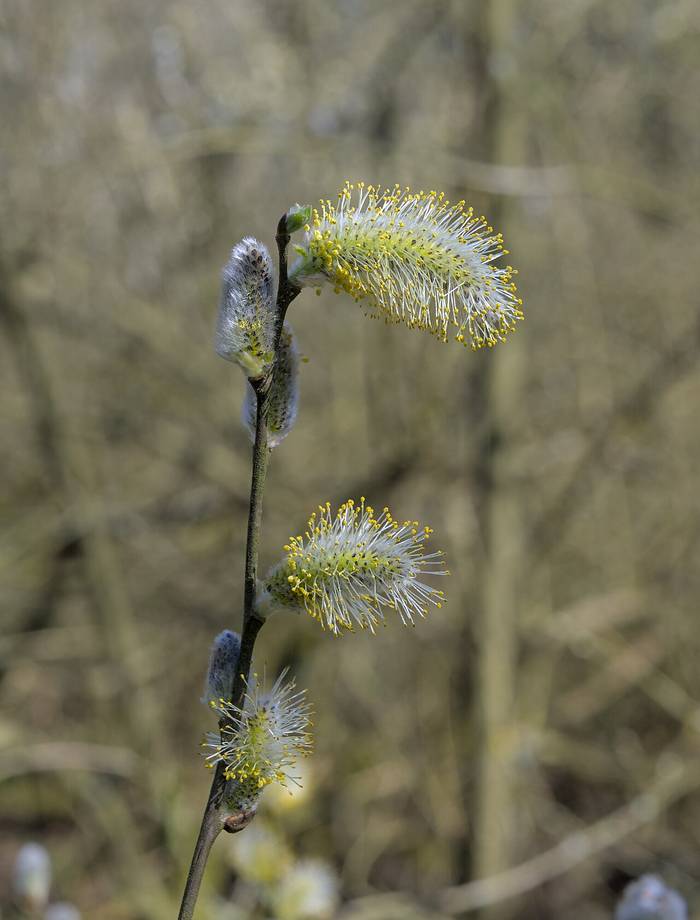
Trougnouf (Benoit Brummer) · CC BY 4.0
Selje-pil
Træ·Salix caprea
Skygge til fuld sol
Sol
Tør til våd jord
Vand
Ikke registreret
Dræning
Zoner 4–8
Hårdførhed
Dækning · 113 felter
Ingen åbenlyse uoverensstemmelser fundet.
Vækst og størrelse11 felter
Plantetype
Løvfældende træ“Salix caprea is a deciduous Tree growing to 10 m (32ft) by 8 m (26ft) at a fast rate.”
Højde
1.000 cm · kilden giver 800–1.000 cm“reaching a height of 8–10 m (26–33 ft)”PFAF“Salix caprea is a deciduous Tree growing to 10 m (32ft) by 8 m (26ft) at a fast rate.”
Bredde
800 cm“Salix caprea is a deciduous Tree growing to 10 m (32ft) by 8 m (26ft) at a fast rate.”
Højde ved alder
—
tomt
Størrelse efter plantning
7 år: 10 m høj, 4 m krone · 12 år: 7,5 m høj, 5 m krone · 16 år: 9 m høj, 6 m krone · 44 år: 10 m høj, 8 m krone · 70 år: 13,5 m høj, 10 m krone“Berlin tree register: 509 trees of this species measured with years since planting, height and crown diameter; median crown 10.0 m and height 13.5 m at 60–100 years after planting (22 trees).”Median af 509 målte træer i Berlin. Årene tælles fra udplantning af planteskoletræer, så et lille træ når hver størrelse senere.
Planteafstand
150 cm (mindst 300 cm)“'Pendula' is female whilst 'Kilmarnock' is a male, they should be spaced about 1.5 metres apart each way.”
Vækstrate
Hurtig“Salix caprea is a deciduous Tree growing to 10 m (32ft) by 8 m (26ft) at a fast rate.”
Vækstform
Bredt udbredt
AI-estimat50 % enig
Roddybde
Middel
AI-estimat63 % enig
Skovhavelag
Lavt trælag
AI-estimat90 % enig
Levetid
~60 år
AI-estimatikke målt endnu
Rødder6 felter
Rodform
Trævlerødder“It has a far-reaching and especially well-developed fibrous root system.”
Lagerorgan
Intet“No clonal growth organ is recorded: it does not spread vegetatively (no suckers, no rhizomes).”
Breder sig
Nej“No clonal growth organ is recorded: it does not spread vegetatively (no suckers, no rhizomes).”
Breder sig sideværts i cm
—
tomt
Roddybde i cm
—
tomt
Mykorrhiza
—
tomt
Lys, vand og jord9 felter
Sol
Fuld sol, let skygge, halvskygge, skygge · bedst: fuld sol“It can grow in semi-shade (light woodland) or no shade.”JRC skovtræ-atlas“it is one of the few willow species able to grow in forest understories.”
Timer sol
6 t
AI-estimatikke målt endnu
Vand
Tør, fugtig, våd · bedst: fugtig · Middel“It prefers dry moist or wet soil.”PFAFdelvist“Succeeds in most soils, including wet, ill-drained or intermittently flooded soils, but prefers a damp, heavy soil in a sunny position.”
Tørketålende
—
tomt
Tåler vandlidende jord
—
tomt
Jordtype
Sand, muld, ler · bedst: ler“Suitable for: light (sandy), medium (loamy) and heavy (clay) soils and can grow in heavy clay soil.”PFAFdelvist“Succeeds in most soils, including wet, ill-drained or intermittently flooded soils, but prefers a damp, heavy soil in a sunny position.”
Komprimeret jord
Tåler det nogenlunde
AI-estimatikke målt endnu
Klima5 felter
Hårdførhed
Zone 4–8
AI-estimatikke målt endnu
Dræbende frost
-25 °C
AI-estimatikke målt endnu
Vækst-temperatur
0–30 °C · optimal 5–25 °C
AI-estimatikke målt endnu
Kuldetimer
400 t
AI-estimatikke målt endnu
Hjemsted
AD, AL, AM, AT, AZ, BA, BE, BG, BY, CH, CN, CZ, DE, DK, EE, ES, FI, FR, GB, GE, GG, GI, GR, HR, HU, IE, IT, JE, JP, KP, KR, KZ, LB, LI, LT, LU, LV, MC, MD, ME, MK, MT, NL, NO, PL, RO, RS, RU, SE, SI, SK, SM, SY, TR, UA, VA, XK
Pleje (bliver til opgaver i Manage)2 felter
Beskæring
Februar · varer 28 dage · new growth if coppicing · dead, damaged, or crossing branches
AI-estimatikke målt endnu
Jorddække
Marts · varer 30 dage
AI-estimatikke målt endnu
Året rundt5 felter
Blomstring
Marts · varer 61 dage“It is in flower from March to April, and the seeds ripen in May.”
Går i dvale
Efter første frost · varer 30 dage
AI-estimatikke målt endnu
Spring ud
Efter sidste frost
AI-estimatikke målt endnu
Dvale
Efter første frost · 30 dage efter · varer 150 dage
AI-estimatikke målt endnu
Spiselige dele og bestøvning6 felter
Inner bark
Raw or cooked; can be dried, ground into a powder and added to cereal flour for bread“Inner bark - raw or cooked. It can be dried, ground into a powder and then added to cereal flour for use in making bread etc.”PFAF“A very bitter flavour, it is a famine food that is only used when all else fails.”
Bestøvning
Kræver en partner · en hanplante · tvebo“The species is dioecious (individual flowers are either male or female, but only one sex is to be found on any one plant so both male and female plants must be grown if seed is required).”PFAF“and is pollinated by Bees.”PFAF“Although the flowers are produced in catkins early in the year, they are pollinated by bees and other insects rather than by the wind.”PFAF“The plant is not self-fertile.”PFAF“Dioecious. Male and female plants must be grown if seed is required.”
Økologi6 felter
Tiltrækker
Bier, other insects, birds such as Eurasian blue tits“Although the flowers are produced in catkins early in the year, they are pollinated by bees and other insects rather than by the wind.”JRC skovtræ-atlas“This willow is among the first flowering plants in the spring, the catkins providing a high quantity of pollen and nectar as a food source, to bees, insects or birds, such as Eurasian blue tits (Cyanistes caeruleus).”
Skadedyr
Galmyg, bladhvepse, bladhvepse, bladhvepse, asiatisk løvtræbuk, løvskovsnonne“Willows are very susceptible to gall inducers, and the midge Rhabdophaga rosaria forms the camellia gall on S. caprea.”JRC skovtræ-atlas“The fungus Rhytisma salicinum, the leaf-galler sawfly Pontania pedunculi and the leaf-folder sawfly of genus Phyllocolpa may cause damage to individuals, by affecting the leaves.”JRC skovtræ-atlas“Nematus miliaris can completely defoliate the goat willow, which in Poland has been reported to be preferentially attacked (along with Salix elegantissima), compared with other willows.”JRC skovtræ-atlas“The goat willow is susceptible to attacks from the Asian longhorned beetle (Anoplophora glabripennis), despite showing noticeable resistance and thus potentially acting as overwintering reservoir of the beetle.”JRC skovtræ-atlas“It is also vulnerable to the gypsy moth (Lymantria dispar).”
Sygdomme
Rust, tjærepletsyge, honningsvamp“The rust fungus Melampsora capaearum may infect the goat willow and its hybrids, raising dusty orange spots or pustules on the leaves, resulting in lower photosynthetic performance and eventually defoliating the trees.”JRC skovtræ-atlas“The fungus Rhytisma salicinum, the leaf-galler sawfly Pontania pedunculi and the leaf-folder sawfly of genus Phyllocolpa may cause damage to individuals, by affecting the leaves.”PFAF“Plants in this genus are notably susceptible to honey fungus.”
Optager
—
tomt
Fikserer kvælstof
Nej
AI-estimatikke målt endnu
Mykorrhiza
Ja
AI-estimatikke målt endnu
Formering og navne4 felter
Metoder
Seed (surface sown as soon as ripe in late spring), hardwood cuttings of the current year's growth, November to February, half-ripe cuttings, June to August in a frame“Seed - must be surface sown as soon as it is ripe in late spring.”PFAF“Cuttings of mature wood of the current year's growth, November to February in a sheltered outdoor bed or planted straight into their permanent position and given a good weed-suppressing mulch.”PFAF“Cuttings of half-ripe wood, June to August in a frame.”
Sværhedsgrad
2 / 5
AI-estimatikke målt endnu
Frø
cold stratification
AI-estimatikke målt endnu
Ikke sorteret endnu59 felter
Felter som parseren gemmer, men som siden ikke har en række til endnu. De vises her automatisk, så intet er skjult.
forage.DK.local_name
Selje-pil
AI-estimatikke målt endnu
forage.DK.prep_cautions
bitter taste, best used in small quantities or as a famine food
AI-estimatikke målt endnu
forage.DK.edibility_basis
inferred
AI-estimatikke målt endnu
forage.DK.foraging_months.notes
Young leaves and catkins in spring, inner bark also in spring.
AI-estimatikke målt endnu
forage.DK.foraging_months.months
3, 4, 5
AI-estimatikke målt endnu
forage.DK.foraging_months.year_round
false
AI-estimatikke målt endnu
forage.DK.habitat_affinity
woodland, hedgerow, riverbank, disturbed_ground“Woods, scrub and hedges, usually on basic soils, to 840 metres.”JRC skovtræ-atlas“In northern Europe, it is a common species in the agricultural landscape, used as a windbreak and hedge, and its foliage is used as fodder for cattle and goats.”Wikipedia“S. caprea occurs both in wet/damp environments, such as riverbanks and lake shores, and in drier sites, wherever bare soil becomes available due to ground disturbance.”
forage.US.edible_parts
[{"part":"young leaves","caution":"bitter taste, best in small quantities","preparation":"raw or cooked","season_months":[4,5]},{"part":"inner bark","caution":"bitter, used as a famine food","preparation":"dried and g…
AI-estimatikke målt endnu
forage.US.prep_cautions
bitter taste, best used in small quantities or as a famine food
AI-estimatikke målt endnu
forage.US.edibility_basis
inferred
AI-estimatikke målt endnu
forage.US.foraging_months.notes
Young leaves and catkins in spring, inner bark also in spring.
AI-estimatikke målt endnu
forage.US.foraging_months.months
3, 4, 5
AI-estimatikke målt endnu
forage.US.foraging_months.year_round
false
AI-estimatikke målt endnu
forage.US.habitat_affinity
woodland, hedgerow, verge, disturbed_ground
AI-estimatikke målt endnu
forage.TROPICAL.edibility_basis
inferred
AI-estimatikke målt endnu
forage.TROPICAL.foraging_months.notes
Not typically found or foraged in tropical regions.
AI-estimatikke målt endnu
forage.TROPICAL.foraging_months.year_round
false
AI-estimatikke målt endnu
ornamental.basis
documented
AI-estimatikke målt endnu
ornamental.fragrance.source
flower
AI-estimat100 % enig
ornamental.fragrance.intensity
subtle
AI-estimatikke målt endnu
ornamental.confidence
high
AI-estimatikke målt endnu
ornamental.fall_interest
true
AI-estimatikke målt endnu
ornamental.evidence_quote
The male catkins are bright yellow with pollen, appearing before the leaves. Leaves are dull green above and grey-green beneath, turning yellow-green in autumn. Young stems can have a reddish hue in winter.
AI-estimatikke målt endnu
ornamental.foliage_colour
green, grey_green“The upper side of the leaf is green and glossy, while the underside is covered by densely and softy white-downy hairs.”Wikipediadelvist“dull green and slightly hairy above, grey and woolly pubescent below”
ornamental.foliage_texture
medium
AI-estimatikke målt endnu
ornamental.winter_structure
coloured_stems
AI-estimatikke målt endnu
ornamental.autumn_foliage_colour
yellow_green
AI-estimatikke målt endnu
care_regime
none
AI-estimatikke målt endnu
propagation.self_seeding
moderate
AI-estimat20 % enig
propagation.establishment_years
1
AI-estimat40 % enig
size_at_age.v
1
AI-estimatikke målt endnu
size_at_age.basis
years_after_planting
AI-estimatikke målt endnu
sun_requirement.best
full_sun“Succeeds in most soils, including wet, ill-drained or intermittently flooded soils, but prefers a damp, heavy soil in a sunny position.”
PFAFdelvist
forage_proposals.DK.edibility_tier.tier
caution
AI-estimatikke målt endnu
forage_proposals.DK.edibility_tier.confidence
high
AI-estimatikke målt endnu
forage_proposals.DK.edibility_tier.evidence_quote
The young leaves and catkins can be eaten raw or cooked, though they are often bitter. The inner bark can be dried and ground into a flour, but it is also bitter and generally considered a famine food.
AI-estimatikke målt endnu
forage_proposals.US.edibility_tier.tier
caution
AI-estimatikke målt endnu
forage_proposals.US.edibility_tier.confidence
high
AI-estimatikke målt endnu
forage_proposals.US.edibility_tier.evidence_quote
The young leaves and catkins can be eaten raw or cooked, though they are often bitter. The inner bark can be dried and ground into a flour, but it is also bitter and generally considered a famine food.
AI-estimatikke målt endnu
forage_proposals.TROPICAL.edibility_tier.confidence
low
AI-estimatikke målt endnu
function_profile.biomass_return.confidence
high“The goat willow is particularly valuable for its high biomass production in short rotation plantations and its role in landscape restoration, as it is able to tolerate even polluted land.”
JRC skovtræ-atlasdelvist
function_profile.nutrient_flows.consumes
[{"basis":"inferred","demand":"moderate","nutrient":"nitrogen","confidence":"medium"},{"basis":"inferred","demand":"moderate","nutrient":"phosphorus","confidence":"medium"},{"basis":"inferred","demand":"moderate","nut…
AI-estimatikke målt endnu
function_profile.nutrient_flows.provides
[{"basis":"inferred","nutrient":"calcium","mechanism":"biomass_return","confidence":"medium"},{"basis":"inferred","nutrient":"potassium","mechanism":"biomass_return","confidence":"medium"}]
AI-estimatikke målt endnu
function_profile.biotic_interactions
[{"taxa":["bees","other insects"],"basis":"documented","valence":"beneficial","relation":"attracts","confidence":"high","evidence_quote":"Although the flowers are produced in catkins early in the year, they are pollin…“Although the flowers are produced in catkins early in the year, they are pollinated by bees and other insects rather than by the wind.”JRC skovtræ-atlas“This willow is among the first flowering plants in the spring, the catkins providing a high quantity of pollen and nectar as a food source, to bees, insects or birds, such as Eurasian blue tits (Cyanistes caeruleus).”Wikipedia“Willows are very susceptible to gall inducers, and the midge Rhabdophaga rosaria forms the camellia gall on S. caprea.”JRC skovtræ-atlas“The fungus Rhytisma salicinum, the leaf-galler sawfly Pontania pedunculi and the leaf-folder sawfly of genus Phyllocolpa may cause damage to individuals, by affecting the leaves.”JRC skovtræ-atlas“Nematus miliaris can completely defoliate the goat willow, which in Poland has been reported to be preferentially attacked (along with Salix elegantissima), compared with other willows.”JRC skovtræ-atlas“The goat willow is susceptible to attacks from the Asian longhorned beetle (Anoplophora glabripennis), despite showing noticeable resistance and thus potentially acting as overwintering reservoir of the beetle.”JRC skovtræ-atlas“It is also vulnerable to the gypsy moth (Lymantria dispar).”Wikipedia“The leaves are used as a food resource by several species of Lepidoptera, and are also commonly eaten by browsing mammals.”JRC skovtræ-atlas“The rust fungus Melampsora capaearum may infect the goat willow and its hybrids, raising dusty orange spots or pustules on the leaves, resulting in lower photosynthetic performance and eventually defoliating the trees.”PFAF“Plants in this genus are notably susceptible to honey fungus.”
function_profile.aromatic_pest_effect.value
false
AI-estimat80 % enig
function_profile.aromatic_pest_effect.confidence
low
AI-estimatikke målt endnu
function_profile.structural_interfaces.provides_shelter.basis
documented
AI-estimatikke målt endnu
function_profile.structural_interfaces.provides_shelter.kinds
wind, shade
AI-estimatikke målt endnu
function_profile.structural_interfaces.provides_shelter.confidence
high
AI-estimatikke målt endnu
function_profile.structural_interfaces.provides_shelter.evidence_quote
Goat willow provides good windbreak and shade due to its dense canopy.
AI-estimatikke målt endnu
function_profile.structural_interfaces.provides_physical_support.form
stout_stem
AI-estimatikke målt endnu
function_profile.structural_interfaces.provides_physical_support.basis
taxonomic
AI-estimatikke målt endnu
function_profile.structural_interfaces.provides_physical_support.confidence
high
AI-estimatikke målt endnu
climate_tolerance.photoperiod_response
day_neutral
AI-estimatikke målt endnu
soil_interactions.organic_matter_contribution
high
AI-estimatikke målt endnu
component_metadata.growth_cycle
perennial
AI-estimat100 % enig
resource_interfaces.inputs
[{"resource":"light","quantity_description":"full sun in open areas; very shade intolerant"},{"resource":"shade","quantity_description":"tolerates semi-shade or no shade"},{"resource":"water","quantity_description":"p…“Regarding its demand for light, it is a very shade intolerant species, occurring in open areas with full sun, but it is one of the few willow species able to grow in forest understories.”PFAF“It can grow in semi-shade (light woodland) or no shade.”PFAF“It prefers dry moist or wet soil.”
resource_interfaces.outputs
[{"resource":"pollinator_services","quantity_description":"catkins pollinated by bees and other insects"},{"resource":"nectar","quantity_description":"catkins supply nectar early in spring"},{"resource":"pollen","quan…“Although the flowers are produced in catkins early in the year, they are pollinated by bees and other insects rather than by the wind.”JRC skovtræ-atlas“This willow is among the first flowering plants in the spring, the catkins providing a high quantity of pollen and nectar as a food source, to bees, insects or birds, such as Eurasian blue tits (Cyanistes caeruleus).”PFAF“The plant is fast growing and tolerant of maritime exposure, it can be used as a windbreak hedge and shelterbelt though it is of untidy habit.”JRC skovtræ-atlas“Finally, the goat willow plays an important role in maintaining species diversity, by being the host of several lichen species.”PFAF“Some cultivars can be grown as ground cover.”PFAF“The seeds are very light and so can travel some distance in the wind.”JRC skovtræ-atlas“The goat willow is particularly valuable for its high biomass production in short rotation plantations and its role in landscape restoration, as it is able to tolerate even polluted land.”PFAFdelvist“Wood - soft, elastic, easily split.”