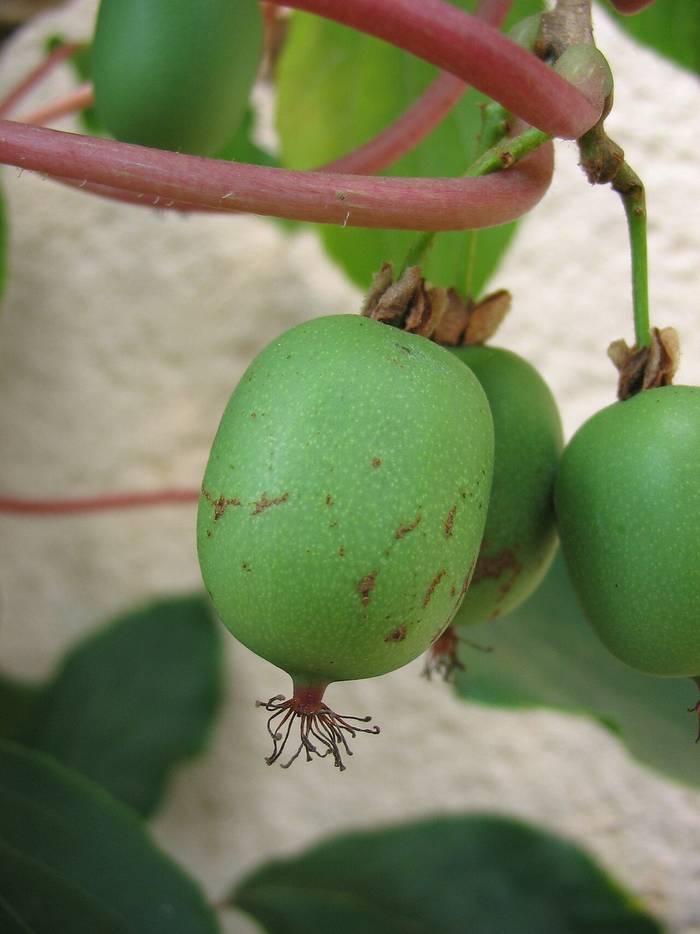
Björn Appel · CC BY-SA 3.0
Stikkelsbærkiwi
Plante·Actinidia arguta
Halvskygge til fuld sol
Sol
Tør til fugtig jord
Vand
Veldrænet jord
Dræning
Zoner 4–8
Hårdførhed
Dækning · 130 felter
Vækst og størrelse10 felter
Plantetype
Løvfældende plante“Actinidia arguta is a deciduous Climber growing to 15 m (49ft 3in) at a fast rate.”
Højde
1.500 cm“Actinidia arguta is a deciduous Climber growing to 15 m (49ft 3in) at a fast rate.”
Bredde
300 cm
AI-estimat58 % enig
Højde ved alder
—
tomt
Planteafstand
300 cm (mindst 200 cm)
AI-estimat55 % enig
Vækstrate
Hurtig“Actinidia arguta is a deciduous Climber growing to 15 m (49ft 3in) at a fast rate.”
Roddybde
Middel
AI-estimat63 % enig
Skovhavelag
Klatrelag“Actinidia arguta is a deciduous Climber growing to 15 m (49ft 3in) at a fast rate.”
Levetid
~50 år
AI-estimatikke målt endnu
Rødder6 felter
Rodform
Hjerterod“The root pattern is a heart root, dividing from the crown into several primary roots going down and out [1-2].”
Lagerorgan
Intet
AI-estimat100 % enig
Breder sig
Nej
AI-estimat75 % enig
Breder sig sideværts i cm
—
tomt
Roddybde i cm
—
tomt
Mykorrhiza
Arbuskulær (AM)
AI-estimatikke målt endnu
Lys, vand og jord9 felter
Sol
Fuld sol, let skygge, halvskygge · bedst: fuld sol“It can grow in semi-shade (light woodland) or no shade.”
Timer sol
6–10 t
AI-estimatikke målt endnu
Vand
Tør, fugtig · Middel · 4–8 l/dag“It prefers dry or moist soil.”Wikipediadelvist“Hardy kiwi vines consume large volumes of water; therefore, they are usually grown in well-drained, acidic soils to prevent root rot.”
Tørketålende
—
tomt
Tåler vandlidende jord
Nej
AI-estimatikke målt endnu
Jordtype
Sand, muld, ler · bedst: muld“Prefers a sound loamy neutral soil.”PFAF“Suitable for: light (sandy), medium (loamy) and heavy (clay) soils.”
Dræning
Veldrænet“Hardy kiwi vines consume large volumes of water; therefore, they are usually grown in well-drained, acidic soils to prevent root rot.”
Komprimeret jord
Tåler det dårligt
AI-estimatikke målt endnu
Klima5 felter
Hårdførhed
Zone 4–8
AI-estimatikke målt endnu
Dræbende frost
0 °C“Killing temp. early growth: 0”EcoCrops tal er frost under tidlig vækst (forårsfrost på nye skud), ikke vinterkulde.
Vækst-temperatur
5–30 °C · optimal 12–25 °C“Temperature absolute min: 5 · Temperature absolute max: 30 · Temperature optimal min: 12 · Temperature optimal max: 25”
Kuldetimer
200 t
AI-estimatikke målt endnu
Pleje (bliver til opgaver i Manage)9 felter
Beskæring
Efter forrige fase · second-year wood and fruit spurs on older wood“Fruits are formed on second-year wood and also on fruit spurs on older wood”PFAFdelvist“any pruning is best carried out in the winter”
Støtte
Efter sidste frost“vines grow extremely quickly and require a strong trellis for support”
Støtte står 2 gange med forskellig timing.
Wikipediadelvist
Udplantning
Efter sidste frost“plant them out into their permanent positions in late spring or early summer, after the last expected frosts”
Beskæring
Januar · varer 60 dage · fruit-bearing wood
AI-estimatikke målt endnu
Vanding
Efter sidste frost · varer 150 dage
Vanding står 2 gange med forskellig timing.
AI-estimatikke målt endnu
Gødning
Marts · varer 15 dage · a balanced granular fertiliser or compost
AI-estimatikke målt endnu
Vanding
Juni · varer 90 dage
Vanding står 2 gange med forskellig timing.
AI-estimatikke målt endnu
Jorddække
April · varer 30 dage
AI-estimatikke målt endnu
Støtte
Maj · varer 30 dage
Støtte står 2 gange med forskellig timing.
AI-estimatikke målt endnu
Året rundt5 felter
Spiselige dele og bestøvning6 felter
Frugterne
Raw, cooked or dried for later use“Fruit - raw, cooked or dried for later use.”PFAFdelvist“Edible Parts: Fruit Sap”
Saften
Tapped and drunk in spring“The plant is rich in sap and this can be tapped and drunk in the spring.”PFAFdelvist“Edible Parts: Fruit Sap”
Young leaves
Namul vegetable“Young leaves, called darae-sun, are often consumed as namul vegetable.”
Bestøvning
Kræver en partner · en hanplante · tvebo“The species is dioecious (individual flowers are either male or female, but only one sex is to be found on any one plant so both male and female plants must be grown if seed is required).”PFAF“and is pollinated by Bees, insects.”PFAF“The plant is not self-fertile.”Wikipedia“For vines to bear fruit, both male and female plants must be present to enable pollination.”Wikipedia“A male pollinator can enable six female producers to fruit.”
Økologi5 felter
Tiltrækker
Dyreliv, cats“It is noted for attracting wildlife.”Wikipedia“Cats can also pose a problem, as they are attracted to a catnip-like smell produced by the hardy kiwi vines.”
Skadedyr
Rodgallenematoder, væksthusspindemide, viklere, thrips, torbister“Vines are also vulnerable to pest infestations, including root knot nematodes, two-spotted spider mites, leaf rollers, thrips, and Japanese beetles.”
Sygdomme
Phytophthora, gråskimmel, knoldbægersvamp“Hardy kiwi vines are vulnerable to several botanical diseases, including phytophthora crown and root rot (the most serious problem), botrytis rot, and sclerotinia blight.”
Optager
Kalium
AI-estimatikke målt endnu
Fikserer kvælstof
Nej
AI-estimatikke målt endnu
Formering og navne4 felter
Metoder
Frø, grønne stiklinger, half-ripe cuttings, ripe wood cuttings, grafting onto kiwifruit rootstock“Seed - sow spring in a greenhouse.”PFAF“Cuttings of softwood as soon as ready in spring in a frame”PFAF“Cuttings of half-ripe wood, July/August in a frame”PFAF“Cuttings of ripe wood, October/November in a frame”Wikipedia“Hardy kiwi cuttings may be grafted directly onto established kiwifruit rootstock, or rooted themselves”
Sværhedsgrad
2 / 5
AI-estimatikke målt endnu
Ikke sorteret endnu71 felter
Felter som parseren gemmer, men som siden ikke har en række til endnu. De vises her automatisk, så intet er skjult.
forage.DK.local_name
Minikiwi
AI-estimatikke målt endnu
forage.DK.edibility_basis
inferred
AI-estimatikke målt endnu
forage.DK.foraging_months.notes
Seeds ripen in October; harvest is late autumn to early winter.“It is in leaf from May to November, in flower from June to July, and the seeds ripen in October.”
forage.DK.foraging_months.months
9, 10“Kiwifruit is typically harvested in late autumn to early winter, depending on the variety and climate.”
PFAFdelvist
forage.DK.foraging_months.year_round
false
AI-estimatikke målt endnu
forage.DK.habitat_affinity
woodland, riverbank“Climbing up trees in woodland, mountain forests, thickets, streamsides and moist places at elevations of 700 - 3600 metres.”
forage.US.local_name
Hardy kiwi
AI-estimatikke målt endnu
forage.US.edible_parts
[{"part":"fruit","preparation":"raw, cooked or dried for later use"},{"part":"sap","preparation":"tapped and drunk in spring"},{"part":"young leaves","preparation":"namul vegetable"}]“Young leaves, called darae-sun, are often consumed as namul vegetable.”PFAF“Fruit - raw, cooked or dried for later use.”PFAF“The plant is rich in sap and this can be tapped and drunk in the spring.”PFAFdelvist“Edible Parts: Fruit Sap”
forage.US.edibility_basis
inferred
AI-estimatikke målt endnu
forage.US.foraging_months.notes
Seeds ripen in October; harvest is late autumn to early winter.“It is in leaf from May to November, in flower from June to July, and the seeds ripen in October.”
forage.US.foraging_months.months
9, 10“Kiwifruit is typically harvested in late autumn to early winter, depending on the variety and climate.”
PFAFdelvist
forage.US.foraging_months.year_round
false
AI-estimatikke målt endnu
forage.US.habitat_affinity
woodland, riverbank“Climbing up trees in woodland, mountain forests, thickets, streamsides and moist places at elevations of 700 - 3600 metres.”
forage.TROPICAL.edible_parts
[{"part":"fruit","preparation":"raw"},{"part":"fruit","preparation":"cooked"},{"part":"fruit","preparation":"dried"},{"part":"sap","preparation":"raw","season_months":[3,4,5]}]
AI-estimatikke målt endnu
forage.TROPICAL.edibility_basis
inferred
AI-estimatikke målt endnu
forage.TROPICAL.foraging_months.notes
Not typically found in tropical climates.
AI-estimatikke målt endnu
forage.TROPICAL.foraging_months.months
9, 10
AI-estimatikke målt endnu
forage.TROPICAL.foraging_months.year_round
false
AI-estimatikke målt endnu
forage.TROPICAL.habitat_affinity
tropical_forest, riverbank
AI-estimatikke målt endnu
ornamental.basis
documented
AI-estimatikke målt endnu
ornamental.fragrance.intensity
subtle
AI-estimatikke målt endnu
ornamental.confidence
high
AI-estimatikke målt endnu
ornamental.fall_interest
true
AI-estimatikke målt endnu
ornamental.flower_colour
white
AI-estimat67 % enig
ornamental.evidence_quote
Hardy kiwi (Actinidia arguta) produces small, fragrant white flowers in late spring, followed by green foliage that turns yellow-green in autumn. The vines provide an architectural skeleton in winter.
AI-estimatikke målt endnu
ornamental.foliage_colour
green
AI-estimat82 % enig
ornamental.foliage_texture
medium
AI-estimatikke målt endnu
ornamental.winter_structure
architectural_skeleton
AI-estimatikke målt endnu
ornamental.autumn_foliage_colour
yellow_green
AI-estimatikke målt endnu
care_regime
routine
AI-estimatikke målt endnu
propagation.self_seeding
none
AI-estimat20 % enig
propagation.division_season
late_winter_early_spring
AI-estimatikke målt endnu
sun_requirement.best_for
fruit“Succeeds in semi-shade but full sun is best for fruit production.”
forage_proposals.DK.edibility_tier.confidence
medium“All members of this genus produce edible fruits.”
forage_proposals.DK.edibility_tier.evidence_quote
All members of this genus produce edible fruits.“All members of this genus produce edible fruits.”
forage_proposals.US.edibility_tier.confidence
medium“All members of this genus produce edible fruits.”
forage_proposals.US.edibility_tier.evidence_quote
All members of this genus produce edible fruits.“All members of this genus produce edible fruits.”
forage_proposals.TROPICAL.edibility_tier.tier
choice
AI-estimatikke målt endnu
forage_proposals.TROPICAL.edibility_tier.confidence
medium
AI-estimatikke målt endnu
forage_proposals.TROPICAL.edibility_tier.evidence_quote
While not native to tropical regions, if cultivated, the fruit of Actinidia arguta is a choice edible, consumed raw or cooked.
AI-estimatikke målt endnu
function_profile.biomass_return.confidence
medium
AI-estimatikke målt endnu
function_profile.nutrient_flows.consumes
[{"basis":"documented","demand":"high","nutrient":"nitrogen","confidence":"high"},{"basis":"documented","demand":"moderate","nutrient":"phosphorus","confidence":"high"},{"basis":"documented","demand":"high","nutrient"…
AI-estimatikke målt endnu
function_profile.nutrient_flows.provides
[{"basis":"inferred","nutrient":"potassium","mechanism":"biomass_return","confidence":"low"}]
AI-estimatikke målt endnu
function_profile.biotic_interactions
[{"taxa":["bees","insects"],"basis":"documented","valence":"beneficial","relation":"attracts","confidence":"medium","evidence_quote":"and is pollinated by Bees, insects.","organism_group":"pollinator","ecological_func…“and is pollinated by Bees, insects.”PFAF“It is noted for attracting wildlife.”Wikipedia“Hardy kiwi vines are vulnerable to several botanical diseases, including phytophthora crown and root rot (the most serious problem), botrytis rot, and sclerotinia blight.”Wikipedia“Cats can also pose a problem, as they are attracted to a catnip-like smell produced by the hardy kiwi vines.”Wikipediadelvist“Vines are also vulnerable to pest infestations, including root knot nematodes, two-spotted spider mites, leaf rollers, thrips, and Japanese beetles.”
function_profile.aromatic_pest_effect.value
false
AI-estimat80 % enig
function_profile.aromatic_pest_effect.confidence
low
AI-estimatikke målt endnu
function_profile.structural_interfaces.provides_shelter.basis
documented
AI-estimatikke målt endnu
function_profile.structural_interfaces.provides_shelter.kinds
shade
AI-estimatikke målt endnu
function_profile.structural_interfaces.provides_shelter.confidence
high
AI-estimatikke målt endnu
function_profile.structural_interfaces.provides_shelter.evidence_quote
The dense foliage of hardy kiwi can provide significant shade.
AI-estimatikke målt endnu
function_profile.structural_interfaces.requires_shelter.basis
documented
AI-estimatikke målt endnu
function_profile.structural_interfaces.requires_shelter.kinds
frost“A very hardy plant tolerates temperatures down to -30°c or more, but the young spring growth is susceptible to frost damage.”
function_profile.structural_interfaces.requires_shelter.stage
establishment
AI-estimatikke målt endnu
function_profile.structural_interfaces.requires_shelter.confidence
medium
AI-estimatikke målt endnu
function_profile.structural_interfaces.requires_shelter.evidence_quote
Young hardy kiwi plants can be sensitive to strong winds.
AI-estimatikke målt endnu
function_profile.structural_interfaces.provides_physical_support.basis
inferred
AI-estimatikke målt endnu
function_profile.structural_interfaces.provides_physical_support.confidence
low
AI-estimatikke målt endnu
function_profile.structural_interfaces.requires_physical_support.basis
documented
AI-estimatikke målt endnu
function_profile.structural_interfaces.requires_physical_support.mechanism
twiner“This is a climbing plant, supporting itself by twining around branches etc.”
function_profile.structural_interfaces.requires_physical_support.confidence
high
AI-estimatikke målt endnu
function_profile.structural_interfaces.requires_physical_support.evidence_quote
Actinidia arguta is a vigorous climbing vine that requires strong support.
AI-estimatikke målt endnu
climate_tolerance.photoperiod_response
day_neutral
AI-estimatikke målt endnu
soil_interactions.organic_matter_contribution
medium
AI-estimatikke målt endnu
component_metadata.growth_cycle
perennial“Actinidia arguta is a perennial vine native to Japan, Korea, Northern China, and the Russian Far East.”
resource_interfaces.inputs
[{"resource":"light","quantity_description":"full sun best for fruit production; succeeds in semi-shade"},{"resource":"water","quantity_description":"prefers dry or moist soil"},{"resource":"physical_support","quantit…“Succeeds in semi-shade but full sun is best for fruit production.”PFAF“It prefers dry or moist soil.”PFAF“and is pollinated by Bees, insects.”PFAFdelvist“They require support structures for optimal growth.”
resource_interfaces.outputs
[{"resource":"fruit","quantity_description":"raw, cooked or dried"},{"resource":"aromatic_compounds","quantity_description":"sweetly scented flowers"},{"resource":"habitat","quantity_description":"attracts wildlife"}]“Fruit - raw, cooked or dried for later use.”PFAF“The flowers are sweetly scented.”PFAF“It is noted for attracting wildlife.”