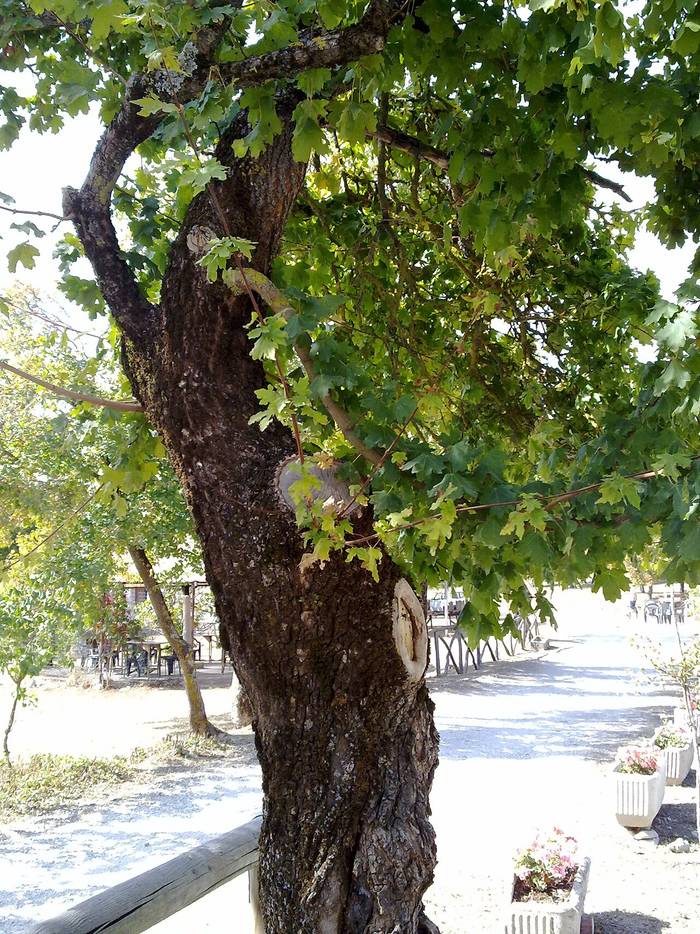
Galloramenu · CC BY-SA 3.0
Field maple
Tree·Acer campestre
Part shade to full sun
Sun
Moist soil
Water
Not recorded
Drainage
Zones 4–8
Hardiness
Coverage · 112 fields
No obvious inconsistencies found.
Growth and size11 fields
Plant type
Deciduous tree“Acer campestre is a deciduous Tree growing to 15 m (49ft 3in) at a fast rate.”
Spread
1,000 cm
AI estimate58 % agree
Height at age
—
empty
Size after planting
3 yrs: 5 m tall, 1.2 m crown · 12 yrs: 7 m tall, 3 m crown · 17 yrs: 8 m tall, 4 m crown · 34 yrs: 12 m tall, 6 m crown · 67 yrs: 16 m tall, 8.5 m crown“Berlin tree register: 18440 trees of this species measured with years since planting, height and crown diameter; median crown 8.5 m and height 16.0 m at 60–100 years after planting (1378 trees).”Median of 18,440 measured trees in Berlin. Years count from planting nursery stock, so a small tree reaches each size later.
Spacing
800 cm (at least 500 cm)
AI estimate55 % agree
Habit
Spreading
AI estimate50 % agree
Root depth
Medium
AI estimate63 % agree
Forest garden layer
Lower tree layer
AI estimate90 % agree
Lifespan
~300 years
AI estimatenot measured yet
Roots6 fields
Root form
—
empty
Storage organ
None“No clonal growth organ is recorded: it does not spread vegetatively (no suckers, no rhizomes).”
Spreads
No“No clonal growth organ is recorded: it does not spread vegetatively (no suckers, no rhizomes).”
Lateral spread in cm
—
empty
Root depth in cm
—
empty
Mycorrhiza
Arbuscular (AM)
AI estimatenot measured yet
Light, water and soil9 fields
Sun
Full sun, light shade, part shade · best: full sun“It can grow in semi-shade (light woodland) or no shade.”
Hours of sun
6 h
AI estimatenot measured yet
Drought tolerant
—
empty
Tolerates waterlogging
No“water needs and avoids waterlogging, favouring calcareous soils, but also grows well on heavy clay and is able to subsist on soils with pH lower than 6 or higher than 8.”
Soil type
Sand, loam, clay“Suitable for: light (sandy), medium (loamy) and heavy (clay) soils and can grow in heavy clay soil.”
pH
8“Does well on chalky soils, tolerating a pH as high as 8, but becoming a shrub in such conditions.”PFAF“Suitable pH: mildly acid, neutral and basic (mildly alkaline) soils and can grow in very alkaline soils.”
Drainage
Moist, well-drained“Of easy cultivation, it prefers a good moist well-drained soil in a sunny position but tolerates some shade.”
Compacted soil
Copes fairly well
AI estimatenot measured yet
Climate5 fields
Hardiness
Zone 4–8
AI estimatenot measured yet
Killing frost
-25 °C
AI estimatenot measured yet
Growing temperature
5–30 °C · optimal 10–25 °C
AI estimatenot measured yet
Chill hours
800 h
AI estimatenot measured yet
Native range
AD, AL, AM, AT, AZ, BA, BE, BG, BY, CH, CZ, DE, DK, DZ, ES, FR, GB, GE, GG, GI, GR, HR, HU, IR, IT, JE, LI, LU, MC, MD, ME, MK, MT, NL, PL, RO, RS, RU, SE, SI, SK, SM, TR, UA, VA, XK
Care (becomes tasks in Manage)3 fields
Pruning
After the previous stage“can also be used as part of a native wildlife hedge where it is only trimmed every 3 - 4 years”
PFAFpartly
Pruning
November · lasts 60 days · healthy main framework · dead, damaged, or crossing branches
AI estimatenot measured yet
Mulching
March · lasts 30 days
AI estimatenot measured yet
Through the year6 fields
Leafing out
April · lasts 30 days“flowering usually starts in late April, either simultaneously with, or several days before bud burst.”
JRC forest tree atlaspartly
Flowering
May · lasts 61 days“It is in flower from May to June, and the seeds ripen from September to October.”
Fruiting
September · lasts 61 days“It is in flower from May to June, and the seeds ripen from September to October.”
Dying back
After the first frost · lasts 30 days“In autumn the foliage colour is rich gold over a long period, sometimes red.”
Harvest
After the last frost · lasts 30 days“The tree trunk is tapped in the early spring, the sap flowing better on warm sunny days following a frost.”
Dormant
After the first frost · 30 days after · lasts 150 days
AI estimatenot measured yet
Edible parts and pollination3 fields
The sap
Drink it, or boil off the water to make a syrup used as a sweetener on many foods.“The sap contains a certain amount of sugar and can either be used as a drink, or can be concentrated into a syrup by boiling off the water.”
Pollination
Self-fertile · monoecious“The species is monoecious (individual flowers are either male or female, but both sexes can be found on the same plant) and is pollinated by Insects.”
Pollinated by
Insects“The species is monoecious (individual flowers are either male or female, but both sexes can be found on the same plant) and is pollinated by Insects.”
Ecology5 fields
Attracts
Pests
Gall mites (aceria), aphid (periphyllus villosus), asian longhorn beetle (anoplophora glabripennis)“The leaves are also sometimes damaged by gall mites in the genus Aceria, and the aphid Periphyllus villosus.”JRC forest tree atlas“The field maple and other species of genus Acer are highly vulnerable to the Asian longhorn beetle (Anoplophora glabripennis) which is a large wood-boring beetle native of Asian countries, such as Japan, Korea and China.”
Diseases
Leaf spot (didymosporina aceris), powdery mildew (uncinula bicornis), canker (nectria galligena), verticillium wilt (verticillium alboatrum), sooty bark disease (cryptostroma corticale)“Diseases include a leaf spot fungus Didymosporina aceris, a mildew Uncinula bicornis, a canker Nectria galligena, and verticillium wilt Verticillium alboatrum.”JRC forest tree atlas“As other maples, this species can be a host for the fungus Cryptostroma corticale, which causes sooty bark disease, a pathogen common in northern America and now present Europe.”
Takes up
—
empty
Fixes nitrogen
No
AI estimatenot measured yet
Propagation and names4 fields
Methods
Difficulty
2 / 5
AI estimatenot measured yet
Seed
24-hour pre-soak, then 2-4 months at 1-8°C“Pre-soak stored seed for 24 hours and then stratify for 2 - 4 months at 1 - 8°c.”
Not sorted yet60 fields
Fields the parser stores that this page has no row for yet. They show up here automatically, so nothing is hidden.
forage.DK.local_name
Hjorterod
AI estimatenot measured yet
forage.DK.prep_cautions
The concentration of sugar is considerably lower than in the sugar maples (A. saccharum).“The concentration of sugar is considerably lower than in the sugar maples (A. saccharum).”
forage.DK.edibility_basis
inferred
AI estimatenot measured yet
forage.DK.foraging_months.notes
The tree trunk is tapped in the early spring, the sap flowing better on warm sunny days following a frost.“The tree trunk is tapped in the early spring, the sap flowing better on warm sunny days following a frost.”
forage.DK.foraging_months.months
2, 3, 4, 5, 6, 8, 9, 10
AI estimatenot measured yet
forage.DK.foraging_months.year_round
false
AI estimatenot measured yet
forage.DK.habitat_affinity
woodland, hedgerow“Open deciduous woods, hedgerows and scrub, usually on basic soils.”
forage.US.local_name
Hedge maple
AI estimatenot measured yet
forage.US.edible_parts
[{"part":"sap","preparation":"Drink it, or boil off the water to make a syrup used as a sweetener on many foods."}]“The sap contains a certain amount of sugar and can either be used as a drink, or can be concentrated into a syrup by boiling off the water.”
forage.US.edibility_basis
inferred
AI estimatenot measured yet
forage.US.foraging_months.notes
The tree trunk is tapped in the early spring, the sap flowing better on warm sunny days following a frost.“The tree trunk is tapped in the early spring, the sap flowing better on warm sunny days following a frost.”
forage.US.foraging_months.months
2, 3, 4, 5, 6, 8, 9, 10
AI estimatenot measured yet
forage.US.foraging_months.year_round
false
AI estimatenot measured yet
forage.US.habitat_affinity
hedgerow, woodland, verge
AI estimatenot measured yet
ornamental.basis
documented
AI estimatenot measured yet
ornamental.fragrance.source
none
AI estimate100 % agree
ornamental.fragrance.intensity
subtle
AI estimatenot measured yet
ornamental.confidence
high
AI estimatenot measured yet
ornamental.fall_interest
true“It is also appreciated as an ornamental plant for its flowers and coloured foliage in autumn.”
ornamental.evidence_quote
The leaves turn yellow-green in autumn, and the bark is fissured, providing winter interest.
AI estimatenot measured yet
ornamental.foliage_colour
green“Leaves are in opposite pairs, bright green when just unfolding, becoming darker.”
ornamental.foliage_texture
medium
AI estimatenot measured yet
ornamental.winter_structure
ornamental_bark, architectural_skeleton
AI estimatenot measured yet
ornamental.autumn_foliage_colour
care_regime
light
AI estimatenot measured yet
propagation.self_seeding
light
AI estimate20 % agree
propagation.establishment_years
5“well-established 5 to 8 year-old seedlings begin rapid growth that lasts for about 25 years.”
size_at_age.v
1
AI estimatenot measured yet
size_at_age.basis
years_after_planting
AI estimatenot measured yet
sun_requirement.best
full_sun“Of easy cultivation, it prefers a good moist well-drained soil in a sunny position but tolerates some shade.”
PFAFpartly
forage_proposals.DK.edibility_tier.tier
edible“The sap contains a certain amount of sugar and can either be used as a drink, or can be concentrated into a syrup by boiling off the water.”
PFAFpartly
forage_proposals.DK.edibility_tier.confidence
high
AI estimatenot measured yet
forage_proposals.DK.edibility_tier.evidence_quote
The young leaves can be eaten raw or cooked, and the seeds can be boiled to remove bitterness. Sap can be tapped and used to make syrup.
AI estimatenot measured yet
forage_proposals.US.edibility_tier.tier
edible“The sap contains a certain amount of sugar and can either be used as a drink, or can be concentrated into a syrup by boiling off the water.”
PFAFpartly
forage_proposals.US.edibility_tier.confidence
high
AI estimatenot measured yet
forage_proposals.US.edibility_tier.evidence_quote
Young leaves are edible raw or cooked, and the seeds can be prepared after boiling. The sap can be used for syrup.
AI estimatenot measured yet
function_profile.biomass_return.confidence
high
AI estimatenot measured yet
function_profile.nutrient_flows.consumes
[{"basis":"documented","demand":"moderate","nutrient":"nitrogen","confidence":"high"},{"basis":"documented","demand":"moderate","nutrient":"phosphorus","confidence":"high"},{"basis":"documented","demand":"moderate","n…
AI estimatenot measured yet
function_profile.nutrient_flows.provides
[{"basis":"inferred","nutrient":"calcium","mechanism":"biomass_return","confidence":"medium"},{"basis":"inferred","nutrient":"potassium","mechanism":"biomass_return","confidence":"medium"}]
AI estimatenot measured yet
function_profile.biotic_interactions
[{"taxa":["insects"],"basis":"documented","valence":"beneficial","relation":"attracts","confidence":"high","evidence_quote":"The species is monoecious (individual flowers are either male or female, but both sexes can …“The species is monoecious (individual flowers are either male or female, but both sexes can be found on the same plant) and is pollinated by Insects.”PFAF“A good bee plant.”PFAF“It is noted for attracting wildlife.”Wikipedia“The leaves are also sometimes damaged by gall mites in the genus Aceria, and the aphid Periphyllus villosus.”JRC forest tree atlas“The field maple and other species of genus Acer are highly vulnerable to the Asian longhorn beetle (Anoplophora glabripennis) which is a large wood-boring beetle native of Asian countries, such as Japan, Korea and China.”Wikipedia“Diseases include a leaf spot fungus Didymosporina aceris, a mildew Uncinula bicornis, a canker Nectria galligena, and verticillium wilt Verticillium alboatrum.”JRC forest tree atlas“As other maples, this species can be a host for the fungus Cryptostroma corticale, which causes sooty bark disease, a pathogen common in northern America and now present Europe.”
function_profile.aromatic_pest_effect.value
false
AI estimate80 % agree
function_profile.aromatic_pest_effect.confidence
low
AI estimatenot measured yet
function_profile.structural_interfaces.provides_shelter.basis
documented
AI estimatenot measured yet
function_profile.structural_interfaces.provides_shelter.kinds
wind, shade
AI estimatenot measured yet
function_profile.structural_interfaces.provides_shelter.confidence
high
AI estimatenot measured yet
function_profile.structural_interfaces.requires_shelter.basis
documented“It is very shade-tolerant during the initial stages of its life, but it has higher light requirements during its seed-bearing years.”
Wikipediapartly
function_profile.structural_interfaces.requires_shelter.confidence
medium“It is very shade-tolerant during the initial stages of its life, but it has higher light requirements during its seed-bearing years.”
Wikipediapartly
function_profile.structural_interfaces.requires_shelter.evidence_quote
It is very shade-tolerant during the initial stages of its life, but it has higher light requirements during its seed-bearing years.“It is very shade-tolerant during the initial stages of its life, but it has higher light requirements during its seed-bearing years.”
Wikipediapartly
function_profile.structural_interfaces.provides_physical_support.form
trunk“Together with elms, this maple has been planted traditionally in rural areas as living props for grapevines.”
function_profile.structural_interfaces.provides_physical_support.basis
documented“Together with elms, this maple has been planted traditionally in rural areas as living props for grapevines.”
function_profile.structural_interfaces.provides_physical_support.confidence
medium“Together with elms, this maple has been planted traditionally in rural areas as living props for grapevines.”
function_profile.structural_interfaces.provides_physical_support.evidence_quote
Together with elms, this maple has been planted traditionally in rural areas as living props for grapevines.“Together with elms, this maple has been planted traditionally in rural areas as living props for grapevines.”
function_profile.structural_interfaces.requires_physical_support.basis
taxonomic
AI estimatenot measured yet
function_profile.structural_interfaces.requires_physical_support.confidence
high
AI estimatenot measured yet
climate_tolerance.photoperiod_response
day_neutral
AI estimatenot measured yet
soil_interactions.organic_matter_contribution
high
AI estimatenot measured yet
component_metadata.growth_cycle
perennial
AI estimate100 % agree
resource_interfaces.inputs
[{"resource":"light","quantity_description":"sunny position, tolerates some shade"},{"resource":"water","quantity_description":"prefers moist soil"}]“Of easy cultivation, it prefers a good moist well-drained soil in a sunny position but tolerates some shade.”PFAF“It prefers moist soil.”
resource_interfaces.outputs
[{"resource":"timber","quantity_description":"white, hard, strong wood for furniture, flooring and turning"},{"resource":"seeds","quantity_description":"samaras ripen September to October"},{"resource":"pollen","quant…“The wood is white, hard and strong, and used for furniture, flooring, wood turning and musical instruments, though the small size of the tree and its relatively slow growth make it an unimportant wood.”JRC forest tree atlas“Field maple flowers provide abundant pollen and its nectar used by bees resulting in good honey and honeydew yield.”PFAF“It is noted for attracting wildlife.”PFAF“A good bee plant.”JRC forest tree atlas“Together with elms, this maple has been planted traditionally in rural areas as living props for grapevines.”PFAFpartly“It is in flower from May to June, and the seeds ripen from September to October.”