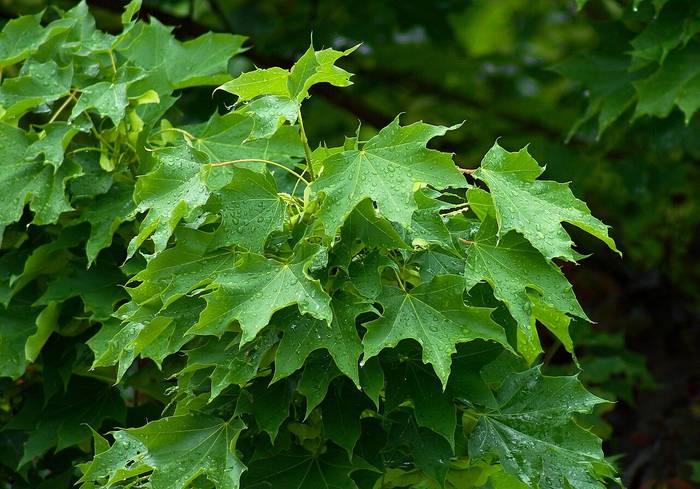
Martin Bobka (= Martin120 ) · CC BY-SA 2.5
Norway maple
Tree·Acer platanoides
Part shade to full sun
Sun
Moist soil
Water
Not recorded
Drainage
Zones 3–7
Hardiness
Coverage · 119 fields
No obvious inconsistencies found.
Growth and size11 fields
Plant type
Deciduous tree“Acer platanoides is a deciduous Tree growing to 21 m (69ft) by 15 m (49ft) at a fast rate.”Wikipedia“Acer platanoides is a deciduous tree, growing to 20–30 m (65–100 ft) tall with a trunk up to 1.5 m (5 ft) in diameter, and a broad, rounded crown.”
Height
2,100 cm“Acer platanoides is a deciduous Tree growing to 21 m (69ft) by 15 m (49ft) at a fast rate.”
Spread
1,500 cm“Acer platanoides is a deciduous Tree growing to 21 m (69ft) by 15 m (49ft) at a fast rate.”
Height at age
—
empty
Size after planting
3 yrs: 5 m tall, 1 m crown · 12 yrs: 7 m tall, 3 m crown · 17 yrs: 9 m tall, 4 m crown · 35 yrs: 12 m tall, 7 m crown · 72 yrs: 18 m tall, 11 m crown“Berlin tree register: 80248 trees of this species measured with years since planting, height and crown diameter; median crown 11.0 m and height 18.0 m at 60–100 years after planting (16637 trees).”Median of 80,248 measured trees in Berlin. Years count from planting nursery stock, so a small tree reaches each size later.
Spacing
1,000 cm (at least 800 cm)
AI estimate55 % agree
Growth rate
Fast“Acer platanoides is a deciduous Tree growing to 21 m (69ft) by 15 m (49ft) at a fast rate.”
Root depth
Shallow“In addition, their roots tend to be quite shallow and thereby they easily out-compete nearby plants for nutrient uptake.”
Forest garden layer
Canopy
AI estimate90 % agree
Lifespan
~250 years“Under ideal conditions in its native range, Norway maple may live up to 250 years, but often has a much shorter life expectancy; in North America, for example, sometimes only 60 years.”
Roots6 fields
Root form
Plate root (shallow)“The roots of Norway maples grow very close to the ground surface, starving other plants of moisture.”
Wikipediapartly
Storage organ
None“No clonal growth organ is recorded: it does not spread vegetatively (no suckers, no rhizomes).”
Spreads
No“No clonal growth organ is recorded: it does not spread vegetatively (no suckers, no rhizomes).”
Lateral spread in cm
—
empty
Root depth in cm
—
empty
Mycorrhiza
Arbuscular (AM)
AI estimatenot measured yet
Light, water and soil9 fields
Sun
Full sun, light shade, part shade · best: full sun“Prefers a sunny position but tolerates some shade.”PFAF“It can grow in semi-shade (light woodland) or no shade.”
Hours of sun
6 h
AI estimatenot measured yet
Drought tolerant
—
empty
Tolerates waterlogging
—
empty
Soil type
Sand, loam, clay“Suitable for: light (sandy), medium (loamy) and heavy (clay) soils, prefers well-drained soil and can grow in heavy clay soil.”
pH
5.5–9“Suitable pH: mildly acid, neutral and basic (mildly alkaline) soils and can grow in very alkaline soils.”
Drainage
Well-drained, moist“Of easy cultivation, it prefers a good moist well-drained soil but thrives in any soil.”
Compacted soil
Copes well“It is favored due to its tall trunk and tolerance of poor, compacted soils and urban pollution, conditions in which the sugar maple has difficulty.”
Climate5 fields
Hardiness
Zone 3–7
AI estimatenot measured yet
Killing frost
-35 °C
AI estimatenot measured yet
Growing temperature
5–30 °C · optimal 10–25 °C
AI estimatenot measured yet
Chill hours
800 h
AI estimatenot measured yet
Native range
AD, AF, AL, AM, AT, AZ, BA, BE, BG, BY, CH, CZ, DE, DK, EE, FI, FR, GE, GI, GR, HR, HU, IR, IT, KG, LI, LT, LU, MC, MD, ME, MK, NO, PK, PL, RO, RS, RU, SE, SI, SK, SM, TJ, TR, UA, UZ, VA, XK
Care (becomes tasks in Manage)2 fields
Pruning
July · lasts 30 days · dead, damaged, or crossing branches
AI estimatenot measured yet
Mulching
April · lasts 30 days
AI estimatenot measured yet
Through the year5 fields
Flowering
April · lasts 61 days“It is in flower from April to May, and the seeds ripen from September to October.”Wikipediapartly“The flowers emerge in spring before the leaves and last 2–3 weeks.”
Fruiting
September · lasts 61 days“It is in flower from April to May, and the seeds ripen from September to October.”
Leafing out
Above 12 °C · Set by day length · lasts 14 days“Leafout of Norway maple occurs roughly when air temperatures reach 55°F (12°C) and there is at least 13 hours of daylight.”
Dying back
Set by day length · lasts 21 days“Leaf drop in autumn is initiated when day lengths fall to approximately 10 hours.”Wikipediapartly“Depending on the latitude, leaf drop may vary by as much as three weeks, beginning in the second week of October in Scandinavia and the first week of November in southern Europe.”
Dormant
After the first frost · 30 days after · lasts 150 days
AI estimatenot measured yet
Edible parts and pollination3 fields
The sap
Drink as is, or boil off the water to concentrate it into a syrup used as a sweetener. · March–April“Edible Parts: Sap”PFAF“The sap contains a certain amount of sugar and can either be used as a drink, or can be concentrated into a syrup by boiling off the water.”
Pollination
Self-fertile · monoecious“The species is monoecious (individual flowers are either male or female, but both sexes can be found on the same plant) and is pollinated by Bees.”JRC forest tree atlas“In this species flowers appear from about 25-30 years and are insect pollinated.”
Pollinated by
Bees, insects“The species is monoecious (individual flowers are either male or female, but both sexes can be found on the same plant) and is pollinated by Bees.”JRC forest tree atlas“In this species flowers appear from about 25-30 years and are insect pollinated.”
Ecology5 fields
Attracts
Bees“The species is monoecious (individual flowers are either male or female, but both sexes can be found on the same plant) and is pollinated by Bees.”
Pests
Lepidoptera larvae, ectoedemia sericopeza (norway maple seedminer), aceria pseudoplatani (felt gall mite)“The larvae of a number of species of Lepidoptera feed on Norway maple foliage.”Wikipedia“Ectoedemia sericopeza, the Norway maple seedminer, is a moth of the family Nepticulidae.”Wikipedia“Aceria pseudoplatani is an acarine mite that causes a 'felt gall', found on the underside of leaves of both sycamore maple (Acer pseudoplatanus) and Norway maples.”
Diseases
Powdery mildew (uncinula bicornis), verticillium wilt (verticillium spp.), tar spot (rhytisma acerinum)“Norway maple is generally free of serious diseases, though can be attacked by the powdery mildew Uncinula bicornis, and verticillium wilt disease caused by Verticillium spp.”Wikipedia“"Tar spots" caused by Rhytisma acerinum infection are common but largely harmless.”
Takes up
—
empty
Fixes nitrogen
No
AI estimatenot measured yet
Propagation and names4 fields
Methods
Seed, cuttings, layering, budding, grafting“Seed - best sown as soon as it is ripe in a cold frame, it usually germinates in the following spring.”PFAF“Cuttings of young shoots in June or July.”PFAF“Layering, which takes about 12 months, is successful with most species in this genus.”PFAF“Cultivars can be budded onto rootstocks of the species.”PFAF“Any grafting is best carried out in September rather than February.”
Difficulty
2 / 5
AI estimatenot measured yet
Seed
Pre-soak seed for 24 hours, then stratify for 2-4 months at 1-8°C.“Pre-soak stored seed for 24 hours and then stratify for 2 - 4 months at 1 - 8°c.”
Not sorted yet69 fields
Fields the parser stores that this page has no row for yet. They show up here automatically, so nothing is hidden.
forage.DK.local_name
Spids-løn
AI estimatenot measured yet
forage.DK.prep_cautions
Sugar concentration is considerably lower than in sugar maple sap.
AI estimatenot measured yet
forage.DK.edibility_basis
inferred
AI estimatenot measured yet
forage.DK.foraging_months.notes
Sap is collected in early spring.“The tree trunk is tapped in the early spring, the sap flowing better on warm sunny days following a frost.”
forage.DK.foraging_months.months
2, 3, 4, 5, 6
AI estimatenot measured yet
forage.DK.foraging_months.year_round
false
AI estimatenot measured yet
forage.DK.habitat_affinity
woodland, disturbed_ground“In natural stands it occurs in fresh and humid sites in temperate mixed forests, both with conifers and broadleaves.”
JRC forest tree atlaspartly
forage.US.local_name
Norway Maple
AI estimatenot measured yet
forage.US.edible_parts
[{"part":"sap","caution":"Lower sugar content than sugar maple sap, so it is not typically tapped for syrup.","preparation":"Drink as is, or boil off the water to concentrate it into a syrup used as a sweetener.","sea…“Edible Parts: Sap”Wikipedia“Norway maples are not typically cultivated for maple syrup production due to the lower sugar content of the sap compared to sugar maple.”PFAF“The sap contains a certain amount of sugar and can either be used as a drink, or can be concentrated into a syrup by boiling off the water.”
forage.US.prep_cautions
Not typically used for maple syrup production due to lower sugar content than sugar maple sap.
AI estimatenot measured yet
forage.US.edibility_basis
inferred
AI estimatenot measured yet
forage.US.foraging_months.notes
Sap is collected in early spring.“The tree trunk is tapped in the early spring, the sap flowing better on warm sunny days following a frost.”
forage.US.foraging_months.months
2, 3, 4, 5, 6
AI estimatenot measured yet
forage.US.foraging_months.year_round
false
AI estimatenot measured yet
forage.US.habitat_affinity
woodland, disturbed_ground
AI estimatenot measured yet
forage.TROPICAL.edibility_basis
inferred
AI estimatenot measured yet
forage.TROPICAL.foraging_months.notes
Norway maple is not native to tropical regions and typically does not thrive there.
AI estimatenot measured yet
forage.TROPICAL.foraging_months.year_round
false
AI estimatenot measured yet
ornamental.basis
documented
AI estimatenot measured yet
ornamental.fragrance.source
none
AI estimate100 % agree
ornamental.fragrance.intensity
subtle
AI estimatenot measured yet
ornamental.confidence
high
AI estimatenot measured yet
ornamental.fall_interest
true“The autumn colour is usually yellow, occasionally orange-red.”
ornamental.flower_colour
yellow, green“The flowers are in corymbs of 15–30 together, yellow to yellow-green”PFAF“Bloom Color: Green.”
ornamental.evidence_quote
The flowers are yellow-green, appearing in early spring before the leaves. Leaves are green throughout summer, turning yellow-green in autumn. The tree provides good architectural structure in winter.
AI estimatenot measured yet
ornamental.foliage_colour
green“The colour is bright to shiny green turning yellow in autumn”
ornamental.foliage_texture
medium
AI estimatenot measured yet
ornamental.winter_structure
architectural_skeleton
AI estimatenot measured yet
ornamental.autumn_foliage_colour
yellow_green
AI estimatenot measured yet
care_regime
none
AI estimatenot measured yet
propagation.self_seeding
moderate“The heavy seed crop and high germination rate contributes to its invasiveness in North America, where it forms dense monotypic stands that choke out native vegetation.”
Wikipediapartly
propagation.division_season
not applicable
AI estimatenot measured yet
propagation.establishment_years
1
AI estimate40 % agree
size_at_age.v
1
AI estimatenot measured yet
size_at_age.basis
years_after_planting
AI estimatenot measured yet
spatial_profile.canopy_density
dense“The stem is straight, short with perpendicular shoots and the crown is dense with foliage.”
forage_proposals.DK.edibility_tier.tier
edible
AI estimatenot measured yet
forage_proposals.DK.edibility_tier.confidence
high
AI estimatenot measured yet
forage_proposals.DK.edibility_tier.evidence_quote
The young leaves can be eaten raw or cooked. The sap can be tapped and used to make syrup, though it has a lower sugar content than sugar maple.
AI estimatenot measured yet
forage_proposals.US.edibility_tier.tier
edible
AI estimatenot measured yet
forage_proposals.US.edibility_tier.confidence
high
AI estimatenot measured yet
forage_proposals.US.edibility_tier.evidence_quote
Young leaves are edible raw or cooked, and the sap can be boiled down for syrup.
AI estimatenot measured yet
forage_proposals.TROPICAL.edibility_tier.confidence
low
AI estimatenot measured yet
function_profile.biomass_return.confidence
high
AI estimatenot measured yet
function_profile.nutrient_flows.consumes
[{"basis":"documented","demand":"moderate","nutrient":"nitrogen","confidence":"medium","evidence_quote":"It is intolerant of low soil nitrogen conditions"}]“It is intolerant of low soil nitrogen conditions”
function_profile.nutrient_flows.provides
[{"basis":"inferred","nutrient":"calcium","mechanism":"biomass_return","confidence":"medium"},{"basis":"inferred","nutrient":"potassium","mechanism":"biomass_return","confidence":"medium"}]
AI estimatenot measured yet
function_profile.biotic_interactions
[{"taxa":["bees"],"basis":"documented","valence":"beneficial","relation":"attracts","confidence":"high","evidence_quote":"The species is monoecious (individual flowers are either male or female, but both sexes can be …“The species is monoecious (individual flowers are either male or female, but both sexes can be found on the same plant) and is pollinated by Bees.”Wikipedia“The larvae of a number of species of Lepidoptera feed on Norway maple foliage.”Wikipedia“Ectoedemia sericopeza, the Norway maple seedminer, is a moth of the family Nepticulidae.”Wikipedia“Norway maple is generally free of serious diseases, though can be attacked by the powdery mildew Uncinula bicornis, and verticillium wilt disease caused by Verticillium spp.”Wikipedia“"Tar spots" caused by Rhytisma acerinum infection are common but largely harmless.”
function_profile.aromatic_pest_effect.value
false
AI estimate80 % agree
function_profile.aromatic_pest_effect.confidence
high
AI estimatenot measured yet
function_profile.structural_interfaces.provides_shelter.basis
taxonomic
AI estimatenot measured yet
function_profile.structural_interfaces.provides_shelter.kinds
wind, shade“The trees are fairly wind tolerant and are often used in to give protection from the wind in mixed shelterbelts.”Wikipedia“In addition, the dense canopy of Norway maples can inhibit understory growth.”
function_profile.structural_interfaces.provides_shelter.confidence
high
AI estimatenot measured yet
function_profile.structural_interfaces.provides_shelter.evidence_quote
The trees are fairly wind tolerant and are often used in to give protection from the wind in mixed shelterbelts.
AI estimatenot measured yet
function_profile.structural_interfaces.requires_shelter.basis
taxonomic
AI estimatenot measured yet
function_profile.structural_interfaces.requires_shelter.kinds
shade“It germinates and grows quickly in shade, even under close canopy.”
function_profile.structural_interfaces.requires_shelter.stage
establishment
AI estimatenot measured yet
function_profile.structural_interfaces.requires_shelter.confidence
high
AI estimatenot measured yet
function_profile.structural_interfaces.requires_shelter.evidence_quote
It germinates and grows quickly in shade, even under close canopy.
AI estimatenot measured yet
function_profile.structural_interfaces.provides_physical_support.form
trunk
AI estimatenot measured yet
function_profile.structural_interfaces.provides_physical_support.basis
taxonomic
AI estimatenot measured yet
function_profile.structural_interfaces.provides_physical_support.confidence
high
AI estimatenot measured yet
function_profile.structural_interfaces.requires_physical_support.basis
taxonomic
AI estimatenot measured yet
function_profile.structural_interfaces.requires_physical_support.confidence
high
AI estimatenot measured yet
climate_tolerance.photoperiod_response
day_neutral
AI estimatenot measured yet
soil_interactions.organic_matter_contribution
high
AI estimatenot measured yet
component_metadata.growth_cycle
perennial
AI estimate100 % agree
resource_interfaces.inputs
[{"resource":"light","quantity_description":"Prefers a sunny position but tolerates some shade."},{"resource":"water","quantity_description":"prefers moist soil"},{"resource":"shade","quantity_description":"can grow i…“Prefers a sunny position but tolerates some shade.”PFAF“It prefers moist soil.”PFAF“It can grow in semi-shade (light woodland) or no shade.”Wikipedia“Acer platanoides is a deciduous tree, growing to 20–30 m (65–100 ft) tall with a trunk up to 1.5 m (5 ft) in diameter, and a broad, rounded crown.”PFAF“The species is monoecious (individual flowers are either male or female, but both sexes can be found on the same plant) and is pollinated by Bees.”
resource_interfaces.outputs
[{"resource":"shade","quantity_description":"dense canopy that inhibits understory growth"},{"resource":"wind_shelter","quantity_description":"fairly wind tolerant; used in mixed shelterbelts"},{"resource":"mulch_biom…“In addition, the dense canopy of Norway maples can inhibit understory growth.”PFAF“The trees are fairly wind tolerant and are often used in to give protection from the wind in mixed shelterbelts.”PFAF“The leaves are packed around apples, rootcrops etc to help preserve them.”Wikipedia“The wood is hard, yellowish-white to pale reddish, with the heartwood not distinct; it is used for furniture and woodturning.”Wikipedia“It typically produces a large quantity of viable seeds.”JRC forest tree atlas“The fruit is a double samara, 3-5 cm each, greenish-yellow, dispersed by the wind.”