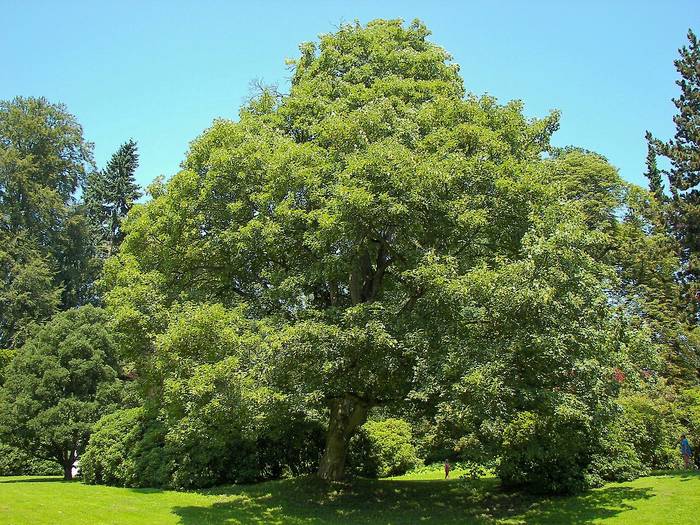
Willow · CC BY 2.5
Sycamore
Tree·Acer pseudoplatanus
Part shade to full sun
Sun
Moist soil
Water
Moist soil
Drainage
Zones 4–7
Hardiness
Coverage · 117 fields
No obvious inconsistencies found.
Growth and size11 fields
Plant type
Deciduous tree“Acer pseudoplatanus is a deciduous Tree growing to 30 m (98ft) by 15 m (49ft) at a fast rate.”
Height
3,000 cm · the source gives 3,000–3,500 cm · other sources: 3,500 cm“It grows up to 30-35 m in height with a diameter of 60-80 cm and a very broad domed crown whose diameter can sometimes exceed the height of the tree.”PFAF“Acer pseudoplatanus is a deciduous Tree growing to 30 m (98ft) by 15 m (49ft) at a fast rate.”Wikipedia“The sycamore can grow to a height of about 35 metres (115 feet) and the branches form a broad, rounded crown.”
Spread
1,500 cm“Acer pseudoplatanus is a deciduous Tree growing to 30 m (98ft) by 15 m (49ft) at a fast rate.”
Height at age
—
empty
Size after planting
3 yrs: 4 m tall, 1 m crown · 8 yrs: 6 m tall, 2 m crown · 17 yrs: 9 m tall, 4 m crown · 36 yrs: 12 m tall, 6 m crown · 71 yrs: 17 m tall, 10 m crown“Berlin tree register: 21644 trees of this species measured with years since planting, height and crown diameter; median crown 10.0 m and height 17.0 m at 60–100 years after planting (5331 trees).”Median of 21,644 measured trees in Berlin. Years count from planting nursery stock, so a small tree reaches each size later.
Spacing
1,500 cm (at least 1,000 cm)
AI estimate55 % agree
Growth rate
Fast“Acer pseudoplatanus is a deciduous Tree growing to 30 m (98ft) by 15 m (49ft) at a fast rate.”
Root depth
Deep
AI estimate63 % agree
Forest garden layer
Canopy
AI estimate90 % agree
Lifespan
~350 years“The sycamore maple (Acer pseudoplatanus L.) is a large deciduous tree that can live for more than 350-400 years.”
Roots6 fields
Root form
Heart root“The root pattern is branching: a heart root, dividing from the crown into several primary roots going down and out [2-1].”
Storage organ
None“No clonal growth organ is recorded: it does not spread vegetatively (no suckers, no rhizomes).”
Spreads
No“No clonal growth organ is recorded: it does not spread vegetatively (no suckers, no rhizomes).”
Lateral spread in cm
—
empty
Root depth in cm
—
empty
Mycorrhiza
Arbuscular (AM)“Sycamore mycorrhizas are of the internal arbuscular mycorrhizal type”
Light, water and soil9 fields
Sun
Full sun, light shade, part shade · best: full sun“It can grow in semi-shade (light woodland) or no shade.”
Hours of sun
6 h
AI estimatenot measured yet
Drought tolerant
No“The sycamore maple is not able to thrive in drought-prone regions.”
JRC forest tree atlaspartly
Soil type
Sand, loam, clay“Suitable for: light (sandy), medium (loamy) and heavy (clay) soils, prefers well-drained soil and can grow in heavy clay and nutritionally poor soils.”
Drainage
Well-drained to moist“Suitable for: light (sandy), medium (loamy) and heavy (clay) soils, prefers well-drained soil and can grow in heavy clay and nutritionally poor soils.”
PFAFpartly
Compacted soil
Copes fairly well
AI estimatenot measured yet
Climate5 fields
Hardiness
Zone 4–7
AI estimatenot measured yet
Killing frost
-25 °C
AI estimatenot measured yet
Growing temperature
5–30 °C · optimal 10–25 °C
AI estimatenot measured yet
Chill hours
800 h
AI estimatenot measured yet
Native range
AD, AL, AT, BA, BE, BG, CH, CZ, DE, ES, FR, GI, GR, HR, HU, IT, LI, LU, MC, MD, ME, MK, MT, PL, PT, RO, RS, RU, SI, SK, SM, TR, VA, XK
Care (becomes tasks in Manage)2 fields
Pruning
November · lasts 60 days · healthy structural branches · dead, diseased, or crossing branches
AI estimatenot measured yet
Mulching
March · lasts 30 days
AI estimatenot measured yet
Through the year6 fields
Flowering
April · lasts 91 days“It is in flower from April to June, and the seeds ripen from September to October.”
Fruiting
September · lasts 61 days“It is in flower from April to June, and the seeds ripen from September to October.”
Harvest
February · lasts 59 days“It can be harvested in late winter but is not produced in economic quantities.”
PFAFpartly
Leafing out
After the last frost · lasts 30 days
AI estimatenot measured yet
Dying back
After the first frost · lasts 30 days
AI estimatenot measured yet
Dormant
After the first frost · 30 days after · lasts 150 days
AI estimatenot measured yet
Edible parts and pollination6 fields
The sap
The leaves
Wrapped around buns or other food when baking, imparting a sweet flavour“Edible Parts: Leaves Sap Seedpod”PFAF“The leaves can be wrapped round food such as buns when baking them and they impart a sweet flavour.”
Seed keys
Suck the sweet exudation from the keys“Edible Parts: Leaves Sap Seedpod”Wikipedia“Horses eating seeds or emergent seedlings of A. pseudoplatanus can suffer from an often fatal condition of atypical myopathy.”PFAF“The keys of the developing seeds have a sweet exudation on them and this is often sucked by children.”
Pollination
Self-fertile · monoecious“The species is monoecious (individual flowers are either male or female, but both sexes can be found on the same plant) and is pollinated by Bees.”JRC forest tree atlas“There is a wide array of pollinating insects”
Pollinated by
Bees, insects“The species is monoecious (individual flowers are either male or female, but both sexes can be found on the same plant) and is pollinated by Bees.”JRC forest tree atlas“There is a wide array of pollinating insects”
Ecology5 fields
Attracts
Bees, insects“The species is monoecious (individual flowers are either male or female, but both sexes can be found on the same plant) and is pollinated by Bees.”Wikipedia“They produce copious amounts of pollen and nectar that are attractive to insects.”
Pests
Asian longhorn beetle, grey squirrels“The sycamore maple and other species of genus Acer are highly vulnerable to the Asian longhorn beetle (Anoplophora glabripennis) which is a large wood-boring beetle native of Asian countries, such as Japan, Korea and China.”JRC forest tree atlas“Bark stripping by grey squirrels and damage by other browsing animals can reduce the amount of valuable timber.”
Diseases
Sooty bark disease“Plants are subject to sooty bark disease - this is not fatal and occurs most often in years that follow hot summers.”
Takes up
—
empty
Fixes nitrogen
No
AI estimatenot measured yet
Propagation and names4 fields
Methods
Seed, layering, cuttings of young shoots, budding or grafting for cultivars“Seed - best sown as soon as it is ripe in a cold frame, it usually germinates in the following spring.”PFAF“Layering, which takes about 12 months, is successful with most species in this genus.”PFAF“Cuttings of young shoots in June or July.”PFAF“Cultivars can be budded onto rootstocks of the species.”
Difficulty
2 / 5“Of easy cultivation, it prefers a good moist well-drained soil and a sunny position, but tolerates most conditions including poor soils and some shade.”
PFAFpartly
Seed
Pre-soak seed for 24 hours, then stratify 2-4 months at 1-8°C“Pre-soak stored seed for 24 hours and then stratify for 2 - 4 months at 1 - 8°c.”
Not sorted yet63 fields
Fields the parser stores that this page has no row for yet. They show up here automatically, so nothing is hidden.
forage.DK.local_name
Ahorn
AI estimatenot measured yet
forage.DK.prep_cautions
Seeds contain large amounts of hypoglycin A, which may induce atypical myopathy in horses grazing under the canopy.“Its seeds contain large amounts of hypoglycin A, which may induce atypical myopathy on horses grazing under their canopies.”
forage.DK.edibility_basis
inferred
AI estimatenot measured yet
forage.DK.foraging_months.notes
Sap in late winter/early spring; young leaves and flowers in spring; young seeds in early summer.
AI estimatenot measured yet
forage.DK.foraging_months.months
2, 3, 9, 10“It is in flower from April to June, and the seeds ripen from September to October.”PFAFpartly“It can be harvested in late winter but is not produced in economic quantities.”
forage.DK.foraging_months.year_round
false
AI estimatenot measured yet
forage.DK.habitat_affinity
woodland, hedgerow, disturbed_ground, verge“Found in woodland, hedgerows etc. in Britain, in all but very poor soils.”Wikipedia“It readily invades disturbed habitats such as forest plantations, abandoned farmland and brownfield land, railway lines and roadsides verges, hedgerows, native and semi-natural woodland.”
forage.US.local_name
False Planetree
AI estimatenot measured yet
forage.US.edible_parts
[{"part":"leaves","caution":"best when young and tender","preparation":"raw or cooked","season_months":[4,5,6]},{"part":"flowers","caution":null,"preparation":"raw","season_months":[5,6]},{"part":"seeds (samaras)","ca…
AI estimatenot measured yet
forage.US.edibility_basis
inferred
AI estimatenot measured yet
forage.US.foraging_months.notes
Sap in late winter/early spring; young leaves and flowers in spring; young seeds in early summer.
AI estimatenot measured yet
forage.US.foraging_months.months
2, 3, 4, 5, 6, 7
AI estimatenot measured yet
forage.US.foraging_months.year_round
false
AI estimatenot measured yet
forage.US.habitat_affinity
woodland, hedgerow, verge, disturbed_ground
AI estimatenot measured yet
forage.TROPICAL.edibility_basis
inferred
AI estimatenot measured yet
forage.TROPICAL.foraging_months.notes
Sycamore is not typically found in tropical regions.
AI estimatenot measured yet
forage.TROPICAL.foraging_months.year_round
false
AI estimatenot measured yet
ornamental.basis
documented
AI estimatenot measured yet
ornamental.fragrance.source
none
AI estimate100 % agree
ornamental.fragrance.intensity
subtle
AI estimatenot measured yet
ornamental.confidence
high
AI estimatenot measured yet
ornamental.fall_interest
true
AI estimatenot measured yet
ornamental.evidence_quote
The flowers are yellowish-green, appearing in pendulous racemes. Leaves are typically green, turning yellowish-green in autumn. The bark can be attractive, especially on mature trees, and the overall form provides winter interest.
AI estimatenot measured yet
ornamental.foliage_texture
medium“The leaves are opposite, large, 10 to 25 cm (4 to 10 in) long and broad, palmate with 5 pointed lobes that are coarsely toothed or serrated.”
Wikipediapartly
ornamental.winter_structure
ornamental_bark, architectural_skeleton
AI estimatenot measured yet
ornamental.autumn_foliage_colour
yellow_green
AI estimatenot measured yet
care_regime
none
AI estimatenot measured yet
propagation.self_seeding
aggressive“A fairly aggressive tree, it self-sows freely and inhibits the growth of nearby plants.”
propagation.establishment_years
3
AI estimate40 % agree
size_at_age.v
1
AI estimatenot measured yet
size_at_age.basis
years_after_planting
AI estimatenot measured yet
sun_requirement.best
full_sun“Of easy cultivation, it prefers a good moist well-drained soil and a sunny position, but tolerates most conditions including poor soils and some shade.”
forage_proposals.DK.edibility_tier.tier
edible
AI estimatenot measured yet
forage_proposals.DK.edibility_tier.confidence
high
AI estimatenot measured yet
forage_proposals.DK.edibility_tier.evidence_quote
The young leaves, flowers, and seeds are edible, as is the sap, which can be tapped and boiled down to syrup similar to maple syrup.
AI estimatenot measured yet
forage_proposals.US.edibility_tier.tier
edible
AI estimatenot measured yet
forage_proposals.US.edibility_tier.confidence
high
AI estimatenot measured yet
forage_proposals.US.edibility_tier.evidence_quote
The young leaves, flowers, and seeds are edible, as is the sap, which can be tapped and boiled down to syrup similar to maple syrup.
AI estimatenot measured yet
forage_proposals.TROPICAL.edibility_tier.confidence
low
AI estimatenot measured yet
function_profile.biomass_return.confidence
high“Its litter improves humus formation and nutrient cycling and thus contributes to landscape diversity.”
JRC forest tree atlaspartly
function_profile.nutrient_flows.consumes
[{"basis":"inferred","demand":"high","nutrient":"nitrogen","confidence":"medium"},{"basis":"inferred","demand":"moderate","nutrient":"phosphorus","confidence":"medium"},{"basis":"inferred","demand":"high","nutrient":"…“The roots of the sycamore form highly specific beneficial mycorrhizal associations with the fungus Glomus hoi, which promotes phosphorus uptake from the soil.”
Wikipediapartly
function_profile.nutrient_flows.provides
[{"basis":"inferred","nutrient":"calcium","mechanism":"mineral_extraction","confidence":"medium"},{"basis":"inferred","nutrient":"potassium","mechanism":"mineral_extraction","confidence":"medium"}]
AI estimatenot measured yet
function_profile.biotic_interactions
[{"taxa":["bees","pollinating insects"],"basis":"documented","valence":"beneficial","relation":"attracts","confidence":"high","evidence_quote":"The species is monoecious (individual flowers are either male or female, …“The species is monoecious (individual flowers are either male or female, but both sexes can be found on the same plant) and is pollinated by Bees.”JRC forest tree atlas“The sycamore maple and other species of genus Acer are highly vulnerable to the Asian longhorn beetle (Anoplophora glabripennis) which is a large wood-boring beetle native of Asian countries, such as Japan, Korea and China.”PFAF“Plants are subject to sooty bark disease - this is not fatal and occurs most often in years that follow hot summers.”JRC forest tree atlas“Bark stripping by grey squirrels and damage by other browsing animals can reduce the amount of valuable timber.”Wikipedia“In its native range, the sycamore is associated with a biodiverse range of invertebrates and fungi, but these are not always present in areas to which it has been introduced.”JRC forest tree atlas“There is a wide array of pollinating insects; each inflorescence may result in up to 30 fruits and a single tree may have more than 800 inflorescences.”
function_profile.aromatic_pest_effect.value
false
AI estimate80 % agree
function_profile.aromatic_pest_effect.confidence
low
AI estimatenot measured yet
function_profile.structural_interfaces.provides_shelter.basis
taxonomic
AI estimatenot measured yet
function_profile.structural_interfaces.provides_shelter.kinds
wind“The trees are fast-growing and make a good windbreak for exposed and maritime areas.”
function_profile.structural_interfaces.provides_shelter.confidence
high
AI estimatenot measured yet
function_profile.structural_interfaces.provides_shelter.evidence_quote
The trees are fast-growing and make a good windbreak for exposed and maritime areas.
AI estimatenot measured yet
function_profile.structural_interfaces.requires_shelter.basis
taxonomic
AI estimatenot measured yet
function_profile.structural_interfaces.requires_shelter.confidence
high
AI estimatenot measured yet
function_profile.structural_interfaces.provides_physical_support.form
trunk
AI estimatenot measured yet
function_profile.structural_interfaces.provides_physical_support.basis
taxonomic
AI estimatenot measured yet
function_profile.structural_interfaces.provides_physical_support.confidence
high
AI estimatenot measured yet
function_profile.structural_interfaces.requires_physical_support.basis
taxonomic
AI estimatenot measured yet
function_profile.structural_interfaces.requires_physical_support.confidence
high
AI estimatenot measured yet
climate_tolerance.photoperiod_response
day_neutral
AI estimatenot measured yet
soil_interactions.organic_matter_contribution
high
AI estimatenot measured yet
component_metadata.growth_cycle
perennial
AI estimate100 % agree
resource_interfaces.inputs
[{"resource":"light","quantity_description":"prefers a sunny position; grows in semi-shade or some shade"},{"resource":"water","quantity_description":"prefers moist soil; dislikes wet soils"},{"resource":"shade","quan…“Of easy cultivation, it prefers a good moist well-drained soil and a sunny position, but tolerates most conditions including poor soils and some shade.”JRC forest tree atlas“It grows well in shaded conditions, particularly in its juvenile stage and this explains its ability to succeed within established forests.”PFAFpartly“It prefers moist soil.”
resource_interfaces.outputs
[{"resource":"wind_shelter","quantity_description":"fast-growing windbreak for exposed and maritime sites"},{"resource":"pollinator_services","quantity_description":"flowers pollinated by bees and other insects"},{"re…“The trees are fast-growing and make a good windbreak for exposed and maritime areas.”PFAF“The species is monoecious (individual flowers are either male or female, but both sexes can be found on the same plant) and is pollinated by Bees.”Wikipedia“They produce copious amounts of pollen and nectar that are attractive to insects.”Wikipedia“The winged seeds or samaras are borne in pairs and twirl to the ground when ripe.”Wikipedia“It produces a hard-wearing, creamy-white close-grained timber that is used for making musical instruments, furniture, joinery, wood flooring and kitchen utensils.”JRC forest tree atlas“Its litter improves humus formation and nutrient cycling and thus contributes to landscape diversity.”Wikipedia“In its native range, the sycamore is associated with a biodiverse range of invertebrates and fungi, but these are not always present in areas to which it has been introduced.”