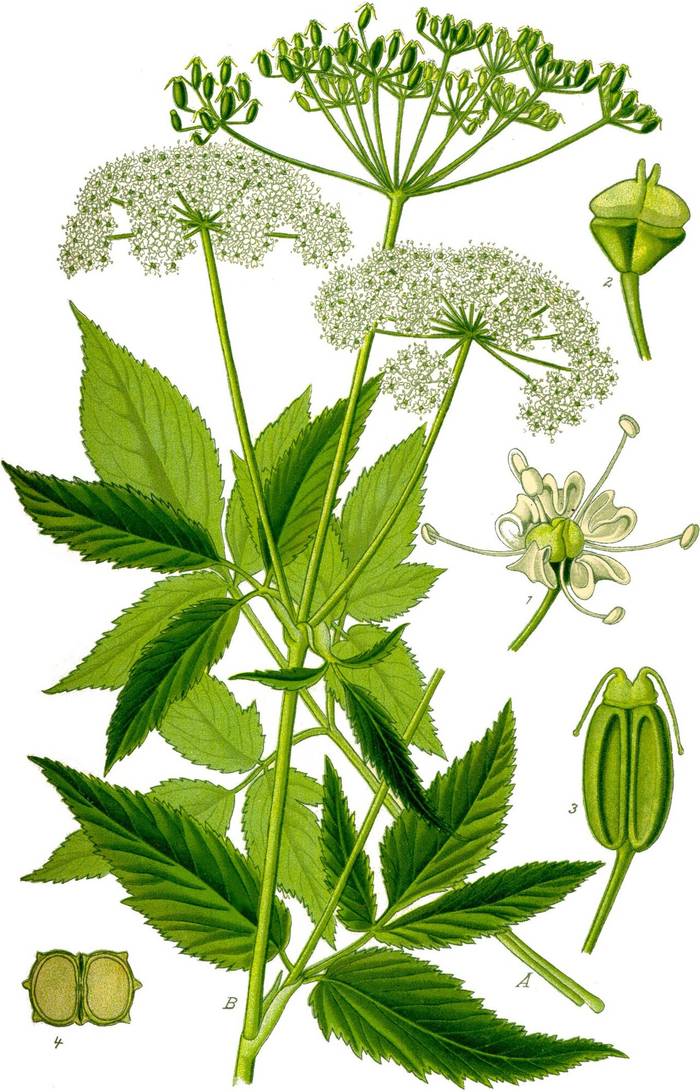
Ground elder
Plant·Aegopodium podagraria
Shade to full sun
Sun
Moist soil
Water
Well-drained soil
Drainage
Zones 3–9
Hardiness
Coverage · 109 fields
No obvious inconsistencies found.
Growth and size10 fields
Height
60 cm · other sources: 100 cm“Aegopodium podagraria is a PERENNIAL growing to 0.6 m (2ft) by 1 m (3ft 3in) at a fast rate.”Wikipedia“This herbaceous perennial grows to a height of 1 metre (3+1⁄2 ft) from underground rhizomes.”
Spread
100 cm“Aegopodium podagraria is a PERENNIAL growing to 0.6 m (2ft) by 1 m (3ft 3in) at a fast rate.”
Height at age
—
empty
Spacing
30 cm (at least 15 cm)
AI estimate55 % agree
Growth rate
Fast“Aegopodium podagraria is a PERENNIAL growing to 0.6 m (2ft) by 1 m (3ft 3in) at a fast rate.”
Root depth
Shallow
AI estimate63 % agree
Forest garden layer
Herb layer
AI estimate90 % agree
Lifespan
~5 years
AI estimatenot measured yet
Roots6 fields
Root form
—
empty
Storage organ
Rhizome“Its storage organ is a rhizome, a creeping underground stem; it spreads by rhizomes.”
Spreads
By rhizomes“Its storage organ is a rhizome, a creeping underground stem; it spreads by rhizomes.”
Root depth in cm
—
empty
Mycorrhiza
—
empty
Light, water and soil9 fields
Sun
Full sun, light shade, part shade, shade · best: part shade“It can grow in full shade (deep woodland) semi-shade (light woodland) or no shade.”
Hours of sun
3–6 h
AI estimatenot measured yet
Drought tolerant
—
empty
Tolerates waterlogging
—
empty
Compacted soil
Copes well
AI estimatenot measured yet
Climate5 fields
Hardiness
Zone 3–9
AI estimatenot measured yet
Killing frost
-30 °C
AI estimatenot measured yet
Growing temperature
5–30 °C · optimal 15–25 °C
AI estimatenot measured yet
Chill hours
0 h
AI estimatenot measured yet
Native range
AL, AM, AT, AZ, BA, BE, BG, BY, CH, CZ, DE, DK, EE, FI, FR, GE, GR, HR, HU, IT, KP, KR, KZ, LI, LT, LU, LV, MC, MD, ME, MK, NL, PL, RO, RS, RU, SE, SI, SK, SM, TR, UA, VA, XK
Through the year5 fields
Leafing out
February“It is best picked from when it appears (as early as February in the UK and other parts of northern Europe) to just before it flowers (May to June).”
Fruiting
August · lasts 120 days“The fruits, produced in late summer and autumn, are small and have long curved styles.”
Wikipediapartly
Harvest
After the previous stage · lasts 120 days“It is best picked from when it appears (as early as February in the UK and other parts of northern Europe) to just before it flowers (May to June).”
Wikipediapartly
Dying back
After the first frost
AI estimatenot measured yet
Edible parts and pollination3 fields
The leaves
Raw or cooked, in salads, soups, or as a vegetable or pot herb · February–May“Edible Parts: Leaves”PFAF“The leaves are best harvested before the plant comes into flower, they can be used in salads, soups, or cooked as a vegetable.”Wikipedia“It is best picked from when it appears (as early as February in the UK and other parts of northern Europe) to just before it flowers (May to June).”Wikipediapartly“If it is picked after this point it tastes pungent and has a laxative effect.”
Pollination
Self-fertile · hermaphrodite“The species is hermaphrodite (has both male and female organs) and is pollinated by Bees, flies.”PFAF“The plant is self-fertile.”
Pollinated by
Bees, flies“The species is hermaphrodite (has both male and female organs) and is pollinated by Bees, flies.”
Ecology6 fields
Attracts
Bees, flies“The species is hermaphrodite (has both male and female organs) and is pollinated by Bees, flies.”
Pests
Dot moth larvae, grey dagger larvae, grey pug larvae“In Eurasia, it is used as a food plant by the larvae of some species of Lepidoptera, including dot moth, grey dagger and grey pug, although A. podagraria is not the exclusive host to any of these species.”
Diseases
Powdery_mildew
AI estimatenot measured yet
Takes up
Potassium, calcium, magnesium
AI estimatenot measured yet
Fixes nitrogen
No
AI estimatenot measured yet
Mycorrhiza
No
AI estimatenot measured yet
Propagation and names4 fields
Difficulty
1 / 5“Very easy, divisions can be carried out at almost any time of the year and the divisions can be planted out straight into their permanent positions.”
PFAFpartly
Seed
—
empty
Not sorted yet61 fields
Fields the parser stores that this page has no row for yet. They show up here automatically, so nothing is hidden.
forage.DK.local_name
Skvalderkål
AI estimatenot measured yet
forage.DK.warnings_da
Kan forveksles med meget giftige skærmplanter, så kend den på bladene.
AI estimatenot measured yet
forage.DK.warnings_en
Can be confused with very poisonous umbellifers, so identify it by the leaves.
AI estimatenot measured yet
forage.DK.prep_cautions
Pick before flowering; later leaves taste pungent and have a laxative effect, Identify by the leaves, not the flowers, because flowers can be confused with extremely toxic Apiaceae“If it is picked after this point it tastes pungent and has a laxative effect.”Wikipedia“As a member of Apiaceae, its flowers may be confused with extremely toxic species such as poison hemlock and hemlock water dropwort; attention to the leaves is required for a conclusive identification.”
forage.DK.edibility_basis
inferred
AI estimatenot measured yet
forage.DK.foraging_months.notes
Young leaves are best; older leaves can be bitter.
AI estimatenot measured yet
forage.DK.foraging_months.months
2, 3, 4, 5“It is best picked from when it appears (as early as February in the UK and other parts of northern Europe) to just before it flowers (May to June).”
forage.DK.foraging_months.year_round
false
AI estimatenot measured yet
forage.DK.habitat_affinity
hedgerow, woodland, disturbed_ground“Hedgerows and cultivated land.”PFAF“It can grow in full shade (deep woodland) semi-shade (light woodland) or no shade.”Wikipediapartly“Seed dispersal and seedling establishment are typically limited by shading, and new establishments from seed are restricted to disturbed areas.”
forage.US.local_name
Ground elder
AI estimatenot measured yet
forage.US.edible_parts
[{"part":"leaves","caution":null,"preparation":"cooked","season_months":[3,4,5,6,7,8,9,10]},{"part":"leaves","caution":"best in small quantities due to strong flavor","preparation":"raw","season_months":[3,4,5,6,7,8,9…
AI estimatenot measured yet
forage.US.prep_cautions
Can be confused with poisonous plants like Hemlock Water Dropwort (Oenanthe crocata) or Cow Parsley (Anthriscus sylvestris) before flowering. Ensure positive identification.
AI estimatenot measured yet
forage.US.edibility_basis
inferred
AI estimatenot measured yet
forage.US.foraging_months.notes
Young leaves are best; older leaves can be bitter.
AI estimatenot measured yet
forage.US.foraging_months.months
3, 4, 5, 6, 7, 8, 9, 10
AI estimatenot measured yet
forage.US.foraging_months.year_round
false
AI estimatenot measured yet
forage.US.habitat_affinity
woodland, disturbed_ground, hedgerow, verge
AI estimatenot measured yet
forage.TROPICAL.edibility_basis
inferred
AI estimatenot measured yet
forage.TROPICAL.foraging_months.year_round
false
AI estimatenot measured yet
ornamental.basis
documented
AI estimatenot measured yet
ornamental.fragrance.source
none
AI estimate100 % agree
ornamental.confidence
high
AI estimatenot measured yet
ornamental.fall_interest
false
AI estimatenot measured yet
ornamental.evidence_quote
Ground elder (Aegopodium podagraria) produces small white flowers. The foliage is typically green, with variegated forms also common. It does not exhibit significant autumn foliage colour and dies back in winter, offering no winter structure or fragrance.
AI estimatenot measured yet
ornamental.foliage_colour
green“All-green goutweed may be more persistent and spread more rapidly than ornamental, variegated goutweed varieties, making the all-green type particularly difficult to control.”
Wikipediapartly
ornamental.foliage_texture
medium
AI estimatenot measured yet
ornamental.winter_structure
none
AI estimatenot measured yet
ornamental.autumn_foliage_colour
none
AI estimatenot measured yet
care_regime
none
AI estimatenot measured yet
propagation.self_seeding
aggressive“A very invasive plant, spreading freely at the roots, though it seldom sets seed in Britain.”
PFAFpartly
propagation.establishment_years
1
AI estimate40 % agree
forage_proposals.DK.edibility_tier.tier
edible“The leaves can be eaten raw or cooked and have an unusual tangy flavour which is an acquired taste, although some people like it.”
forage_proposals.DK.edibility_tier.confidence
high
AI estimatenot measured yet
forage_proposals.DK.edibility_tier.evidence_quote
The tender leaves can be utilized as a spring leaf vegetable akin to spinach, having been used thus since antiquity.
AI estimatenot measured yet
forage_proposals.US.edibility_tier.tier
edible
AI estimatenot measured yet
forage_proposals.US.edibility_tier.confidence
high
AI estimatenot measured yet
forage_proposals.US.edibility_tier.evidence_quote
Ground elder is recognized as an edible wild plant in the US, with young leaves and shoots being consumed raw or cooked. It is often compared to parsley or celery in flavor.
AI estimatenot measured yet
forage_proposals.TROPICAL.edibility_tier.confidence
low
AI estimatenot measured yet
function_profile.biomass_return.confidence
high
AI estimatenot measured yet
function_profile.nutrient_flows.consumes
[{"basis":"documented","demand":"moderate","nutrient":"nitrogen","confidence":"high"},{"basis":"inferred","demand":"moderate","nutrient":"phosphorus","confidence":"medium"},{"basis":"documented","demand":"high","nutri…
AI estimatenot measured yet
function_profile.nutrient_flows.provides
[{"basis":"documented","nutrient":"potassium","mechanism":"biomass_return","confidence":"high"},{"basis":"documented","nutrient":"calcium","mechanism":"biomass_return","confidence":"high"},{"basis":"inferred","nutrien…
AI estimatenot measured yet
function_profile.biotic_interactions
[{"taxa":["bees","flies"],"basis":"documented","valence":"beneficial","relation":"attracts","confidence":"high","evidence_quote":"The species is hermaphrodite (has both male and female organs) and is pollinated by Bee…“The species is hermaphrodite (has both male and female organs) and is pollinated by Bees, flies.”Wikipedia“In Eurasia, it is used as a food plant by the larvae of some species of Lepidoptera, including dot moth, grey dagger and grey pug, although A. podagraria is not the exclusive host to any of these species.”
function_profile.aromatic_pest_effect.value
false
AI estimate80 % agree
function_profile.aromatic_pest_effect.confidence
low
AI estimatenot measured yet
function_profile.structural_interfaces.provides_shelter.basis
documented
AI estimatenot measured yet
function_profile.structural_interfaces.provides_shelter.kinds
shade
AI estimatenot measured yet
function_profile.structural_interfaces.provides_shelter.confidence
medium
AI estimatenot measured yet
function_profile.structural_interfaces.provides_shelter.evidence_quote
The dense foliage of ground elder can provide shade to the soil surface.
AI estimatenot measured yet
function_profile.structural_interfaces.requires_shelter.basis
inferred
AI estimatenot measured yet
function_profile.structural_interfaces.requires_shelter.confidence
low
AI estimatenot measured yet
function_profile.structural_interfaces.provides_physical_support.basis
taxonomic
AI estimatenot measured yet
function_profile.structural_interfaces.provides_physical_support.confidence
high
AI estimatenot measured yet
function_profile.structural_interfaces.requires_physical_support.basis
taxonomic
AI estimatenot measured yet
function_profile.structural_interfaces.requires_physical_support.confidence
high
AI estimatenot measured yet
climate_tolerance.photoperiod_response
day_neutral
AI estimatenot measured yet
soil_interactions.organic_matter_contribution
high
AI estimatenot measured yet
component_metadata.growth_cycle
perennial“Aegopodium podagraria is a PERENNIAL growing to 0.6 m (2ft) by 1 m (3ft 3in) at a fast rate.”
resource_interfaces.inputs
[{"resource":"light","quantity_description":"full shade, semi-shade or no shade"},{"resource":"water","quantity_description":"prefers moist soil"},{"resource":"space","quantity_description":"plenty of room, since it c…“It can grow in full shade (deep woodland) semi-shade (light woodland) or no shade.”PFAF“It prefers moist soil.”PFAF“Make sure that it has plenty of room since it can be very invasive and is considered to be a weed in many gardens.”
resource_interfaces.outputs
[{"resource":"ground_cover","quantity_description":"good ground cover for semi-wild situations"},{"resource":"pollinator_services","quantity_description":"flowers visited by many types of pollinating insects"},{"resou…“This species makes a good ground cover for semi-wild situations.”Wikipedia“These are visited by many types of pollinating insects.”PFAF“A very invasive plant, spreading freely at the roots, though it seldom sets seed in Britain.”Wikipedia“In Eurasia, it is used as a food plant by the larvae of some species of Lepidoptera, including dot moth, grey dagger and grey pug, although A. podagraria is not the exclusive host to any of these species.”