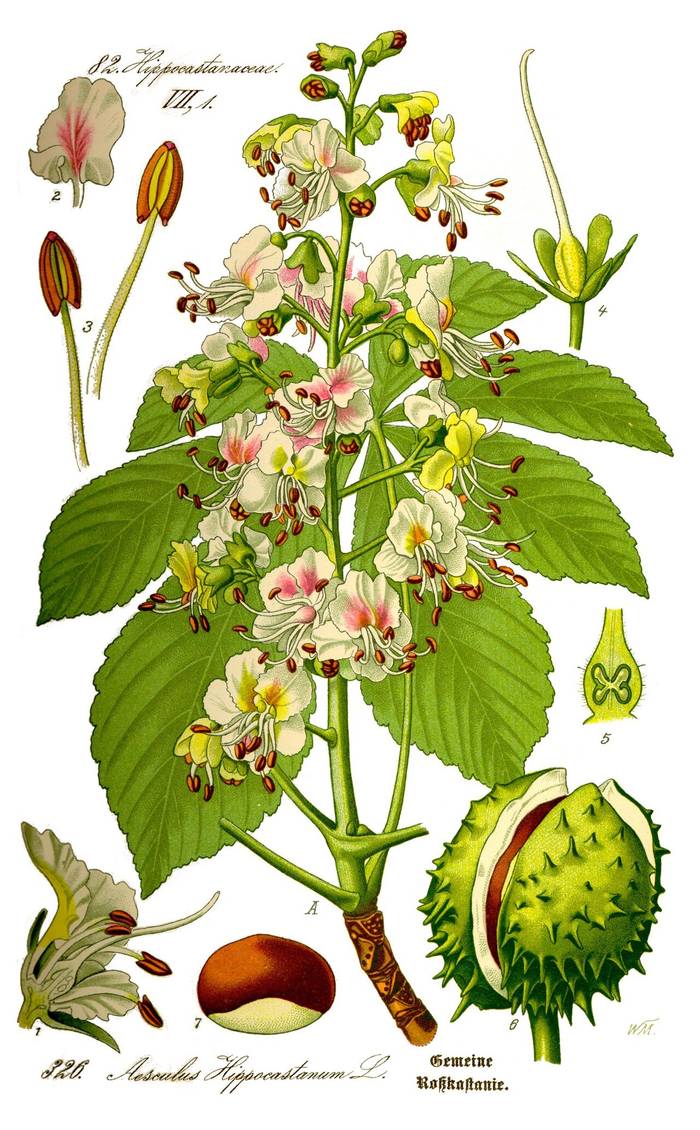
Horse chestnut
Tree·Aesculus hippocastanum
Part shade to full sun
Sun
Dry to moist soil
Water
Well-drained soil
Drainage
Zones 3–8
Hardiness
Coverage · 115 fields
No obvious inconsistencies found.
Growth and size11 fields
Plant type
Deciduous tree“Aesculus hippocastanum is a deciduous Tree growing to 30 m (98ft) by 15 m (49ft) at a fast rate.”
Height
3,000 cm · other sources: 3,900 cm“Aesculus hippocastanum is a deciduous Tree growing to 30 m (98ft) by 15 m (49ft) at a fast rate.”Wikipedia“Aesculus hippocastanum is a large tree, growing to about 39 m (128 ft) tall with a domed crown of stout branches.”
Spread
1,500 cm“Aesculus hippocastanum is a deciduous Tree growing to 30 m (98ft) by 15 m (49ft) at a fast rate.”
Height at age
—
empty
Size after planting
3 yrs: 4 m tall, 1 m crown · 7 yrs: 5 m tall, 3 m crown · 16 yrs: 7 m tall, 4 m crown · 35 yrs: 10 m tall, 6 m crown · 77 yrs: 17 m tall, 10 m crown“Berlin tree register: 14347 trees of this species measured with years since planting, height and crown diameter; median crown 10.0 m and height 17.0 m at 60–100 years after planting (5234 trees).”Median of 14,347 measured trees in Berlin. Years count from planting nursery stock, so a small tree reaches each size later.
Spacing
1,500 cm (at least 1,000 cm)
AI estimate55 % agree
Growth rate
Fast“Aesculus hippocastanum is a deciduous Tree growing to 30 m (98ft) by 15 m (49ft) at a fast rate.”
Habit
Spreading
AI estimate50 % agree
Root depth
Shallow“plant horse chestnut trees to further protect them from the summer heat due to their dense canopies and shallow roots”
Forest garden layer
Canopy
AI estimate90 % agree
Lifespan
~300 years
AI estimatenot measured yet
Roots6 fields
Root form
Plate root (shallow)“plant horse chestnut trees to further protect them from the summer heat due to their dense canopies and shallow roots”
Wikipediapartly
Storage organ
None“No clonal growth organ is recorded: it does not spread vegetatively (no suckers, no rhizomes).”
Spreads
No“No clonal growth organ is recorded: it does not spread vegetatively (no suckers, no rhizomes).”
Lateral spread in cm
—
empty
Root depth in cm
—
empty
Mycorrhiza
—
empty
Light, water and soil9 fields
Sun
Full sun, light shade, part shade · best: full sun“It can grow in semi-shade (light woodland) or no shade.”
Hours of sun
6 h
AI estimatenot measured yet
Drought tolerant
—
empty
Tolerates waterlogging
—
empty
Soil type
Sand, loam, clay · best: loam“Prefers a deep loamy well-drained soil but is not too fussy tolerating poorer drier soils.”PFAF“Suitable for: light (sandy), medium (loamy) and heavy (clay) soils, prefers well-drained soil and can grow in nutritionally poor soil.”
Compacted soil
Copes badly
AI estimatenot measured yet
Climate5 fields
Hardiness
Zone 3–8
AI estimatenot measured yet
Killing frost
-25 °C
AI estimatenot measured yet
Growing temperature
5–30 °C · optimal 10–25 °C
AI estimatenot measured yet
Chill hours
800 h
AI estimatenot measured yet
Care (becomes tasks in Manage)1 fields
Pruning
November · lasts 60 days · dead, diseased, or crossing branches
AI estimatenot measured yet
Through the year5 fields
Leafing out
After the last frost · lasts 30 days“Trees are very hardy when dormant, but the young growth in spring can be damaged by late frosts.”
Dying back
After the first frost · lasts 30 days
AI estimatenot measured yet
Dormant
After the first frost · lasts 150 days
AI estimatenot measured yet
Edible parts and pollination3 fields
The seeds
Roasted, as a coffee substitute · September“Edible Parts: Seed”PFAF“Unfortunately the seed is also rich in saponins, these must be removed before it can be used as a food and this process also removes many of the minerals and vitamins, leaving behind mainly starch.”PFAF“The roasted seed is used as a coffee substitute.”PFAF“the seeds ripen in September”
Pollination
Self-fertile · hermaphrodite“The species is hermaphrodite (has both male and female organs) and is pollinated by Bees.”
Pollinated by
Bees“The species is hermaphrodite (has both male and female organs) and is pollinated by Bees.”
Ecology6 fields
Attracts
Bees“The species is hermaphrodite (has both male and female organs) and is pollinated by Bees.”
Pests
Cameraria ohridella (leaf-mining moth), pulvinaria regalis (horse chestnut scale), asian longhorn beetle (anoplophora glabripennis)“Aesculus hippocastanum is affected by the leaf-mining moth Cameraria ohridella, whose larvae feed on horse chestnut leaves, causing premature colour changes and leaf loss.”Wikipedia“Horse chestnut scale, caused by the insect Pulvinaria regalis”JRC forest tree atlas“Horse-chestnuts are highly vulnerable to the Asian longhorn beetle (Anoplophora glabripennis) which is a large wood-boring beetle native of Asian countries, such as Japan, Korea and China.”
Diseases
Bleeding canker (bacterial), guignardia aesculi (leaf blotch), armillaria (wood rot), ganoderma (wood rot), phytophthora bleeding canker (fungal)“Bleeding canker. Half of all horse-chestnuts in Great Britain are now showing symptoms to some degree of this potentially lethal bacterial infection.”Wikipedia“Guignardia leaf blotch, caused by the fungus Guignardia aesculi”Wikipedia“Wood rotting fungi such as Armillaria and Ganoderma”Wikipedia“Phytophthora bleeding canker, a fungal infection”
Takes up
—
empty
Fixes nitrogen
No
AI estimatenot measured yet
Mycorrhiza
Yes
AI estimatenot measured yet
Propagation and names4 fields
Difficulty
3 / 5
AI estimatenot measured yet
Seed
cold stratification for 3-4 months
AI estimatenot measured yet
Not sorted yet65 fields
Fields the parser stores that this page has no row for yet. They show up here automatically, so nothing is hidden.
forage.DK.local_name
Hestekastanie
AI estimatenot measured yet
forage.DK.prep_cautions
Raw seed is toxic and should not be eaten, Avoid with kidney or liver disease, Avoid if taking warfarin, as it can interfere with anticoagulant therapy“Raw horse chestnut seed, leaf, bark and flower are toxic due to the presence of aesculin and should not be ingested.”PFAF“Avoid in patients with kidney or liver disease.”PFAF“Avoid if taking warfarin as can interfere with anticoagulant therapy”
forage.DK.edibility_basis
inferred
AI estimatenot measured yet
forage.DK.foraging_months.year_round
false
AI estimatenot measured yet
forage.DK.habitat_affinity
woodland“The European horse-chestnut is a mesophytic tree, growing in moist deciduous broad-leaved forests under a warmtemperate climate.”
forage.US.local_name
Conker-tree
AI estimatenot measured yet
forage.US.edible_parts
[{"part":"seed","caution":"saponins must be removed before eating","preparation":"roasted, as a coffee substitute","season_months":[9]}]“Edible Parts: Seed”PFAF“Unfortunately the seed is also rich in saponins, these must be removed before it can be used as a food and this process also removes many of the minerals and vitamins, leaving behind mainly starch.”PFAF“The roasted seed is used as a coffee substitute.”PFAF“the seeds ripen in September”
forage.US.prep_cautions
Raw seed is toxic and should not be eaten, Avoid with kidney or liver disease, Avoid if taking warfarin, as it can interfere with anticoagulant therapy, Classified by the US FDA as an unsafe herb“Raw horse chestnut seed, leaf, bark and flower are toxic due to the presence of aesculin and should not be ingested.”PFAF“Avoid in patients with kidney or liver disease.”PFAF“Avoid if taking warfarin as can interfere with anticoagulant therapy”Wikipedia“Horse chestnut seed is classified by the US Food and Drug Administration as an unsafe herb.”
forage.US.edibility_basis
inferred
AI estimatenot measured yet
forage.US.foraging_months.year_round
false
AI estimatenot measured yet
forage.US.habitat_affinity
woodland“The European horse-chestnut is a mesophytic tree, growing in moist deciduous broad-leaved forests under a warmtemperate climate.”
forage.TROPICAL.edibility_basis
inferred
AI estimatenot measured yet
forage.TROPICAL.foraging_months.year_round
false
AI estimatenot measured yet
ornamental.basis
documented
AI estimatenot measured yet
ornamental.confidence
high
AI estimatenot measured yet
ornamental.fall_interest
true
AI estimatenot measured yet
ornamental.evidence_quote
The flowers are white, often with a yellow or red blotch, appearing in upright panicles in spring. Leaves turn yellow-green to bronze in autumn. The tree has a bold texture due to its large leaves and coarse branching, providing architectural interest in winter.
AI estimatenot measured yet
ornamental.foliage_colour
green
AI estimate82 % agree
ornamental.foliage_texture
bold
AI estimatenot measured yet
ornamental.winter_structure
architectural_skeleton“Aesculus hippocastanum is a large tree, growing to about 39 m (128 ft) tall with a domed crown of stout branches.”
Wikipediapartly
ornamental.autumn_foliage_colour
yellow_green, bronze
AI estimatenot measured yet
care_regime
none
AI estimatenot measured yet
propagation.self_seeding
moderate
AI estimate20 % agree
propagation.division_season
not applicable
AI estimatenot measured yet
propagation.establishment_years
3
AI estimate40 % agree
size_at_age.v
1
AI estimatenot measured yet
size_at_age.basis
years_after_planting
AI estimatenot measured yet
forage_proposals.DK.edibility_tier.tier
toxic“Raw horse chestnut seed, leaf, bark and flower are toxic due to the presence of aesculin and should not be ingested.”
forage_proposals.DK.edibility_tier.confidence
medium“Raw horse chestnut seed, leaf, bark and flower are toxic due to the presence of aesculin and should not be ingested.”
forage_proposals.DK.edibility_tier.evidence_quote
Raw horse chestnut seed, leaf, bark and flower are toxic due to the presence of aesculin and should not be ingested.“Raw horse chestnut seed, leaf, bark and flower are toxic due to the presence of aesculin and should not be ingested.”
forage_proposals.US.edibility_tier.tier
toxic“Horse chestnut seed is classified by the US Food and Drug Administration as an unsafe herb.”
forage_proposals.US.edibility_tier.confidence
high“Horse chestnut seed is classified by the US Food and Drug Administration as an unsafe herb.”
forage_proposals.US.edibility_tier.evidence_quote
Horse chestnut seed is classified by the US Food and Drug Administration as an unsafe herb.“Horse chestnut seed is classified by the US Food and Drug Administration as an unsafe herb.”
forage_proposals.TROPICAL.edibility_tier.tier
toxic
AI estimatenot measured yet
forage_proposals.TROPICAL.edibility_tier.confidence
high
AI estimatenot measured yet
forage_proposals.TROPICAL.edibility_tier.evidence_quote
All parts of the horse chestnut, especially the seeds (conkers), are poisonous and contain aesculin, which can cause vomiting, diarrhoea, and paralysis.
AI estimatenot measured yet
function_profile.biomass_return.confidence
high
AI estimatenot measured yet
function_profile.nutrient_flows.consumes
[{"basis":"inferred","demand":"high","nutrient":"nitrogen","confidence":"medium"},{"basis":"inferred","demand":"moderate","nutrient":"phosphorus","confidence":"medium"},{"basis":"inferred","demand":"high","nutrient":"…
AI estimatenot measured yet
function_profile.nutrient_flows.provides
[{"basis":"inferred","nutrient":"calcium","mechanism":"biomass_return","confidence":"medium"},{"basis":"inferred","nutrient":"potassium","mechanism":"biomass_return","confidence":"medium"}]
AI estimatenot measured yet
function_profile.biotic_interactions
[{"taxa":["bees"],"basis":"documented","valence":"beneficial","relation":"attracts","confidence":"high","evidence_quote":"The species is hermaphrodite (has both male and female organs) and is pollinated by Bees.","org…“The species is hermaphrodite (has both male and female organs) and is pollinated by Bees.”Wikipedia“Aesculus hippocastanum is affected by the leaf-mining moth Cameraria ohridella, whose larvae feed on horse chestnut leaves, causing premature colour changes and leaf loss.”Wikipedia“Horse chestnut scale, caused by the insect Pulvinaria regalis”JRC forest tree atlas“Horse-chestnuts are highly vulnerable to the Asian longhorn beetle (Anoplophora glabripennis) which is a large wood-boring beetle native of Asian countries, such as Japan, Korea and China.”Wikipedia“Bleeding canker. Half of all horse-chestnuts in Great Britain are now showing symptoms to some degree of this potentially lethal bacterial infection.”Wikipedia“Guignardia leaf blotch, caused by the fungus Guignardia aesculi”Wikipedia“Wood rotting fungi such as Armillaria and Ganoderma”Wikipedia“Phytophthora bleeding canker, a fungal infection”
function_profile.aromatic_pest_effect.value
false
AI estimate80 % agree
function_profile.aromatic_pest_effect.confidence
low
AI estimatenot measured yet
function_profile.structural_interfaces.provides_shelter.basis
documented“Prior to the advent of mechanical refrigeration, German beer brewers would dig cellars for lagering and plant horse chestnut trees to further protect them from the summer heat due to their dense canopies and shallow roots.”
function_profile.structural_interfaces.provides_shelter.kinds
shade“Prior to the advent of mechanical refrigeration, German beer brewers would dig cellars for lagering and plant horse chestnut trees to further protect them from the summer heat due to their dense canopies and shallow roots.”
function_profile.structural_interfaces.provides_shelter.confidence
high“Prior to the advent of mechanical refrigeration, German beer brewers would dig cellars for lagering and plant horse chestnut trees to further protect them from the summer heat due to their dense canopies and shallow roots.”
function_profile.structural_interfaces.provides_shelter.evidence_quote
Prior to the advent of mechanical refrigeration, German beer brewers would dig cellars for lagering and plant horse chestnut trees to further protect them from the summer heat due to their dense canopies and shallow roots.“Prior to the advent of mechanical refrigeration, German beer brewers would dig cellars for lagering and plant horse chestnut trees to further protect them from the summer heat due to their dense canopies and shallow roots.”
function_profile.structural_interfaces.requires_shelter.basis
taxonomic
AI estimatenot measured yet
function_profile.structural_interfaces.requires_shelter.kinds
frost
AI estimatenot measured yet
function_profile.structural_interfaces.requires_shelter.confidence
high
AI estimatenot measured yet
function_profile.structural_interfaces.requires_shelter.evidence_quote
the young growth in spring can be damaged by late frosts
AI estimatenot measured yet
function_profile.structural_interfaces.provides_physical_support.form
trunk
AI estimatenot measured yet
function_profile.structural_interfaces.provides_physical_support.basis
taxonomic
AI estimatenot measured yet
function_profile.structural_interfaces.provides_physical_support.confidence
high
AI estimatenot measured yet
function_profile.structural_interfaces.requires_physical_support.basis
taxonomic
AI estimatenot measured yet
function_profile.structural_interfaces.requires_physical_support.confidence
high
AI estimatenot measured yet
climate_tolerance.photoperiod_response
day_neutral
AI estimatenot measured yet
soil_interactions.organic_matter_contribution
high
AI estimatenot measured yet
component_metadata.growth_cycle
perennial
AI estimate100 % agree
resource_interfaces.inputs
[{"resource":"light","quantity_description":"grows in semi-shade or no shade"},{"resource":"water","quantity_description":"prefers dry or moist soil"}]“It can grow in semi-shade (light woodland) or no shade.”PFAF“It prefers dry or moist soil.”
resource_interfaces.outputs
[{"resource":"shade","quantity_description":"dense canopy"},{"resource":"pollinator_services","quantity_description":"spring flowers pollinated by bees"},{"resource":"aromatic_compounds","quantity_description":"delica…“The distinctive flowers appear in spring and are pollinated by bees.”PFAF“The flowers have a delicate honey-like perfume.”PFAF“Wood - soft, light, not durable. Of little commercial value, it is used for furniture, boxes, charcoal.”Wikipedia“The shell is a green, spiky capsule containing one (rarely two or three) nut-like seeds called conkers or horse-chestnuts.”Wikipediapartly“Prior to the advent of mechanical refrigeration, German beer brewers would dig cellars for lagering and plant horse chestnut trees to further protect them from the summer heat due to their dense canopies and shallow roots.”JRC forest tree atlaspartly“Only 2-5 (8) flowers from the base of each inflorescence develop the subglobose fruit, provided with sharp spines and containing one to three seeds.”