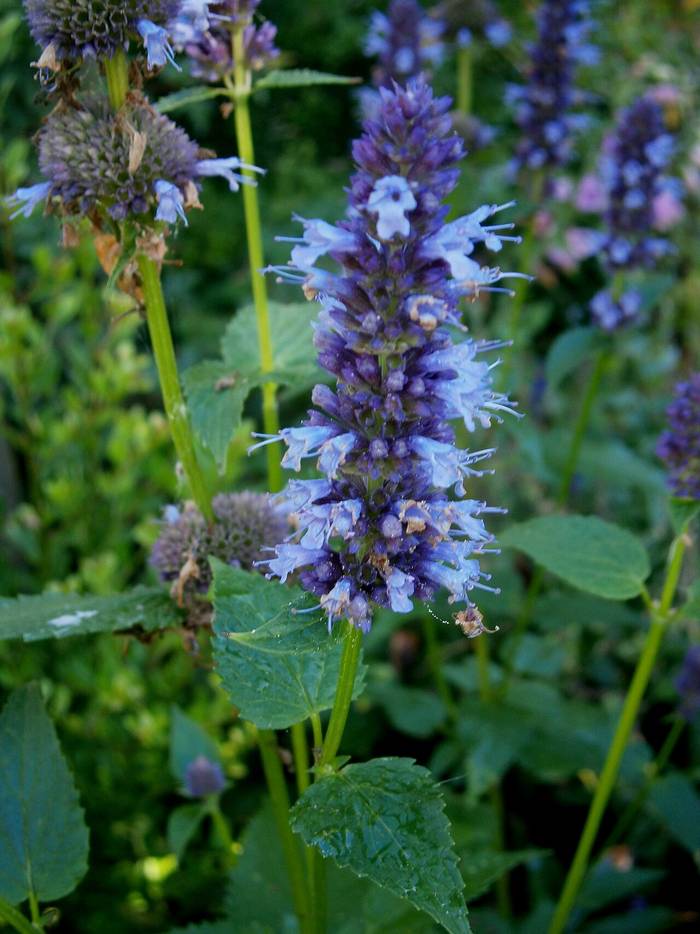
Meneerke bloem · CC BY-SA 3.0
Anise hyssop
Plant·Agastache foeniculum
Full sun
Sun
Dry to moist soil
Water
Not recorded
Drainage
Zones 4–8
Hardiness
Coverage · 109 fields
Growth and size10 fields
Height
90 cm · other sources: 60 cm, 120 cm“Agastache foeniculum is a PERENNIAL growing to 0.9 m (3ft) by 0.4 m (1ft 4in) at a fast rate.”Wikipedia“grows to 0.6–1.2 metres (2–4 feet) in height”
Spread
40 cm“Agastache foeniculum is a PERENNIAL growing to 0.9 m (3ft) by 0.4 m (1ft 4in) at a fast rate.”
Height at age
—
empty
Spacing
45 cm (at least 30 cm)
AI estimate55 % agree
Growth rate
Fast“Agastache foeniculum is a PERENNIAL growing to 0.9 m (3ft) by 0.4 m (1ft 4in) at a fast rate.”
Habit
Vase-shaped
AI estimate50 % agree
Root depth
Shallow“The root pattern is flat with shallow roots forming a plate near the soil surface [1-2].”
Forest garden layer
Herb layer
AI estimate90 % agree
Lifespan
~3 years
AI estimatenot measured yet
Roots6 fields
Root form
Plate root (shallow)“The root pattern is flat with shallow roots forming a plate near the soil surface [1-2].”
Storage organ
—
empty
Spreads
—
empty
Lateral spread in cm
—
empty
Root depth in cm
—
empty
Mycorrhiza
—
empty
Light, water and soil9 fields
Hours of sun
6–12 h
AI estimatenot measured yet
Water
Dry, moist · best: dry · Low“It prefers dry or moist soil.”PFAFpartly“Prefers a sunny position and a dry well-drained soil.”
Tolerates waterlogging
—
empty
Soil type
Sand, loam“Suitable for: light (sandy) and medium (loamy) soils and prefers well-drained soil.”
Compacted soil
Copes fairly well
AI estimatenot measured yet
Climate5 fields
Hardiness
Zone 4–8
Killing frost (-10 °C) doesn't fit hardiness zone 4, which survives far lower temperatures.
AI estimatenot measured yet
Killing frost
-10 °C
Killing frost (-10 °C) doesn't fit hardiness zone 4, which survives far lower temperatures.
AI estimatenot measured yet
Growing temperature
5–32 °C · optimal 18–28 °C
AI estimatenot measured yet
Chill hours
0 h
AI estimatenot measured yet
Care (becomes tasks in Manage)3 fields
Sowing
After the last frost · 14 days after · lasts 7 days
AI estimatenot measured yet
Watering
July · lasts 60 days
AI estimatenot measured yet
Pruning
March · lasts 15 days · dead stems
AI estimatenot measured yet
Through the year4 fields
Flowering
June · lasts 122 days“The plant blooms from June to September with bright lavender flowers that become more colorful near the tip.”
Leafing out
After the last frost“The young growth in spring is very susceptible to slug damage”
PFAFpartly
Dying back
After the first frost
AI estimatenot measured yet
Edible parts and pollination4 fields
The flowers
Raw or cooked, as a flavouring in salads and cooked dishes · June–September“Leaves and flowers - raw or cooked. They are used as a flavouring in raw or cooked dishes.”Wikipediapartly“The plant blooms from June to September with bright lavender flowers that become more colorful near the tip.”
PFAFpartly
The leaves
Raw or cooked as a flavouring, or infused as a tea“If eaten in quantity, the leaves can have a drying effect.”PFAFpartly“A pleasant tasting tea is made from the leaves.”
Pollination
Self-fertile · hermaphrodite“The species is hermaphrodite (has both male and female organs) and is pollinated by Bees.”PFAF“The plant is self-fertile.”
Pollinated by
Bees“The species is hermaphrodite (has both male and female organs) and is pollinated by Bees.”
Ecology6 fields
Attracts
Bees, butterflies, hummingbirds, honey bees, bumblebees, carpenter bees, night-flying moths, wildlife“The flowering plants are very attractive to bees and butterflies”Wikipedia“The species is tolerant of deer and drought, and attracts various potential pollinators, including hummingbirds, butterflies, bumblebees, honey bees, carpenter bees, and night-flying moths.”PFAF“It is noted for attracting wildlife.”
Diseases
—
empty
Takes up
Potassium, calcium
AI estimatenot measured yet
Fixes nitrogen
No
AI estimatenot measured yet
Mycorrhiza
Yes
AI estimatenot measured yet
Propagation and names4 fields
Methods
Difficulty
2 / 5
AI estimatenot measured yet
Seed
cold stratification for 30-60 days
AI estimatenot measured yet
Not sorted yet58 fields
Fields the parser stores that this page has no row for yet. They show up here automatically, so nothing is hidden.
forage.DK.local_name
Anis isop
AI estimatenot measured yet
forage.DK.prep_cautions
Leaves can have a drying effect in the mouth and should not be eaten in quantity.“The only drawback to the leaves is that they tend to have a drying effect in the mouth and so cannot be eaten in quantity”
forage.DK.edibility_basis
inferred
AI estimatenot measured yet
forage.DK.foraging_months.notes
Leaves and flowers are best harvested before the plant goes to seed.
AI estimatenot measured yet
forage.DK.foraging_months.months
5, 6, 7, 8, 9“The plant blooms from June to September with bright lavender flowers that become more colorful near the tip.”
Wikipediapartly
forage.DK.foraging_months.year_round
false
AI estimatenot measured yet
forage.DK.habitat_affinity
disturbed_ground“Dry thickets, fields and waste ground on prairies and plains.”
forage.US.local_name
Anise hyssop
AI estimatenot measured yet
forage.US.edible_parts
[{"part":"flowers","caution":null,"preparation":"raw or cooked, as a flavouring in salads and cooked dishes","season_months":[6,7,8,9]},{"part":"leaves","caution":"Drying effect in the mouth; do not eat in quantity.",…“If eaten in quantity, the leaves can have a drying effect.”PFAFpartly“Leaves and flowers - raw or cooked. They are used as a flavouring in raw or cooked dishes.”PFAFpartly“A pleasant tasting tea is made from the leaves.”Wikipediapartly“The plant blooms from June to September with bright lavender flowers that become more colorful near the tip.”
forage.US.prep_cautions
Leaves can have a drying effect in the mouth and should not be eaten in quantity.“The only drawback to the leaves is that they tend to have a drying effect in the mouth and so cannot be eaten in quantity”
forage.US.edibility_basis
inferred
AI estimatenot measured yet
forage.US.foraging_months.notes
Leaves are best before flowering, but can be harvested throughout the growing season. Flowers are edible when in bloom.
AI estimatenot measured yet
forage.US.foraging_months.months
5, 6, 7, 8, 9“The plant blooms from June to September with bright lavender flowers that become more colorful near the tip.”
Wikipediapartly
forage.US.foraging_months.year_round
false
AI estimatenot measured yet
forage.US.habitat_affinity
disturbed_ground“Dry thickets, fields and waste ground on prairies and plains.”
forage.TROPICAL.local_name
Anise hyssop
AI estimatenot measured yet
forage.TROPICAL.edible_parts
[{"part":"leaves","caution":null,"preparation":"raw or cooked","season_months":[1,2,3,4,5,6,7,8,9,10,11,12]},{"part":"flowers","caution":null,"preparation":"raw","season_months":[1,2,3,4,5,6,7,8,9,10,11,12]}]
AI estimatenot measured yet
forage.TROPICAL.edibility_basis
inferred
AI estimatenot measured yet
forage.TROPICAL.foraging_months.notes
In tropical climates, leaves and flowers can be harvested year-round.
AI estimatenot measured yet
forage.TROPICAL.foraging_months.year_round
true
AI estimatenot measured yet
forage.TROPICAL.habitat_affinity
disturbed_ground
AI estimatenot measured yet
ornamental.basis
documented
AI estimatenot measured yet
ornamental.fragrance.intensity
strong
AI estimatenot measured yet
ornamental.confidence
high
AI estimatenot measured yet
ornamental.fall_interest
true
AI estimatenot measured yet
ornamental.flower_colour
purple“The plant blooms from June to September with bright lavender flowers that become more colorful near the tip.”
Wikipediapartly
ornamental.evidence_quote
Agastache foeniculum, commonly known as Anise Hyssop, features spikes of purple flowers and green foliage. The foliage has a strong anise scent. It provides fall interest with its persistent seed heads.
AI estimatenot measured yet
ornamental.foliage_colour
green
AI estimate82 % agree
ornamental.foliage_texture
medium
AI estimatenot measured yet
ornamental.winter_structure
seed_heads
AI estimatenot measured yet
ornamental.autumn_foliage_colour
none
AI estimatenot measured yet
care_regime
none
AI estimatenot measured yet
propagation.self_seeding
moderate
AI estimate20 % agree
propagation.establishment_years
1
AI estimate40 % agree
spatial_profile.canopy_density
medium
AI estimatenot measured yet
forage_proposals.DK.edibility_tier.tier
edible
AI estimatenot measured yet
forage_proposals.DK.edibility_tier.confidence
high
AI estimatenot measured yet
forage_proposals.DK.edibility_tier.evidence_quote
The leaves and flowers of Anise Hyssop are edible and have a sweet, licorice-like flavor. They can be used in teas, salads, or as a seasoning.
AI estimatenot measured yet
forage_proposals.US.edibility_tier.tier
edible
AI estimatenot measured yet
forage_proposals.US.edibility_tier.confidence
high
AI estimatenot measured yet
forage_proposals.US.edibility_tier.evidence_quote
Anise hyssop leaves and flowers are commonly used in culinary applications, including teas, salads, and desserts, due to their sweet, anise-like flavor.
AI estimatenot measured yet
forage_proposals.TROPICAL.edibility_tier.tier
edible
AI estimatenot measured yet
forage_proposals.TROPICAL.edibility_tier.confidence
high
AI estimatenot measured yet
forage_proposals.TROPICAL.edibility_tier.evidence_quote
Agastache foeniculum is widely recognized as an edible herb, with its leaves and flowers used for flavoring and in beverages.
AI estimatenot measured yet
function_profile.biomass_return.confidence
medium
AI estimatenot measured yet
function_profile.nutrient_flows.consumes
[{"basis":"inferred","demand":"moderate","nutrient":"nitrogen","confidence":"medium"},{"basis":"inferred","demand":"moderate","nutrient":"phosphorus","confidence":"medium"},{"basis":"inferred","demand":"moderate","nut…
AI estimatenot measured yet
function_profile.nutrient_flows.provides
[{"basis":"inferred","nutrient":"potassium","mechanism":"biomass_return","confidence":"medium"},{"basis":"inferred","nutrient":"calcium","mechanism":"biomass_return","confidence":"medium"}]
AI estimatenot measured yet
function_profile.biotic_interactions
[{"taxa":["bees","butterflies"],"basis":"documented","valence":"beneficial","relation":"attracts","confidence":"high","evidence_quote":"The flowering plants are very attractive to bees and butterflies","organism_group…“The flowering plants are very attractive to bees and butterflies”Wikipedia“The species is tolerant of deer and drought, and attracts various potential pollinators, including hummingbirds, butterflies, bumblebees, honey bees, carpenter bees, and night-flying moths.”PFAF“It is noted for attracting wildlife.”PFAF“The young growth in spring is very susceptible to slug damage”PFAFpartly“Invertebrate Shelter, nectary.”
function_profile.aromatic_pest_effect.value
true
AI estimate80 % agree
function_profile.aromatic_pest_effect.confidence
medium
AI estimatenot measured yet
climate_tolerance.photoperiod_response
long_day
AI estimatenot measured yet
soil_interactions.organic_matter_contribution
medium
AI estimatenot measured yet
component_metadata.growth_cycle
perennial“Agastache foeniculum is a PERENNIAL growing to 0.9 m (3ft) by 0.4 m (1ft 4in) at a fast rate.”
resource_interfaces.inputs
[{"resource":"light","quantity_description":"sunny position"},{"resource":"water","quantity_description":"dry or moist soil"}]“Prefers a sunny position and a dry well-drained soil.”PFAF“It prefers dry or moist soil.”
resource_interfaces.outputs
[{"resource":"habitat","quantity_description":"invertebrate shelter"},{"resource":"nectar","quantity_description":"nectary"},{"resource":"pollinator_services","quantity_description":"one of the premier species for fee…“The plant is considered one of the premier species for feeding pollinators.”Wikipedia“The foliage has a scent resembling anise.”PFAF“It is in flower in July, and the seeds ripen in August.”PFAFpartly“Invertebrate Shelter, nectary.”