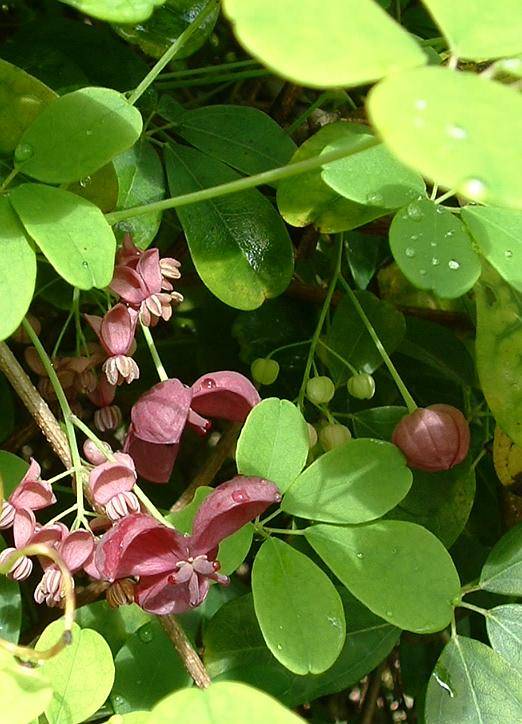
Jeffdelonge · CC BY-SA 3.0
chocolate vine
Plant·Akebia quinata
Shade to full sun
Sun
Dry to moist soil
Water
Well-drained soil
Drainage
Zones 4–9
Hardiness
Coverage · 125 fields
- Parser flag (climate_tolerance_low_confidence): Climate tolerance values are LLM-extracted (no authoritative EcoCrop match found). EcoCrop covers ~2,568 food-crop taxa; ornamental/native/medicinal species rely on LLM extraction.
Growth and size10 fields
Height
1,200 cm · other sources: 1,000 cm“Akebia quinata is a deciduous Climber growing to 12 m (39ft 4in) at a fast rate.”Wikipedia“Akebia quinata is a climbing evergreen vine that grows to 10 m (30 ft) or more in height”
Spread
300 cm
AI estimate58 % agree
Height at age
—
empty
Spacing
300 cm (at least 150 cm)
AI estimate55 % agree
Root depth
Medium
AI estimate63 % agree
Forest garden layer
Climber“Akebia quinata is a deciduous Climber growing to 12 m (39ft 4in) at a fast rate.”
Lifespan
~20 years
AI estimatenot measured yet
Roots6 fields
Root form
Heart root“The root pattern is branching: a heart root, dividing from the crown into several primary roots going down and out.”
Storage organ
—
empty
Spreads
By suckers“The root pattern is suckering with new plants from underground runners away from the plant [2-1].”
Lateral spread in cm
—
empty
Root depth in cm
—
empty
Mycorrhiza
—
empty
Light, water and soil9 fields
Sun
Full sun, light shade, part shade, shade · best: part shade“It can grow in full shade (deep woodland) semi-shade (light woodland) or no shade.”PFAFpartly“It prefers partial shade but thrives in full sun”
Hours of sun
4–6 h
AI estimatenot measured yet
Drought tolerant
Yes“Akebia prefers sandy soils with good drainage, and regular watering, though it is drought resistant.”
Tolerates waterlogging
—
empty
Soil type
Sand, loam, clay · best: loam“Suitable for: light (sandy), medium (loamy) and heavy (clay) soils and prefers well-drained soil.”Wikipedia“Akebia prefers sandy soils with good drainage, and regular watering, though it is drought resistant.”PFAFpartly“It prefers good loamy soil and succeeds in acid or alkaline soils.”
Compacted soil
Copes fairly well
AI estimatenot measured yet
Climate5 fields
Growing temperature
5–30 °C · optimal 15–25 °C
AI estimatenot measured yet
Chill hours
0 h
AI estimatenot measured yet
Care (becomes tasks in Manage)6 fields
Pruning
March · stems that have grown too large“if they grow too large, they can be cut back by trimming them with shears in early spring”
PFAFpartly
Protection
Planting out
After the last frost“Plant out in late spring or early summer, after the last expected frosts.”PFAFpartly“Plant out in late spring or early summer, after the last expected frosts”
PFAFpartly
Sowing
After the previous stage
AI estimatenot measured yet
Watering
July · lasts 60 days
AI estimatenot measured yet
Mulching
March · lasts 30 days
AI estimatenot measured yet
Through the year6 fields
Dormant
After the first frost“when dormant, it can tolerate temperatures down to about -20 to -30°c”
Harvest
After the previous stage
AI estimatenot measured yet
First harvest
4 years after plantingBalkan Ecology Project (permaculture reference site, not a university extension); does not state whether the 4 years is counted from planting a nursery plant or from seed. RHS separately gives a broader 'Time to Maturity 5–10 years' (https://www.rhs.org.uk/plants/747/akebia-quinata/details), but that figure covers the plant reaching full size/spread, not specifically first fruiting, so it is not treated as disputing this field.
Edible parts and pollination7 fields
Fruit pulp
Eaten fresh, best once the fruit fully opens on the vine · September–October“The fruit contains a sweet soft pulp, eaten primarily in Japan as a seasonal delicacy.”Wikipedia“Often eaten fresh, the Akebia fruit is best after it fully opens naturally on the vine.”Wikipedia“The fruiting season is from September to October.”
Rind
Fried, or stuffed with ground meat or mushrooms“The rind, with a slight bitter taste, is used as vegetable, fried and stuffed with ground meat or mushrooms.”
Pollination
Needs a partner · another variety · monoecious“will only produce fruit if pollinated by a genetically different plant”PFAF“Plants are shy to fruit outside their native range - possibly require some protection in the flowering season, so hand pollination is advisable.”PFAFpartly“The plant is not self-fertile.”
Pollinated by
—
empty
Ecology6 fields
Attracts
Bees
AI estimatenot measured yet
Pests
—
empty
Diseases
—
empty
Takes up
—
empty
Fixes nitrogen
No
AI estimatenot measured yet
Mycorrhiza
Yes
AI estimatenot measured yet
Propagation and names4 fields
Methods
Seed, half-ripe cuttings, softwood cuttings, root cuttings, layering“Seed - best sown in a cold frame as soon as it is ripe”PFAF“Cuttings of half-ripe wood, July/August in a frame”PFAF“Cuttings can also be taken of soft wood in spring”PFAF“Root cuttings, December in a warm greenhouse”PFAF“Layering in early spring”
Difficulty
2 / 5
AI estimatenot measured yet
Seed
1 month cold stratification“Stored seed should be given 1 month cold stratification and can be very difficult to germinate”
Not sorted yet66 fields
Fields the parser stores that this page has no row for yet. They show up here automatically, so nothing is hidden.
forage.DK.local_name
femfingret akebia
AI estimatenot measured yet
forage.DK.prep_cautions
Do not chew the seeds: they are very bitter and can cause throat irritation., Discard the seeds by spitting them out or swallowing them whole.“The seeds are very bitter and can even lead to throat irritation if chewed.”Wikipedia“They are discarded by spitting out or simply swallowing them whole.”
forage.DK.edibility_basis
inferred
AI estimatenot measured yet
forage.DK.foraging_months.notes
Fruit season. Spring shoots and leaves are not dated in the sources.
AI estimatenot measured yet
forage.DK.foraging_months.year_round
false
AI estimatenot measured yet
forage.DK.habitat_affinity
woodland, hedgerow, riverbank“Woods, hedges and thickets in mountainous areas.”PFAFpartly“Forest margins along streams, scrub on mountain slopes at elevations of 300 - 1500 metres in China.”
forage.US.local_name
Chocolate vine
AI estimatenot measured yet
forage.US.edible_parts
[{"part":"fruit pulp","caution":null,"preparation":"eaten fresh, best once the fruit fully opens on the vine","season_months":[9,10]},{"part":"rind","caution":null,"preparation":"fried, or stuffed with ground meat or …“The fruit contains a sweet soft pulp, eaten primarily in Japan as a seasonal delicacy.”Wikipedia“The rind, with a slight bitter taste, is used as vegetable, fried and stuffed with ground meat or mushrooms.”PFAF“The leaves are used as a tea substitute.”PFAF“Soft young shoots are used in salads or pickled.”Wikipedia“Often eaten fresh, the Akebia fruit is best after it fully opens naturally on the vine.”Wikipedia“The fruiting season is from September to October.”
forage.US.prep_cautions
Do not chew the seeds: they are very bitter and can cause throat irritation., Discard the seeds by spitting them out or swallowing them whole.“The seeds are very bitter and can even lead to throat irritation if chewed.”Wikipedia“They are discarded by spitting out or simply swallowing them whole.”
forage.US.edibility_basis
inferred
AI estimatenot measured yet
forage.US.foraging_months.notes
Fruit season. Spring shoots and leaves are not dated in the sources.
AI estimatenot measured yet
forage.US.foraging_months.year_round
false
AI estimatenot measured yet
forage.US.habitat_affinity
woodland, hedgerow, riverbank“Woods, hedges and thickets in mountainous areas.”PFAFpartly“Forest margins along streams, scrub on mountain slopes at elevations of 300 - 1500 metres in China.”
forage.TROPICAL.edible_parts
[{"part":"fruit","caution":null,"preparation":"raw","season_months":[9,10]},{"part":"young shoots","caution":null,"preparation":"cooked","season_months":[4,5]}]
AI estimatenot measured yet
forage.TROPICAL.edibility_basis
inferred
AI estimatenot measured yet
forage.TROPICAL.foraging_months.months
4, 5, 9, 10
AI estimatenot measured yet
forage.TROPICAL.foraging_months.year_round
false
AI estimatenot measured yet
forage.TROPICAL.habitat_affinity
woodland, hedgerow
AI estimatenot measured yet
ornamental.basis
documented
AI estimatenot measured yet
ornamental.fragrance.intensity
subtle
AI estimatenot measured yet
ornamental.confidence
high
AI estimatenot measured yet
ornamental.fall_interest
true
AI estimatenot measured yet
ornamental.evidence_quote
Akebia quinata, commonly known as chocolate vine, produces small, fragrant, purple flowers in spring, followed by edible, sausage-shaped fruit in autumn. The foliage is green and typically does not show significant autumn color change. The flowers have a subtle, chocolate-like fragrance.
AI estimatenot measured yet
ornamental.foliage_colour
green
AI estimate82 % agree
ornamental.foliage_texture
medium
AI estimatenot measured yet
ornamental.winter_structure
persistent_fruit
AI estimatenot measured yet
ornamental.autumn_foliage_colour
none
AI estimatenot measured yet
care_regime
light
AI estimatenot measured yet
propagation.self_seeding
moderate
AI estimate20 % agree
propagation.division_season
spring
AI estimatenot measured yet
propagation.establishment_years
2
AI estimate40 % agree
forage_proposals.DK.edibility_tier.tier
edible
AI estimatenot measured yet
forage_proposals.DK.edibility_tier.confidence
high
AI estimatenot measured yet
forage_proposals.DK.edibility_tier.evidence_quote
The fruit of Akebia quinata is edible, with a sweet, mild pulp. It can be eaten raw or cooked.
AI estimatenot measured yet
forage_proposals.US.edibility_tier.tier
edible
AI estimatenot measured yet
forage_proposals.US.edibility_tier.confidence
high
AI estimatenot measured yet
forage_proposals.US.edibility_tier.evidence_quote
The fruit of Akebia quinata is edible, with a sweet, mild pulp. It can be eaten raw or cooked.
AI estimatenot measured yet
forage_proposals.TROPICAL.edibility_tier.confidence
low
AI estimatenot measured yet
function_profile.biomass_return.confidence
high
AI estimatenot measured yet
function_profile.nutrient_flows.consumes
[{"basis":"inferred","demand":"moderate","nutrient":"nitrogen","confidence":"medium"},{"basis":"inferred","demand":"moderate","nutrient":"phosphorus","confidence":"medium"},{"basis":"inferred","demand":"moderate","nut…
AI estimatenot measured yet
function_profile.biotic_interactions
[{"taxa":["bees"],"basis":"documented","valence":"beneficial","relation":"attracts","confidence":"high","organism_group":"pollinator","ecological_function":"pollination"}]
AI estimatenot measured yet
function_profile.aromatic_pest_effect.value
false
AI estimate80 % agree
function_profile.aromatic_pest_effect.confidence
low
AI estimatenot measured yet
function_profile.structural_interfaces.provides_shelter.basis
documented
AI estimatenot measured yet
function_profile.structural_interfaces.provides_shelter.kinds
shade
AI estimatenot measured yet
function_profile.structural_interfaces.provides_shelter.confidence
medium
AI estimatenot measured yet
function_profile.structural_interfaces.provides_shelter.evidence_quote
The dense foliage of Akebia quinata provides significant shade.
AI estimatenot measured yet
function_profile.structural_interfaces.requires_shelter.basis
documented
AI estimatenot measured yet
function_profile.structural_interfaces.requires_shelter.kinds
frost“to help protect them from potential frost damage”
function_profile.structural_interfaces.requires_shelter.stage
establishment“plants can be somewhat tender when young - new growth in spring can be damaged even by light frosts”
function_profile.structural_interfaces.requires_shelter.confidence
medium
AI estimatenot measured yet
function_profile.structural_interfaces.requires_shelter.evidence_quote
However, plants can be somewhat tender when young - new growth in spring can be damaged even by light frosts.
AI estimatenot measured yet
function_profile.structural_interfaces.requires_physical_support.basis
documented
AI estimatenot measured yet
function_profile.structural_interfaces.requires_physical_support.mechanism
twiner
AI estimatenot measured yet
function_profile.structural_interfaces.requires_physical_support.confidence
high
AI estimatenot measured yet
function_profile.structural_interfaces.requires_physical_support.evidence_quote
Akebia quinata is a vigorous twining vine that requires a support structure to climb.
AI estimatenot measured yet
climate_tolerance.photoperiod_response
day_neutral
AI estimatenot measured yet
soil_interactions.organic_matter_contribution
medium
AI estimatenot measured yet
component_metadata.growth_cycle
perennial
AI estimate100 % agree
resource_interfaces.inputs
[{"resource":"light","quantity_description":"partial shade to full sun"},{"resource":"shade","quantity_description":"tolerates full shade to no shade"},{"resource":"water","quantity_description":"prefers moist soil an…“It prefers partial shade but thrives in full sun”PFAF“It can grow in full shade (deep woodland) semi-shade (light woodland) or no shade.”PFAF“It prefers moist soil and can tolerate drought.”PFAFpartly“The plant is not self-fertile.”
resource_interfaces.outputs
[{"resource":"ground_cover","quantity_description":"used to prevent erosion of hills"},{"resource":"fruit","quantity_description":"sausage-shaped pods 5-10 cm long with sweet edible pulp"},{"resource":"seeds","quantit…“A. quinata seeds produce an oil used in traditional soap making in China [1-8].”PFAF“The flowers have a spicy fragrance reminiscent of vanilla.”Wikipediapartly“It is primarily used to cover less attractive spots on the sides of businesses or a ground cover to prevent erosion of hills.”Wikipediapartly“The fruits are sausage-shaped pods which contain edible pulp.”