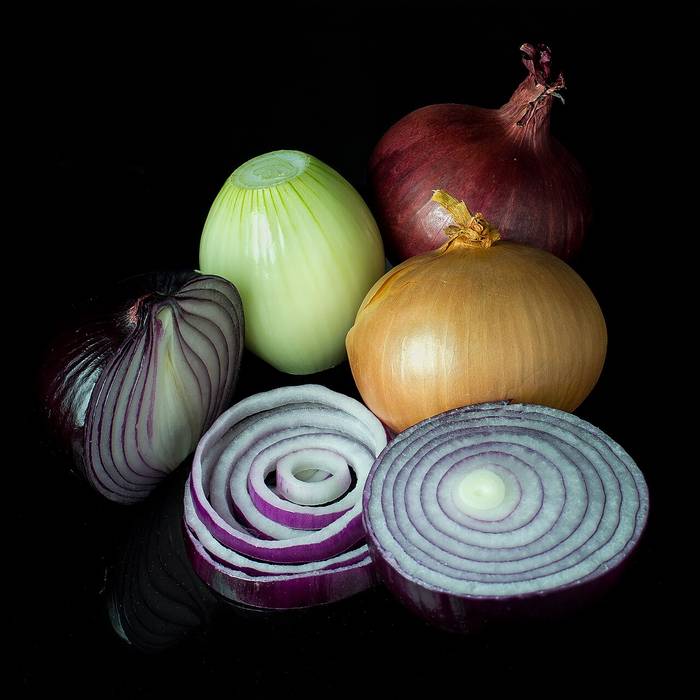
Colin · CC BY-SA 3.0
Onion
Plant·Allium cepa
Full sun
Sun
Moist soil
Water
Well-drained soil
Drainage
Zones 5–10
Hardiness
Coverage · 118 fields
Growth and size10 fields
Plant type
Plant
AI estimate100 % agree
Height
60 cm · other sources: 45 cm“Allium cepa is an evergreen Bulb growing to 0.6 m (2ft) at a medium rate.”Wikipedia“Modern varieties typically grow to a height of 15 to 45 cm (6 to 18 in).”
Spread
20 cm
AI estimate58 % agree
Height at age
—
empty
Spacing
10 cm (at least 5 cm)
AI estimate55 % agree
Habit
Columnar
AI estimate50 % agree
Root depth
Shallow“The plants are shallow-rooted and do not need much water when established.”
Forest garden layer
Herb layer
AI estimate90 % agree
Lifespan
~2 years
AI estimatenot measured yet
Roots6 fields
Root form
Fibrous roots“From the underside of the plate, a bundle of fibrous roots extends for a short way into the soil.”
Spreads
—
empty
Root depth in cm
—
empty
Mycorrhiza
Arbuscular (AM)
AI estimatenot measured yet
Light, water and soil9 fields
Hours of sun
6–12 h
AI estimatenot measured yet
Water
Moist · best: moist · Medium · 2–4 l/day“It prefers moist soil.”Wikipediapartly“The plants are shallow-rooted and do not need much water when established.”
Drought tolerant
—
empty
Tolerates waterlogging
—
empty
Soil type
Sand, loam · best: sand“Suitable for: light (sandy) and medium (loamy) soils and prefers well-drained soil.”PFAFpartly“Prefers a sunny sheltered position in a rich light well-drained soil.”
pH
Drainage
Well drained“Suitable for: light (sandy) and medium (loamy) soils and prefers well-drained soil.”
Compacted soil
Copes badly
AI estimatenot measured yet
Climate5 fields
Hardiness
Zone 5–10
Killing frost (-10 °C) doesn't fit hardiness zone 5, which survives far lower temperatures.
AI estimatenot measured yet
Killing frost
-10 °C
Killing frost (-10 °C) doesn't fit hardiness zone 5, which survives far lower temperatures.
AI estimatenot measured yet
Growing temperature
2–29 °C · optimal 20–25 °C“Optimum growth takes place at temperatures between 20 and 25°c.”
Chill hours
0 h
AI estimatenot measured yet
Care (becomes tasks in Manage)7 fields
Sowing
March · lasts 61 days“The main sowing is made in March or April in an outdoor seedbed, this bed must be very well prepared.”
Starting indoors
February“Early sowings can be made in February in a greenhouse to be planted out in late spring.”
Feeding
After the previous stage · -28 days after · nitrogen and potash“Nitrogen and potash can be applied at regular intervals during the growing season, the last application of nitrogen being at least four weeks before harvesting.”
Feeding appears 2 times with different timing.
Weeding
After the previous stage“Routine care during the growing season involves keeping the rows free of competing weeds, especially when the plants are young.”
Dividing
After the previous stage · lasts 1 days
AI estimatenot measured yet
Watering
After the previous stage · lasts 120 days
AI estimatenot measured yet
Feeding
After the previous stage · 30 days after · lasts 30 days · a balanced fertiliser
Feeding appears 2 times with different timing.
AI estimatenot measured yet
Through the year4 fields
Leafing out
After the last frost“If left in the soil over winter, the growing point in the middle of the bulb begins to develop in the spring.”
Wikipediapartly
Dying back
After the first frost“In the autumn, the leaves die back, and the outer scales of the bulb become dry and brittle, so the crop is normally harvested.”
Harvest
After the previous stage“In the autumn, the leaves die back, and the outer scales of the bulb become dry and brittle, so the crop is normally harvested.”
Edible parts and pollination6 fields
The flowers
Raw · June–July“Flowers - raw. Used as a garnish on salads.”PFAFpartly“It is in flower from June to July.”
Ecology5 fields
Attracts
Pests
Onion fly (delia antiqua), onion leaf miner or leek moth (acrolepiopsis assectella), onion eelworm (ditylenchus dipsaci)“The onion fly (Delia antiqua) lays eggs on the leaves and stems and on the ground close to onion, shallot, leek, and garlic plants.”Wikipedia“The larvae of the onion leaf miner or leek moth (Acrolepiopsis assectella) sometimes attack the foliage and may burrow down into the bulb.”Wikipedia“The onion eelworm (Ditylenchus dipsaci), a tiny parasitic soil-living nematode, causes swollen, distorted foliage.”
Diseases
White rot (sclerotium cepivorum), neck rot (botrytis allii), rust, smut, downy mildew, white tip disease“White rot of onions, leeks, and garlic is caused by the soil-borne fungus Sclerotium cepivorum.”Wikipedia“It is caused by Botrytis allii, which attacks the neck and upper parts of the bulb, causing a grey mould to develop.”Wikipedia“Diseases affecting the foliage include rust and smut, downy mildew, and white tip disease.”
Takes up
—
empty
Fixes nitrogen
No
AI estimatenot measured yet
Propagation and names4 fields
Methods
Seed, sets“Onions are grown from seeds or from partially grown bulbs called "sets" or starter bulbs.”
Difficulty
2 / 5
AI estimatenot measured yet
Seed
none
AI estimatenot measured yet
Not sorted yet62 fields
Fields the parser stores that this page has no row for yet. They show up here automatically, so nothing is hidden.
forage.DK.local_name
Løg
AI estimatenot measured yet
forage.DK.warnings_da
Giftig for hunde og katte., Hyppig håndtering kan give udslæt på hænderne.
AI estimatenot measured yet
forage.DK.warnings_en
Poisonous to dogs and cats., Frequent handling can cause a rash on the hands.
AI estimatenot measured yet
forage.DK.prep_cautions
Eye irritation can be minimised by cutting onions under running water or submerged in a basin of water., Hand eczema may occur with frequent handling., Some people suffer from allergic reactions after handling onions., May interfere with drug control of blood sugar., Onions are toxic to animals including dogs, cats, and guinea pigs.“Eye irritation can be minimised by cutting onions under running water or submerged in a basin of water.”PFAF“Hand eczema may occur with frequent handling.”Wikipedia“Some people suffer from allergic reactions after handling onions.”PFAF“May interfere with drug control of blood sugar .”Wikipedia“Onions are toxic to animals including dogs, cats, and guinea pigs.”
forage.DK.edibility_basis
inferred
AI estimatenot measured yet
forage.DK.foraging_months.notes
Bulbs are harvested in autumn when the leaves die back.“In the autumn, the leaves die back, and the outer scales of the bulb become dry and brittle, so the crop is normally harvested.”
forage.DK.foraging_months.months
4, 5, 6, 7, 8, 9
AI estimatenot measured yet
forage.DK.foraging_months.year_round
true“Eat the leaves and flowers in salads for a plentiful supply throughout the year.”
forage.DK.habitat_affinity
disturbed_ground
AI estimatenot measured yet
forage.US.local_name
Onion
AI estimatenot measured yet
forage.US.edible_parts
[{"part":"bulb","preparation":"raw or cooked"},{"part":"leaves","preparation":"raw or cooked"},{"part":"flowers","preparation":"raw","season_months":[6,7]},{"part":"seeds","preparation":"sprouted"}]“Bulb - raw or cooked.”PFAF“Leaves - raw or cooked.”PFAF“Flowers - raw. Used as a garnish on salads.”PFAF“The seeds are sprouted and eaten.”PFAFpartly“It is in flower from June to July.”
forage.US.prep_cautions
Eye irritation can be minimised by cutting onions under running water or submerged in a basin of water., Hand eczema may occur with frequent handling., Some people suffer from allergic reactions after handling onions., May interfere with drug control of blood sugar., Onions are toxic to animals including dogs, cats, and guinea pigs.“Eye irritation can be minimised by cutting onions under running water or submerged in a basin of water.”PFAF“Hand eczema may occur with frequent handling.”Wikipedia“Some people suffer from allergic reactions after handling onions.”PFAF“May interfere with drug control of blood sugar .”Wikipedia“Onions are toxic to animals including dogs, cats, and guinea pigs.”
forage.US.edibility_basis
inferred
AI estimatenot measured yet
forage.US.foraging_months.notes
Bulbs are harvested in autumn when the leaves die back.“In the autumn, the leaves die back, and the outer scales of the bulb become dry and brittle, so the crop is normally harvested.”
forage.US.foraging_months.months
4, 5, 6, 7, 8, 9
AI estimatenot measured yet
forage.US.foraging_months.year_round
true“Eat the leaves and flowers in salads for a plentiful supply throughout the year.”
forage.US.habitat_affinity
disturbed_ground
AI estimatenot measured yet
forage.TROPICAL.local_name
Cebolla
AI estimatenot measured yet
forage.TROPICAL.edible_parts
[{"part":"Bulb","preparation":"raw or cooked"},{"part":"Leaves","preparation":"raw or cooked"},{"part":"Flowers","preparation":"raw"},{"part":"Seed","preparation":"sprouted and eaten"}]
AI estimatenot measured yet
forage.TROPICAL.prep_cautions
Hand eczema may occur with frequent handling., Some people suffer from allergic reactions after handling onions., Dogs seem to be particularly susceptible.
AI estimatenot measured yet
forage.TROPICAL.edibility_basis
inferred
AI estimatenot measured yet
forage.TROPICAL.foraging_months.notes
Typically harvested in late spring to early summer, when the bulbs mature and the tops begin to yellow.
AI estimatenot measured yet
forage.TROPICAL.foraging_months.months
4, 5, 6, 7, 8, 9
AI estimatenot measured yet
forage.TROPICAL.foraging_months.year_round
false
AI estimatenot measured yet
forage.TROPICAL.habitat_affinity
disturbed_ground
AI estimatenot measured yet
ornamental.basis
documented
AI estimatenot measured yet
ornamental.fragrance.source
foliage
AI estimate100 % agree
ornamental.fragrance.intensity
strong
AI estimatenot measured yet
ornamental.confidence
high
AI estimatenot measured yet
ornamental.fall_interest
false
AI estimatenot measured yet
ornamental.flower_colour
white“The inflorescence takes the form of a rounded umbel of white flowers with parts in sixes.”
ornamental.evidence_quote
Onion (Allium cepa) produces white, insignificant flowers. Its foliage is green and does not change color in autumn. The foliage has a medium texture. It does not offer fall interest or winter structure. The foliage has a strong, characteristic onion fragrance.
AI estimatenot measured yet
ornamental.foliage_colour
yellow_green, blue_green“The leaves are yellowish- to bluish green and grow alternately in a flattened, fan-shaped swathe.”
ornamental.foliage_texture
medium
AI estimatenot measured yet
ornamental.winter_structure
none
AI estimatenot measured yet
ornamental.autumn_foliage_colour
none
AI estimatenot measured yet
care_regime
routine
AI estimatenot measured yet
propagation.self_seeding
light
AI estimate20 % agree
propagation.division_season
summer
AI estimatenot measured yet
propagation.establishment_years
1
AI estimate40 % agree
spatial_profile.canopy_density
light
AI estimatenot measured yet
sun_requirement.best
full_sun“Prefers a sunny sheltered position in a rich light well-drained soil.”
forage_proposals.DK.edibility_tier.confidence
high
AI estimatenot measured yet
forage_proposals.DK.edibility_tier.evidence_quote
Allium cepa, commonly known as onion, is a widely cultivated and consumed vegetable globally, prized for its culinary versatility and flavor. All parts above and below ground are edible.
AI estimatenot measured yet
forage_proposals.US.edibility_tier.confidence
high
AI estimatenot measured yet
forage_proposals.US.edibility_tier.evidence_quote
Allium cepa, commonly known as onion, is a widely cultivated and consumed vegetable globally, prized for its culinary versatility and flavor. All parts above and below ground are edible.
AI estimatenot measured yet
forage_proposals.TROPICAL.edibility_tier.tier
choice
AI estimatenot measured yet
forage_proposals.TROPICAL.edibility_tier.confidence
high
AI estimatenot measured yet
forage_proposals.TROPICAL.edibility_tier.evidence_quote
Allium cepa, commonly known as onion, is a widely cultivated and consumed vegetable globally, prized for its culinary versatility and flavor. All parts above and below ground are edible.
AI estimatenot measured yet
function_profile.biomass_return.confidence
low
AI estimatenot measured yet
function_profile.nutrient_flows.consumes
[{"basis":"documented","demand":"high","nutrient":"nitrogen","confidence":"medium"},{"basis":"documented","demand":"moderate","nutrient":"potassium","confidence":"medium"},{"basis":"documented","demand":"moderate","nu…“Onions require a high level of nutrients in the soil.”Wikipedia“Phosphorus is often present in sufficient quantities, but may be applied before planting because of its low level of availability in cold soils.”Wikipediapartly“Nitrogen and potash can be applied at regular intervals during the growing season, the last application of nitrogen being at least four weeks before harvesting.”
function_profile.biotic_interactions
[{"taxa":["bees","insects","butterflies"],"basis":"documented","valence":"beneficial","relation":"attracts","confidence":"high","organism_group":"pollinator","ecological_function":"pollination"},{"taxa":["onion fly (D…“The onion fly (Delia antiqua) lays eggs on the leaves and stems and on the ground close to onion, shallot, leek, and garlic plants.”Wikipedia“The larvae of the onion leaf miner or leek moth (Acrolepiopsis assectella) sometimes attack the foliage and may burrow down into the bulb.”Wikipedia“The onion eelworm (Ditylenchus dipsaci), a tiny parasitic soil-living nematode, causes swollen, distorted foliage.”Wikipedia“White rot of onions, leeks, and garlic is caused by the soil-borne fungus Sclerotium cepivorum.”Wikipedia“It is caused by Botrytis allii, which attacks the neck and upper parts of the bulb, causing a grey mould to develop.”Wikipedia“Diseases affecting the foliage include rust and smut, downy mildew, and white tip disease.”PFAF“Yes – Allium species produce flowers rich in nectar and pollen, attracting pollinators like bees and butterflies.”PFAF“The species is hermaphrodite (has both male and female organs) and is pollinated by Bees, insects.”
function_profile.aromatic_pest_effect.value
true
AI estimate80 % agree
function_profile.aromatic_pest_effect.confidence
high
AI estimatenot measured yet
climate_tolerance.photoperiod_response
long_day“Bulb formation takes place in response to long-day conditions.”
soil_interactions.organic_matter_contribution
low
AI estimatenot measured yet
component_metadata.growth_cycle
biennial“The onion is a biennial plant but is usually grown as an annual.”
resource_interfaces.inputs
[{"resource":"light","quantity_description":"a sunny position; cannot grow in shade"},{"resource":"water","quantity_description":"moist soil; shallow-rooted and needs little water once established"}]“Prefers a sunny sheltered position in a rich light well-drained soil.”PFAFpartly“It prefers moist soil.”
resource_interfaces.outputs
[{"resource":"nectar","quantity_description":"flowers rich in nectar and pollen"},{"resource":"pollen","quantity_description":"flowers rich in nectar and pollen"},{"resource":"pollinator_services","quantity_descriptio…“Yes – Allium species produce flowers rich in nectar and pollen, attracting pollinators like bees and butterflies.”Wikipedia“The seeds are glossy black and triangular in cross-section.”Wikipedia“They are pungent when chopped and contain certain chemical substances which may irritate the eyes.”
biotic_relationships.repels
carrot rust fly, aphids
AI estimatenot measured yet