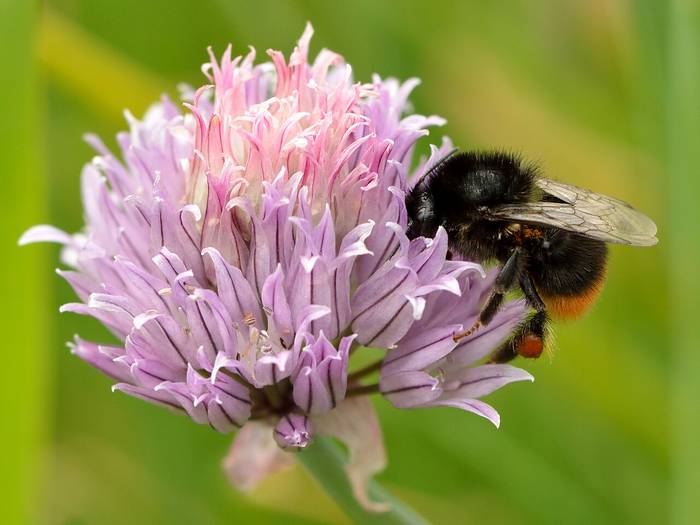
Ivar Leidus · CC BY-SA 4.0
Chives
Plant·Allium schoenoprasum
Part shade to full sun
Sun
Moist soil
Water
Well-drained soil
Drainage
Zones 3–9
Hardiness
Coverage · 121 fields
Growth and size10 fields
Height
30 cm · other sources: 25 cm“Allium schoenoprasum is a BULB growing to 0.3 m (1ft) by 0.3 m (1ft in) at a medium rate.”Wikipedia“Chives are a bulb-forming herbaceous perennial plant, growing to 25 centimetres (10 in) tall.”
Spread
30 cm“Allium schoenoprasum is a BULB growing to 0.3 m (1ft) by 0.3 m (1ft in) at a medium rate.”
Height at age
—
empty
Spacing
20 cm (at least 15 cm)
AI estimate55 % agree
Growth rate
Medium“Allium schoenoprasum is a BULB growing to 0.3 m (1ft) by 0.3 m (1ft in) at a medium rate.”
Habit
Mounding
AI estimate50 % agree
Root depth
Shallow
AI estimate63 % agree
Forest garden layer
Herb layer“Chives are a bulb-forming herbaceous perennial plant, growing to 25 centimetres (10 in) tall.”
Lifespan
~5 years
AI estimatenot measured yet
Roots6 fields
Root form
Fibrous roots
AI estimate43 % agree
Spreads
—
empty
Root depth in cm
—
empty
Mycorrhiza
Arbuscular (AM)
AI estimatenot measured yet
Light, water and soil9 fields
Sun
Full sun, light shade, part shade · best: full sun“An easily grown plant, it prefers a sunny position in a rich moist but well-drained soil, though it succeeds in most soils and also in light shade.”PFAF“Chives (A. schoenoprasum) are a very productive crop supplying mild, onion-flavoured leaves in full sun to semi-shade positions.”PFAF“It can grow in semi-shade (light woodland) or no shade.”
Hours of sun
6–8 h
AI estimatenot measured yet
Drought tolerant
—
empty
Tolerates waterlogging
—
empty
Soil type
Sand, loam, clay“Suitable for: light (sandy), medium (loamy) and heavy (clay) soils, prefers well-drained soil and can grow in heavy clay soil.”
pH
Drainage
Well drained“Chives thrive in well-drained soil, rich in organic matter, with a pH of 6–7 and full sun.”
Compacted soil
Copes fairly well
AI estimatenot measured yet
Climate5 fields
Hardiness
Zone 3–9
AI estimatenot measured yet
Killing frost
-25 °C
AI estimatenot measured yet
Growing temperature
2–35 °C · optimal 10–20 °C“Temperature absolute min: 2 · Temperature absolute max: 35 · Temperature optimal min: 10 · Temperature optimal max: 20”
Chill hours
0 h
AI estimatenot measured yet
Native range
AD, AF, AL, AM, AT, AZ, BA, BG, BY, CA, CH, CN, CZ, DE, DK, EE, ES, FI, FR, GB, GE, GG, GI, GR, HR, IN, IQ, IR, IT, JE, JP, KP, KR, KZ, LI, LT, MC, MD, ME, MK, MN, NL, NO, PK, PL, PT, RO, RS, RU, SE, SI, SK, SM, TJ, TR, UA, US, VA, XK
Care (becomes tasks in Manage)10 fields
Dividing
After the last frost · lasts 1 days“The clumps should be divided at least every 3 or 4 years in order to maintain vigour, the divisions can be planted out direct into their permanent positions.”
Dividing appears 2 times with different timing.
Pruning
After the previous stage · stalks that look old“Chives starting to look old can be cut back to about 2–5 cm.”
Wikipediapartly
Protection
After the first frost · lasts 150 days · frost“Plants can be moved into a frame or other protected environment in the autumn and will then produce leaves throughout the winter.”
Starting indoors
After the last frost · lasts 28 days“Germination is usually free and easy, pot up the seedlings as soon as they are large enough to handle easily and plant out in the following spring.”
PFAFpartly
Planting out
After the last frost“They can also be planted under a cloche or germinated indoors in cooler climates, then planted out later.”
Planting out appears 2 times with different timing.
Wikipediapartly
Planting out
After the previous stage · 28 days after
Planting out appears 2 times with different timing.
AI estimatenot measured yet
Feeding
April · a balanced organic fertiliser
AI estimatenot measured yet
Watering
After rain · lasts 180 days
AI estimatenot measured yet
Dividing
March · lasts 30 days · lift and split with a spade
Dividing appears 2 times with different timing.
AI estimatenot measured yet
Through the year5 fields
Leafing out
February · lasts 300 days“It is in leaf from February to December, in flower from June to July, and the seeds ripen from July to August.”
Flowering
June · lasts 60 days“It is in leaf from February to December, in flower from June to July, and the seeds ripen from July to August.”
Fruiting
July · lasts 60 days“It is in leaf from February to December, in flower from June to July, and the seeds ripen from July to August.”
Harvest
February · lasts 300 days“Chives are commonly cultivated in the garden for their edible leaves which are available from late winter to the beginning of the following winter[K].”
PFAFpartly
Dormant
After the first frost · lasts 120 days“In cold regions, chives die back to the underground bulbs in winter, with the new leaves appearing in early spring.”
Edible parts and pollination5 fields
The leaves
Raw, cooked or dried for later use · February–December“Leaves - raw, cooked or dried for later use.”PFAF“It is in leaf from February to December, in flower from June to July, and the seeds ripen from July to August.”
The flowers
Garnish in salads; used to make blossom vinegars · June–July“The flowers can be used as a garnish in salads etc.”Wikipedia“The edible flowers are used in salads, or used to make blossom vinegars.”PFAF“It is in leaf from February to December, in flower from June to July, and the seeds ripen from July to August.”
The bulbs
Harvested with the leaves still attached and used as spring onions“They can be harvested with the leaves still attached and be used as spring onions”
Pollination
Pollinated by
Bees, flies, moths, butterflies“pollinated by Bees, flies, Lepidoptera (Moths & Butterflies)”
Ecology5 fields
Attracts
Bees, flies, moths, butterflies, wildlife“Chives are repulsive to most insects due to their sulfur compounds, but their flowers attract bees, and they are at times kept to increase desired insect life.”PFAF“The species is hermaphrodite (has both male and female organs) and is pollinated by Bees, flies, Lepidoptera (Moths & Butterflies).”PFAF“Attracts butterflies”PFAF“It is noted for attracting wildlife.”
Pests
Leek moth larvae“Chives are susceptible to damage by leek moth larvae, which bore into the leaves or bulbs of the plant.”
Diseases
—
empty
Takes up
Sulfur
AI estimatenot measured yet
Fixes nitrogen
No
AI estimatenot measured yet
Propagation and names4 fields
Methods
Seed, division“Seed - sow spring in a cold frame.”PFAF“Division can be carried out at almost any time of the year but is probably best done in spring.”
Difficulty
1 / 5
AI estimatenot measured yet
Seed
not_required
AI estimatenot measured yet
Not sorted yet62 fields
Fields the parser stores that this page has no row for yet. They show up here automatically, so nothing is hidden.
forage.DK.local_name
Purløg
AI estimatenot measured yet
forage.DK.warnings_da
Giftig for hunde og katte.
AI estimatenot measured yet
forage.DK.warnings_en
Poisonous to dogs and cats.
AI estimatenot measured yet
forage.DK.prep_cautions
Poisoning has been reported from very large quantities of certain members of this genus, consumed by some mammals; dogs seem particularly susceptible.“Although no individual reports regarding this species have been seen, there have been cases of poisoning caused by the consumption, in very large quantities and by some mammals, of certain members of this genus.”
forage.DK.edibility_basis
inferred
AI estimatenot measured yet
forage.DK.foraging_months.notes
Leaves are often available from late winter until early the following winter, especially in a warm, sheltered position.“The leaves are often available from late winter and can continue to produce leaves until early the following winter, especially if they are in a warm, sheltered position”
forage.DK.foraging_months.months
2, 3, 4, 5, 6, 7, 8, 9, 10, 11, 12“It is in leaf from February to December, in flower from June to July, and the seeds ripen from July to August.”
forage.DK.foraging_months.year_round
false
AI estimatenot measured yet
forage.DK.habitat_affinity
disturbed_ground, verge
AI estimatenot measured yet
forage.US.local_name
Chives
AI estimatenot measured yet
forage.US.edible_parts
[{"part":"leaves","caution":null,"preparation":"raw, cooked or dried for later use","season_months":[2,3,4,5,6,7,8,9,10,11,12]},{"part":"flowers","caution":null,"preparation":"garnish in salads; used to make blossom v…“Leaves - raw, cooked or dried for later use.”PFAF“The flowers can be used as a garnish in salads etc.”PFAF“They can be harvested with the leaves still attached and be used as spring onions”Wikipedia“The edible flowers are used in salads, or used to make blossom vinegars.”PFAF“It is in leaf from February to December, in flower from June to July, and the seeds ripen from July to August.”
forage.US.prep_cautions
Poisoning has been reported from very large quantities of certain members of this genus, consumed by some mammals; dogs seem particularly susceptible.“Although no individual reports regarding this species have been seen, there have been cases of poisoning caused by the consumption, in very large quantities and by some mammals, of certain members of this genus.”
forage.US.edibility_basis
inferred
AI estimatenot measured yet
forage.US.foraging_months.notes
Leaves are often available from late winter until early the following winter, especially in a warm, sheltered position.“The leaves are often available from late winter and can continue to produce leaves until early the following winter, especially if they are in a warm, sheltered position”
forage.US.foraging_months.months
2, 3, 4, 5, 6, 7, 8, 9, 10, 11, 12“It is in leaf from February to December, in flower from June to July, and the seeds ripen from July to August.”
forage.US.foraging_months.year_round
false
AI estimatenot measured yet
forage.US.habitat_affinity
disturbed_ground, verge
AI estimatenot measured yet
forage.TROPICAL.local_name
Chives
AI estimatenot measured yet
forage.TROPICAL.edible_parts
[{"part":"leaves","caution":null,"preparation":"raw or cooked","season_months":[1,2,3,4,5,6,7,8,9,10,11,12]},{"part":"flowers","caution":null,"preparation":"raw","season_months":[1,2,3,4,5,6,7,8,9,10,11,12]}]
AI estimatenot measured yet
forage.TROPICAL.prep_cautions
Excessive consumption may cause digestive upset in some individuals.
AI estimatenot measured yet
forage.TROPICAL.edibility_basis
inferred
AI estimatenot measured yet
forage.TROPICAL.foraging_months.notes
In tropical climates, chives can grow year-round, with continuous leaf production and multiple flowering cycles.
AI estimatenot measured yet
forage.TROPICAL.foraging_months.months
1, 2, 3, 4, 5, 6, 7, 8, 9, 10, 11, 12
AI estimatenot measured yet
forage.TROPICAL.foraging_months.year_round
true
AI estimatenot measured yet
forage.TROPICAL.habitat_affinity
disturbed_ground
AI estimatenot measured yet
ornamental.basis
documented
AI estimatenot measured yet
ornamental.fragrance.source
foliage“North American native, Edible, Fragrant foliage, Invasive, Naturalizing, Attracts butterflies, Suitable for cut flowers, Suitable for dried flowers, Fragrant flowers.”
ornamental.fragrance.intensity
strong
AI estimatenot measured yet
ornamental.confidence
high
AI estimatenot measured yet
ornamental.fall_interest
false
AI estimatenot measured yet
ornamental.flower_colour
purple“The flowers are pale purple, and star-shaped with six petals”
ornamental.evidence_quote
Chives produce attractive purple flowers and fine, green, grass-like foliage. The foliage has a strong oniony scent when bruised. As an herbaceous perennial, it dies back to the ground in winter and does not offer autumn foliage color or winter structure.
AI estimatenot measured yet
ornamental.foliage_colour
green
AI estimate82 % agree
ornamental.foliage_texture
fine
AI estimatenot measured yet
ornamental.winter_structure
none“In cold regions, chives die back to the underground bulbs in winter”
ornamental.autumn_foliage_colour
none
AI estimatenot measured yet
care_regime
light
AI estimatenot measured yet
propagation.self_seeding
moderate
AI estimate20 % agree
propagation.division_season
spring“Division can be carried out at almost any time of the year but is probably best done in spring.”
propagation.establishment_years
1
AI estimate40 % agree
sun_requirement.best
full_sun“An easily grown plant, it prefers a sunny position in a rich moist but well-drained soil, though it succeeds in most soils and also in light shade.”
forage_proposals.DK.edibility_tier.confidence
high
AI estimatenot measured yet
forage_proposals.DK.edibility_tier.evidence_quote
Chives are widely cultivated and consumed as a culinary herb, with both leaves and flowers being edible and flavorful.
AI estimatenot measured yet
forage_proposals.US.edibility_tier.confidence
high
AI estimatenot measured yet
forage_proposals.US.edibility_tier.evidence_quote
Chives are a common culinary herb, with leaves and flowers used fresh in various dishes.
AI estimatenot measured yet
forage_proposals.TROPICAL.edibility_tier.tier
choice
AI estimatenot measured yet
forage_proposals.TROPICAL.edibility_tier.confidence
high
AI estimatenot measured yet
forage_proposals.TROPICAL.edibility_tier.evidence_quote
Chives are a well-known edible herb, used globally for their mild onion flavor in both leaves and flowers.
AI estimatenot measured yet
function_profile.biomass_return.confidence
medium
AI estimatenot measured yet
function_profile.nutrient_flows.consumes
[{"basis":"documented","demand":"moderate","nutrient":"nitrogen","confidence":"high"},{"basis":"documented","demand":"moderate","nutrient":"phosphorus","confidence":"high"},{"basis":"documented","demand":"moderate","n…
AI estimatenot measured yet
function_profile.nutrient_flows.provides
[{"basis":"inferred","nutrient":"sulfur","mechanism":"biomass_return","confidence":"low"}]
AI estimatenot measured yet
function_profile.biotic_interactions
[{"taxa":["bees","flies","moths","butterflies"],"basis":"documented","valence":"beneficial","relation":"attracts","confidence":"high","evidence_quote":"The species is hermaphrodite (has both male and female organs) an…“The species is hermaphrodite (has both male and female organs) and is pollinated by Bees, flies, Lepidoptera (Moths & Butterflies).”PFAF“It is noted for attracting wildlife.”Wikipedia“Chives are repulsive to most insects due to their sulfur compounds, but their flowers attract bees, and they are at times kept to increase desired insect life.”PFAF“The growing plant is said to repel insects and moles.”Wikipedia“Chives are susceptible to damage by leek moth larvae, which bore into the leaves or bulbs of the plant.”
function_profile.aromatic_pest_effect.value
true“Yes – The strong aroma of Allium species can help deter pests, acting as a natural pest confuser due to their sulfur compounds.”
PFAFpartly
function_profile.aromatic_pest_effect.confidence
high
AI estimatenot measured yet
climate_tolerance.photoperiod_response
long_day
AI estimatenot measured yet
soil_interactions.organic_matter_contribution
medium
AI estimatenot measured yet
component_metadata.growth_cycle
perennial“A perennial plant, A. schoenoprasum is widespread in nature across much of Eurasia and North America.”
resource_interfaces.inputs
[{"resource":"light","quantity_description":"full sun to semi-shade positions"},{"resource":"water","quantity_description":"prefers moist soil"}]“Chives (A. schoenoprasum) are a very productive crop supplying mild, onion-flavoured leaves in full sun to semi-shade positions.”PFAF“It prefers moist soil.”
resource_interfaces.outputs
[{"resource":"pollinator_services","quantity_description":"pollinated by bees, flies and Lepidoptera (moths and butterflies)"},{"resource":"nectar","quantity_description":"provides a great deal of nectar for pollinato…“The species is hermaphrodite (has both male and female organs) and is pollinated by Bees, flies, Lepidoptera (Moths & Butterflies).”Wikipedia“The plant provides a great deal of nectar for pollinators.”PFAF“It is in leaf from February to December, in flower from June to July, and the seeds ripen from July to August.”PFAF“Fragrant foliage”