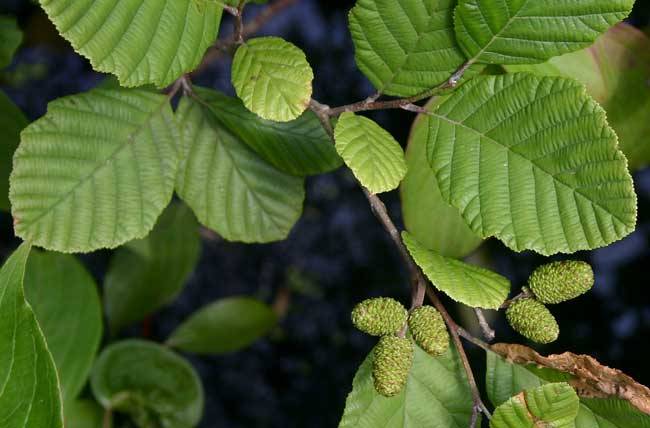
Quadell · CC BY-SA 3.0
Grey alder
Tree·Alnus incana
Part shade to full sun
Sun
Dry to wet soil
Water
Not recorded
Drainage
Zones 2–7
Hardiness
Coverage · 116 fields
No obvious inconsistencies found.
Growth and size11 fields
Plant type
Deciduous tree“Alnus incana is a deciduous Tree growing to 18 m (59ft) by 5 m (16ft) at a fast rate.”
Height
1,800 cm · the source gives 1,500–2,000 cm“It is a small- to medium-sized tree 15–20 metres (49–66 ft) tall with smooth grey bark even in old age, its life span being a maximum of 60 to 100 years.”PFAF“Alnus incana is a deciduous Tree growing to 18 m (59ft) by 5 m (16ft) at a fast rate.”
Spread
500 cm“Alnus incana is a deciduous Tree growing to 18 m (59ft) by 5 m (16ft) at a fast rate.”
Height at age
—
empty
Size after planting
17 yrs: 9.5 m tall, 5 m crown · 35 yrs: 12 m tall, 5 m crown · 72 yrs: 17 m tall, 8 m crown“Berlin tree register: 201 trees of this species measured with years since planting, height and crown diameter; median crown 8.0 m and height 17.0 m at 60–100 years after planting (37 trees).”Median of 201 measured trees in Berlin. Years count from planting nursery stock, so a small tree reaches each size later.
Spacing
500 cm (at least 300 cm)
AI estimate55 % agree
Growth rate
Fast“Alnus incana is a light-demanding, fast-growing tree that grows well on poorer soils.”
Habit
Columnar
AI estimate50 % agree
Root depth
Shallow“The grey alder has a shallow root system, and is marked not only by vigorous production of stump suckers, but also by root suckers, especially in the northern parts of its range.”
Forest garden layer
Lower tree layer
AI estimate90 % agree
Roots6 fields
Root form
Heart root“The root pattern is branching: a heart root, dividing from the crown into several primary roots going down and out [2-1].”
Storage organ
None
AI estimate100 % agree
Lateral spread in cm
—
empty
Root depth in cm
—
empty
Mycorrhiza
—
empty
Light, water and soil9 fields
Sun
Full sun, light shade, part shade · best: full sun“It can grow in semi-shade (light woodland) or no shade.”
Hours of sun
6–12 h
AI estimatenot measured yet
Water
Dry, moist, wet · Medium“It prefers dry moist or wet soil.”Wikipedia“Tolerant of wetter soils, it can slowly spread with runners and is a common sight in swamps and wetlands.”JRC forest tree atlaspartly“It prefers mesic and moist conditions”
Drought tolerant
—
empty
Tolerates waterlogging
—
empty
Soil type
pH
3.5“able to stand pH levels of 3.5-4.0 without problems”PFAF“Suitable pH: mildly acid, neutral and basic (mildly alkaline) soils.”JRC forest tree atlas“it is tolerant of acid soils, able to stand pH levels of 3.5-4.0 without problems”
Compacted soil
Copes fairly well
AI estimatenot measured yet
Climate5 fields
Hardiness
Zone 2–7
AI estimatenot measured yet
Killing frost
-40 °C
AI estimatenot measured yet
Growing temperature
0–30 °C · optimal 10–25 °C
AI estimatenot measured yet
Chill hours
1,000 h
AI estimatenot measured yet
Native range
AL, AM, AT, AZ, BA, BG, BY, CA, CH, CZ, DE, EE, FI, FR, GE, GG, GR, HR, HU, IT, JE, LI, LT, LV, MC, MD, ME, MK, NL, NO, PL, PM, RO, RS, RU, SE, SI, SK, SM, TR, UA, US, VA, XK
Care (becomes tasks in Manage)1 fields
Pruning
November · lasts 30 days · dead, damaged, or crossing branches
AI estimatenot measured yet
Through the year5 fields
Fruiting
September · lasts 91 days“The seeds are small flat obovate samaras which ripen and disperse between September and November, usually by wind or water.”
Dying back
After the first frost · lasts 30 days“Cuttings of mature wood, taken as soon as the leaves fall in autumn, outdoors in sandy soil.”
PFAFpartly
Leafing out
After the last frost · lasts 30 days
AI estimatenot measured yet
Dormant
After the first frost · 30 days after · lasts 150 days
AI estimatenot measured yet
Edible parts and pollination4 fields
Male catkins
Boiled and eaten · February–June“Male catkins, which appear from late winter through early summer, can be boiled and eaten.”PFAF“Male catkins can also be harvested for their pollen, which can be sifted off and sprinkled back onto the cooked catkins; however, pollen may trigger allergies in sensitive individuals.”
Inner bark
Boiled in multiple changes of water, dried and ground into flour“The inner bark is technically edible but of very poor quality.”PFAF“Even then, the bitterness persists, and the flour has little nutritional value.”PFAF“It contains high levels of bitter tannins that require extensive processing—boiling in multiple changes of water, drying, and grinding into flour.”
Pollination
Needs a partner · monoecious“The species is monoecious (individual flowers are either male or female, but both sexes can be found on the same plant) and is pollinated by Wind.”
Pollinated by
Wind“The species is monoecious (individual flowers are either male or female, but both sexes can be found on the same plant) and is pollinated by Wind.”
Ecology6 fields
Attracts
Pollinators, birds
AI estimatenot measured yet
Pests
Lepidoptera caterpillars, alder woolly sawfly larvae“Several species of Lepidoptera use grey alder as a food plant for their caterpillars.”Wikipedia“The larvae of the alder woolly sawfly sometimes cause considerable defoliation to the grey alder.”
Diseases
Stem-decay fungi“older stems are prone to decay by a number of fungus species.”
Takes up
Nitrogen, calcium, magnesium
AI estimatenot measured yet
Mycorrhiza
Yes
AI estimatenot measured yet
Propagation and names4 fields
Methods
Seed sown in a cold frame as soon as it is ripe, only just covered, Cuttings of mature wood taken in autumn, in sandy soil, Root suckers“Seed - best sown in a cold frame as soon as it is ripe and only just covered”PFAF“Cuttings of mature wood, taken as soon as the leaves fall in autumn, outdoors in sandy soil.”CLO-PLA (clonal growth)“It spreads by suckers: new shoots from buds on its roots.”
Difficulty
2 / 5
AI estimatenot measured yet
Seed
requires cold stratification for 60-90 days
AI estimatenot measured yet
Not sorted yet65 fields
Fields the parser stores that this page has no row for yet. They show up here automatically, so nothing is hidden.
forage.DK.local_name
Grå-el
AI estimatenot measured yet
forage.DK.prep_cautions
Female catkins are not suitable for food., The sap and other tissues of alder contain tannins and are not suitable for consumption as food.“Female catkins are small and woody, eventually maturing into cone-like structures that are not suitable for food.”PFAF“The sap and other tissues of alder contain tannins and are not suitable for consumption as food.”
forage.DK.edibility_basis
inferred
AI estimatenot measured yet
forage.DK.foraging_months.notes
male catkins appear late winter through early summer; the bark is available year-round“Male catkins, which appear from late winter through early summer, can be boiled and eaten.”
PFAFpartly
forage.DK.foraging_months.months
2, 3, 4, 5, 6
AI estimatenot measured yet
forage.DK.foraging_months.year_round
true
AI estimatenot measured yet
forage.DK.habitat_affinity
riverbank, woodland, disturbed_ground“Grey alder can be found on stream banks, lake shores and damp meadows and also in bogs and nutrient-rich swamp communities.”Wikipedia“In the northern part of its range, it is a common tree species at sea level in forests, abandoned fields and on lakeshores.”JRC forest tree atlas“Able to withstand direct sunlight, it is a pioneer species, quickly colonising open disturbed areas and able to regenerate rapidly from root suckers; at its northern and elevational limits this is its main method of reproduction.”
forage.US.local_name
Grey alder
AI estimatenot measured yet
forage.US.edible_parts
[{"part":"male catkins","caution":"Pollen may trigger allergies in sensitive individuals.","preparation":"boiled and eaten","season_months":[2,3,4,5,6]},{"part":"inner bark","caution":"The bitterness persists, and the…“Male catkins, which appear from late winter through early summer, can be boiled and eaten.”PFAF“The inner bark is technically edible but of very poor quality.”PFAF“Male catkins can also be harvested for their pollen, which can be sifted off and sprinkled back onto the cooked catkins; however, pollen may trigger allergies in sensitive individuals.”PFAF“Even then, the bitterness persists, and the flour has little nutritional value.”PFAF“It contains high levels of bitter tannins that require extensive processing—boiling in multiple changes of water, drying, and grinding into flour.”
forage.US.prep_cautions
Female catkins are not suitable for food., The sap and other tissues of alder contain tannins and are not suitable for consumption as food.“Female catkins are small and woody, eventually maturing into cone-like structures that are not suitable for food.”PFAF“The sap and other tissues of alder contain tannins and are not suitable for consumption as food.”
forage.US.edibility_basis
inferred
AI estimatenot measured yet
forage.US.foraging_months.notes
male catkins appear late winter through early summer; the bark is available year-round“Male catkins, which appear from late winter through early summer, can be boiled and eaten.”
PFAFpartly
forage.US.foraging_months.months
2, 3, 4, 5, 6
AI estimatenot measured yet
forage.US.foraging_months.year_round
true
AI estimatenot measured yet
forage.US.habitat_affinity
riverbank, woodland, disturbed_ground“Grey alder can be found on stream banks, lake shores and damp meadows and also in bogs and nutrient-rich swamp communities.”Wikipedia“In the northern part of its range, it is a common tree species at sea level in forests, abandoned fields and on lakeshores.”JRC forest tree atlas“Able to withstand direct sunlight, it is a pioneer species, quickly colonising open disturbed areas and able to regenerate rapidly from root suckers; at its northern and elevational limits this is its main method of reproduction.”
forage.TROPICAL.edibility_basis
inferred
AI estimatenot measured yet
forage.TROPICAL.foraging_months.notes
Not typically found in tropical regions.
AI estimatenot measured yet
forage.TROPICAL.foraging_months.year_round
false
AI estimatenot measured yet
ornamental.basis
documented
AI estimatenot measured yet
ornamental.fragrance.source
none
AI estimate100 % agree
ornamental.fragrance.intensity
subtle
AI estimatenot measured yet
ornamental.confidence
high
AI estimatenot measured yet
ornamental.fall_interest
true
AI estimatenot measured yet
ornamental.evidence_quote
Alnus incana, commonly known as grey alder, is a fast-growing, medium-sized deciduous tree. Its leaves are green, turning yellow-green in autumn. The bark is smooth and grey, providing winter interest. Flowers are insignificant catkins.
AI estimatenot measured yet
ornamental.foliage_texture
medium
AI estimatenot measured yet
ornamental.winter_structure
ornamental_bark, architectural_skeleton
AI estimatenot measured yet
ornamental.autumn_foliage_colour
yellow_green
AI estimatenot measured yet
care_regime
none
AI estimatenot measured yet
propagation.self_seeding
moderate
AI estimate20 % agree
propagation.division_season
not applicable
AI estimatenot measured yet
propagation.establishment_years
2
AI estimate40 % agree
size_at_age.v
1
AI estimatenot measured yet
size_at_age.basis
years_after_planting
AI estimatenot measured yet
spatial_profile.canopy_density
medium
AI estimatenot measured yet
forage_proposals.DK.edibility_tier.tier
caution“The inner bark is technically edible but of very poor quality.”
PFAFpartly
forage_proposals.DK.edibility_tier.confidence
medium
AI estimatenot measured yet
forage_proposals.DK.edibility_tier.evidence_quote
It contains high levels of bitter tannins that require extensive processing—boiling in multiple changes of water, drying, and grinding into flour.
AI estimatenot measured yet
forage_proposals.US.edibility_tier.tier
caution“The inner bark is technically edible but of very poor quality.”
PFAFpartly
forage_proposals.US.edibility_tier.confidence
medium
AI estimatenot measured yet
forage_proposals.US.edibility_tier.evidence_quote
It contains high levels of bitter tannins that require extensive processing—boiling in multiple changes of water, drying, and grinding into flour.
AI estimatenot measured yet
forage_proposals.TROPICAL.edibility_tier.confidence
low
AI estimatenot measured yet
function_profile.biomass_return.confidence
high“when the leaves fall in the autumn they help to build up the humus content of the soil”
PFAFpartly
function_profile.nutrient_flows.consumes
[{"basis":"documented","demand":"moderate","nutrient":"nitrogen","confidence":"high"},{"basis":"inferred","demand":"moderate","nutrient":"phosphorus","confidence":"medium"},{"basis":"inferred","demand":"moderate","nut…
AI estimatenot measured yet
function_profile.nutrient_flows.provides
[{"basis":"documented","nutrient":"nitrogen","mechanism":"fixation","confidence":"high","evidence_quote":"It can fix Nitrogen."},{"basis":"inferred","nutrient":"nitrogen","mechanism":"biomass_return","confidence":"med…“It can fix Nitrogen.”
function_profile.biotic_interactions
[{"taxa":["Lepidoptera caterpillars"],"basis":"documented","valence":"neutral","relation":"hosts","confidence":"medium","evidence_quote":"Several species of Lepidoptera use grey alder as a food plant for their caterpi…“Several species of Lepidoptera use grey alder as a food plant for their caterpillars.”Wikipedia“The larvae of the alder woolly sawfly sometimes cause considerable defoliation to the grey alder.”JRC forest tree atlas“older stems are prone to decay by a number of fungus species.”
function_profile.aromatic_pest_effect.value
false
AI estimate80 % agree
function_profile.aromatic_pest_effect.confidence
high
AI estimatenot measured yet
function_profile.structural_interfaces.provides_shelter.basis
documented
AI estimatenot measured yet
function_profile.structural_interfaces.provides_shelter.kinds
wind, shade
AI estimatenot measured yet
function_profile.structural_interfaces.provides_shelter.confidence
high
AI estimatenot measured yet
function_profile.structural_interfaces.provides_shelter.evidence_quote
Its fast rate of growth means that it quickly provides sheltered conditions to allow more permanent woodland trees to become established.
AI estimatenot measured yet
function_profile.structural_interfaces.requires_shelter.basis
taxonomic
AI estimatenot measured yet
function_profile.structural_interfaces.requires_shelter.confidence
high
AI estimatenot measured yet
function_profile.structural_interfaces.provides_physical_support.form
trunk
AI estimatenot measured yet
function_profile.structural_interfaces.provides_physical_support.basis
taxonomic
AI estimatenot measured yet
function_profile.structural_interfaces.provides_physical_support.confidence
high
AI estimatenot measured yet
function_profile.structural_interfaces.requires_physical_support.basis
taxonomic
AI estimatenot measured yet
function_profile.structural_interfaces.requires_physical_support.confidence
high
AI estimatenot measured yet
climate_tolerance.photoperiod_response
long_day
AI estimatenot measured yet
soil_interactions.organic_matter_contribution
high
AI estimatenot measured yet
component_metadata.growth_cycle
perennial
AI estimate100 % agree
resource_interfaces.inputs
[{"resource":"light","quantity_description":"light-demanding"},{"resource":"water","quantity_description":"prefers moist to wet soil; tolerates drier soil than many alders"}]“Alnus incana is a light-demanding, fast-growing tree that grows well on poorer soils.”PFAFpartly“Thrives in drier soils than many other members of this genus.”
resource_interfaces.outputs
[{"resource":"shade","quantity_description":"heavy leaf canopy"},{"resource":"wind_shelter","quantity_description":"quickly provides sheltered conditions for slower woodland trees to establish"},{"resource":"leaf_litt…“Alder trees also have a heavy leaf canopy”PFAF“Its fast rate of growth means that it quickly provides sheltered conditions to allow more permanent woodland trees to become established.”PFAF“when the leaves fall in the autumn they help to build up the humus content of the soil”JRC forest tree atlas“The seeds are small flat obovate samaras which ripen and disperse between September and November, usually by wind or water.”PFAFpartly“Wood - light, soft, fairly elastic, easy to split.”