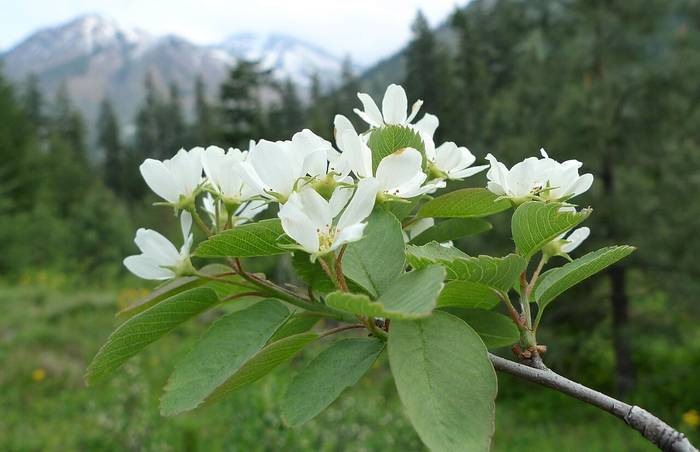
Thayne Tuason · CC BY-SA 4.0
Saskatoon berry
Shrub·Amelanchier alnifolia
Part shade to full sun
Sun
Dry to moist soil
Water
Not recorded
Drainage
Zones 2–7
Hardiness
Coverage · 121 fields
- Parser flag (climate_tolerance_low_confidence): Climate tolerance values are LLM-extracted (no authoritative EcoCrop match found). EcoCrop covers ~2,568 food-crop taxa; ornamental/native/medicinal species rely on LLM extraction.
- Killing frost (-20 °C) doesn't fit hardiness zone 2, which survives far lower temperatures.
Growth and size10 fields
Plant type
Deciduous shrub“Amelanchier alnifolia is a deciduous Shrub growing to 4 m (13ft) by 3 m (9ft) at a medium rate.”
Height
400 cm“Amelanchier alnifolia is a deciduous Shrub growing to 4 m (13ft) by 3 m (9ft) at a medium rate.”
Spread
300 cm“Amelanchier alnifolia is a deciduous Shrub growing to 4 m (13ft) by 3 m (9ft) at a medium rate.”
Height at age
—
empty
Spacing
91 cm (at least 46 cm)“Seedlings are planted with 4.0–6.1 m (13–20 ft) between rows and 0.46–0.91 m (1.5–3 ft) between plants.”
Growth rate
Medium“Amelanchier alnifolia is a deciduous Shrub growing to 4 m (13ft) by 3 m (9ft) at a medium rate.”
Habit
Spreading
AI estimate50 % agree
Root depth
Medium
AI estimate63 % agree
Forest garden layer
Shrub layer
AI estimate90 % agree
Lifespan
~50 years
AI estimatenot measured yet
Roots6 fields
Root form
Fibrous roots
AI estimate43 % agree
Storage organ
None
AI estimate100 % agree
Lateral spread in cm
—
empty
Root depth in cm
—
empty
Mycorrhiza
Arbuscular (AM)
AI estimatenot measured yet
Light, water and soil9 fields
Sun
Full sun, light shade, part shade · best: full sun“Prefers a rich loamy soil in a sunny position or semi-shade but thrives in any soil that is not too dry or water-logged.”PFAF“It can grow in semi-shade (light woodland) or no shade.”
Hours of sun
6 h
AI estimatenot measured yet
Water
Tolerates waterlogging
No“Saskatoons are adaptable to most soil types with exception of poorly drained or heavy clay soils lacking organic matter.”
Wikipediapartly
Soil type
Sand, loam, clay · best: loam“Prefers a rich loamy soil in a sunny position or semi-shade but thrives in any soil that is not too dry or water-logged.”PFAF“Suitable for: light (sandy), medium (loamy) and heavy (clay) soils and can grow in heavy clay soil.”
Drainage
Moist, well-drained“Thickets, woodland edges and banks of streams in moist well-drained soils.”
Compacted soil
Copes fairly well
AI estimatenot measured yet
Climate5 fields
Hardiness
Zone 2–7
Killing frost (-20 °C) doesn't fit hardiness zone 2, which survives far lower temperatures.
AI estimatenot measured yet
Killing frost
-20 °C“Hardy to about -20°c according to one report”
Killing frost (-20 °C) doesn't fit hardiness zone 2, which survives far lower temperatures.
Growing temperature
0–30 °C · optimal 15–25 °C
AI estimatenot measured yet
Chill hours
800 h
AI estimatenot measured yet
Native range
—
empty
Care (becomes tasks in Manage)4 fields
Pruning
March · lasts 30 days · new growth for future fruit production · dead, damaged, or crossing branches, and older, less productive canes
AI estimatenot measured yet
Feeding
April · lasts 15 days · a balanced granular fertiliser or well-rotted compost
AI estimatenot measured yet
Mulching
May · lasts 30 days
AI estimatenot measured yet
Watering
After rain · lasts 120 days
AI estimatenot measured yet
Through the year6 fields
Leafing out
After the last frost · lasts 30 days
AI estimatenot measured yet
Dying back
After the first frost · lasts 30 days
AI estimatenot measured yet
Dormant
After the first frost · 30 days after · lasts 150 days
AI estimatenot measured yet
First harvest
2–4 years after plantingManitoba Agriculture: "Saskatoons begin to bear fruit when three to five years old" (plant age).
Edible parts and pollination5 fields
Pollination
Pollinated by
Bees“The species is hermaphrodite (has both male and female organs) and is pollinated by Bees.”
Ecology5 fields
Attracts
Bees, birds, squirrels, bears“The species is hermaphrodite (has both male and female organs) and is pollinated by Bees.”PFAF“The main draw-back to this genus is that birds adore the fruit and will often completely strip a tree before it is fully ripe[K].”Wikipedia“The fruit are eaten by wildlife including birds, squirrels, and bears.”
Pests
Aphids, thrips, mites, bud moths, saskatoon sawflies, pear slug sawflies“Problem insects include aphids, thrips, mites, bud moths, saskatoon sawflies, and pear slug sawflies.”
Diseases
Cedar-apple rust, entomosporium leaf spot, fireblight, brown rot, cytospora canker, powdery mildew, blackleaf“A. alnifolia is susceptible to cedar-apple rust, Entomosporium leaf spot, fireblight, brown rot, Cytospora canker, powdery mildew, and blackleaf.”
Takes up
Calcium, magnesium, potassium
AI estimatenot measured yet
Fixes nitrogen
No
AI estimatenot measured yet
Propagation and names4 fields
Methods
Difficulty
2 / 5
AI estimatenot measured yet
Seed
4 weeks warm stratification before winter
AI estimatenot measured yet
Not sorted yet67 fields
Fields the parser stores that this page has no row for yet. They show up here automatically, so nothing is hidden.
forage.DK.local_name
Saskatoonbær
AI estimatenot measured yet
forage.DK.warnings_da
Frø og bark må ikke spises.
AI estimatenot measured yet
forage.DK.warnings_en
Don't eat the seeds or bark.
AI estimatenot measured yet
forage.DK.prep_cautions
Leaves, bark and seeds contain cyanogenic compounds (prunasin) and are considered inedible.
AI estimatenot measured yet
forage.DK.edibility_basis
inferred
AI estimatenot measured yet
forage.DK.foraging_months.notes
early July in southern Britain
AI estimatenot measured yet
forage.DK.foraging_months.months
7, 8“The fruit ripens in mid summer (early July in southern Britain), it is soft and juicy with a few small seeds in the centre.”
PFAFpartly
forage.DK.foraging_months.year_round
false
AI estimatenot measured yet
forage.DK.habitat_affinity
woodland, riverbank“Thickets, woodland edges and banks of streams in moist well-drained soils.”
forage.US.local_name
Saskatoon berry
AI estimatenot measured yet
forage.US.edible_parts
[{"part":"fruit","caution":null,"preparation":"fresh or dried","season_months":[6,7]}]“It is a member of the rose family, and bears an edible berry-like fruit.”Wikipedia“With a sweet, nutty taste, the fruits have long been eaten by Indigenous peoples in Canada, fresh or dried.”
forage.US.prep_cautions
Leaves, bark and seeds contain cyanogenic compounds (prunasin) and are considered inedible.
AI estimatenot measured yet
forage.US.edibility_basis
inferred
AI estimatenot measured yet
forage.US.foraging_months.notes
Birds often strip the bush before the fruit is fully ripe.
AI estimatenot measured yet
forage.US.foraging_months.year_round
false
AI estimatenot measured yet
forage.US.habitat_affinity
woodland, riverbank
AI estimatenot measured yet
forage.TROPICAL.edibility_basis
inferred
AI estimatenot measured yet
forage.TROPICAL.foraging_months.notes
Not typically found in tropical regions.
AI estimatenot measured yet
forage.TROPICAL.foraging_months.year_round
false
AI estimatenot measured yet
ornamental.basis
documented
AI estimatenot measured yet
ornamental.fragrance.source
flower
AI estimate100 % agree
ornamental.fragrance.intensity
subtle
AI estimatenot measured yet
ornamental.confidence
high
AI estimatenot measured yet
ornamental.fall_interest
true
AI estimatenot measured yet
ornamental.evidence_quote
Amelanchier alnifolia, commonly known as Saskatoon berry, produces white flowers in spring, followed by edible purplish-black fruit. Its green foliage turns attractive shades of yellow-green and red in autumn. The plant offers subtle fragrance from its flowers and provides winter interest with its persistent fruit.
AI estimatenot measured yet
ornamental.foliage_colour
green
AI estimate82 % agree
ornamental.foliage_texture
medium
AI estimatenot measured yet
ornamental.winter_structure
persistent_fruit
AI estimatenot measured yet
ornamental.autumn_foliage_colour
yellow_green, red
AI estimatenot measured yet
care_regime
none
AI estimatenot measured yet
propagation.self_seeding
moderate
AI estimate20 % agree
propagation.establishment_years
2“Grow the seedlings on for two years in the seedbed before planting them out into their permanent positions during the winter.”
forage_proposals.DK.edibility_tier.confidence
high
AI estimatenot measured yet
forage_proposals.DK.edibility_tier.evidence_quote
The berries are sweet and juicy, excellent for eating fresh or in pies, jams, and jellies.
AI estimatenot measured yet
forage_proposals.US.edibility_tier.tier
edible“It is a member of the rose family, and bears an edible berry-like fruit.”
forage_proposals.US.edibility_tier.confidence
high
AI estimatenot measured yet
forage_proposals.US.edibility_tier.evidence_quote
Saskatoon berries are highly prized for their sweet flavor and versatility in culinary applications, including fresh eating, baking, and preserves.
AI estimatenot measured yet
forage_proposals.TROPICAL.edibility_tier.confidence
low
AI estimatenot measured yet
function_profile.biomass_return.confidence
medium
AI estimatenot measured yet
function_profile.nutrient_flows.consumes
[{"basis":"documented","demand":"moderate","nutrient":"nitrogen","confidence":"high"},{"basis":"documented","demand":"moderate","nutrient":"phosphorus","confidence":"high"},{"basis":"documented","demand":"moderate","n…
AI estimatenot measured yet
function_profile.nutrient_flows.provides
[{"basis":"inferred","nutrient":"calcium","mechanism":"biomass_return","confidence":"low"},{"basis":"inferred","nutrient":"magnesium","mechanism":"biomass_return","confidence":"low"},{"basis":"inferred","nutrient":"po…
AI estimatenot measured yet
function_profile.biotic_interactions
[{"taxa":["bees"],"basis":"documented","valence":"beneficial","relation":"attracts","confidence":"high","evidence_quote":"The species is hermaphrodite (has both male and female organs) and is pollinated by Bees.","org…“The species is hermaphrodite (has both male and female organs) and is pollinated by Bees.”Wikipedia“Problem insects include aphids, thrips, mites, bud moths, saskatoon sawflies, and pear slug sawflies.”Wikipedia“A. alnifolia is susceptible to cedar-apple rust, Entomosporium leaf spot, fireblight, brown rot, Cytospora canker, powdery mildew, and blackleaf.”Wikipedia“The foliage is browsed by deer, elk, rabbits, and livestock.”PFAF“The main draw-back to this genus is that birds adore the fruit and will often completely strip a tree before it is fully ripe[K].”Wikipedia“It is also a larval host to the pale tiger swallowtail, two-tailed swallowtail, and the western tiger swallowtail.”Wikipediapartly“The fruit are eaten by wildlife including birds, squirrels, and bears.”
function_profile.aromatic_pest_effect.value
false
AI estimate80 % agree
function_profile.aromatic_pest_effect.confidence
low
AI estimatenot measured yet
function_profile.structural_interfaces.provides_shelter.basis
documented
AI estimatenot measured yet
function_profile.structural_interfaces.provides_shelter.kinds
wind“Plants have a spreading, suckering root system and are used in windbreaks for erosion control.”
function_profile.structural_interfaces.provides_shelter.confidence
high
AI estimatenot measured yet
function_profile.structural_interfaces.provides_shelter.evidence_quote
Plants have a spreading, suckering root system and are used in windbreaks for erosion control.
AI estimatenot measured yet
function_profile.structural_interfaces.requires_shelter.basis
inferred
AI estimatenot measured yet
function_profile.structural_interfaces.requires_shelter.confidence
low
AI estimatenot measured yet
function_profile.structural_interfaces.provides_physical_support.form
dense_thicket“A stoloniferous species, spreading by suckers to form a thicket.”
function_profile.structural_interfaces.provides_physical_support.basis
taxonomic
AI estimatenot measured yet
function_profile.structural_interfaces.provides_physical_support.confidence
medium
AI estimatenot measured yet
function_profile.structural_interfaces.provides_physical_support.evidence_quote
A stoloniferous species, spreading by suckers to form a thicket.
AI estimatenot measured yet
function_profile.structural_interfaces.requires_physical_support.basis
inferred
AI estimatenot measured yet
function_profile.structural_interfaces.requires_physical_support.confidence
low
AI estimatenot measured yet
climate_tolerance.photoperiod_response
day_neutral
AI estimatenot measured yet
soil_interactions.organic_matter_contribution
medium
AI estimatenot measured yet
component_metadata.growth_cycle
perennial
AI estimate100 % agree
resource_interfaces.inputs
[{"resource":"light","quantity_description":"large amounts of sunshine for fruit ripening"},{"resource":"water","quantity_description":"moist soil; tolerates drought"},{"resource":"shade","quantity_description":"semi-…“Large amounts of sunshine are needed for fruit ripening.”PFAF“It prefers moist soil and can tolerate drought.”PFAF“It can grow in semi-shade (light woodland) or no shade.”PFAF“The species is hermaphrodite (has both male and female organs) and is pollinated by Bees.”
resource_interfaces.outputs
[{"resource":"fruit","quantity_description":"small clusters, about the size of a blackcurrant"},{"resource":"wind_shelter","quantity_description":"used in windbreaks"},{"resource":"timber","quantity_description":"hard…“Plants have a spreading, suckering root system and are used in windbreaks for erosion control.”PFAF“Wood - hard, straight grained, tough. Used for tool handles etc.”PFAF“About the size of a blackcurrant, the fruit is produced in small clusters and the best wild forms can be 15mm in diameter.”PFAFpartly“Edible fruit - raw or cooked.”