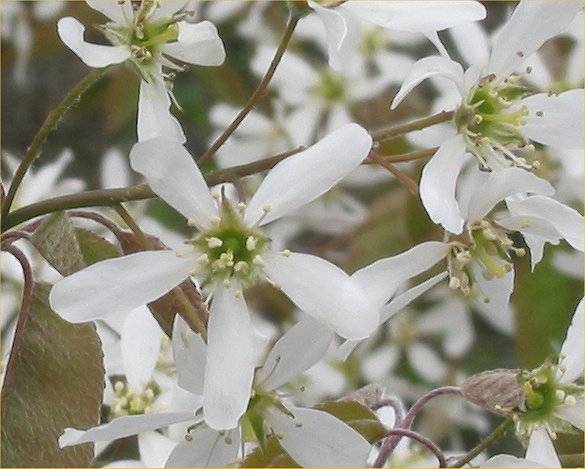
Rasbak · CC BY-SA 3.0
Canadian serviceberry
Shrub·Amelanchier canadensis
Part shade to full sun
Sun
Moist to wet soil
Water
Not recorded
Drainage
Zones 3–8
Hardiness
Coverage · 116 fields
- Parser flag (layer_mismatch): The plant is categorized as a 'tree' in component_metadata.category but 'shrub' in spatial_profile.layer. Amelanchier canadensis can be either a large shrub or a small tree, but these two fields should be consistent.
Growth and size10 fields
Plant type
Deciduous shrub“Amelanchier canadensis is a deciduous Shrub growing to 6 m (19ft) by 3 m (9ft) at a medium rate.”Wikipediapartly“It is a deciduous shrub or small tree”
Height
600 cm · the source gives 50–800 cm“It is a deciduous shrub or small tree growing to 0.5–8 metres (1.6–26.2 ft) tall with one to many stems and a narrow, fastigiate crown.”PFAF“Amelanchier canadensis is a deciduous Shrub growing to 6 m (19ft) by 3 m (9ft) at a medium rate.”
Spread
300 cm“Amelanchier canadensis is a deciduous Shrub growing to 6 m (19ft) by 3 m (9ft) at a medium rate.”
Height at age
—
empty
Spacing
300 cm (at least 200 cm)
AI estimate55 % agree
Growth rate
Medium“Amelanchier canadensis is a deciduous Shrub growing to 6 m (19ft) by 3 m (9ft) at a medium rate.”
Root depth
Medium
AI estimate63 % agree
Forest garden layer
Shrub layer
AI estimate90 % agree
Lifespan
~40 years
AI estimatenot measured yet
Roots6 fields
Root form
Fibrous roots
AI estimate43 % agree
Storage organ
None
AI estimate100 % agree
Lateral spread in cm
—
empty
Root depth in cm
—
empty
Mycorrhiza
Arbuscular (AM)
AI estimatenot measured yet
Light, water and soil9 fields
Sun
Full sun, light shade, part shade · best: full sun“It can grow in semi-shade (light woodland) or no shade.”PFAFpartly“Prefers a rich loamy soil in a sunny position or semi-shade”
Hours of sun
6–12 h
AI estimatenot measured yet
Water
Moist, wet · best: moist · Medium“It is largely restricted to wet sites, particularly on the Atlantic coastal plain, growing at altitudes from sea level up to 200 m.”PFAFpartly“It prefers moist soil.”
Drought tolerant
—
empty
Tolerates waterlogging
—
empty
Soil type
Sand, loam, clay · best: loam“Prefers a rich loamy soil in a sunny position or semi-shade but thrives in any soil that is not water-logged, too dry or poor, though it is more wet-tolerant than other members of this genus.”PFAF“Suitable for: light (sandy), medium (loamy) and heavy (clay) soils and can grow in heavy clay soil.”
Compacted soil
Copes fairly well
AI estimatenot measured yet
Climate5 fields
Hardiness
Zone 3–8
AI estimatenot measured yet
Killing frost
-35 °C
AI estimatenot measured yet
Growing temperature
0–30 °C · optimal 10–25 °C
AI estimatenot measured yet
Chill hours
800 h
AI estimatenot measured yet
Care (becomes tasks in Manage)4 fields
Pruning
January · lasts 30 days · dead, damaged, or crossing branches
AI estimatenot measured yet
Mulching
April · lasts 30 days
AI estimatenot measured yet
Watering
After rain · lasts 120 days
AI estimatenot measured yet
Through the year6 fields
Harvest
After the previous stage · lasts 30 days
AI estimatenot measured yet
Leafing out
After the last frost · lasts 30 days
AI estimatenot measured yet
Dying back
After the first frost · lasts 30 days
AI estimatenot measured yet
Dormant
After the first frost · 30 days after · lasts 150 days
AI estimatenot measured yet
Edible parts and pollination4 fields
The fruit
Raw or cooked; eaten out of hand, in pies or preserves, or dried like raisins.
AI estimatenot measured yet
Pollination
Self-fertile · hermaphrodite“The species is hermaphrodite (has both male and female organs) and is pollinated by Bees.”PFAF“The plant is self-fertile.”
Pollinated by
Bees“The species is hermaphrodite (has both male and female organs) and is pollinated by Bees.”
Ecology5 fields
Attracts
Birds, small mammals, butterflies, bees“Attracts birds, North American native, Attracts butterflies, Blooms are very showy.”Wikipedia“The fruits are a food source for many different species of birds and small mammals including cardinals, woodpeckers, robins, orioles, chipmunks, and squirrels.”Wikipedia“it is an important food source for pollinators like butterflies and honeybees.”PFAF“The species is hermaphrodite (has both male and female organs) and is pollinated by Bees.”
Pests
Sawfly, leaf miners, borers, scales“Insects that can burden the tree include the sawfly, leaf miners, borers, and scales.”
Diseases
Rust leaf spot blight, apple powdery mildew, gymnosporangium rust“Rust leaf spot blight and apple powdery mildew can occur on Amelanchier canadensis.”Wikipedia“Gymnosporangium infecting leaves will begin to produce yellow circular marks.”
Takes up
Calcium, magnesium, potassium
AI estimatenot measured yet
Fixes nitrogen
No
AI estimatenot measured yet
Propagation and names4 fields
Methods
Difficulty
2 / 5
AI estimatenot measured yet
Seed
4 weeks warm stratification, if stored seed is available in autumn“If stored seed is obtained early enough in the autumn, it can be given 4 weeks warm stratification before being left out in the winter and it should then germinate in the spring.”
Not sorted yet63 fields
Fields the parser stores that this page has no row for yet. They show up here automatically, so nothing is hidden.
forage.DK.local_name
Bærmispel
AI estimatenot measured yet
forage.DK.edibility_basis
inferred
AI estimatenot measured yet
forage.DK.foraging_months.notes
Fruits ripen in early summer.
AI estimatenot measured yet
forage.DK.foraging_months.months
6, 7
AI estimatenot measured yet
forage.DK.foraging_months.year_round
false
AI estimatenot measured yet
forage.DK.habitat_affinity
hedgerow, woodland
AI estimatenot measured yet
forage.US.local_name
Canadian serviceberry
AI estimatenot measured yet
forage.US.edible_parts
forage.US.prep_cautions
fruit quality is variable and some forms are distinctly bitter“We have found the fruit to be of variable quality, with some forms having a distinct bitterness in the flavour whilst others are sweet, juicy and delicious[K].”
forage.US.edibility_basis
inferred
AI estimatenot measured yet
forage.US.foraging_months.notes
Fruits ripen in early summer.
AI estimatenot measured yet
forage.US.foraging_months.months
6, 7“Fruits become ripe in June and July in its native range.”
forage.US.foraging_months.year_round
false
AI estimatenot measured yet
forage.US.habitat_affinity
woodland, hedgerow, riverbank“Swamps, low ground, woods and thickets.”
PFAFpartly
forage.TROPICAL.edibility_basis
inferred
AI estimatenot measured yet
forage.TROPICAL.foraging_months.year_round
false
AI estimatenot measured yet
ornamental.basis
documented
AI estimatenot measured yet
ornamental.fragrance.source
flower
AI estimate100 % agree
ornamental.fragrance.intensity
subtle
AI estimatenot measured yet
ornamental.confidence
high
AI estimatenot measured yet
ornamental.fall_interest
true
AI estimatenot measured yet
ornamental.evidence_quote
Amelanchier canadensis, commonly known as Canadian serviceberry, produces white flowers in spring, followed by green foliage that turns yellow-green to red in autumn. It has medium-textured foliage and offers fall interest with its autumn color and persistent fruit. The bark is also ornamental, and the flowers have a subtle fragrance.
AI estimatenot measured yet
ornamental.foliage_colour
green
AI estimate82 % agree
ornamental.foliage_texture
medium
AI estimatenot measured yet
ornamental.winter_structure
ornamental_bark, coloured_stems“They have a brown or copper color.”
Wikipediapartly
ornamental.autumn_foliage_colour
yellow_green, red
AI estimatenot measured yet
care_regime
light
AI estimatenot measured yet
propagation.self_seeding
moderate
AI estimate20 % agree
propagation.establishment_years
2“Grow the seedlings on for two years in the seedbed before planting them out into their permanent positions during the winter.”
sun_requirement.best
full_sun“Trees produce more and better quality fruits better when growing in a sunny position.”
PFAFpartly
sun_requirement.best_for
fruit“Trees produce more and better quality fruits better when growing in a sunny position.”
forage_proposals.DK.edibility_tier.tier
choice
AI estimatenot measured yet
forage_proposals.DK.edibility_tier.confidence
high
AI estimatenot measured yet
forage_proposals.DK.edibility_tier.evidence_quote
The berries are sweet and juicy, excellent for eating raw or cooked in pies, jams, and jellies.
AI estimatenot measured yet
forage_proposals.US.edibility_tier.tier
edible
AI estimatenot measured yet
forage_proposals.US.edibility_tier.confidence
high
AI estimatenot measured yet
forage_proposals.US.edibility_tier.evidence_quote
The berries are sweet and juicy, excellent for eating raw or cooked in pies, jams, and jellies.
AI estimatenot measured yet
forage_proposals.TROPICAL.edibility_tier.confidence
low
AI estimatenot measured yet
function_profile.biomass_return.confidence
medium
AI estimatenot measured yet
function_profile.nutrient_flows.consumes
[{"basis":"documented","demand":"moderate","nutrient":"nitrogen","confidence":"high"},{"basis":"documented","demand":"moderate","nutrient":"phosphorus","confidence":"high"},{"basis":"documented","demand":"moderate","n…
AI estimatenot measured yet
function_profile.nutrient_flows.provides
[{"basis":"inferred","nutrient":"calcium","mechanism":"biomass_return","confidence":"low"},{"basis":"inferred","nutrient":"magnesium","mechanism":"biomass_return","confidence":"low"},{"basis":"inferred","nutrient":"po…
AI estimatenot measured yet
function_profile.biotic_interactions
[{"taxa":["bees","honeybees","butterflies"],"basis":"documented","valence":"beneficial","relation":"attracts","confidence":"high","evidence_quote":"The serviceberry blooms early in the spring. it is an important food …“The main draw-back to this genus is that birds adore the fruit and will often completely strip a tree before it is fully ripe[K].”Wikipedia“Insects that can burden the tree include the sawfly, leaf miners, borers, and scales.”PFAF“The species is hermaphrodite (has both male and female organs) and is pollinated by Bees.”Wikipedia“Gymnosporangium infecting leaves will begin to produce yellow circular marks.”Wikipediapartly“The serviceberry blooms early in the spring. it is an important food source for pollinators like butterflies and honeybees.”Wikipediapartly“The fruits are a food source for many different species of birds and small mammals including cardinals, woodpeckers, robins, orioles, chipmunks, and squirrels.”Wikipediapartly“Rust leaf spot blight and apple powdery mildew can occur on Amelanchier canadensis.”
function_profile.aromatic_pest_effect.value
false
AI estimate80 % agree
function_profile.aromatic_pest_effect.confidence
high
AI estimatenot measured yet
function_profile.structural_interfaces.provides_shelter.basis
documented“A fairly wind-tolerant species, it can be used to give protection from the wind as part of a mixed shelterbelt.”
function_profile.structural_interfaces.provides_shelter.kinds
wind“A fairly wind-tolerant species, it can be used to give protection from the wind as part of a mixed shelterbelt.”
function_profile.structural_interfaces.provides_shelter.confidence
high“A fairly wind-tolerant species, it can be used to give protection from the wind as part of a mixed shelterbelt.”
function_profile.structural_interfaces.provides_shelter.evidence_quote
A fairly wind-tolerant species, it can be used to give protection from the wind as part of a mixed shelterbelt.“A fairly wind-tolerant species, it can be used to give protection from the wind as part of a mixed shelterbelt.”
function_profile.structural_interfaces.requires_shelter.basis
inferred
AI estimatenot measured yet
function_profile.structural_interfaces.requires_shelter.confidence
low
AI estimatenot measured yet
function_profile.structural_interfaces.requires_shelter.evidence_quote
It is hardy to UK zone 4 and is not frost tender.
AI estimatenot measured yet
function_profile.structural_interfaces.provides_physical_support.form
stout_stem
AI estimatenot measured yet
function_profile.structural_interfaces.provides_physical_support.basis
taxonomic
AI estimatenot measured yet
function_profile.structural_interfaces.provides_physical_support.confidence
high
AI estimatenot measured yet
function_profile.structural_interfaces.requires_physical_support.basis
taxonomic
AI estimatenot measured yet
function_profile.structural_interfaces.requires_physical_support.confidence
high
AI estimatenot measured yet
climate_tolerance.photoperiod_response
long_day
AI estimatenot measured yet
soil_interactions.organic_matter_contribution
medium
AI estimatenot measured yet
component_metadata.growth_cycle
perennial
AI estimate100 % agree
resource_interfaces.inputs
[{"resource":"light","quantity_description":"semi-shade (light woodland) or no shade"},{"resource":"water","quantity_description":"moist soil, not waterlogged"},{"resource":"pollination","quantity_description":"bee po…“It can grow in semi-shade (light woodland) or no shade.”PFAF“The species is hermaphrodite (has both male and female organs) and is pollinated by Bees.”PFAFpartly“It prefers moist soil.”
resource_interfaces.outputs
[{"resource":"fruit","quantity_description":"7 to 15 tonnes per hectare"},{"resource":"timber","quantity_description":"hard, strong, close-grained wood for tool handles"},{"resource":"wind_shelter","quantity_descripti…“A fairly wind-tolerant species, it can be used to give protection from the wind as part of a mixed shelterbelt.”PFAF“Trees can yield 7 to 15 tonnes per hectare.”PFAFpartly“Edible fruit - raw or cooked.”PFAFpartly“Wood - hard, strong, close grained.”Wikipediapartly“it is an important food source for pollinators like butterflies and honeybees.”