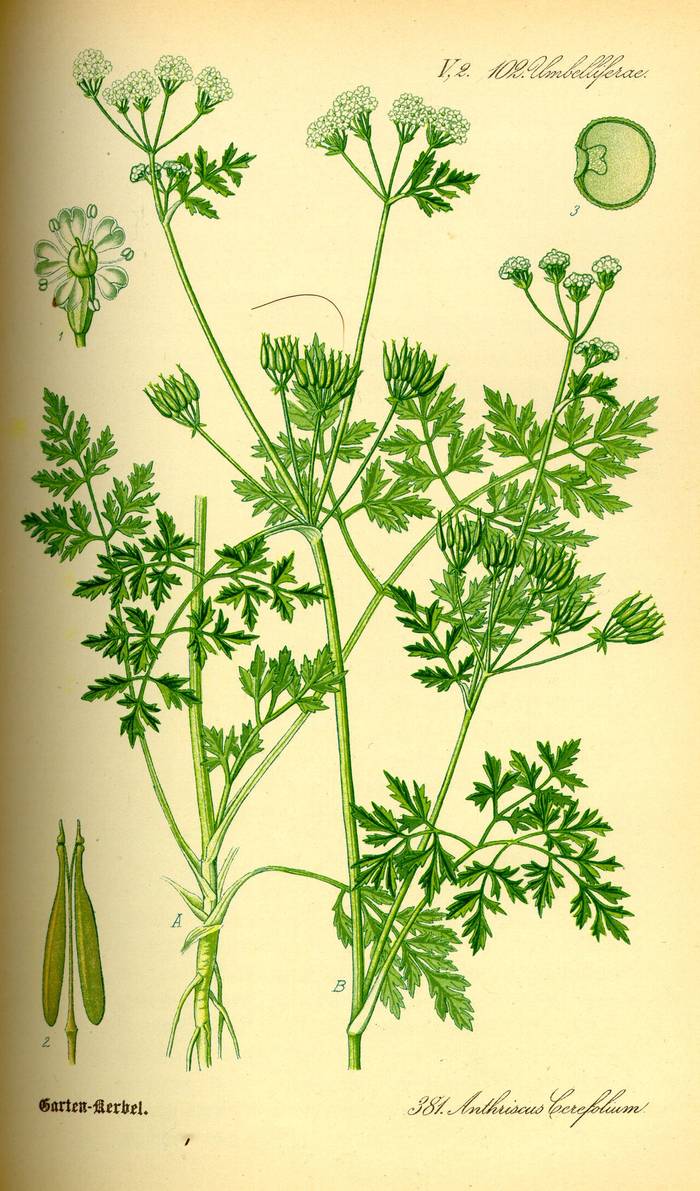
Chervil
Plant·Anthriscus cerefolium
Shade to full sun
Sun
Moist soil
Water
Not recorded
Drainage
Zones 2–11
Hardiness
Coverage · 112 fields
Growth and size10 fields
Plant type
Plant
AI estimate100 % agree
Height
50 cm · the source gives 40–70 cm“The plants grow to 40–70 cm (16–28 in), with tripinnate leaves that may be curly.”PFAF“Anthriscus cerefolium is a BIENNIAL growing to 0.5 m (1ft 8in) by 0.3 m (1ft).”
Height at age
—
empty
Spacing
20 cm (at least 15 cm)
AI estimate55 % agree
Growth rate
—
empty
Habit
Mounding
AI estimate50 % agree
Forest garden layer
Herb layer
AI estimate90 % agree
Lifespan
~1 years
AI estimatenot measured yet
Roots6 fields
Storage organ
None“It does not multiply vegetatively: it has no rhizomes, runners, suckers or offspring bulbs or tubers.”
Spreads
No“It does not multiply vegetatively: it has no rhizomes, runners, suckers or offspring bulbs or tubers.”
Lateral spread in cm
—
empty
Root depth in cm
—
empty
Mycorrhiza
—
empty
Light, water and soil9 fields
Sun
Full sun, light shade, part shade, shade · best: part shade“It can grow in full shade (deep woodland) semi-shade (light woodland) or no shade.”
Hours of sun
3–6 h
AI estimatenot measured yet
Drought tolerant
—
empty
Tolerates waterlogging
—
empty
Soil type
Sand, loam, clay“Suitable for: light (sandy), medium (loamy) and heavy (clay) soils and prefers well-drained soil.”
pH
5.8–7.6 · best 6–7“Tolerates a pH in the range 5.8 to 7.6.”PFAF“Suitable pH: mildly acid, neutral and basic (mildly alkaline) soils.”
Compacted soil
Copes badly
AI estimatenot measured yet
Climate5 fields
Hardiness
Zone 2–11
Killing frost (-10 °C) doesn't fit hardiness zone 2, which survives far lower temperatures.
AI estimatenot measured yet
Killing frost
-10 °C“Plants are hardy to about -10°c.”
Killing frost (-10 °C) doesn't fit hardiness zone 2, which survives far lower temperatures.
Growing temperature
4–25 °C · optimal 7–21 °C“Temperature absolute min: 4 · Temperature absolute max: 25 · Temperature optimal min: 7 · Temperature optimal max: 21”
Chill hours
0 h
AI estimatenot measured yet
Native range
AL, AM, AZ, BA, BG, CH, GE, GR, HR, HU, IQ, IR, LI, MD, ME, MK, PL, RO, RS, RU, SE, SI, TM, TR, XK
Care (becomes tasks in Manage)5 fields
Protection
After the first frost“It can supply fresh leaves all year round from successional sowings, especially if given some protection in winter.”
PFAFpartly
Protection
December · lasts 90 days
AI estimatenot measured yet
Watering
May · lasts 120 days
AI estimatenot measured yet
Mulching
April · lasts 30 days
AI estimatenot measured yet
Through the year2 fields
Flowering
May · lasts 61 days“It is in flower from May to June, and the seeds ripen from June to July.”
Fruiting
June · lasts 61 days“It is in flower from May to June, and the seeds ripen from June to July.”
Edible parts and pollination5 fields
The leaves
Raw in salads, or used as a flavouring in cooked foods such as soups and stews; use fresh“Edible leaves - raw in salads or used as a flavouring in cooked foods such as soups and stews.”PFAF“Be careful if harvesting this plant from the wild because it is superficially similar to some poisonous species such as young plants of hemlock, Conium maculatum.”
The flowers
Used as a seasoning · May–June“The flowers are used as a seasoning.”PFAFpartly“It is in flower from May to June, and the seeds ripen from June to July.”
Pollination
Self-fertile · hermaphrodite“The species is hermaphrodite (has both male and female organs) and is pollinated by Insects.”PFAF“The plant is self-fertile.”
Pollinated by
Insects“The species is hermaphrodite (has both male and female organs) and is pollinated by Insects.”
Ecology6 fields
Attracts
Insects, slugs“The species is hermaphrodite (has both male and female organs) and is pollinated by Insects.”Wikipedia“According to some, slugs are attracted to chervil and the plant is sometimes used to bait them.”
Pests
—
empty
Diseases
—
empty
Takes up
Potassium, calcium
AI estimatenot measured yet
Fixes nitrogen
No
AI estimatenot measured yet
Mycorrhiza
No
AI estimatenot measured yet
Propagation and names4 fields
Difficulty
2 / 5
AI estimatenot measured yet
Seed
none
AI estimatenot measured yet
Names
64 names in 26 languagesFransk Høgeskæg, Grøn Høgeskæg, Have-kørvel, Havekørvel, Kanadisk Bakkestjerne, Toårig Høgeskæg
Not sorted yet60 fields
Fields the parser stores that this page has no row for yet. They show up here automatically, so nothing is hidden.
forage.DK.local_name
Kørvel
AI estimatenot measured yet
forage.DK.prep_cautions
The leaves should always be used fresh because the delicate flavour does not withstand drying or prolonged cooking.“The leaves should always be used fresh because the delicate flavour does not withstand drying or prolonged cooking.”
forage.DK.edibility_basis
inferred
AI estimatenot measured yet
forage.DK.foraging_months.notes
Best harvested before flowering for optimal flavor.
AI estimatenot measured yet
forage.DK.foraging_months.months
4, 5, 6, 7, 8, 9, 10
AI estimatenot measured yet
forage.DK.foraging_months.year_round
true“It can supply fresh leaves all year round from successional sowings, especially if given some protection in winter.”
forage.DK.habitat_affinity
hedgerow, verge, disturbed_ground“Hedgebanks, roadsides and waste places.”
forage.US.local_name
Chervil
AI estimatenot measured yet
forage.US.edible_parts
[{"part":"leaves","caution":"Be careful if harvesting this plant from the wild because it is superficially similar to some poisonous species such as young plants of hemlock, Conium maculatum.","preparation":"raw in sa…“Edible leaves - raw in salads or used as a flavouring in cooked foods such as soups and stews.”PFAF“The flowers are used as a seasoning.”PFAF“The root is said to be edible.”PFAF“Be careful if harvesting this plant from the wild because it is superficially similar to some poisonous species such as young plants of hemlock, Conium maculatum.”PFAFpartly“It is in flower from May to June, and the seeds ripen from June to July.”
forage.US.prep_cautions
The leaves should always be used fresh because the delicate flavour does not withstand drying or prolonged cooking.“The leaves should always be used fresh because the delicate flavour does not withstand drying or prolonged cooking.”
forage.US.edibility_basis
inferred
AI estimatenot measured yet
forage.US.foraging_months.notes
Best harvested before flowering for optimal flavor.
AI estimatenot measured yet
forage.US.foraging_months.months
4, 5, 6, 7, 8, 9, 10
AI estimatenot measured yet
forage.US.foraging_months.year_round
true“It can supply fresh leaves all year round from successional sowings, especially if given some protection in winter.”
forage.US.habitat_affinity
woodland, verge, disturbed_ground
AI estimatenot measured yet
forage.TROPICAL.edible_parts
[{"part":"leaves","caution":null,"preparation":"raw or cooked","season_months":[1,2,3,4,5,6,7,8,9,10,11,12]},{"part":"stems","caution":null,"preparation":"raw or cooked","season_months":[1,2,3,4,5,6,7,8,9,10,11,12]}]
AI estimatenot measured yet
forage.TROPICAL.prep_cautions
Ensure positive identification to avoid confusion with poisonous lookalikes.
AI estimatenot measured yet
forage.TROPICAL.edibility_basis
inferred
AI estimatenot measured yet
forage.TROPICAL.foraging_months.notes
May be less common in truly tropical climates, but can grow year-round where conditions are suitable.
AI estimatenot measured yet
forage.TROPICAL.foraging_months.year_round
true
AI estimatenot measured yet
forage.TROPICAL.habitat_affinity
disturbed_ground
AI estimatenot measured yet
ornamental.basis
documented
AI estimatenot measured yet
ornamental.fragrance.source
foliage“Chervil is an aromatic plant with pleasantly scented leaves.”
ornamental.fragrance.intensity
subtle
AI estimatenot measured yet
ornamental.confidence
high
AI estimatenot measured yet
ornamental.fall_interest
false
AI estimatenot measured yet
ornamental.flower_colour
white“The small white flowers form small umbels, 2.5–5 cm (1–2 in) across.”
ornamental.evidence_quote
Chervil has delicate, lacy, bright green leaves and small white flowers. It is an annual herb and does not have autumn foliage color or winter structure beyond its delicate foliage.
AI estimatenot measured yet
ornamental.foliage_colour
green
AI estimate82 % agree
ornamental.foliage_texture
fine
AI estimatenot measured yet
ornamental.winter_structure
none
AI estimatenot measured yet
ornamental.autumn_foliage_colour
none
AI estimatenot measured yet
care_regime
routine
AI estimatenot measured yet
propagation.establishment_years
0
AI estimate40 % agree
spatial_profile.canopy_density
light
AI estimatenot measured yet
forage_proposals.DK.edibility_tier.tier
edible
AI estimatenot measured yet
forage_proposals.DK.edibility_tier.confidence
medium
AI estimatenot measured yet
forage_proposals.DK.edibility_tier.evidence_quote
Edible leaves - raw in salads or used as a flavouring in cooked foods such as soups and stews.
AI estimatenot measured yet
forage_proposals.US.edibility_tier.tier
edible
AI estimatenot measured yet
forage_proposals.US.edibility_tier.confidence
medium
AI estimatenot measured yet
forage_proposals.US.edibility_tier.evidence_quote
Edible leaves - raw in salads or used as a flavouring in cooked foods such as soups and stews.
AI estimatenot measured yet
forage_proposals.TROPICAL.edibility_tier.confidence
low
AI estimatenot measured yet
function_profile.biomass_return.confidence
medium
AI estimatenot measured yet
function_profile.nutrient_flows.consumes
[{"basis":"documented","demand":"moderate","nutrient":"nitrogen","confidence":"high"},{"basis":"documented","demand":"moderate","nutrient":"phosphorus","confidence":"high"},{"basis":"documented","demand":"moderate","n…
AI estimatenot measured yet
function_profile.nutrient_flows.provides
[{"basis":"inferred","nutrient":"potassium","mechanism":"biomass_return","confidence":"low"},{"basis":"inferred","nutrient":"calcium","mechanism":"biomass_return","confidence":"low"}]
AI estimatenot measured yet
function_profile.biotic_interactions
[{"taxa":["insects"],"basis":"documented","valence":"beneficial","relation":"attracts","confidence":"medium","organism_group":"pollinator","ecological_function":"pollination"},{"taxa":["slugs"],"basis":"documented","v…“The species is hermaphrodite (has both male and female organs) and is pollinated by Insects.”Wikipedia“According to some, slugs are attracted to chervil and the plant is sometimes used to bait them.”PFAF“The growing plant is said to repel slugs.”PFAF“When grown with lettuces it is said to protect them from aphids and ants, the plant is also said to repel slugs.”
function_profile.aromatic_pest_effect.value
true
AI estimate80 % agree
function_profile.aromatic_pest_effect.confidence
medium
AI estimatenot measured yet
function_profile.structural_interfaces.requires_shelter.basis
documented
AI estimatenot measured yet
function_profile.structural_interfaces.requires_shelter.kinds
shade“It can supply fresh leaves all year round from successional sowings, especially if given some protection in winter.”PFAFpartly“Plants dislike hot dry summers, it is best to give summer crops a cool shady position but winter crops require a sunny position.”
PFAFpartly
function_profile.structural_interfaces.requires_shelter.stage
permanent
AI estimatenot measured yet
function_profile.structural_interfaces.requires_shelter.confidence
high
AI estimatenot measured yet
function_profile.structural_interfaces.requires_shelter.evidence_quote
Chervil prefers partial shade, especially in warmer climates, to prevent bolting.
AI estimatenot measured yet
climate_tolerance.photoperiod_response
long_day
AI estimatenot measured yet
soil_interactions.organic_matter_contribution
medium
AI estimatenot measured yet
component_metadata.growth_cycle
biennial“Anthriscus cerefolium is a BIENNIAL growing to 0.5 m (1ft 8in) by 0.3 m (1ft).”
resource_interfaces.inputs
[{"resource":"light","quantity_description":"grows in full shade, semi-shade or no shade"},{"resource":"water","quantity_description":"prefers moist soil"},{"resource":"shade","quantity_description":"summer crops best…“It can grow in full shade (deep woodland) semi-shade (light woodland) or no shade.”PFAF“It prefers moist soil.”PFAF“Plants dislike hot dry summers, it is best to give summer crops a cool shady position but winter crops require a sunny position.”PFAF“The species is hermaphrodite (has both male and female organs) and is pollinated by Insects.”
resource_interfaces.outputs
[{"resource":"aromatic_compounds","quantity_description":"leaves are aromatic and pleasantly scented"},{"resource":"seeds","quantity_description":"seeds ripen June to July"}]“Chervil is an aromatic plant with pleasantly scented leaves.”PFAF“It is in flower from May to June, and the seeds ripen from June to July.”