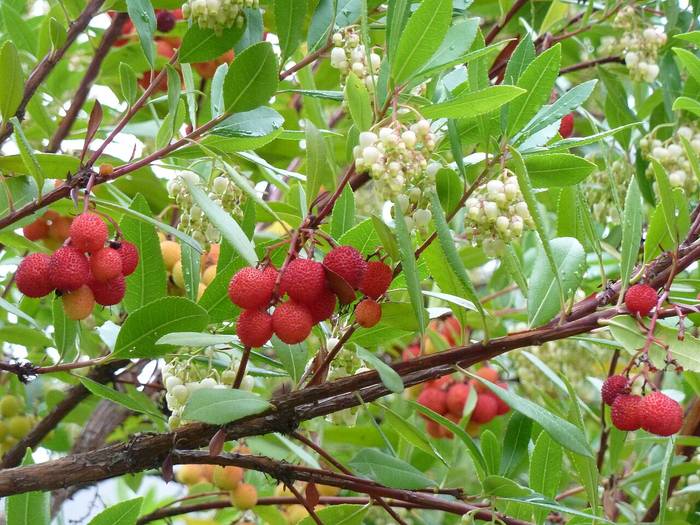
Wendy Cutler from Vancouver, Canada · CC BY 2.0
Strawberry tree
Tree·Arbutus unedo
Part shade to full sun
Sun
Dry to moist soil
Water
Well-drained soil
Drainage
Zones 7–10
Hardiness
Coverage · 122 fields
No obvious inconsistencies found.
Growth and size10 fields
Plant type
Evergreen tree“Arbutus unedo is an evergreen Tree growing to 9 m (29ft) by 8 m (26ft) at a medium rate.”
Height
900 cm · other sources: 400 cm, 700 cm“Arbutus unedo is an evergreen Tree growing to 9 m (29ft) by 8 m (26ft) at a medium rate.”Wikipedia“Arbutus unedo grows to 4–7 m (13–23 ft) tall, rarely up to 13 m (45 ft), with a trunk diameter of up to 120 cm (47 in).”
Spread
800 cm“Arbutus unedo is an evergreen Tree growing to 9 m (29ft) by 8 m (26ft) at a medium rate.”
Height at age
—
empty
Spacing
400 cm (at least 300 cm)
AI estimate55 % agree
Growth rate
Medium“Arbutus unedo is an evergreen Tree growing to 9 m (29ft) by 8 m (26ft) at a medium rate.”
Habit
Spreading
AI estimate50 % agree
Root depth
Medium
AI estimate63 % agree
Forest garden layer
Lower tree layer
AI estimate90 % agree
Lifespan
~50 years
AI estimatenot measured yet
Roots6 fields
Root form
Heart root“The root pattern is branching: a heart root, dividing from the crown into several primary roots going down and out [2-1].”
Storage organ
None“No clonal growth organ is recorded: it does not spread vegetatively (no suckers, no rhizomes).”
Spreads
No“No clonal growth organ is recorded: it does not spread vegetatively (no suckers, no rhizomes).”
Lateral spread in cm
—
empty
Root depth in cm
—
empty
Mycorrhiza
—
empty
Light, water and soil9 fields
Sun
Full sun, light shade, part shade · best: full sun“It can grow in semi-shade (light woodland) or no shade.”PFAFpartly“Requires a nutrient-rich well-drained moisture-retentive soil in sun or semi-shade and shelter from cold drying winds, especially when young.”
Hours of sun
6 h
AI estimatenot measured yet
Drought tolerant
Yes“Once established it is fairly drought resistant, frost resistant, shade tolerant and salt tolerant.”
Tolerates waterlogging
—
empty
Soil type
Sand, loam, clay“Suitable for: light (sandy) and medium (loamy) soils, prefers well-drained soil and can grow in heavy clay soil.”
Drainage
Well drained“Suitable for: light (sandy) and medium (loamy) soils, prefers well-drained soil and can grow in heavy clay soil.”
PFAFpartly
Compacted soil
Copes badly
AI estimatenot measured yet
Climate5 fields
Hardiness
Zone 7–10
AI estimatenot measured yet
Killing frost
-15 °C
AI estimatenot measured yet
Growing temperature
0–35 °C · optimal 10–25 °C
AI estimatenot measured yet
Chill hours
0 h
AI estimatenot measured yet
Native range
AD, AL, BA, BG, CY, DZ, ES, FR, GG, GI, GR, HR, IT, JE, LB, MA, MC, ME, MK, MT, PT, RS, SI, SM, SY, TN, TR, VA, XK
Care (becomes tasks in Manage)5 fields
Protection
After the first frost · lasts 150 days“Give them some protection in their first winter.”
PFAFpartly
Planting out
After the last frost · lasts 30 days“plant out in late spring after the last expected frosts”
PFAFpartly
Pruning
March · lasts 30 days · dead, damaged, or crossing branches
AI estimatenot measured yet
Mulching
April · lasts 30 days
AI estimatenot measured yet
Watering
After rain · lasts 180 days
AI estimatenot measured yet
Through the year4 fields
Fruiting
November · lasts 61 days“It is ripe in November/December and is about 15mm in diameter.”
Harvest
November · lasts 61 days
AI estimatenot measured yet
First harvest
3–4 years after plantingSource is a fruit/edibles nursery (One Green World), not an extension service. States years after planting directly, matching the field convention.
Edible parts and pollination4 fields
The fruit
Pollination
Self-fertile · hermaphrodite“The species is hermaphrodite (has both male and female organs) and is pollinated by Bees.”PFAF“The plant is self-fertile.”
Pollinated by
Bees“The species is hermaphrodite (has both male and female organs) and is pollinated by Bees.”
Ecology6 fields
Attracts
Bees, birds“They have a sweet honey-like scent with plentiful nectar, and are pollinated by bees.”PFAF“Special Features:Attracts birds, Not North American native, Attractive flowers or blooms.”
Pests
Scales, thrips“Pests include scales and thrips, and diseases include anthracnose, Phytophthora, root rot, and rust.”
Diseases
Anthracnose, phytophthora, root rot, rust“Pests include scales and thrips, and diseases include anthracnose, Phytophthora, root rot, and rust.”
Takes up
Potassium, calcium
AI estimatenot measured yet
Fixes nitrogen
No
AI estimatenot measured yet
Mycorrhiza
Yes
AI estimatenot measured yet
Propagation and names4 fields
Methods
Difficulty
3 / 5
AI estimatenot measured yet
Not sorted yet69 fields
Fields the parser stores that this page has no row for yet. They show up here automatically, so nothing is hidden.
forage.DK.local_name
Jordbærtræ
AI estimatenot measured yet
forage.DK.prep_cautions
gritty texture from numerous small hard seeds, bruises very easily when mature“its gritty texture from the numerous small, hard seeds”Wikipedia“the mature fruit tends to bruise very easily”
forage.DK.edibility_basis
inferred
AI estimatenot measured yet
forage.DK.foraging_months.notes
Fruits ripen in autumn and early winter, often overlapping with the next year's flowers.
AI estimatenot measured yet
forage.DK.foraging_months.months
11, 12“It is ripe in November/December and is about 15mm in diameter.”
forage.DK.foraging_months.year_round
false
AI estimatenot measured yet
forage.DK.habitat_affinity
woodland“Woodland, scrub and rocky hillsides, often on limestone and sandstone.”
forage.US.local_name
Strawberry Tree
AI estimatenot measured yet
forage.US.edible_parts
[{"part":"fruit","caution":null,"preparation":"raw or cooked","season_months":[11,12]}]
AI estimatenot measured yet
forage.US.prep_cautions
Edible when fully ripe, but tasteless
AI estimatenot measured yet
forage.US.edibility_basis
inferred
AI estimatenot measured yet
forage.US.foraging_months.notes
Fruits ripen in autumn and early winter, often overlapping with the next year's flowers.
AI estimatenot measured yet
forage.US.foraging_months.months
10, 11, 12
AI estimatenot measured yet
forage.US.foraging_months.year_round
false
AI estimatenot measured yet
forage.US.habitat_affinity
woodland
AI estimatenot measured yet
forage.TROPICAL.edible_parts
[{"part":"fruit","caution":null,"preparation":"raw or cooked","season_months":[10,11,12]}]
AI estimatenot measured yet
forage.TROPICAL.edibility_basis
inferred
AI estimatenot measured yet
forage.TROPICAL.foraging_months.notes
Not typically found in tropical climates.
AI estimatenot measured yet
forage.TROPICAL.foraging_months.months
10, 11, 12
AI estimatenot measured yet
forage.TROPICAL.foraging_months.year_round
false
AI estimatenot measured yet
forage.TROPICAL.habitat_affinity
woodland
AI estimatenot measured yet
ornamental.basis
documented
AI estimatenot measured yet
ornamental.confidence
high
AI estimatenot measured yet
ornamental.fall_interest
true“because its autumn colour is reminiscent of the flag of Italy (green for its leaves, white for its flowers and red for its berries)”
Wikipediapartly
ornamental.flower_colour
white, pink“The flowers are hermaphrodite, white, or rarely pale pink to reddish, bell-shaped, 6–8 mm (0.24–0.31 in) diameter, produced in clusters of 15–20 on a reddish hanging panicle in autumn.”PFAF“Bloom Color: Pink, White.”
ornamental.evidence_quote
Arbutus unedo, commonly known as the strawberry tree, is an evergreen shrub or small tree with dark green foliage. It produces white, bell-shaped flowers in autumn, often at the same time as the previous year's fruit ripens. The fruit is red and persistent, providing winter interest. The flowers have a subtle honey-like fragrance.
AI estimatenot measured yet
ornamental.foliage_colour
green“The leaves are green and glossy on the upper side, dull on the underside, 5–10 cm (2–4 in) long and 1.5–4 cm (1–2 in) broad, laurel-like and usually with a serrated or serrulated margin, rarely entire.”
ornamental.foliage_texture
medium
AI estimatenot measured yet
ornamental.winter_structure
persistent_fruit, evergreen_form“Arbutus unedo is an evergreen Tree growing to 9 m (29ft) by 8 m (26ft) at a medium rate.”
PFAFpartly
ornamental.autumn_foliage_colour
none
AI estimatenot measured yet
care_regime
light
AI estimatenot measured yet
propagation.self_seeding
light
AI estimate20 % agree
propagation.division_season
spring
AI estimatenot measured yet
propagation.establishment_years
3
AI estimate40 % agree
spatial_profile.canopy_density
dense
AI estimatenot measured yet
forage_proposals.DK.edibility_tier.tier
edible
AI estimatenot measured yet
forage_proposals.DK.edibility_tier.confidence
high
AI estimatenot measured yet
forage_proposals.DK.edibility_tier.evidence_quote
The fruit of Arbutus unedo is edible when fully ripe, though it can be bland or mealy. It is often used in jams, preserves, or fermented beverages.
AI estimatenot measured yet
forage_proposals.US.edibility_tier.tier
edible
AI estimatenot measured yet
forage_proposals.US.edibility_tier.confidence
high
AI estimatenot measured yet
forage_proposals.US.edibility_tier.evidence_quote
The fruit of Arbutus unedo is edible when fully ripe, though it can be bland or mealy. It is often used in jams, preserves, or fermented beverages.
AI estimatenot measured yet
forage_proposals.TROPICAL.edibility_tier.confidence
low
AI estimatenot measured yet
function_profile.biomass_return.confidence
medium
AI estimatenot measured yet
function_profile.nutrient_flows.consumes
[{"basis":"inferred","demand":"moderate","nutrient":"nitrogen","confidence":"medium"},{"basis":"inferred","demand":"moderate","nutrient":"phosphorus","confidence":"medium"},{"basis":"inferred","demand":"moderate","nut…
AI estimatenot measured yet
function_profile.nutrient_flows.provides
[{"basis":"inferred","nutrient":"potassium","mechanism":"biomass_return","confidence":"medium"},{"basis":"inferred","nutrient":"calcium","mechanism":"biomass_return","confidence":"medium"}]
AI estimatenot measured yet
function_profile.biotic_interactions
[{"taxa":["bees"],"basis":"documented","valence":"beneficial","relation":"attracts","confidence":"high","evidence_quote":"They have a sweet honey-like scent with plentiful nectar, and are pollinated by bees.","organis…“They have a sweet honey-like scent with plentiful nectar, and are pollinated by bees.”Wikipedia“The seeds are small, brown and angular and are dispersed by frugivorous birds.”PFAF“Special Features:Attracts birds, Not North American native, Attractive flowers or blooms.”Wikipedia“The dense foliage throughout the year can be a shelter for insects and small animals during the winter.”Wikipedia“Pests include scales and thrips, and diseases include anthracnose, Phytophthora, root rot, and rust.”
function_profile.aromatic_pest_effect.value
false
AI estimate80 % agree
function_profile.aromatic_pest_effect.confidence
low
AI estimatenot measured yet
function_profile.structural_interfaces.provides_shelter.basis
taxonomic
AI estimatenot measured yet
function_profile.structural_interfaces.provides_shelter.kinds
shade
AI estimatenot measured yet
function_profile.structural_interfaces.provides_shelter.confidence
high
AI estimatenot measured yet
function_profile.structural_interfaces.provides_shelter.evidence_quote
Its dense evergreen foliage provides good windbreak and shade.
AI estimatenot measured yet
function_profile.structural_interfaces.requires_shelter.basis
documented
AI estimatenot measured yet
function_profile.structural_interfaces.requires_shelter.kinds
wind, frost
AI estimatenot measured yet
function_profile.structural_interfaces.requires_shelter.stage
establishment
AI estimatenot measured yet
function_profile.structural_interfaces.requires_shelter.confidence
high
AI estimatenot measured yet
function_profile.structural_interfaces.requires_shelter.evidence_quote
Young plants may require protection from strong winds and hard frosts.
AI estimatenot measured yet
function_profile.structural_interfaces.provides_physical_support.form
trunk
AI estimatenot measured yet
function_profile.structural_interfaces.provides_physical_support.basis
taxonomic
AI estimatenot measured yet
function_profile.structural_interfaces.provides_physical_support.confidence
high
AI estimatenot measured yet
function_profile.structural_interfaces.requires_physical_support.basis
taxonomic
AI estimatenot measured yet
function_profile.structural_interfaces.requires_physical_support.confidence
high
AI estimatenot measured yet
climate_tolerance.photoperiod_response
day_neutral
AI estimatenot measured yet
soil_interactions.organic_matter_contribution
medium
AI estimatenot measured yet
component_metadata.growth_cycle
perennial
AI estimate100 % agree
resource_interfaces.inputs
[{"resource":"light","quantity_description":"semi-shade (light woodland) or no shade"},{"resource":"water","quantity_description":"dry or moist soil"},{"resource":"wind_shelter","quantity_description":"shelter from co…“It can grow in semi-shade (light woodland) or no shade.”PFAF“It prefers dry or moist soil.”PFAF“Requires a nutrient-rich well-drained moisture-retentive soil in sun or semi-shade and shelter from cold drying winds, especially when young.”PFAF“Arbutus unedo is an evergreen Tree growing to 9 m (29ft) by 8 m (26ft) at a medium rate.”
resource_interfaces.outputs
[{"resource":"nectar","quantity_description":"significant source of nectar for bees"},{"resource":"pollen","quantity_description":"significant source of pollen for bees"},{"resource":"fruit","quantity_description":"fo…“The flowers are a significant source of nectar and pollen for bees, while the fruit is food for birds.”Wikipedia“The dense foliage throughout the year can be a shelter for insects and small animals during the winter.”Wikipedia“Its salt tolerance, coupled with it being an evergreen, make it a good choice for wind barriers in lands close to the sea.”Wikipedia“The wood is quite hard and well suited for a various uses such as firewood and to make pipes.”Wikipedia“The seeds are small, brown and angular and are dispersed by frugivorous birds.”