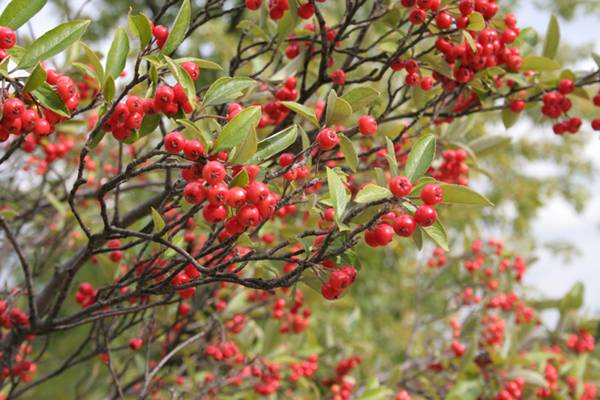
No machine-readable author provided. Abrahami assumed (based on copyright claims). · CC BY-SA 2.5
red chokeberry
Shrub·Aronia arbutifolia
Part shade to full sun
Sun
Moist to wet soil
Water
Well-drained soil
Drainage
Zones 4–9
Hardiness
Coverage · 118 fields
- Parser flag (climate_tolerance_low_confidence): Climate tolerance values are LLM-extracted (no authoritative EcoCrop match found). EcoCrop covers ~2,568 food-crop taxa; ornamental/native/medicinal species rely on LLM extraction.
Growth and size10 fields
Plant type
Deciduous shrub“Aronia arbutifolia is a deciduous Shrub growing to 3 m (9ft) by 3 m (9ft).”
Height
300 cm · the source gives 180–360 cm“It may reach a height between 1.8 and 3.6 meters (6 and 12 feet).”PFAF“Aronia arbutifolia is a deciduous Shrub growing to 3 m (9ft) by 3 m (9ft).”
Height at age
—
empty
Spacing
120 cm (at least 90 cm)
AI estimate55 % agree
Growth rate
—
empty
Habit
Vase-shaped
AI estimate50 % agree
Root depth
Shallow“The root pattern is flat with shallow roots forming a plate near the soil surface [1-2].”
Forest garden layer
Shrub layer“Aronia arbutifolia is a deciduous Shrub growing to 3 m (9ft) by 3 m (9ft).”
Lifespan
~20 years
AI estimatenot measured yet
Roots6 fields
Root form
Plate root (shallow)“The root pattern is flat with shallow roots forming a plate near the soil surface [1-2].”
Storage organ
—
empty
Spreads
By suckers“The root pattern is suckering with new plants from underground runners away from the plant [1-2].”
Lateral spread in cm
—
empty
Root depth in cm
—
empty
Mycorrhiza
Arbuscular (AM)
AI estimatenot measured yet
Light, water and soil9 fields
Sun
Full sun, light shade, part shade · best: full sun“It can grow in semi-shade (light woodland) or no shade.”PFAFpartly“Prefers a moist peaty soil in full sun or partial shade.”
Hours of sun
6 h
AI estimatenot measured yet
Water
Moist, wet · best: moist · Medium“It prefers moist soil.”Wikipedia“may be found in habitats such as titi bogs, boggy pine flatwoods, various hammocks, and other wet environments.”
Drought tolerant
—
empty
Tolerates waterlogging
—
empty
Soil type
Sand, loam, clay, peat · best: peat“Suitable for: light (sandy), medium (loamy) and heavy (clay) soils and prefers well-drained soil.”PFAFpartly“Prefers a moist peaty soil in full sun or partial shade.”
Drainage
Well drained“Suitable for: light (sandy), medium (loamy) and heavy (clay) soils and prefers well-drained soil.”
Compacted soil
Copes fairly well
AI estimatenot measured yet
Climate5 fields
Hardiness
Zone 4–9
AI estimatenot measured yet
Growing temperature
5–30 °C · optimal 15–25 °C
AI estimatenot measured yet
Chill hours
400 h
AI estimatenot measured yet
Care (becomes tasks in Manage)2 fields
Pruning
January · lasts 30 days · dead, damaged, or crossing branches
AI estimatenot measured yet
Mulching
April · lasts 30 days
AI estimatenot measured yet
Through the year6 fields
Flowering
May · lasts 31 days“It is in flower in May, and the seeds ripen from October to December.”
PFAFpartly
Fruiting
October · lasts 92 days“It is in flower in May, and the seeds ripen from October to December.”
PFAFpartly
Leafing out
After the last frost · lasts 30 days
AI estimatenot measured yet
Dying back
After the first frost · lasts 30 days
AI estimatenot measured yet
Dormant
After the first frost · 30 days after · lasts 150 days
AI estimatenot measured yet
First harvest
1–2 years after plantingGeneral gardening site, not an extension service. Source wording 'year two to three after planting' is ordinal (counting the planting year as year one), so converted per convention (N-1) to 1-2 years after planting a nursery plant. Counted from planting, not from seed.
Edible parts and pollination4 fields
The fruit
Cooked · August–October
AI estimatenot measured yet
Pollination
Self-fertile · hermaphrodite“The species is hermaphrodite (has both male and female organs) and is pollinated by Insects.”
Pollinated by
Insects“The species is hermaphrodite (has both male and female organs) and is pollinated by Insects.”
Ecology5 fields
Attracts
Birds, butterflies, sweat bees, Andrenidae bees, insects“Attracts birds, North American native, Wetlands plant, Attracts butterflies.”Wikipedia“has been often observed to host insect species such as sweat bees, as well as bees from the Andrenidae family.”PFAF“The species is hermaphrodite (has both male and female organs) and is pollinated by Insects.”
Pests
Marsh rabbits
AI estimatenot measured yet
Diseases
—
empty
Takes up
Potassium, phosphorus
AI estimatenot measured yet
Fixes nitrogen
No
AI estimatenot measured yet
Propagation and names4 fields
Methods
Difficulty
2 / 5
AI estimatenot measured yet
Not sorted yet67 fields
Fields the parser stores that this page has no row for yet. They show up here automatically, so nothing is hidden.
forage.DK.local_name
Brunfrugtet surbær
AI estimatenot measured yet
forage.DK.prep_cautions
Fruits are very astringent raw and are best cooked or processed into jams, jellies, or juices.
AI estimatenot measured yet
forage.DK.edibility_basis
inferred
AI estimatenot measured yet
forage.DK.foraging_months.notes
Fruits persist on the bush into winter but become less palatable after repeated freezing and thawing.
AI estimatenot measured yet
forage.DK.foraging_months.months
8, 9, 10
AI estimatenot measured yet
forage.DK.foraging_months.year_round
false
AI estimatenot measured yet
forage.DK.habitat_affinity
woodland, hedgerow, verge
AI estimatenot measured yet
forage.US.local_name
Red Chokeberry
AI estimatenot measured yet
forage.US.edible_parts
[{"part":"fruit","caution":"bitterly acidic when eaten raw","preparation":"raw or cooked; can be dried; high in pectin, so good for thick jams and jellies"}]“Edible Parts: Fruit”Wikipedia“The fruits, whose ill taste inspired the common name, are bitterly acidic (though edible) when eaten raw.”PFAF“Fruit - raw or cooked. It can also be dried and used for making pemmican.”
forage.US.prep_cautions
Fruit quality is variable; some forms are pleasant only when fully ripe, especially after frost“Fruit quality is rather variable, some forms are rather pleasant when fully ripe, especially if they have experienced some frost.”
forage.US.edibility_basis
inferred
AI estimatenot measured yet
forage.US.foraging_months.notes
it can hang on the plant for several months
AI estimatenot measured yet
forage.US.foraging_months.months
10, 11, 12
AI estimatenot measured yet
forage.US.foraging_months.year_round
false
AI estimatenot measured yet
forage.US.habitat_affinity
woodland, verge“Low woods, thickets, swamps, damp pine barrens etc.”
PFAFpartly
forage.TROPICAL.edible_parts
[{"part":"fruit","caution":"astringent raw","preparation":"cooked","season_months":[8,9,10]}]
AI estimatenot measured yet
forage.TROPICAL.prep_cautions
astringent raw
AI estimatenot measured yet
forage.TROPICAL.edibility_basis
inferred
AI estimatenot measured yet
forage.TROPICAL.foraging_months.notes
Not typically found in tropical regions.
AI estimatenot measured yet
forage.TROPICAL.foraging_months.months
8, 9, 10
AI estimatenot measured yet
forage.TROPICAL.foraging_months.year_round
false
AI estimatenot measured yet
forage.TROPICAL.habitat_affinity
woodland, verge
AI estimatenot measured yet
ornamental.basis
documented
AI estimatenot measured yet
ornamental.fragrance.source
none
AI estimate100 % agree
ornamental.fragrance.intensity
subtle
AI estimatenot measured yet
ornamental.confidence
high
AI estimatenot measured yet
ornamental.fall_interest
true
AI estimatenot measured yet
ornamental.flower_colour
white, pink“Bloom Color: White.”Wikipedia“Flowers are white or pink, producing black or bright red fruits.”
ornamental.evidence_quote
Aronia arbutifolia, commonly known as red chokeberry, is a deciduous shrub with white flowers in spring, green foliage in summer, and brilliant red autumn foliage. It produces persistent red berries that remain on the plant through winter, providing ornamental interest.
AI estimatenot measured yet
ornamental.foliage_colour
green
AI estimate82 % agree
ornamental.foliage_texture
medium
AI estimatenot measured yet
ornamental.winter_structure
persistent_fruit“The fruit is about 7mm in diameter, it can hang on the plant for several months.”
ornamental.autumn_foliage_colour
red
AI estimatenot measured yet
care_regime
none
AI estimatenot measured yet
propagation.self_seeding
moderate
AI estimate20 % agree
propagation.establishment_years
2
AI estimate40 % agree
forage_proposals.DK.edibility_tier.tier
edible
AI estimatenot measured yet
forage_proposals.DK.edibility_tier.confidence
high
AI estimatenot measured yet
forage_proposals.DK.edibility_tier.evidence_quote
The fruits of Aronia arbutifolia are edible, though very astringent when raw. They are commonly used in cooked applications like jams, jellies, and juices.
AI estimatenot measured yet
forage_proposals.US.edibility_tier.confidence
high
AI estimatenot measured yet
forage_proposals.US.edibility_tier.evidence_quote
Red chokeberry fruits are edible, but their high astringency makes them unpalatable raw. They are excellent for processing into various culinary products.
AI estimatenot measured yet
forage_proposals.TROPICAL.edibility_tier.confidence
low
AI estimatenot measured yet
function_profile.biomass_return.confidence
medium
AI estimatenot measured yet
function_profile.nutrient_flows.consumes
[{"basis":"documented","demand":"moderate","nutrient":"nitrogen","confidence":"high"},{"basis":"documented","demand":"moderate","nutrient":"phosphorus","confidence":"high"},{"basis":"documented","demand":"moderate","n…
AI estimatenot measured yet
function_profile.nutrient_flows.provides
[{"basis":"inferred","nutrient":"potassium","mechanism":"biomass_return","confidence":"low"},{"basis":"inferred","nutrient":"phosphorus","mechanism":"biomass_return","confidence":"low"}]
AI estimatenot measured yet
function_profile.biotic_interactions
[{"taxa":["sweat bees","Andrenidae bees"],"basis":"documented","valence":"beneficial","relation":"attracts","confidence":"medium","evidence_quote":"has been often observed to host insect species such as sweat bees, as…“has been often observed to host insect species such as sweat bees, as well as bees from the Andrenidae family.”PFAF“The species is hermaphrodite (has both male and female organs) and is pollinated by Insects.”PFAFpartly“Attracts birds, North American native, Wetlands plant, Attracts butterflies.”Wikipediapartly“It has been reported to be consumed by marsh rabbits, and accounts for 5-10% of the diet of a variety of game bird and songbird species.”
function_profile.aromatic_pest_effect.value
false
AI estimate80 % agree
function_profile.aromatic_pest_effect.confidence
low
AI estimatenot measured yet
function_profile.structural_interfaces.provides_shelter.basis
inferred
AI estimatenot measured yet
function_profile.structural_interfaces.provides_shelter.kinds
wind, shade
AI estimatenot measured yet
function_profile.structural_interfaces.provides_shelter.confidence
medium
AI estimatenot measured yet
function_profile.structural_interfaces.provides_shelter.evidence_quote
The dense growth habit of Aronia arbutifolia can provide some windbreak and shade.
AI estimatenot measured yet
function_profile.structural_interfaces.requires_shelter.basis
inferred
AI estimatenot measured yet
function_profile.structural_interfaces.requires_shelter.confidence
low
AI estimatenot measured yet
function_profile.structural_interfaces.provides_physical_support.form
dense_thicket“A suckering plant, it forms thickets in the wild.”
function_profile.structural_interfaces.provides_physical_support.basis
documented
AI estimatenot measured yet
function_profile.structural_interfaces.provides_physical_support.confidence
medium
AI estimatenot measured yet
function_profile.structural_interfaces.provides_physical_support.evidence_quote
A suckering plant, it forms thickets in the wild.
AI estimatenot measured yet
function_profile.structural_interfaces.requires_physical_support.basis
inferred
AI estimatenot measured yet
function_profile.structural_interfaces.requires_physical_support.confidence
low
AI estimatenot measured yet
climate_tolerance.photoperiod_response
day_neutral
AI estimatenot measured yet
soil_interactions.organic_matter_contribution
medium
AI estimatenot measured yet
component_metadata.growth_cycle
perennial
AI estimate100 % agree
resource_interfaces.inputs
[{"resource":"light","quantity_description":"full sun or partial shade; tolerates semi-shade (light woodland) or no shade"},{"resource":"water","quantity_description":"moist soil"},{"resource":"pollination","quantity_…“Prefers a moist peaty soil in full sun or partial shade.”PFAF“It prefers moist soil.”PFAF“The species is hermaphrodite (has both male and female organs) and is pollinated by Insects.”
resource_interfaces.outputs
[{"resource":"habitat","quantity_description":"attracts birds and butterflies"},{"resource":"pollinator_services","quantity_description":"observed hosting sweat bees and Andrenidae bees"},{"resource":"fruit","quantity…“Attracts birds, North American native, Wetlands plant, Attracts butterflies.”Wikipedia“has been often observed to host insect species such as sweat bees, as well as bees from the Andrenidae family.”PFAF“It is in flower in May, and the seeds ripen from October to December.”PFAF“A suckering plant, it forms thickets in the wild.”PFAFpartly“Fruit - raw or cooked.”