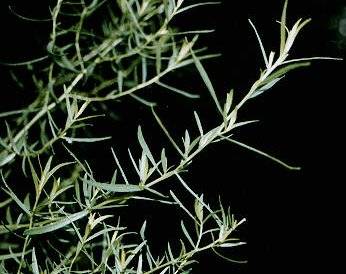
French tarragon
Plant·Artemisia dracunculus
Part shade to full sun
Sun
Dry to moist soil
Water
Well-drained soil
Drainage
Zones 4–9
Hardiness
Coverage · 113 fields
No obvious inconsistencies found.
Growth and size10 fields
Height
60 cm · other sources: 120 cm, 150 cm“Artemisia dracunculus is a PERENNIAL growing to 0.6 m (2ft) by 0.3 m (1ft in) at a medium rate.”Wikipedia“Tarragon grows to 120–150 centimetres (4–5 feet) tall, with slender branches.”
Spread
30 cm“Artemisia dracunculus is a PERENNIAL growing to 0.6 m (2ft) by 0.3 m (1ft in) at a medium rate.”
Height at age
—
empty
Spacing
45 cm (at least 30 cm)
AI estimate55 % agree
Growth rate
Medium“Artemisia dracunculus is a PERENNIAL growing to 0.6 m (2ft) by 0.3 m (1ft in) at a medium rate.”
Habit
Mounding
AI estimate50 % agree
Root depth
Medium
AI estimate63 % agree
Forest garden layer
Herb layer
AI estimate90 % agree
Lifespan
~5 years
AI estimatenot measured yet
Roots6 fields
Root form
—
empty
Storage organ
Rhizome“Its storage organ is a rhizome, a creeping underground stem; it spreads by rhizomes.”
Spreads
By rhizomes“Its storage organ is a rhizome, a creeping underground stem; it spreads by rhizomes.”
Root depth in cm
—
empty
Mycorrhiza
Arbuscular (AM)
AI estimatenot measured yet
Light, water and soil9 fields
Sun
Full sun, light shade, part shade · best: full sun“Easily grown in a well-drained circumneutral or slightly alkaline loamy soil, preferring a warm sunny dry position.”PFAFpartly“It can grow in semi-shade (light woodland) or no shade.”
Hours of sun
6–12 h
AI estimatenot measured yet
Water
Dry, moist · best: dry · Low · 2–4 l/day“It is best to grow tarragon in a dry, rather poor soil since this will produce hardier plants.”PFAF“It prefers dry or moist soil and can tolerate drought.”
Tolerates waterlogging
No“Plants are relatively hardy in Britain, but can be killed in wet winters.”
PFAFpartly
Soil type
Sand, loam · best: loam“Easily grown in a well-drained circumneutral or slightly alkaline loamy soil, preferring a warm sunny dry position.”PFAF“Suitable for: light (sandy) and medium (loamy) soils and prefers well-drained soil.”
pH
5.5–7.8 · best 5.5–7“Tolerates a pH in the range 6.5 to 7.8.”PFAF“Suitable pH: neutral and basic (mildly alkaline) soils.”The figures 5.5–7.8 are EcoCrop's optimal pH, not the range the quote gives.
Drainage
Well drained“Suitable for: light (sandy) and medium (loamy) soils and prefers well-drained soil.”
Compacted soil
Copes badly
AI estimatenot measured yet
Climate5 fields
Hardiness
Zone 4–9
AI estimatenot measured yet
Killing frost
-5 °C“Killing temp. early growth: -5”EcoCrop's figure is frost during early growth (spring frost on new shoots), not winter cold.
Growing temperature
4–26 °C · optimal 12–22 °C“Temperature absolute min: 4 · Temperature absolute max: 26 · Temperature optimal min: 12 · Temperature optimal max: 22”
Chill hours
0 h
AI estimatenot measured yet
Native range
AD, AE, AF, AM, AZ, BH, BN, BT, BY, CA, CN, EE, GE, GI, HK, ID, IL, IN, IQ, IR, JO, JP, KG, KW, KZ, LB, MM, MN, MO, MX, MY, NL, NP, OM, PH, PK, PT, QA, RU, SA, SG, SY, TJ, TM, TR, TW, US, UZ, VN, YE
Care (becomes tasks in Manage)5 fields
Mulching
November · lasts 30 days
AI estimatenot measured yet
Pruning
March · lasts 15 days · dead or weak stems
AI estimatenot measured yet
Feeding
April · lasts 15 days · balanced organic fertiliser
AI estimatenot measured yet
Watering
After rain · lasts 180 days
AI estimatenot measured yet
Through the year5 fields
Harvest
After the previous stage“The aerial parts can be harvested in summer when they are in full bloom”
Leafing out
After the last frost
AI estimatenot measured yet
Dormant
After the first frost
AI estimatenot measured yet
Edible parts and pollination4 fields
The leaves
Raw or used as a flavouring in soups etc.“Edible Parts: Leaves Shoots”PFAF“Leaves - raw or used as a flavouring in soups etc.”
The young shoots
Young shoots cooked and used as a potherb“Edible Parts: Leaves Shoots”PFAF“The young shoots can also be cooked and used as a potherb.”
Pollination
Self-fertile · hermaphrodite“The species is hermaphrodite (has both male and female organs) and is pollinated by Wind.”PFAF“The plant is self-fertile.”
Pollinated by
Wind“The species is hermaphrodite (has both male and female organs) and is pollinated by Wind.”
Ecology5 fields
Attracts
Wildlife, bees“It is noted for attracting wildlife.”PFAF“Yes – Artemisia species produce flowers that can provide nectar and pollen, attracting various pollinators, including bees.”
Pests
Slugs“The dry soil will also help to reduce predation by slugs, these creatures are very fond of the young growth and have been known to completely destroy even well-established plants[K].”
PFAFpartly
Diseases
—
empty
Takes up
Potassium
AI estimatenot measured yet
Fixes nitrogen
No
AI estimatenot measured yet
Propagation and names4 fields
Methods
Division, basal cuttings“Division is very easy in spring or autumn”PFAF“Basal cuttings in late spring.”
Seed
not applicable (sterile seeds)
AI estimatenot measured yet
Not sorted yet60 fields
Fields the parser stores that this page has no row for yet. They show up here automatically, so nothing is hidden.
forage.DK.local_name
Fransk estragon
AI estimatenot measured yet
forage.DK.warnings_da
Berøring kan give udslæt på huden hos nogle.
AI estimatenot measured yet
forage.DK.warnings_en
Touching it can cause a skin rash in some people.
AI estimatenot measured yet
forage.DK.prep_cautions
skin contact with some members of this genus can cause dermatitis or other allergic reactions in some people“Although no reports of toxicity have been seen for this species, skin contact with some members of this genus can cause dermatitis or other allergic reactions in some people.”
forage.DK.edibility_basis
inferred
AI estimatenot measured yet
forage.DK.foraging_months.notes
The aerial parts can be harvested in summer when they are in full bloom“The aerial parts can be harvested in summer when they are in full bloom, while roots can be harvested in autumn.”
forage.DK.foraging_months.months
5, 6, 7, 8, 9
AI estimatenot measured yet
forage.DK.foraging_months.year_round
false
AI estimatenot measured yet
forage.US.local_name
French tarragon
AI estimatenot measured yet
forage.US.edible_parts
[{"part":"leaves","caution":null,"preparation":"raw or used as a flavouring in soups etc."},{"part":"shoots","caution":null,"preparation":"young shoots cooked and used as a potherb"}]“Edible Parts: Leaves Shoots”PFAF“Leaves - raw or used as a flavouring in soups etc.”PFAF“The young shoots can also be cooked and used as a potherb.”
forage.US.prep_cautions
skin contact with some members of this genus can cause dermatitis or other allergic reactions in some people“Although no reports of toxicity have been seen for this species, skin contact with some members of this genus can cause dermatitis or other allergic reactions in some people.”
forage.US.edibility_basis
inferred
AI estimatenot measured yet
forage.US.foraging_months.notes
The aerial parts can be harvested in summer when they are in full bloom“The aerial parts can be harvested in summer when they are in full bloom, while roots can be harvested in autumn.”
forage.US.foraging_months.months
5, 6, 7, 8, 9
AI estimatenot measured yet
forage.US.foraging_months.year_round
false
AI estimatenot measured yet
forage.TROPICAL.local_name
French tarragon
AI estimatenot measured yet
forage.TROPICAL.edible_parts
[{"part":"leaves","caution":null,"preparation":"raw, cooked","season_months":[1,2,3,4,5,6,7,8,9,10,11,12]}]
AI estimatenot measured yet
forage.TROPICAL.edibility_basis
inferred
AI estimatenot measured yet
forage.TROPICAL.foraging_months.notes
May grow year-round in suitable tropical climates.
AI estimatenot measured yet
forage.TROPICAL.foraging_months.year_round
true
AI estimatenot measured yet
forage.TROPICAL.habitat_affinity
disturbed_ground
AI estimatenot measured yet
ornamental.basis
documented
AI estimatenot measured yet
ornamental.fragrance.intensity
strong
AI estimatenot measured yet
ornamental.confidence
high
AI estimatenot measured yet
ornamental.fall_interest
false
AI estimatenot measured yet
ornamental.evidence_quote
French tarragon has insignificant flowers and fine green foliage. It does not have significant autumn color or winter structure. The foliage is strongly aromatic.
AI estimatenot measured yet
ornamental.foliage_texture
fine
AI estimatenot measured yet
ornamental.winter_structure
none
AI estimatenot measured yet
ornamental.autumn_foliage_colour
none
AI estimatenot measured yet
care_regime
light
AI estimatenot measured yet
propagation.establishment_years
2“Artemisia species can vary in growth rate, but many are moderately fast-growing, reaching maturity within 1-2 years under optimal conditions.”
sun_requirement.best
full_sun“Easily grown in a well-drained circumneutral or slightly alkaline loamy soil, preferring a warm sunny dry position.”
forage_proposals.DK.edibility_tier.tier
choice“However, a European Union investigation concluded that the danger of estragole is minimal.”
Wikipediapartly
forage_proposals.DK.edibility_tier.confidence
high
AI estimatenot measured yet
forage_proposals.DK.edibility_tier.evidence_quote
French tarragon is widely cultivated and highly prized as a culinary herb, with its leaves used fresh or dried in various dishes.
AI estimatenot measured yet
forage_proposals.US.edibility_tier.tier
choice“However, a European Union investigation concluded that the danger of estragole is minimal.”
Wikipediapartly
forage_proposals.US.edibility_tier.confidence
high
AI estimatenot measured yet
forage_proposals.US.edibility_tier.evidence_quote
French tarragon is a popular culinary herb, with its distinctive anise-like flavor making it a staple in many cuisines.
AI estimatenot measured yet
forage_proposals.TROPICAL.edibility_tier.tier
choice
AI estimatenot measured yet
forage_proposals.TROPICAL.edibility_tier.confidence
high
AI estimatenot measured yet
forage_proposals.TROPICAL.edibility_tier.evidence_quote
French tarragon leaves are edible and commonly used as a culinary herb, providing a unique flavor to dishes.
AI estimatenot measured yet
function_profile.biomass_return.confidence
medium
AI estimatenot measured yet
function_profile.nutrient_flows.consumes
[{"basis":"documented","demand":"moderate","nutrient":"nitrogen","confidence":"high"},{"basis":"documented","demand":"moderate","nutrient":"potassium","confidence":"high"}]
AI estimatenot measured yet
function_profile.nutrient_flows.provides
[{"basis":"inferred","nutrient":"potassium","mechanism":"biomass_return","confidence":"low"}]
AI estimatenot measured yet
function_profile.biotic_interactions
[{"taxa":["various pollinators","bees"],"basis":"documented","valence":"beneficial","relation":"attracts","confidence":"medium","organism_group":"pollinator","ecological_function":"pollination"},{"taxa":["beneficial i…
AI estimatenot measured yet
function_profile.aromatic_pest_effect.value
true“Both the growing and the dried plant repels insects.”
function_profile.aromatic_pest_effect.confidence
high
AI estimatenot measured yet
climate_tolerance.photoperiod_response
long_day
AI estimatenot measured yet
soil_interactions.organic_matter_contribution
medium
AI estimatenot measured yet
component_metadata.growth_cycle
perennial“Artemisia dracunculus is a PERENNIAL growing to 0.6 m (2ft) by 0.3 m (1ft in) at a medium rate.”
resource_interfaces.inputs
[{"resource":"light","quantity_description":"warm sunny dry position"},{"resource":"water","quantity_description":"dry or moist soil; tolerates drought"}]“Easily grown in a well-drained circumneutral or slightly alkaline loamy soil, preferring a warm sunny dry position.”PFAF“It prefers dry or moist soil and can tolerate drought.”
resource_interfaces.outputs
[{"resource":"nectar","quantity_description":"specialist nectary plant"},{"resource":"pollinator_services","quantity_description":"flowers attract various pollinators, including bees"},{"resource":"aromatic_compounds"…“A specialist nectary plant [1-2].”PFAF“Yes – Artemisia species produce flowers that can provide nectar and pollen, attracting various pollinators, including bees.”PFAF“The leaves contain about 0.3% essential oil, about 70% of which is methyl chivacol.”PFAF“Provides shelter for beneficial invertebrates: insects and other arthropods.”