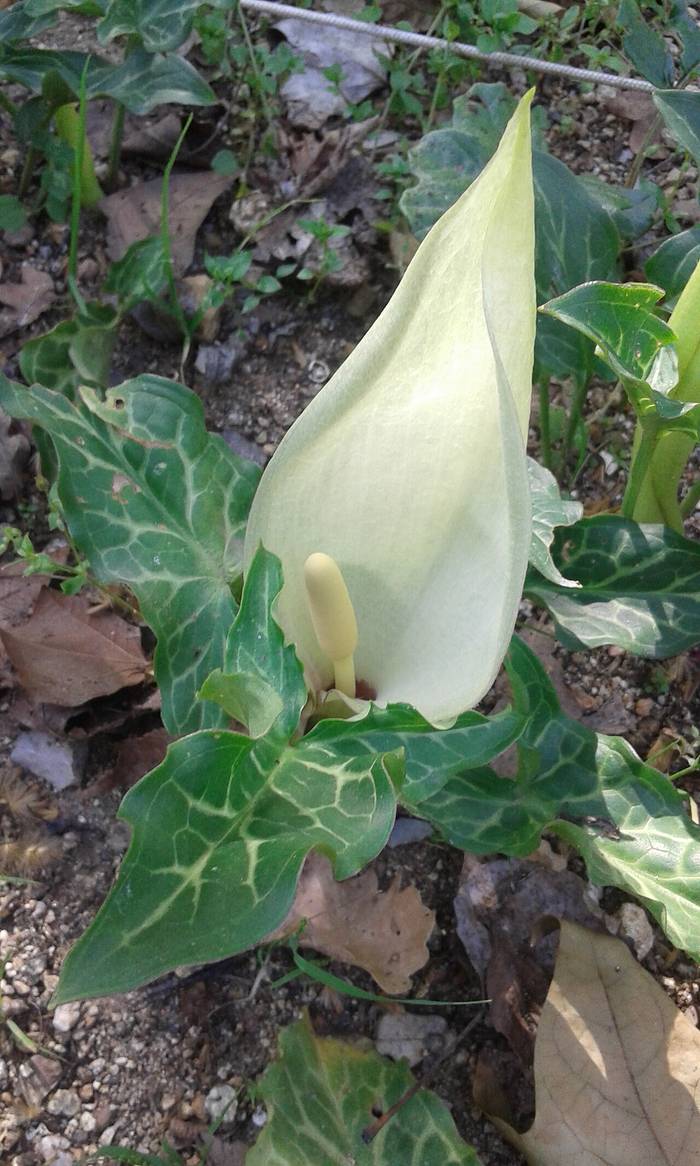
Consultaplantas · CC BY-SA 4.0
Italian arum
Plant·Arum italicum
Shade to full sun
Sun
Dry to moist soil
Water
Not recorded
Drainage
Zones 5–9
Hardiness
Coverage · 118 fields
- Parser flag (internal_inconsistency): The 'foliage_retention' is listed as 'deciduous', but the phenology events describe leaves emerging in autumn and remaining through winter, which contradicts a typical deciduous pattern. The ornamental section also mentions 'foliage that emerges in autumn and persists through winter', which is inconsistent with 'deciduous'.
Growth and size10 fields
Plant type
Deciduous plant“Arum italicum is a species of flowering herbaceous perennial plant in the family Araceae”
Height
40 cm · the source gives 30–46 cm“Arum italicum grows 30–46 cm (1–1.5 ft) high, with equal spread.”PFAF“Arum italicum is a PERENNIAL growing to 0.4 m (1ft 4in) by 0.3 m (1ft).”
Height at age
—
empty
Spacing
30 cm (at least 20 cm)
AI estimate55 % agree
Growth rate
—
empty
Habit
Mounding
AI estimate50 % agree
Root depth
Medium
AI estimate63 % agree
Forest garden layer
Herb layer“Arum italicum is a species of flowering herbaceous perennial plant in the family Araceae”
Lifespan
~5 years
AI estimatenot measured yet
Roots6 fields
Root form
—
empty
Storage organ
Stem tuber“Its storage organ is a stem tuber; it multiplies by offspring stem tubers.”
Spreads
—
empty
Root depth in cm
—
empty
Mycorrhiza
—
empty
Light, water and soil9 fields
Sun
Shade, part shade, light shade, full sun · best: shade“It can grow in full shade (deep woodland) semi-shade (light woodland) or no shade.”
Hours of sun
3–6 h
AI estimatenot measured yet
Water
Dry, moist · Medium · 2–4 l/day“It prefers dry or moist soil.”PFAFpartly“Prefers a humus rich soil and abundant water in the growing season.”
Drought tolerant
—
empty
Tolerates waterlogging
—
empty
Compacted soil
Copes badly
AI estimatenot measured yet
Climate5 fields
Hardiness
Zone 5–9
AI estimatenot measured yet
Killing frost
-15 °C
AI estimatenot measured yet
Growing temperature
0–25 °C · optimal 10–20 °C
AI estimatenot measured yet
Chill hours
0 h
AI estimatenot measured yet
Native range
AD, AL, AM, AZ, BA, BE, BG, CH, CY, DZ, ES, FR, GB, GE, GG, GI, GR, HR, IQ, IT, JE, LB, MA, MC, ME, MK, MT, PT, RS, RU, SI, SM, SY, TN, TR, UA, VA, XK
Care (becomes tasks in Manage)2 fields
Mulching
After the first frost · lasts 14 days
AI estimatenot measured yet
Dividing
August · lasts 30 days · lift and separate offsets
AI estimatenot measured yet
Through the year2 fields
Leafing out
October · lasts 210 days“The leaves appear in the autumn, the plant staying green all winter[1, K].”
Edible parts and pollination3 fields
The roots
Pollination
Self-fertile · monoecious“The species is monoecious (individual flowers are either male or female, but both sexes can be found on the same plant) and is pollinated by Flies.”
Pollinated by
Flies“The species is monoecious (individual flowers are either male or female, but both sexes can be found on the same plant) and is pollinated by Flies.”
Ecology6 fields
Attracts
Flies“The species is monoecious (individual flowers are either male or female, but both sexes can be found on the same plant) and is pollinated by Flies.”
Pests
Slugs, snails
AI estimatenot measured yet
Diseases
—
empty
Takes up
Calcium, potassium
AI estimatenot measured yet
Fixes nitrogen
No
AI estimatenot measured yet
Mycorrhiza
No
AI estimatenot measured yet
Propagation and names4 fields
Methods
Seed, division of corms“Seed - best sown in a greenhouse or cold frame as soon as it is ripe.”PFAF“Division of the corms in summer after flowering.”
Difficulty
2 / 5
AI estimatenot measured yet
Seed
cold stratification might help to speed up the process“A period of cold stratification might help to speed up the process.”
Not sorted yet71 fields
Fields the parser stores that this page has no row for yet. They show up here automatically, so nothing is hidden.
forage.DK.local_name
Italiensk arum
AI estimatenot measured yet
forage.DK.warnings_da
Planten er giftig; roden skal koges eller tørres grundigt, før den spises., Kan irritere hud og øjne.
AI estimatenot measured yet
forage.DK.warnings_en
The plant is poisonous; the root must be cooked or dried thoroughly before eating., Can irritate skin and eyes.
AI estimatenot measured yet
forage.DK.prep_cautions
The root must be thoroughly dried or cooked before being eaten., Calcium oxalate crystals are easily neutralized by thoroughly drying or cooking the plant or by steeping it in water.“The root must be thoroughly dried or cooked before being eaten, see the notes above on toxicity.”PFAF“These cause an extremely unpleasant sensation similar to needles being stuck into the mouth and tongue if they are eaten, but they are easily neutralized by thoroughly drying or cooking the plant or by steeping it in water.”
forage.DK.edibility_basis
inferred
AI estimatenot measured yet
forage.DK.foraging_months.notes
Leaves in winter/early spring, berries in summer/autumn.
AI estimatenot measured yet
forage.DK.foraging_months.months
1, 2, 3, 4, 7, 8, 9, 10, 11, 12
AI estimatenot measured yet
forage.DK.foraging_months.year_round
false
AI estimatenot measured yet
forage.DK.habitat_affinity
coast, hedgerow, woodland“Stony ground near the sea, hedges and among old walls, often on calcareous soils.”PFAFpartly“It can grow in full shade (deep woodland) semi-shade (light woodland) or no shade.”
forage.US.local_name
Italian lords and ladies
AI estimatenot measured yet
forage.US.edible_parts
[{"part":"root","caution":"Eat only after thorough drying or cooking; raw tissue is an irritant","preparation":"cooked and used as a vegetable; arrowroot can be extracted from the dried root"}]
AI estimatenot measured yet
forage.US.prep_cautions
Thoroughly dry or cook the root before eating, The plant contains calcium oxalate crystals, Crystals are easily neutralised by thorough drying, cooking or steeping in water
AI estimatenot measured yet
forage.US.edibility_basis
inferred
AI estimatenot measured yet
forage.US.foraging_months.notes
Leaves in winter/early spring, berries in summer/autumn.
AI estimatenot measured yet
forage.US.foraging_months.months
1, 2, 3, 4, 7, 8, 9, 10, 11, 12
AI estimatenot measured yet
forage.US.foraging_months.year_round
false
AI estimatenot measured yet
forage.US.habitat_affinity
coast, hedgerow
AI estimatenot measured yet
forage.TROPICAL.prep_cautions
All parts are toxic and should not be consumed.
AI estimatenot measured yet
forage.TROPICAL.edibility_basis
inferred
AI estimatenot measured yet
forage.TROPICAL.foraging_months.notes
All parts of Arum italicum are toxic and should not be consumed.
AI estimatenot measured yet
forage.TROPICAL.foraging_months.year_round
false
AI estimatenot measured yet
forage.TROPICAL.habitat_affinity
woodland, hedgerow, disturbed_ground
AI estimatenot measured yet
ornamental.basis
documented
AI estimatenot measured yet
ornamental.fragrance.source
none
AI estimate100 % agree
ornamental.confidence
high
AI estimatenot measured yet
ornamental.fall_interest
true
AI estimatenot measured yet
ornamental.flower_colour
white“It blooms in spring with white flowers that turn to showy red fruit.”
ornamental.evidence_quote
Arum italicum is known for its attractive, often variegated, dark green foliage that emerges in autumn and persists through winter, dying back in spring. The flowers are insignificant, but it produces striking red-orange berries in autumn and winter, providing significant fall and winter interest.
AI estimatenot measured yet
ornamental.foliage_colour
green“The leaves appear in the autumn, the plant staying green all winter[1, K].”
ornamental.foliage_texture
medium
AI estimatenot measured yet
ornamental.winter_structure
evergreen_form“The leaves appear in the autumn, the plant staying green all winter[1, K].”
PFAFpartly
ornamental.autumn_foliage_colour
none“The leaves appear in the autumn, the plant staying green all winter[1, K].”
PFAFpartly
care_regime
none
AI estimatenot measured yet
propagation.self_seeding
moderate
AI estimate20 % agree
propagation.division_season
summer, after flowering“Division of the corms in summer after flowering.”
propagation.establishment_years
1“grow them on in light shade in the greenhouse for a further year, planting out when dormant in the autumn.”
PFAFpartly
spatial_profile.canopy_density
medium
AI estimatenot measured yet
sun_requirement.best
shade
AI estimatenot measured yet
forage_proposals.DK.edibility_tier.tier
toxic
AI estimatenot measured yet
forage_proposals.DK.edibility_tier.confidence
high
AI estimatenot measured yet
forage_proposals.DK.edibility_tier.evidence_quote
All parts of Arum italicum contain calcium oxalate crystals, which are highly irritating and toxic if ingested, causing severe pain, swelling, and difficulty breathing.
AI estimatenot measured yet
forage_proposals.US.edibility_tier.tier
toxic
AI estimatenot measured yet
forage_proposals.US.edibility_tier.confidence
high
AI estimatenot measured yet
forage_proposals.US.edibility_tier.evidence_quote
All parts of Arum italicum contain calcium oxalate crystals, which are highly irritating and toxic if ingested, causing severe pain, swelling, and difficulty breathing.
AI estimatenot measured yet
forage_proposals.TROPICAL.edibility_tier.tier
toxic
AI estimatenot measured yet
forage_proposals.TROPICAL.edibility_tier.confidence
high
AI estimatenot measured yet
forage_proposals.TROPICAL.edibility_tier.evidence_quote
All parts of Arum italicum contain calcium oxalate crystals, which are highly irritating and toxic if ingested, causing severe pain, swelling, and difficulty breathing.
AI estimatenot measured yet
function_profile.biomass_return.confidence
medium
AI estimatenot measured yet
function_profile.nutrient_flows.consumes
[{"basis":"inferred","demand":"moderate","nutrient":"nitrogen","confidence":"medium"},{"basis":"inferred","demand":"moderate","nutrient":"potassium","confidence":"medium"}]
AI estimatenot measured yet
function_profile.nutrient_flows.provides
[{"basis":"inferred","nutrient":"calcium","mechanism":"biomass_return","confidence":"low"},{"basis":"inferred","nutrient":"potassium","mechanism":"biomass_return","confidence":"low"}]
AI estimatenot measured yet
function_profile.biotic_interactions
[{"taxa":["flies"],"basis":"documented","valence":"beneficial","relation":"attracts","confidence":"high","evidence_quote":"The species is monoecious (individual flowers are either male or female, but both sexes can be…“The species is monoecious (individual flowers are either male or female, but both sexes can be found on the same plant) and is pollinated by Flies.”
function_profile.aromatic_pest_effect.value
false
AI estimate80 % agree
function_profile.aromatic_pest_effect.confidence
high
AI estimatenot measured yet
function_profile.structural_interfaces.provides_shelter.basis
documented
AI estimatenot measured yet
function_profile.structural_interfaces.provides_shelter.kinds
shade
AI estimatenot measured yet
function_profile.structural_interfaces.provides_shelter.confidence
high
AI estimatenot measured yet
function_profile.structural_interfaces.provides_shelter.evidence_quote
Its broad leaves provide ground cover and some shade during its active growth period.
AI estimatenot measured yet
function_profile.structural_interfaces.requires_shelter.basis
documented
AI estimatenot measured yet
function_profile.structural_interfaces.requires_shelter.kinds
shade“Succeeds in sun or dry shade, preferring a shady position and growing well in woodland conditions.”
function_profile.structural_interfaces.requires_shelter.stage
permanent
AI estimatenot measured yet
function_profile.structural_interfaces.requires_shelter.confidence
high
AI estimatenot measured yet
function_profile.structural_interfaces.requires_shelter.evidence_quote
Prefers sheltered locations, though tolerant of some exposure.
AI estimatenot measured yet
function_profile.structural_interfaces.provides_physical_support.basis
inferred
AI estimatenot measured yet
function_profile.structural_interfaces.provides_physical_support.confidence
medium
AI estimatenot measured yet
function_profile.structural_interfaces.requires_physical_support.basis
inferred
AI estimatenot measured yet
function_profile.structural_interfaces.requires_physical_support.confidence
medium
AI estimatenot measured yet
climate_tolerance.photoperiod_response
day_neutral
AI estimatenot measured yet
soil_interactions.organic_matter_contribution
medium
AI estimatenot measured yet
component_metadata.growth_cycle
perennial“Arum italicum is a species of flowering herbaceous perennial plant in the family Araceae”
resource_interfaces.inputs
[{"resource":"light","quantity_description":"from full shade to no shade, in deep or light woodland"},{"resource":"shade","quantity_description":"prefers a shady position"},{"resource":"water","quantity_description":"…“It can grow in full shade (deep woodland) semi-shade (light woodland) or no shade.”PFAF“Succeeds in sun or dry shade, preferring a shady position and growing well in woodland conditions.”PFAF“Prefers a humus rich soil and abundant water in the growing season.”PFAF“The species is monoecious (individual flowers are either male or female, but both sexes can be found on the same plant) and is pollinated by Flies.”
resource_interfaces.outputs
[{"resource":"ground_cover","quantity_description":"replaces Hosta foliage in early winter when underplanted, maintaining ground cover"},{"resource":"fruit","quantity_description":"showy red fruit after white spring f…“Some gardeners use this arum to underplant with Hosta, as they produce foliage sequentially: when the Hosta withers away, the arum replaces it in early winter, maintaining ground-cover.”Wikipedia“It blooms in spring with white flowers that turn to showy red fruit.”