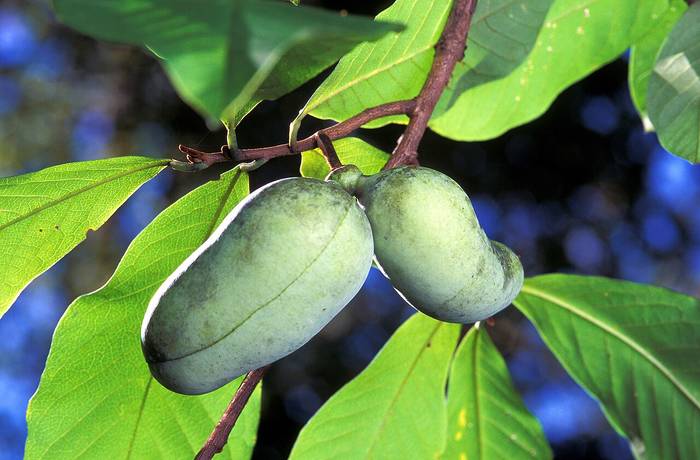
American Pawpaw
Tree·Asimina triloba
Part shade to full sun
Sun
Moist soil
Water
Well-drained soil
Drainage
Zones 5–8
Hardiness
Coverage · 134 fields
No obvious inconsistencies found.
Growth and size10 fields
Plant type
Deciduous tree“Asimina triloba, the American papaw, pawpaw, paw paw, or paw-paw, among many regional names, is a species of small deciduous tree.”PFAF“Asimina triloba is a deciduous Shrub growing to 4.5 m (14ft) by 4 m (13ft) at a slow rate.”
Height
450 cm · other sources: 1,100 cm“Asimina triloba is a deciduous Shrub growing to 4.5 m (14ft) by 4 m (13ft) at a slow rate.”Wikipedia“A. triloba is a large shrub or small tree growing to a height of 35 ft (11 m), rarely as tall as 45 ft (14 m), with trunks 8–12 in (20–30 cm) or more in diameter.”
Spread
400 cm“Asimina triloba is a deciduous Shrub growing to 4.5 m (14ft) by 4 m (13ft) at a slow rate.”
Height at age
—
empty
Spacing
300 cm (at least 200 cm)
AI estimate55 % agree
Growth rate
Slow“Asimina triloba is a deciduous Shrub growing to 4.5 m (14ft) by 4 m (13ft) at a slow rate.”
Habit
Spreading
AI estimate50 % agree
Root depth
Taproot“Because of its long taproot, pawpaw grows well even in drier upland plantings.”
Forest garden layer
Lower tree layer“An understorey tree of woodlands, growing in deep rich moist soils of river valleys and bottomlands, often forming dense thickets.”
Lifespan
~20 years
AI estimatenot measured yet
Roots6 fields
Storage organ
None
AI estimate100 % agree
Spreads
By suckers“Spreads by root suckers to form colonies, so give it room to spread (nfs.unl.edu).”
Lateral spread in cm
—
empty
Root depth in cm
—
empty
Mycorrhiza
—
empty
Light, water and soil9 fields
Sun
Full sun, light shade, part shade · best: full sun“It can grow in semi-shade (light woodland) or no shade.”PFAF“Full sun to part shade.”
Hours of sun
6–8 h
AI estimatenot measured yet
Drought tolerant
—
empty
Tolerates waterlogging
—
empty
Soil type
Loam · best: loam“Prefers a rich loamy soil with plenty of moisture and a sunny position.”PFAF“Suitable for: medium (loamy) soils and prefers well-drained soil.”
Compacted soil
Copes badly
AI estimatenot measured yet
Climate5 fields
Hardiness
Zone 5–8
AI estimatenot measured yet
Killing frost
0 °C“Killing temp. early growth: 0”EcoCrop's figure is frost during early growth (spring frost on new shoots), not winter cold.
Growing temperature
8–32 °C · optimal 12–22 °C“Temperature absolute min: 8 · Temperature absolute max: 32 · Temperature optimal min: 12 · Temperature optimal max: 22”
Chill hours
400 h
AI estimatenot measured yet
Care (becomes tasks in Manage)9 fields
Protection
After the first frost · frost“Consider giving them some protection from winter cold for their first winter outdoors.”
Planting out
June“plant them into their permanent positions in early summer once the plants are more than 15cm tall”
PFAFpartly
Starting indoors
After the previous stage · lasts 120 days
AI estimatenot measured yet
Protection
November · lasts 120 days · frost
AI estimatenot measured yet
Mulching
April · lasts 15 days
AI estimatenot measured yet
Watering
June · lasts 90 days
AI estimatenot measured yet
Feeding
May · lasts 15 days · balanced slow-release granular fertilizer
AI estimatenot measured yet
Pruning
March · lasts 30 days · dead, diseased, or crossing branches
AI estimatenot measured yet
Through the year7 fields
Leafing out
After the last frost“The flowers are produced in early spring at the same time as or slightly before the new leaves appear”
Harvest
After the previous stage“The fruit falls from the tree in autumn and is then stored until fully ripe.”
Dying back
After the first frost“In autumn, the leaves are a rusty yellow, allowing pawpaw groves to be spotted from a long distance.”
Wikipediapartly
Dormant
After the previous stage“Asimina triloba is a deciduous Shrub growing to 4.5 m (14ft) by 4 m (13ft) at a slow rate.”
PFAFpartly
First harvest
3 years after plantingFigure is for grafted nursery trees (minimum years after planting); no upper bound given for grafted stock. Same page gives a separate, much longer seed-origin timeline that is NOT used here because it counts from seed, not from planting a nursery plant: "Trees normally begin to bear fruit when the saplings reach 6 feet, which usually requires five to eight years." Alabama Cooperative Extension reports a trial planting that "took 5 years to first production" (https://www.aces.edu/blog/topics/crop-production/pawpaw-production-guide/), within the same general range but not used as max since planting stock/age at that trial isn't specified.
Edible parts and pollination4 fields
The fruit
Raw or cooked
AI estimatenot measured yet
Pollination
Needs a partner · another variety · hermaphrodite“The species is hermaphrodite (has both male and female organs).”Wikipedia“Two species of tiny sap beetle were reported as the most abundant and the most consistently present insect types at depth within the flowers, and thus as the most likely effective pollinators.”Wikipedia“Pawpaw are self-incompatible, meaning pollen cannot fertilize flowers on the same plant.”Wikipedia“Cross-pollination of at least two different genetic varieties of the plant is recommended.”PFAF“The plant is not self-fertile.”
Pollinated by
Beetles“Two species of tiny sap beetle were reported as the most abundant and the most consistently present insect types at depth within the flowers, and thus as the most likely effective pollinators.”
Ecology6 fields
Attracts
Sap beetles (Nitidulidae), butterflies, wildlife, ground-based mammals
AI estimatenot measured yet
Pests
Pawpaw peduncle borer, pawpaw webworm
AI estimatenot measured yet
Diseases
Phyllosticta leaf spot
AI estimatenot measured yet
Takes up
Calcium, potassium, phosphorus
AI estimatenot measured yet
Fixes nitrogen
No
AI estimatenot measured yet
Mycorrhiza
Yes
AI estimatenot measured yet
Propagation and names4 fields
Difficulty
3 / 5
AI estimatenot measured yet
Seed
Stored seed requires stratification, with embryo dormancy and an impermeable seedcoat; can take up to 18 months to germinate“Stored seed requires stratification, it has embryo dormancy and an impermeable seedcoat and can take up to 18 months to germinate.”
Not sorted yet74 fields
Fields the parser stores that this page has no row for yet. They show up here automatically, so nothing is hidden.
forage.DK.warnings_da
Spis ikke kernerne.
AI estimatenot measured yet
forage.DK.warnings_en
Don't eat the pips.
AI estimatenot measured yet
forage.DK.prep_cautions
The fruit can cause gastro-intestinal upsets for some people.
AI estimatenot measured yet
forage.DK.edibility_basis
inferred
AI estimatenot measured yet
forage.DK.foraging_months.notes
The mature fruit is rarely seen in Britain, only ripening after a long hot summer.
AI estimatenot measured yet
forage.DK.foraging_months.months
10
AI estimatenot measured yet
forage.DK.foraging_months.year_round
false
AI estimatenot measured yet
forage.DK.habitat_affinity
woodland, riverbank, disturbed_ground
AI estimatenot measured yet
forage.US.local_name
Pawpaw
AI estimatenot measured yet
forage.US.edible_parts
[{"part":"fruit","caution":"Eat in moderation; excessive consumption may be harmful.","preparation":"raw or cooked; also preserves, pies, ice cream and desserts","season_months":[9,10]}]“Edible Parts: Fruit”PFAF“It is recommended to eat pawpaw in moderation, as research suggests that excessive consumption—even low cumulative intake over time—might be harmful.”PFAFpartly“Edible fruit - raw or cooked.”Wikipediapartly“they are initially green, maturing by September or October to green, yellowish green, or brown.”
forage.US.prep_cautions
Avoid splitting or injuring seeds, which can contaminate the pulp with seed poisons., The fruit can cause gastro-intestinal upsets in some people., Handling the fruit can cause dermatitis., The seed contains a toxic alkaloid and is poisonous., Much of the plant contains the neurotoxin annonacin; the ripe fruit is edible.“but any splitting or injury of seeds can contaminate the remaining pulp with seed poisons.”PFAF“The fruit can cause gastro-intestinal upsets for some people.”PFAF“Other reports say that handling the fruit can cause dermatitis.”PFAF“The seed contains a toxic alkaloid and is poisonous.”Wikipedia“Although much of the plant contains the neurotoxin annonacin, the ripe fruits are edible.”
forage.US.edibility_basis
inferred
AI estimatenot measured yet
forage.US.foraging_months.notes
The fruit falls from the tree in autumn and is then stored until fully ripe.“The fruit falls from the tree in autumn and is then stored until fully ripe.”
forage.US.foraging_months.months
9, 10“they are initially green, maturing by September or October to green, yellowish green, or brown.”
Wikipediapartly
forage.US.foraging_months.year_round
false
AI estimatenot measured yet
forage.US.habitat_affinity
woodland, riverbank“An understorey tree of woodlands, growing in deep rich moist soils of river valleys and bottomlands, often forming dense thickets.”
forage.TROPICAL.edible_parts
[{"part":"fruit","caution":"The fruit can cause gastro-intestinal upsets for some people.","preparation":"raw or cooked","season_months":[9,10]}]
AI estimatenot measured yet
forage.TROPICAL.prep_cautions
The fruit can cause gastro-intestinal upsets for some people.
AI estimatenot measured yet
forage.TROPICAL.edibility_basis
inferred
AI estimatenot measured yet
forage.TROPICAL.foraging_months.months
9, 10
AI estimatenot measured yet
forage.TROPICAL.foraging_months.year_round
false
AI estimatenot measured yet
forage.TROPICAL.habitat_affinity
woodland, riverbank, disturbed_ground
AI estimatenot measured yet
ornamental.basis
documented
AI estimatenot measured yet
ornamental.fragrance.source
flower“have a faint fetid or yeasty smell to attract pollinators”
ornamental.fragrance.intensity
subtle“have a faint fetid or yeasty smell to attract pollinators”
ornamental.confidence
high
AI estimatenot measured yet
ornamental.fall_interest
true“In autumn, the leaves are a rusty yellow, allowing pawpaw groves to be spotted from a long distance.”
ornamental.evidence_quote
The flowers are a deep reddish-brown or purplish-brown, appearing in early spring. The leaves turn an attractive yellow-green in autumn. The flowers have a faint, yeasty fragrance.
AI estimatenot measured yet
ornamental.foliage_colour
dark_green“when fully grown they are smooth, dark green above, and paler beneath.”
ornamental.foliage_texture
medium“The large leaves of pawpaw trees are clustered symmetrically at the ends of the branches, giving a distinctive imbricated appearance to the tree's foliage.”
Wikipediapartly
ornamental.winter_structure
none
AI estimatenot measured yet
ornamental.autumn_foliage_colour
yellow_green, yellow_green
AI estimatenot measured yet
care_regime
light
AI estimatenot measured yet
propagation.self_seeding
light
AI estimate20 % agree
propagation.division_season
spring
AI estimatenot measured yet
propagation.establishment_years
3
AI estimate40 % agree
spatial_profile.canopy_density
medium
AI estimatenot measured yet
sun_requirement.best
full_sun
AI estimatenot measured yet
sun_requirement.best_for
fruit
AI estimatenot measured yet
forage_proposals.DK.edibility_tier.tier
caution
AI estimatenot measured yet
forage_proposals.DK.edibility_tier.confidence
high
AI estimatenot measured yet
forage_proposals.DK.edibility_tier.evidence_quote
It is recommended to eat pawpaw in moderation, as research suggests that excessive consumption—even low cumulative intake over time—might be harmful.
AI estimatenot measured yet
forage_proposals.US.edibility_tier.tier
caution
AI estimatenot measured yet
forage_proposals.US.edibility_tier.confidence
high
AI estimatenot measured yet
forage_proposals.US.edibility_tier.evidence_quote
The fruit of the pawpaw is highly prized for its unique tropical flavor, often described as a mix of banana, mango, and pineapple. It is commonly eaten raw, used in desserts, or made into jams and jellies.
AI estimatenot measured yet
forage_proposals.TROPICAL.edibility_tier.tier
caution
AI estimatenot measured yet
forage_proposals.TROPICAL.edibility_tier.confidence
high
AI estimatenot measured yet
forage_proposals.TROPICAL.edibility_tier.evidence_quote
It is recommended to eat pawpaw in moderation, as research suggests that excessive consumption—even low cumulative intake over time—might be harmful.
AI estimatenot measured yet
function_profile.biomass_return.confidence
medium
AI estimatenot measured yet
function_profile.nutrient_flows.consumes
[{"basis":"documented","demand":"moderate","nutrient":"nitrogen","confidence":"high"},{"basis":"documented","demand":"moderate","nutrient":"phosphorus","confidence":"high"},{"basis":"documented","demand":"moderate","n…
AI estimatenot measured yet
function_profile.nutrient_flows.provides
[{"basis":"inferred","nutrient":"calcium","mechanism":"biomass_return","confidence":"low"},{"basis":"inferred","nutrient":"potassium","mechanism":"biomass_return","confidence":"low"},{"basis":"inferred","nutrient":"ph…
AI estimatenot measured yet
function_profile.biotic_interactions
[{"taxa":["Glischrochilus quadrisignatus","Stelidota geminata"],"basis":"documented","valence":"beneficial","relation":"attracts","confidence":"medium","evidence_quote":"Two species of tiny sap beetle were reported as…“Two species of tiny sap beetle were reported as the most abundant and the most consistently present insect types at depth within the flowers, and thus as the most likely effective pollinators.”PFAF“Attracts butterflies”PFAF“It is noted for attracting wildlife.”PFAF“Shelter for wildlife [1-2].”Wikipedia“Full ripening often happens only after the fruit falls naturally, thus signifying a seed dispersal strategy aimed at ground-based, rather than arboreal, mammals.”
function_profile.aromatic_pest_effect.value
false
AI estimate80 % agree
function_profile.aromatic_pest_effect.confidence
high
AI estimatenot measured yet
function_profile.structural_interfaces.provides_shelter.basis
documented
AI estimatenot measured yet
function_profile.structural_interfaces.provides_shelter.kinds
shade
AI estimatenot measured yet
function_profile.structural_interfaces.provides_shelter.confidence
high
AI estimatenot measured yet
function_profile.structural_interfaces.provides_shelter.evidence_quote
Pawpaw trees provide moderate shade, especially when mature.
AI estimatenot measured yet
function_profile.structural_interfaces.requires_shelter.basis
documented
AI estimatenot measured yet
function_profile.structural_interfaces.requires_shelter.kinds
frost, shade“Consider giving them some protection from winter cold for their first winter outdoors.”PFAF“Pawpaw is shade tolerant and would prefer some afternoon shade from other trees or perhaps the shade of a building.”
function_profile.structural_interfaces.requires_shelter.stage
establishment
AI estimatenot measured yet
function_profile.structural_interfaces.requires_shelter.confidence
high
AI estimatenot measured yet
function_profile.structural_interfaces.requires_shelter.evidence_quote
Young pawpaw trees require partial shade for the first year or two to prevent sunburn.
AI estimatenot measured yet
function_profile.structural_interfaces.provides_physical_support.form
trunk
AI estimatenot measured yet
function_profile.structural_interfaces.provides_physical_support.basis
taxonomic
AI estimatenot measured yet
function_profile.structural_interfaces.provides_physical_support.confidence
high
AI estimatenot measured yet
function_profile.structural_interfaces.requires_physical_support.basis
taxonomic
AI estimatenot measured yet
function_profile.structural_interfaces.requires_physical_support.confidence
high
AI estimatenot measured yet
climate_tolerance.photoperiod_response
day_neutral
AI estimatenot measured yet
soil_interactions.organic_matter_contribution
medium
AI estimatenot measured yet
component_metadata.growth_cycle
perennial
AI estimate100 % agree
resource_interfaces.inputs
[{"resource":"light","quantity_description":"full sun to part shade"},{"resource":"shade","quantity_description":"some afternoon shade preferred"},{"resource":"water","quantity_description":"moist soil"},{"resource":"…“Full sun to part shade.”PFAF“Pawpaw is shade tolerant and would prefer some afternoon shade from other trees or perhaps the shade of a building.”PFAF“It prefers moist soil.”PFAF“Spreads by root suckers to form colonies, so give it room to spread (nfs.unl.edu).”PFAF“Flowers are strongly protogynous, self-incompatible and require cross-pollination.”
resource_interfaces.outputs
[{"resource":"fruit","quantity_description":"edible fruit, potentially commercial"},{"resource":"habitat","quantity_description":"shelter for wildlife"},{"resource":"pollinator_services","quantity_description":"flower…“The papaw produces a delicious edible fruit which is a potentially commercial crop.”PFAF“Shelter for wildlife [1-2].”Wikipedia“The flowers are produced in early spring at the same time as or slightly before the new leaves appear, and have a faint fetid or yeasty smell to attract pollinators.”Wikipedia“Abundant leaves, rotting fruit, and other organic material on the ground beneath or near the flowering trees are crucial for the larval stage of the beetle.”Wikipedia“Full ripening often happens only after the fruit falls naturally, thus signifying a seed dispersal strategy aimed at ground-based, rather than arboreal, mammals.”PFAFpartly“Wood - light, soft, weak, spongy, coarse grained.”