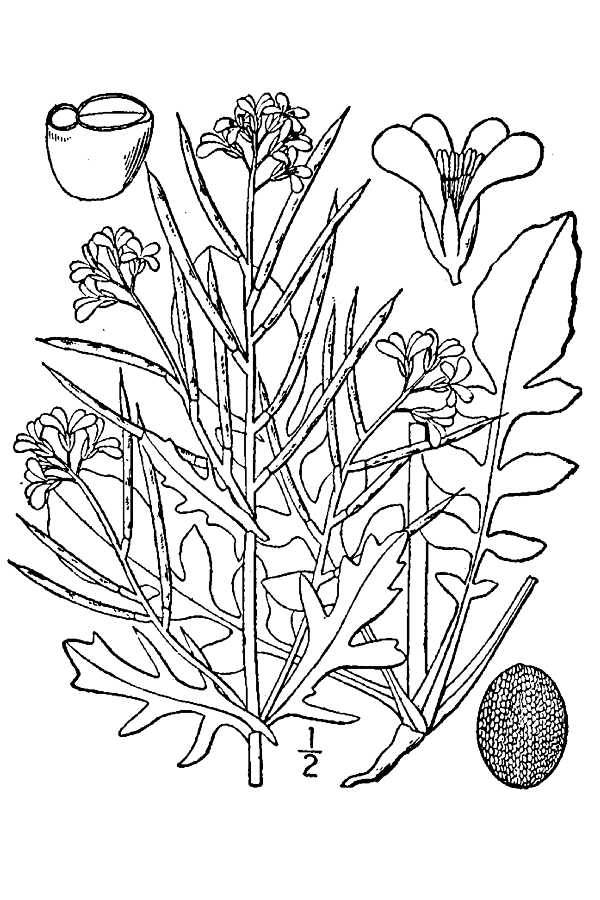
Land cress
Plant·Barbarea verna
Part shade to full sun
Sun
Moist soil
Water
Not recorded
Drainage
Zones 4–9
Hardiness
Coverage · 117 fields
Growth and size10 fields
Plant type
Evergreen plant
AI estimate100 % agree
Height
30 cm · other sources: 90 cm, 130 cm“Barbarea verna is a BIENNIAL growing to 0.3 m (1ft) by 0.3 m (1ft in).”Wikipedia“The following spring, it grows a main stem up to about 90 cm, sometimes up to 130 cm, which is pale green, grooved (sulcate) and occasionally branched.”
Height at age
—
empty
Spacing
15 cm (at least 10 cm)
AI estimate55 % agree
Growth rate
—
empty
Habit
Mounding
AI estimate50 % agree
Root depth
Medium
AI estimate63 % agree
Forest garden layer
Herb layer
AI estimate90 % agree
Lifespan
~2 years
AI estimatenot measured yet
Roots6 fields
Root form
—
empty
Storage organ
None“It does not multiply vegetatively: it has no rhizomes, runners, suckers or offspring bulbs or tubers.”
Spreads
No“It does not multiply vegetatively: it has no rhizomes, runners, suckers or offspring bulbs or tubers.”
Lateral spread in cm
—
empty
Root depth in cm
—
empty
Mycorrhiza
—
empty
Light, water and soil9 fields
Sun
Full sun, light shade, part shade · best: full sun“It can grow in semi-shade (light woodland) or no shade.”Wikipedia“This plant needs full sun or partial shade and moist or poorly drained soil.”
Hours of sun
6–12 h
AI estimatenot measured yet
Drought tolerant
—
empty
Tolerates waterlogging
—
empty
Soil type
Sand, loam, clay · best: loam“Suitable for: light (sandy), medium (loamy) and heavy (clay) soils”
Compacted soil
Copes fairly well
AI estimatenot measured yet
Climate5 fields
Hardiness
Zone 4–9
Killing frost (-10 °C) doesn't fit hardiness zone 4, which survives far lower temperatures.
AI estimatenot measured yet
Killing frost
-10 °C
Killing frost (-10 °C) doesn't fit hardiness zone 4, which survives far lower temperatures.
AI estimatenot measured yet
Growing temperature
5–25 °C · optimal 10–20 °C
AI estimatenot measured yet
Chill hours
0 h
AI estimatenot measured yet
Care (becomes tasks in Manage)10 fields
Sowing
After the last frost · lasts 150 days“Seed - sow spring to September in situ at 3-weekly intervals to provide a succession of leaves.”
Sowing appears 3 times with different timing.
PFAFpartly
Protection
After the first frost · lasts 90 days“Leaves can be obtained throughout the year if autumn-sown plants are given a light protection in winter.”
PFAFpartly
Sowing
March · lasts 214 days
Sowing appears 3 times with different timing.
AI estimatenot measured yet
Sowing
August · lasts 92 days
Sowing appears 3 times with different timing.
AI estimatenot measured yet
Watering
After the previous stage
Watering appears 2 times with different timing.
AI estimatenot measured yet
Mulching
After the previous stage
AI estimatenot measured yet
Feeding
After the previous stage
AI estimatenot measured yet
Protection
Once it is warm enough · sun
AI estimatenot measured yet
Watering
After rain · lasts 180 days
Watering appears 2 times with different timing.
AI estimatenot measured yet
Weeding
After the previous stage · 14 days after · lasts 90 days
AI estimatenot measured yet
Through the year3 fields
Flowering
May · lasts 92 days“It is in flower from May to July, and the seeds ripen from June to August.”
Fruiting
June · lasts 92 days“It is in flower from May to July, and the seeds ripen from June to August.”
Harvest
February · lasts 120 days
AI estimatenot measured yet
Edible parts and pollination5 fields
Young leaves
Raw, cooked or used as a seasoning“Young leaves - raw, cooked or used as a seasoning.”PFAFpartly“Edible Parts: Leaves Oil Seed”
The seeds
Ecology6 fields
Pests
Brassica herbivores
AI estimatenot measured yet
Diseases
—
empty
Takes up
Sulfur, iron
AI estimatenot measured yet
Fixes nitrogen
No
AI estimatenot measured yet
Mycorrhiza
No
AI estimatenot measured yet
Propagation and names4 fields
Methods
Seed“Seed - sow spring to September in situ at 3-weekly intervals to provide a succession of leaves.”
Difficulty
1 / 5
AI estimatenot measured yet
Seed
—
empty
Not sorted yet59 fields
Fields the parser stores that this page has no row for yet. They show up here automatically, so nothing is hidden.
forage.DK.local_name
Vinterkarse
AI estimatenot measured yet
forage.DK.prep_cautions
Standard brassica goitrogens/glucosinolates—moderation advised for thyroid concerns; cooking reduces pungency., Avoid nitrate accumulation by growing in full light with balanced fertility.“Standard brassica goitrogens/glucosinolates—moderation advised for thyroid concerns; cooking reduces pungency.”PFAF“Avoid nitrate accumulation by growing in full light with balanced fertility.”
forage.DK.edibility_basis
inferred
AI estimatenot measured yet
forage.DK.foraging_months.notes
Leaves can be obtained throughout the year if autumn-sown plants are given a light protection in winter.“Leaves can be obtained throughout the year if autumn-sown plants are given a light protection in winter.”
forage.DK.foraging_months.months
2, 3, 4, 5
AI estimatenot measured yet
forage.DK.foraging_months.year_round
true“It can supply leaves all year round from successional sowings.”
forage.US.local_name
Land cress
AI estimatenot measured yet
forage.US.edible_parts
[{"part":"young leaves","caution":null,"preparation":"raw, cooked or used as a seasoning"},{"part":"seed","caution":null,"preparation":"oil obtained from the seed","season_months":[6,7,8]},{"part":"seed sprouts","caut…“The seed can be sprouted and added to salads etc.”PFAF“Young leaves - raw, cooked or used as a seasoning.”PFAF“An edible oil is obtained from the seed.”PFAF“the seeds ripen from June to August.”PFAFpartly“Edible Parts: Leaves Oil Seed”
forage.US.prep_cautions
Standard brassica goitrogens/glucosinolates—moderation advised for thyroid concerns; cooking reduces pungency., Avoid nitrate accumulation by growing in full light with balanced fertility.“Standard brassica goitrogens/glucosinolates—moderation advised for thyroid concerns; cooking reduces pungency.”PFAF“Avoid nitrate accumulation by growing in full light with balanced fertility.”
forage.US.edibility_basis
inferred
AI estimatenot measured yet
forage.US.foraging_months.notes
Leaves can be obtained throughout the year if autumn-sown plants are given a light protection in winter.“Leaves can be obtained throughout the year if autumn-sown plants are given a light protection in winter.”
forage.US.foraging_months.months
2, 3, 4, 5
AI estimatenot measured yet
forage.US.foraging_months.year_round
true“It can supply leaves all year round from successional sowings.”
forage.TROPICAL.local_name
Land cress
AI estimatenot measured yet
forage.TROPICAL.edible_parts
[{"part":"leaves","caution":null,"preparation":"raw or cooked","season_months":[1,2,3,4,5,6,7,8,9,10,11,12]},{"part":"stems","caution":null,"preparation":"raw or cooked","season_months":[1,2,3,4,5,6,7,8,9,10,11,12]}]
AI estimatenot measured yet
forage.TROPICAL.prep_cautions
Best harvested before flowering as leaves can become bitter.
AI estimatenot measured yet
forage.TROPICAL.edibility_basis
inferred
AI estimatenot measured yet
forage.TROPICAL.foraging_months.notes
Can be harvested year-round in suitable tropical highland climates, but best before flowering.
AI estimatenot measured yet
forage.TROPICAL.foraging_months.year_round
true
AI estimatenot measured yet
forage.TROPICAL.habitat_affinity
disturbed_ground
AI estimatenot measured yet
ornamental.basis
documented
AI estimatenot measured yet
ornamental.fragrance.source
none
AI estimate100 % agree
ornamental.confidence
high
AI estimatenot measured yet
ornamental.fall_interest
false
AI estimatenot measured yet
ornamental.evidence_quote
Barbarea verna, commonly known as land cress, produces small yellow flowers and green foliage. It is typically grown as an annual or biennial and does not exhibit significant autumn foliage color or winter structure.
AI estimatenot measured yet
ornamental.foliage_colour
green
AI estimate82 % agree
ornamental.foliage_texture
medium
AI estimatenot measured yet
ornamental.winter_structure
none
AI estimatenot measured yet
ornamental.autumn_foliage_colour
none
AI estimatenot measured yet
care_regime
light
AI estimatenot measured yet
propagation.self_seeding
moderate“Plants usually self-sow freely when growing in a suitable position[K].”
propagation.establishment_years
1
AI estimate40 % agree
forage_proposals.DK.edibility_tier.tier
edible
AI estimatenot measured yet
forage_proposals.DK.edibility_tier.confidence
high
AI estimatenot measured yet
forage_proposals.DK.edibility_tier.evidence_quote
Land cress (Barbarea verna) is widely consumed as a salad green and potherb, known for its peppery, watercress-like flavor.
AI estimatenot measured yet
forage_proposals.US.edibility_tier.tier
edible
AI estimatenot measured yet
forage_proposals.US.edibility_tier.confidence
high
AI estimatenot measured yet
forage_proposals.US.edibility_tier.evidence_quote
Land cress (Barbarea verna) is widely consumed as a salad green and potherb, known for its peppery, watercress-like flavor.
AI estimatenot measured yet
forage_proposals.TROPICAL.edibility_tier.tier
edible
AI estimatenot measured yet
forage_proposals.TROPICAL.edibility_tier.confidence
high
AI estimatenot measured yet
forage_proposals.TROPICAL.edibility_tier.evidence_quote
Land cress (Barbarea verna) is widely consumed as a salad green and potherb, known for its peppery, watercress-like flavor.
AI estimatenot measured yet
function_profile.biomass_return.confidence
medium
AI estimatenot measured yet
function_profile.nutrient_flows.consumes
[{"basis":"documented","demand":"moderate","nutrient":"nitrogen","confidence":"high"},{"basis":"documented","demand":"moderate","nutrient":"phosphorus","confidence":"high"},{"basis":"documented","demand":"moderate","n…
AI estimatenot measured yet
function_profile.nutrient_flows.provides
[{"basis":"inferred","nutrient":"sulfur","mechanism":"biomass_return","confidence":"low"},{"basis":"inferred","nutrient":"iron","mechanism":"biomass_return","confidence":"low"}]
AI estimatenot measured yet
function_profile.biotic_interactions
[{"taxa":["flies","bees","beetles"],"basis":"documented","valence":"beneficial","relation":"attracts","confidence":"high","evidence_quote":"is pollinated by Flies, bees, beetles.","organism_group":"pollinator","ecolog…“is pollinated by Flies, bees, beetles.”
function_profile.aromatic_pest_effect.value
false
AI estimate80 % agree
function_profile.aromatic_pest_effect.confidence
low
AI estimatenot measured yet
function_profile.structural_interfaces.requires_shelter.basis
documented
AI estimatenot measured yet
function_profile.structural_interfaces.requires_shelter.kinds
shade“The summer crop is best if it is given some shade whilst the winter crop succeeds in sunny positions.”
function_profile.structural_interfaces.requires_shelter.confidence
medium
AI estimatenot measured yet
function_profile.structural_interfaces.requires_shelter.evidence_quote
The summer crop is best if it is given some shade whilst the winter crop succeeds in sunny positions.
AI estimatenot measured yet
climate_tolerance.photoperiod_response
day_neutral
AI estimatenot measured yet
soil_interactions.organic_matter_contribution
medium
AI estimatenot measured yet
component_metadata.growth_cycle
biennial“Barbarea verna is a BIENNIAL growing to 0.3 m (1ft) by 0.3 m (1ft in).”
resource_interfaces.inputs
[{"resource":"light","quantity_description":"full sun or partial shade"},{"resource":"water","quantity_description":"moist soil"},{"resource":"shade","quantity_description":"some shade for the summer crop"}]“This plant needs full sun or partial shade and moist or poorly drained soil.”PFAF“It prefers moist soil.”PFAF“The summer crop is best if it is given some shade whilst the winter crop succeeds in sunny positions.”
resource_interfaces.outputs
[{"resource":"seeds","quantity_description":"seeds ripen June to August"}]“the seeds ripen from June to August”