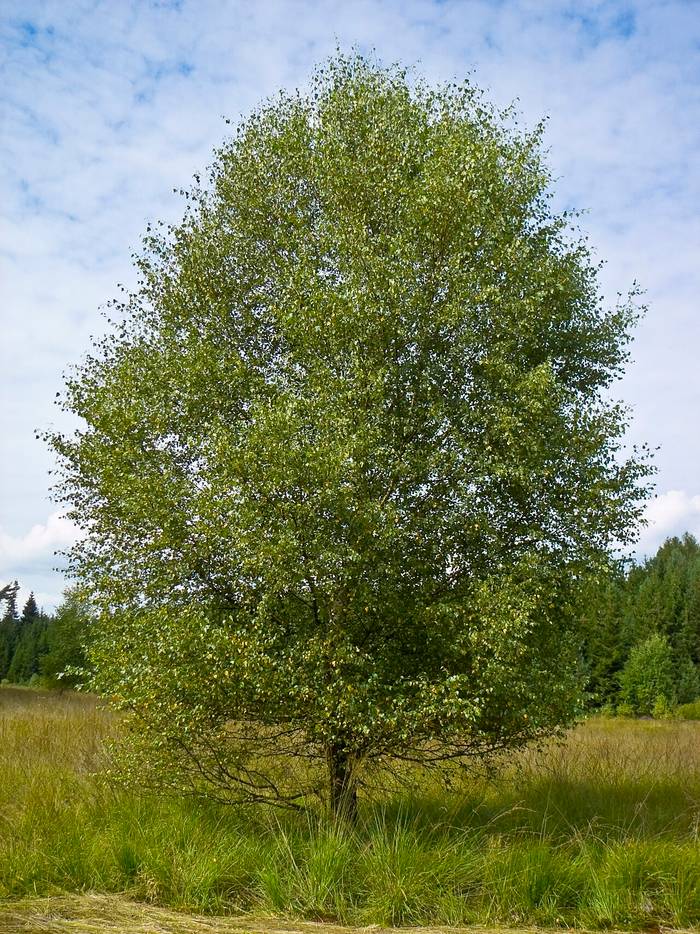
Willow · CC BY 2.5
Downy birch
Tree·Betula pubescens
Full sun
Sun
Dry to wet soil
Water
Not recorded
Drainage
Zones 2–7
Hardiness
Coverage · 115 fields
No obvious inconsistencies found.
Growth and size11 fields
Plant type
Deciduous tree“Betula pubescens is a deciduous Tree growing to 20 m (65ft) by 10 m (32ft) at a fast rate.”
Height
2,000 cm · the source gives 1,000–2,000 cm“growing to 10 to 20 m (33 to 66 ft) tall”PFAF“Betula pubescens is a deciduous Tree growing to 20 m (65ft) by 10 m (32ft) at a fast rate.”
Spread
1,000 cm“Betula pubescens is a deciduous Tree growing to 20 m (65ft) by 10 m (32ft) at a fast rate.”
Height at age
—
empty
Size after planting
4 yrs: 3 m tall, 1 m crown · 49 yrs: 15 m tall, 6 m crown · 73 yrs: 21 m tall, 6 m crown“Berlin tree register: 38 trees of this species measured with years since planting, height and crown diameter; median crown 6.0 m and height 21.0 m at 60–100 years after planting (14 trees).”Median of 38 measured trees in Berlin. Years count from planting nursery stock, so a small tree reaches each size later.
Spacing
600 cm (at least 400 cm)
AI estimate55 % agree
Growth rate
Fast“Betula pubescens is a deciduous Tree growing to 20 m (65ft) by 10 m (32ft) at a fast rate.”
Habit
Columnar
AI estimate50 % agree
Root depth
Medium
AI estimate63 % agree
Forest garden layer
Lower tree layer
AI estimate90 % agree
Lifespan
~100 years
AI estimatenot measured yet
Roots6 fields
Root form
Fibrous roots
AI estimate43 % agree
Storage organ
None
AI estimate100 % agree
Lateral spread in cm
—
empty
Root depth in cm
—
empty
Mycorrhiza
Ectomycorrhizal (EcM)“its roots are easily associated with a large number of ectomycorrhizal fungi”
Light, water and soil9 fields
Hours of sun
6 h
AI estimatenot measured yet
Drought tolerant
No“Southern distribution limits appear to be set by summer drought, which both species, and particularly Betula pendula, do not tolerate.”
JRC forest tree atlaspartly
Soil type
Sand, loam, clay, peat · best: loam“Suitable for: light (sandy), medium (loamy) and heavy (clay) soils and can grow in heavy clay and nutritionally poor soils.”Wikipedia“The two have differences in habitat requirements, with downy birch more common on wet, poorly drained sites, such as clays and peat bogs, and silver birch found mainly on dry, sandy soils.”
pH
4–8 · best 4.5–7.5“Suitable pH: mildly acid, neutral and basic (mildly alkaline) soils and can grow in very acid soils.”
Drainage
Moist to wet; tolerates poorly drained soils“Tolerates a wet position, succeeding in poorly drained soils.”
PFAFpartly
Compacted soil
Copes fairly well
AI estimatenot measured yet
Climate5 fields
Hardiness
Zone 2–7
AI estimatenot measured yet
Killing frost
0 °C“Killing temp. early growth: 0”EcoCrop's figure is frost during early growth (spring frost on new shoots), not winter cold.
Growing temperature
6–26 °C · optimal 10–18 °C“Temperature absolute min: 6 · Temperature absolute max: 26 · Temperature optimal min: 10 · Temperature optimal max: 18”
Chill hours
800 h
AI estimatenot measured yet
Native range
AD, AM, AT, AZ, BA, BE, BY, CA, CH, CZ, DE, DK, EE, ES, FI, FR, GB, GE, GG, GI, GL, HR, HU, IE, IR, IS, IT, JE, LI, LT, LU, LV, MC, MD, ME, MK, NL, NO, PL, PM, PT, RO, RS, RU, SE, SI, SK, SM, TR, UA, VA, XK
Care (becomes tasks in Manage)2 fields
Pruning
August · lasts 30 days · avoid heavy pruning in spring to prevent bleeding · dead, diseased, or crossing branches
AI estimatenot measured yet
Mulching
March · lasts 30 days
AI estimatenot measured yet
Through the year6 fields
Flowering
April · lasts 30 days“It is in flower in April, and the seeds ripen from August to September.”
Fruiting
August · lasts 61 days“It is in flower in April, and the seeds ripen from August to September.”
Harvest
After the previous stage · -7 days after · lasts 28 days
AI estimatenot measured yet
Leafing out
After the last frost · lasts 30 days
AI estimatenot measured yet
Dying back
After the first frost · lasts 30 days
AI estimatenot measured yet
Dormant
After the first frost · 30 days after · lasts 150 days
AI estimatenot measured yet
Edible parts and pollination8 fields
Inner bark
The sap
Young catkins
PFAFpartly
The leaves
Infused in boiling water as a tea“A tea is made from the leaves”Wikipedia“The leaves can be infused with boiling water to make a tea”
Pollination
Self-fertile · monoecious“The species is monoecious (individual flowers are either male or female, but both sexes can be found on the same plant) and is pollinated by Wind.”
Pollinated by
Wind“The species is monoecious (individual flowers are either male or female, but both sexes can be found on the same plant) and is pollinated by Wind.”
Ecology5 fields
Attracts
Wildlife, over 200 associated insect species“It is noted for attracting wildlife.”PFAF“A superb tree for encouraging wildlife, it has over 200 associated insect species.”
Pests
Autumnal moth (epirrita autumnata), geometrid moths (including operophtera fagata), leaf-mining and gall-forming insect larvae, butterfly, moth and sawfly larvae, bronze birch borer (agrilus anxius)“The larva of the autumnal moth (Epirrita autumnata) feeds on the foliage of Betula pubescens and other tree species.”JRC forest tree atlas“geometrid moth species that feed on the leaves from the outside (e.g. Epirrita autumnata and Operophtera fagata)”JRC forest tree atlas“Larvae of other insects consume birch tissue from the inside either by burrowing through the leaf tissue, so-called leaf miners, or creating outgrowths, i.e. galls, in leaves, fruits, or fruit scales.”JRC forest tree atlas“Birch leaves are forage for the larvae of several butterflies, moths and sawfly species.”JRC forest tree atlaspartly“It is a wood-boring beetle native to North America, known to attack all species of birch (with varying susceptibility).”
Diseases
Birch dieback (marssonina betulae, anisogramma virgultorum), honey fungus, birch rust (melampsoridium botulinum), taphrina betulina and taphrina nana (witch's broom), birch polypore (piptoporus betulinus)“Birch dieback disease, associated with the fungal pathogens Marssonina betulae and Anisogramma virgultorum, can affect planted trees, while naturally regenerated trees seem less susceptible.”PFAF“Trees are notably susceptible to honey fungus.”JRC forest tree atlas“birch rust (Melampsoridium botulinum) affects birch leaves, and stunts growth, and reduces life expectancy.”JRC forest tree atlas“Taphrina betulina and Taphrina nana cause abnormal shot growth (socalled witch’s broom) and leaf deformations.”JRC forest tree atlas“birch polypore (Piptoporus betulinus) causes wood rot, eventually killing infected trees.”
Takes up
—
empty
Fixes nitrogen
No
AI estimatenot measured yet
Propagation and names4 fields
Methods
Seed, root suckers“Seed - best sown as soon as it is ripe in a light position in a cold frame.”CLO-PLA (clonal growth)“It spreads by suckers: new shoots from buds on its roots.”
Difficulty
2 / 5
AI estimatenot measured yet
Seed
cold stratification for 4-6 weeks
AI estimatenot measured yet
Not sorted yet59 fields
Fields the parser stores that this page has no row for yet. They show up here automatically, so nothing is hidden.
forage.DK.local_name
Dun-birk
AI estimatenot measured yet
forage.DK.prep_cautions
Do not use in patients with oedema or with poor kidney or heart functions“Do not use in patients with oedema or with poor kidney or heart functions”
forage.DK.edibility_basis
inferred
AI estimatenot measured yet
forage.DK.foraging_months.notes
Harvested in early spring, before the leaves unfurl, by tapping the trunk.“Harvested in early spring, before the leaves unfurl, by tapping the trunk.”
forage.DK.foraging_months.months
3, 4, 5
AI estimatenot measured yet
forage.DK.foraging_months.year_round
false
AI estimatenot measured yet
forage.DK.habitat_affinity
woodland, disturbed_ground“Open woodland and heaths, usually on acid soils, from sea level to 830 metres.”PFAF“A pioneer species, it readily invades old fields, cleared or burnt-over land and creates conditions suitable for other woodland trees to become established.”
forage.US.local_name
Downy birch
AI estimatenot measured yet
forage.US.edible_parts
[{"part":"sap","caution":"collect sustainably in early spring","preparation":"drink","season_months":[3,4]},{"part":"young leaves","caution":null,"preparation":"raw or cooked","season_months":[4,5]}]
AI estimatenot measured yet
forage.US.edibility_basis
inferred
AI estimatenot measured yet
forage.US.foraging_months.notes
Sap in early spring, young leaves in late spring.
AI estimatenot measured yet
forage.US.foraging_months.months
3, 4, 5
AI estimatenot measured yet
forage.US.foraging_months.year_round
false
AI estimatenot measured yet
forage.US.habitat_affinity
woodland, riverbank, disturbed_ground
AI estimatenot measured yet
forage.TROPICAL.edibility_basis
inferred
AI estimatenot measured yet
forage.TROPICAL.foraging_months.year_round
false
AI estimatenot measured yet
ornamental.basis
documented
AI estimatenot measured yet
ornamental.fragrance.source
bark
AI estimate100 % agree
ornamental.fragrance.intensity
subtle
AI estimatenot measured yet
ornamental.confidence
high
AI estimatenot measured yet
ornamental.fall_interest
true
AI estimatenot measured yet
ornamental.flower_colour
brown, insignificant
AI estimate67 % agree
ornamental.evidence_quote
Betula pubescens, commonly known as downy birch, features green foliage that turns yellow-green in autumn, providing fall interest. Its bark is ornamental, and the tree maintains an architectural skeleton in winter. Flowers are inconspicuous catkins.
AI estimatenot measured yet
ornamental.foliage_colour
green
AI estimate82 % agree
ornamental.foliage_texture
medium
AI estimatenot measured yet
ornamental.winter_structure
ornamental_bark, architectural_skeleton
AI estimatenot measured yet
ornamental.autumn_foliage_colour
yellow_green
AI estimatenot measured yet
care_regime
none
AI estimatenot measured yet
propagation.self_seeding
moderate
AI estimate20 % agree
propagation.establishment_years
2“Grow the plants on in the seedbed for 2 years before planting them out into their permanent positions in the winter.”
size_at_age.v
1
AI estimatenot measured yet
size_at_age.basis
years_after_planting
AI estimatenot measured yet
forage_proposals.DK.edibility_tier.tier
edible
AI estimatenot measured yet
forage_proposals.DK.edibility_tier.confidence
high
AI estimatenot measured yet
forage_proposals.DK.edibility_tier.evidence_quote
The sap can be tapped in early spring and drunk fresh or fermented. Young leaves are edible raw or cooked.
AI estimatenot measured yet
forage_proposals.US.edibility_tier.tier
edible
AI estimatenot measured yet
forage_proposals.US.edibility_tier.confidence
high
AI estimatenot measured yet
forage_proposals.US.edibility_tier.evidence_quote
The sap can be tapped in early spring and drunk fresh or fermented. Young leaves are edible raw or cooked.
AI estimatenot measured yet
forage_proposals.TROPICAL.edibility_tier.confidence
low
AI estimatenot measured yet
function_profile.biomass_return.confidence
high“The leaves are a good addition to the compost heap, improving fermentation.”
PFAFpartly
function_profile.nutrient_flows.consumes
[{"basis":"inferred","demand":"moderate","nutrient":"nitrogen","confidence":"medium"},{"basis":"inferred","demand":"moderate","nutrient":"phosphorus","confidence":"medium"},{"basis":"inferred","demand":"moderate","nut…
AI estimatenot measured yet
function_profile.nutrient_flows.provides
[{"basis":"inferred","nutrient":"calcium","mechanism":"biomass_return","confidence":"medium"},{"basis":"inferred","nutrient":"potassium","mechanism":"biomass_return","confidence":"medium"}]
AI estimatenot measured yet
function_profile.biotic_interactions
[{"taxa":["wildlife"],"basis":"documented","valence":"beneficial","relation":"attracts","confidence":"medium","evidence_quote":"It is noted for attracting wildlife.","organism_group":"wildlife","ecological_function":"…“It is noted for attracting wildlife.”JRC forest tree atlas“In spruce plantations in Scandinavia, naturally generating birch trees increase biodiversity of birds and lichens.”Wikipedia“The larva of the autumnal moth (Epirrita autumnata) feeds on the foliage of Betula pubescens and other tree species.”JRC forest tree atlas“geometrid moth species that feed on the leaves from the outside (e.g. Epirrita autumnata and Operophtera fagata)”JRC forest tree atlas“Larvae of other insects consume birch tissue from the inside either by burrowing through the leaf tissue, so-called leaf miners, or creating outgrowths, i.e. galls, in leaves, fruits, or fruit scales.”JRC forest tree atlas“Birch leaves are forage for the larvae of several butterflies, moths and sawfly species.”Wikipedia“Birch dieback disease, associated with the fungal pathogens Marssonina betulae and Anisogramma virgultorum, can affect planted trees, while naturally regenerated trees seem less susceptible.”PFAF“Trees are notably susceptible to honey fungus.”JRC forest tree atlas“birch rust (Melampsoridium botulinum) affects birch leaves, and stunts growth, and reduces life expectancy.”JRC forest tree atlas“Taphrina betulina and Taphrina nana cause abnormal shot growth (socalled witch’s broom) and leaf deformations.”JRC forest tree atlas“birch polypore (Piptoporus betulinus) causes wood rot, eventually killing infected trees.”JRC forest tree atlaspartly“It is a wood-boring beetle native to North America, known to attack all species of birch (with varying susceptibility).”
function_profile.aromatic_pest_effect.value
false
AI estimate80 % agree
function_profile.aromatic_pest_effect.confidence
low
AI estimatenot measured yet
function_profile.structural_interfaces.provides_shelter.basis
documented
AI estimatenot measured yet
function_profile.structural_interfaces.provides_shelter.kinds
frost“Birch plantations can also provide a protective habitat for seedlings of other tree species, including those that are more frost-sensitive, such as beech (Fagus sylvatica) and Norway spruce.”
function_profile.structural_interfaces.provides_shelter.confidence
high
AI estimatenot measured yet
function_profile.structural_interfaces.provides_shelter.evidence_quote
Birch plantations can also provide a protective habitat for seedlings of other tree species, including those that are more frost-sensitive, such as beech (Fagus sylvatica) and Norway spruce.
AI estimatenot measured yet
function_profile.structural_interfaces.provides_physical_support.form
trunk
AI estimatenot measured yet
function_profile.structural_interfaces.provides_physical_support.basis
taxonomic
AI estimatenot measured yet
function_profile.structural_interfaces.provides_physical_support.confidence
high
AI estimatenot measured yet
climate_tolerance.photoperiod_response
long_day
AI estimatenot measured yet
soil_interactions.organic_matter_contribution
high
AI estimatenot measured yet
component_metadata.growth_cycle
perennial
AI estimate100 % agree
resource_interfaces.inputs
[{"resource":"light","quantity_description":"a sunny position; cannot grow in shade"},{"resource":"water","quantity_description":"tolerates wet, poorly drained positions"}]“Succeeds in a well-drained light loamy soil in a sunny position.”PFAF“Tolerates a wet position, succeeding in poorly drained soils.”
resource_interfaces.outputs
[{"resource":"habitat","quantity_description":"a superb tree for encouraging wildlife; over 200 associated insect species"},{"resource":"organic_matter","quantity_description":"leaves are a good addition to the compos…“The leaves are a good addition to the compost heap, improving fermentation.”PFAF“Wood - soft, light, durable.”PFAF“the seeds ripen from August to September.”PFAFpartly“It is noted for attracting wildlife.”
biotic_relationships.repels
insects
AI estimatenot measured yet