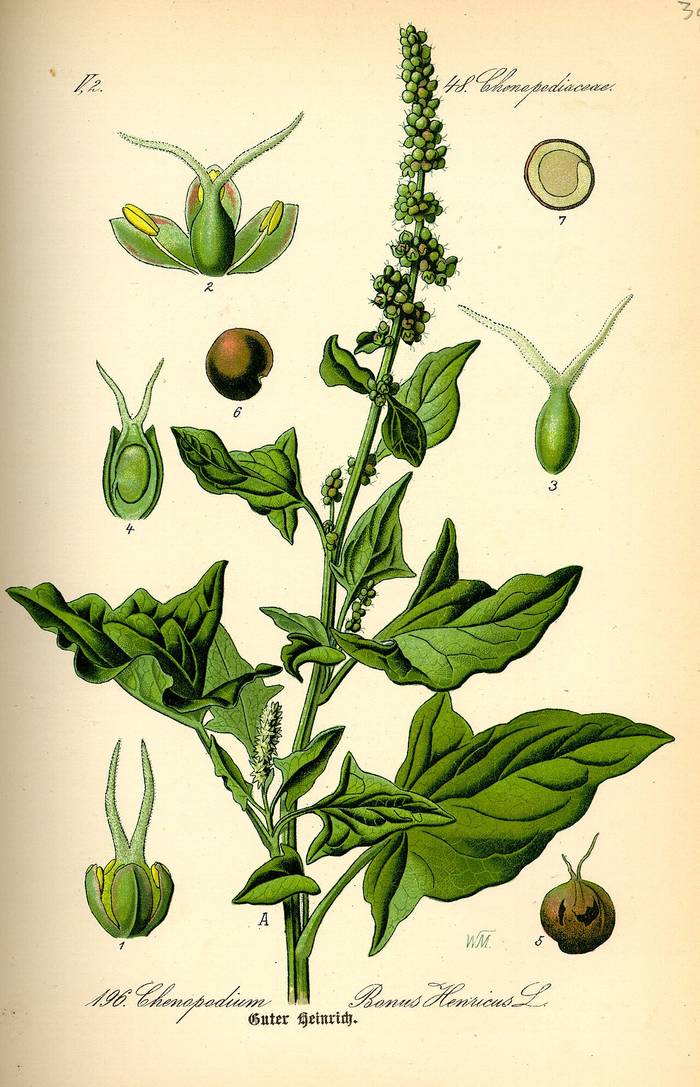
Good King Henry
Plant·Blitum bonus-henricus
Part shade to full sun
Sun
Moist soil
Water
Not recorded
Drainage
Zones 3–9
Hardiness
Coverage · 107 fields
Growth and size10 fields
Height
30 cm · other sources: 60 cm“Chenopodium bonus-henricus is a PERENNIAL growing to 0.3 m (1ft) by 0.3 m (1ft in).”Wikipedia“It is an annual or perennial plant growing up to 60 centimetres (24 inches) tall.”
Spread
30 cm“Chenopodium bonus-henricus is a PERENNIAL growing to 0.3 m (1ft) by 0.3 m (1ft in).”
Height at age
—
empty
Spacing
45 cm (at least 30 cm)
AI estimate55 % agree
Growth rate
—
empty
Root depth
Taproot“The root pattern is a tap root similar to a carrot going directly down [1-2].”
Forest garden layer
Herb layer
AI estimate90 % agree
Lifespan
~5 years
AI estimatenot measured yet
Roots6 fields
Storage organ
None“It does not multiply vegetatively: it has no rhizomes, runners, suckers or offspring bulbs or tubers.”
Spreads
No“It does not multiply vegetatively: it has no rhizomes, runners, suckers or offspring bulbs or tubers.”
Lateral spread in cm
—
empty
Root depth in cm
—
empty
Mycorrhiza
Non-mycorrhizal
AI estimatenot measured yet
Light, water and soil9 fields
Sun
Hours of sun
4–6 h
AI estimatenot measured yet
Drought tolerant
—
empty
Tolerates waterlogging
—
empty
Compacted soil
Copes fairly well
AI estimatenot measured yet
Climate5 fields
Hardiness
Zone 3–9
Killing frost (-20 °C) doesn't fit hardiness zone 3, which survives far lower temperatures.
AI estimatenot measured yet
Killing frost
-20 °C
Killing frost (-20 °C) doesn't fit hardiness zone 3, which survives far lower temperatures.
AI estimatenot measured yet
Growing temperature
0–30 °C · optimal 10–25 °C
AI estimatenot measured yet
Chill hours
0 h
AI estimatenot measured yet
Native range
AD, AL, AT, BA, BE, BG, BY, CH, CZ, DE, ES, FR, GG, GI, GR, HR, HU, IT, JE, LI, LU, MC, MD, ME, MK, MT, NL, PT, RO, RS, RU, SI, SK, SM, UA, VA, XK
Care (becomes tasks in Manage)4 fields
Mulching
March · lasts 14 days
AI estimatenot measured yet
Watering
After rain · lasts 180 days
AI estimatenot measured yet
Weeding
April · lasts 180 days
AI estimatenot measured yet
Dividing
March · lasts 30 days · lift and split with a spade
AI estimatenot measured yet
Through the year6 fields
Flowering
May · lasts 92 days“It is in flower from May to July, and the seeds ripen from June to August.”
Fruiting
June · lasts 92 days“It is in flower from May to July, and the seeds ripen from June to August.”
Harvest
April · lasts 91 days“Some of the new shoots can be thinned out as they appear (usually from mid-spring to early summer) and cooked like asparagus.”
Wikipediapartly
Harvest
June · lasts 92 days“The succulent, triangular leaves may be harvested a few at a time until the end of August and eaten raw or cooked like spinach.”
Wikipediapartly
Leafing out
After the last frost · lasts 75 days
AI estimatenot measured yet
Dying back
After the first frost · lasts 30 days
AI estimatenot measured yet
Edible parts and pollination6 fields
Young leaves
Raw or cooked like spinach · March–August“Young leaves - raw or cooked.”PFAF“The raw leaves should only be eaten in small quantities, see the notes above on toxicity.”Wikipedia“The succulent, triangular leaves may be harvested a few at a time until the end of August and eaten raw or cooked like spinach.”PFAFpartly“The leaves are best in spring and early summer, the older leaves become tough and bitter.”
Young flowering shoots
Peeled and used like asparagus · April–June“Young flowering shoots - cooked.”PFAF“When about 12cm long, they are cut just under the ground, peeled and used like asparagus.”Wikipediapartly“Some of the new shoots can be thinned out as they appear (usually from mid-spring to early summer) and cooked like asparagus.”
Young flower buds
Steamed like broccoli“Young flower buds - cooked.”Wikipedia“Usually, they are steamed in a similar way to broccoli.”
The seeds
Ground and mixed with flour for bread · June–August“Seed - ground and mixed with flour then used in making bread etc.”PFAF“It should be soaked in water overnight and thoroughly rinsed before it is used in order to remove any saponins[K].”PFAFpartly“It is in flower from May to July, and the seeds ripen from June to August.”
Pollination
Self-fertile · hermaphrodite“The species is hermaphrodite (has both male and female organs) and is pollinated by Wind.”
Pollinated by
Wind“The species is hermaphrodite (has both male and female organs) and is pollinated by Wind.”
Ecology5 fields
Attracts
Insects acting as pollinators“Being host plant to insects can have dual effects; on the one hand, the insects can act as pollinators and, thus, can be beneficial for the plant, on the other hand, the larva of some of these insects are known to feed on the plant.”
Pests
Pelurga comitata (dark spinach), eupithecia simpliciata (plain pug)“Moths that are often found in interaction with the plant are for example Pelurga comitata, commonly called dark spinach, or Eupithecia simpliciata, also called plain pug.”
Diseases
Leaf spot
AI estimatenot measured yet
Takes up
Iron
AI estimatenot measured yet
Fixes nitrogen
No
AI estimatenot measured yet
Propagation and names4 fields
Difficulty
2 / 5“A very easily grown plant, it tolerates considerable neglect and succeeds in most soils and situations”
PFAFpartly
Seed
up to 9 weeks at 4°C before germinating at 20°C“Cold stratification of up to 9 weeks at 4C prior to exposure at 20C will increase the germination rate.”
Not sorted yet52 fields
Fields the parser stores that this page has no row for yet. They show up here automatically, so nothing is hidden.
forage.DK.local_name
God Henriks Gåsefod
AI estimatenot measured yet
forage.DK.prep_cautions
cook leaves to reduce oxalic acid, soak and rinse seed to remove saponins, people with rheumatism, arthritis, gout, kidney stones or hyperacidity should take especial caution, use leaves soon after picking because they wilt quickly“Cooking the plants will reduce their content of oxalic acid.”PFAF“It should be soaked in water overnight and thoroughly rinsed before it is used in order to remove any saponins[K].”PFAF“People with a tendency to rheumatism, arthritis, gout, kidney stones or hyperacidity should take especial caution if including this plant in their diet since it can aggravate their condition.”PFAF“The leaves wilt quickly after picking and so they need to be used as soon after harvesting as possible.”
forage.DK.edibility_basis
inferred
AI estimatenot measured yet
forage.DK.foraging_months.notes
Cropping can begin in spring.
AI estimatenot measured yet
forage.DK.foraging_months.year_round
false
AI estimatenot measured yet
forage.DK.habitat_affinity
disturbed_ground, verge“Rich pastures, farmyards, roadsides etc.”Wikipediapartly“In Germany, the plant is classified to occur naturally in two different nutrient-rich biotops; either in the alpine region or at ruderal sites, such as wall bases or corners of buildings.”
PFAFpartly
forage.US.edible_parts
[{"part":"young leaves","caution":"eat raw leaves only in small quantities","preparation":"raw or cooked like spinach","season_months":[3,4,5,6,7,8]},{"part":"young flowering shoots","preparation":"peeled and used lik…“Young leaves - raw or cooked.”PFAF“Young flowering shoots - cooked.”PFAF“Young flower buds - cooked.”PFAF“Seed - ground and mixed with flour then used in making bread etc.”PFAF“The raw leaves should only be eaten in small quantities, see the notes above on toxicity.”PFAF“It should be soaked in water overnight and thoroughly rinsed before it is used in order to remove any saponins[K].”Wikipedia“The succulent, triangular leaves may be harvested a few at a time until the end of August and eaten raw or cooked like spinach.”PFAF“When about 12cm long, they are cut just under the ground, peeled and used like asparagus.”Wikipedia“Usually, they are steamed in a similar way to broccoli.”PFAFpartly“The leaves are best in spring and early summer, the older leaves become tough and bitter.”Wikipediapartly“Some of the new shoots can be thinned out as they appear (usually from mid-spring to early summer) and cooked like asparagus.”PFAFpartly“It is in flower from May to July, and the seeds ripen from June to August.”
forage.US.prep_cautions
cook leaves to reduce oxalic acid, soak and rinse seed to remove saponins, people with rheumatism, arthritis, gout, kidney stones or hyperacidity should take especial caution, use leaves soon after picking because they wilt quickly“Cooking the plants will reduce their content of oxalic acid.”PFAF“It should be soaked in water overnight and thoroughly rinsed before it is used in order to remove any saponins[K].”PFAF“People with a tendency to rheumatism, arthritis, gout, kidney stones or hyperacidity should take especial caution if including this plant in their diet since it can aggravate their condition.”PFAF“The leaves wilt quickly after picking and so they need to be used as soon after harvesting as possible.”
forage.US.edibility_basis
inferred
AI estimatenot measured yet
forage.US.foraging_months.notes
Cropping can begin in spring.
AI estimatenot measured yet
forage.US.foraging_months.year_round
false
AI estimatenot measured yet
forage.US.habitat_affinity
disturbed_ground, verge“Rich pastures, farmyards, roadsides etc.”Wikipediapartly“In Germany, the plant is classified to occur naturally in two different nutrient-rich biotops; either in the alpine region or at ruderal sites, such as wall bases or corners of buildings.”
PFAFpartly
forage.TROPICAL.edibility_basis
inferred
AI estimatenot measured yet
forage.TROPICAL.foraging_months.notes
Not typically found in tropical climates.
AI estimatenot measured yet
forage.TROPICAL.foraging_months.year_round
false
AI estimatenot measured yet
ornamental.basis
documented
AI estimatenot measured yet
ornamental.fragrance.source
none
AI estimate100 % agree
ornamental.confidence
high
AI estimatenot measured yet
ornamental.fall_interest
false
AI estimatenot measured yet
ornamental.flower_colour
green“each flower is very small (3–5 millimetres or 1⁄8–3⁄16 inch in diameter), greenish, with five sepals.”
ornamental.evidence_quote
Good King Henry has insignificant green flowers and green foliage that does not change color in autumn. It does not offer significant fall interest or winter structure.
AI estimatenot measured yet
ornamental.foliage_colour
green
AI estimate82 % agree
ornamental.foliage_texture
medium
AI estimatenot measured yet
ornamental.winter_structure
none
AI estimatenot measured yet
ornamental.autumn_foliage_colour
none
AI estimatenot measured yet
care_regime
none
AI estimatenot measured yet
propagation.self_seeding
moderate
AI estimate20 % agree
propagation.establishment_years
1
AI estimate40 % agree
forage_proposals.DK.edibility_tier.tier
caution
AI estimatenot measured yet
forage_proposals.DK.edibility_tier.confidence
medium
AI estimatenot measured yet
forage_proposals.DK.edibility_tier.evidence_quote
People with a tendency to rheumatism, arthritis, gout, kidney stones or hyperacidity should take especial caution if including this plant in their diet since it can aggravate their condition.
AI estimatenot measured yet
forage_proposals.US.edibility_tier.tier
caution
AI estimatenot measured yet
forage_proposals.US.edibility_tier.confidence
medium
AI estimatenot measured yet
forage_proposals.US.edibility_tier.evidence_quote
People with a tendency to rheumatism, arthritis, gout, kidney stones or hyperacidity should take especial caution if including this plant in their diet since it can aggravate their condition.
AI estimatenot measured yet
forage_proposals.TROPICAL.edibility_tier.confidence
low
AI estimatenot measured yet
function_profile.biomass_return.confidence
high
AI estimatenot measured yet
function_profile.nutrient_flows.consumes
[{"basis":"documented","demand":"moderate","nutrient":"nitrogen","confidence":"high"},{"basis":"inferred","demand":"moderate","nutrient":"potassium","confidence":"medium"}]
AI estimatenot measured yet
function_profile.nutrient_flows.provides
[{"basis":"inferred","nutrient":"iron","mechanism":"biomass_return","confidence":"low"}]
AI estimatenot measured yet
function_profile.biotic_interactions
[{"taxa":["insects"],"basis":"documented","valence":"beneficial","relation":"attracts","confidence":"medium","evidence_quote":"Being host plant to insects can have dual effects; on the one hand, the insects can act as…“Being host plant to insects can have dual effects; on the one hand, the insects can act as pollinators and, thus, can be beneficial for the plant, on the other hand, the larva of some of these insects are known to feed on the plant.”Wikipedia“Moths that are often found in interaction with the plant are for example Pelurga comitata, commonly called dark spinach, or Eupithecia simpliciata, also called plain pug.”
function_profile.aromatic_pest_effect.value
false
AI estimate80 % agree
function_profile.aromatic_pest_effect.confidence
high
AI estimatenot measured yet
function_profile.structural_interfaces.requires_shelter.basis
documented
AI estimatenot measured yet
function_profile.structural_interfaces.requires_shelter.confidence
medium
AI estimatenot measured yet
function_profile.structural_interfaces.requires_shelter.evidence_quote
It is hardy to UK zone 5 and is not frost tender.
AI estimatenot measured yet
climate_tolerance.photoperiod_response
long_day
AI estimatenot measured yet
soil_interactions.organic_matter_contribution
medium
AI estimatenot measured yet
component_metadata.growth_cycle
perennial“Chenopodium bonus-henricus is a PERENNIAL growing to 0.3 m (1ft) by 0.3 m (1ft in).”
resource_interfaces.inputs
[{"resource":"light","quantity_description":"sunny position preferred; cannot grow in shade"},{"resource":"water","quantity_description":"moist soil preferred"},{"resource":"space","quantity_description":"clumping hab…“It cannot grow in the shade.”PFAF“It prefers moist soil.”PFAF“The plant growth habit is a clumper with limited spread [1-2].”PFAFpartly“Prefers a fertile humus rich soil in a sunny position.”