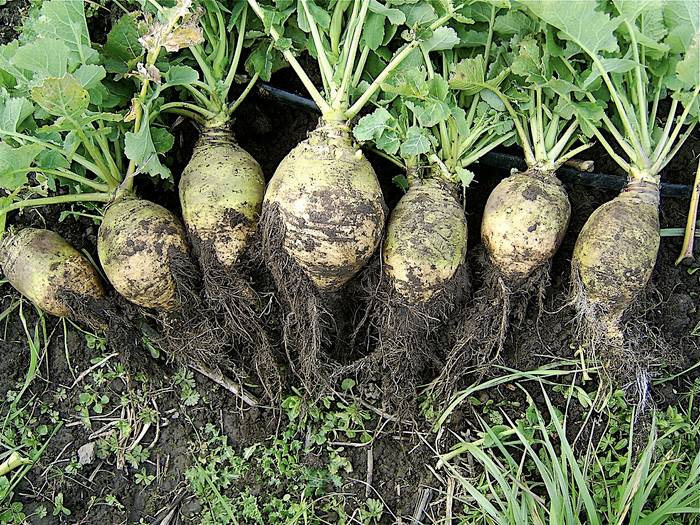
Picasa user Seedambassadors · CC BY-SA 3.0
Rutabaga
Plant·Brassica napus subsp. rapifera
Part shade to full sun
Sun
Moist soil
Water
Well-drained soil
Drainage
Not recorded
Hardiness
Coverage · 86 fields
Growth and size10 fields
Plant type
Plant
AI estimate100 % agree
Height
120 cm · other sources: 100 cm“Brassica napus is a ANNUAL/BIENNIAL growing to 1.2 m (4ft).”Wikipedia“Brassica napus grows to 100 centimetres (39 inches) in height with hairless, fleshy, pinnatifid and glaucous lower leaves which are stalked whereas the upper leaves have no petioles.”
Spread
50 cm
AI estimate58 % agree
Height at age
—
empty
Spacing
30 cm (at least 15 cm)
AI estimate55 % agree
Growth rate
—
empty
Habit
—
empty
Root depth
Taproot“A good green manure, the deep taproot improves drainage and loosens heavy soils.”
Forest garden layer
Herb layer
AI estimate90 % agree
Lifespan
~1 years
AI estimatenot measured yet
Roots6 fields
Root form
Taproot“A good green manure, the deep taproot improves drainage and loosens heavy soils.”
Storage organ
None“It does not multiply vegetatively: it has no rhizomes, runners, suckers or offspring bulbs or tubers.”
Spreads
No“It does not multiply vegetatively: it has no rhizomes, runners, suckers or offspring bulbs or tubers.”
Lateral spread in cm
—
empty
Root depth in cm
—
empty
Mycorrhiza
Non-mycorrhizal
AI estimatenot measured yet
Light, water and soil9 fields
Sun
Full sun, light shade, part shade · best: full sun“It can grow in semi-shade (light woodland) or no shade.”
Hours of sun
6–12 h
AI estimatenot measured yet
Drought tolerant
—
empty
Tolerates waterlogging
—
empty
Soil type
Sand, loam, clay · best: clay“Suitable for: light (sandy), medium (loamy) and heavy (clay) soils, prefers well-drained soil and can grow in heavy clay soil.”PFAFpartly“Prefers a heavy soil and cool moist conditions.”
pH
4.2–8.3 · best 5.5–8.3“Rapeseed can be cultivated on a wide variety of well-drained soils, prefers a pH between 5.5 and 8.3 and has a moderate tolerance of soil salinity.”PFAF“Suitable pH: mildly acid, neutral and basic (mildly alkaline) soils and can grow in very acid and very alkaline soils.”PFAFpartly“Colza is reported to tolerate an annual precipitation of 30 to 280cm, an annual average temperature range of 5 to 27°C and a pH in the range of 4.2 to 8.2.”
Drainage
Well drained“Suitable for: light (sandy), medium (loamy) and heavy (clay) soils, prefers well-drained soil and can grow in heavy clay soil.”
Compacted soil
Copes badly
AI estimatenot measured yet
Climate5 fields
Hardiness
—
empty
Killing frost
—
empty
Growing temperature
5–27 °C · optimal 15–25 °C
AI estimatenot measured yet
Chill hours
0 h
AI estimatenot measured yet
Care (becomes tasks in Manage)4 fields
Sowing
March · lasts 167 days“Seed - sow in situ in early spring to mid-August for a green manure crop.”
PFAFpartly
Feeding
After the previous stage · 30 days after · a balanced fertiliser
AI estimatenot measured yet
Watering
After rain
AI estimatenot measured yet
Weeding
After the previous stage · 14 days after · lasts 60 days
AI estimatenot measured yet
Through the year2 fields
Fruiting
After the previous stage · lasts 42 days“It generally flowers in late spring with the process of pod development and ripening occurring over a period of 6–8 weeks until midsummer.”
Edible parts and pollination4 fields
The roots
Cubed and boiled with smoked meats“Rutabaga roots are eaten as human food in various ways, and the leaves can be eaten as a leaf vegetable.”Wikipedia“In the US, rutabagas are cubed and boiled with smoked meats in the southeast.”
Pollination
Self-fertile · hermaphrodite“The species is hermaphrodite (has both male and female organs) and is pollinated by Bees.”Wikipedia“It is predominantly a wind-pollinated plant but shows significantly increased grain yields when bee-pollinated, almost double the final yield but the effect is cultivar dependent.”PFAF“Colza is 70% self-pollinating and 30% cross-pollinated.”PFAF“The plant is self-fertile.”
Pollinated by
Bees, wind, self“The species is hermaphrodite (has both male and female organs) and is pollinated by Bees.”Wikipedia“It is predominantly a wind-pollinated plant but shows significantly increased grain yields when bee-pollinated, almost double the final yield but the effect is cultivar dependent.”PFAF“Colza is 70% self-pollinating and 30% cross-pollinated.”
Ecology5 fields
Attracts
Bees“The species is hermaphrodite (has both male and female organs) and is pollinated by Bees.”
Pests
Brassica pod midge (dasineura brassicae), cabbage seed weevil (ceutorhynchus assimilis), cabbage stem weevil (ceutorhynchus pallidactylus), cabbage stem flea beetle (psylliodes chrysocephala), rape stem weevil (ceutorhynchus napi), pollen beetles, slugs, nematodes, wood pigeons“The brassica pod midge (Dasineura brassicae)”Wikipedia“cabbage seed weevil (Ceutorhynchus assimilis)”Wikipedia“cabbage stem weevil (Ceutorhynchus pallidactylus)”Wikipedia“cabbage stem flea beetle (Psylliodes chrysocephala)”Wikipedia“rape stem weevil (Ceutorhynchus napi)”Wikipedia“pollen beetles”Wikipedia“Rapeseed is attacked by a wide variety of insects, nematodes, slugs, and wood pigeons.”
Diseases
Canker, light leaf spot (pyrenopeziza brassicae), alternaria stem rot, sclerotinia stem rot, blackleg (leptosphaeria maculans/phoma lingam), verticillium wilt, clubroot“The main diseases of the winter rapeseed crop are canker, light leaf spot (Pyrenopeziza brassicae), alternaria- and sclerotinia- stem rots.”Wikipedia“Blackleg (Leptosphaeria maculans/Phoma lingam) is a major disease.”Wikipedia“Oilseed rape cannot be planted in close rotation with itself due to soil-borne diseases such as sclerotinia, verticillium wilt and clubroot.”
Takes up
Sulfur, boron
AI estimatenot measured yet
Fixes nitrogen
No
AI estimatenot measured yet
Propagation and names3 fields
Difficulty
1 / 5
AI estimatenot measured yet
Seed
—
empty
Not sorted yet38 fields
Fields the parser stores that this page has no row for yet. They show up here automatically, so nothing is hidden.
forage.US.edibility_basis
inferred
AI estimatenot measured yet
forage.US.foraging_months.months
10, 11, 12, 1, 2, 3
AI estimatenot measured yet
forage.US.foraging_months.year_round
false
AI estimatenot measured yet
ornamental.basis
documented
AI estimatenot measured yet
ornamental.fragrance.source
none
AI estimate100 % agree
ornamental.fragrance.intensity
subtle
AI estimatenot measured yet
ornamental.confidence
high
AI estimatenot measured yet
ornamental.fall_interest
false
AI estimatenot measured yet
ornamental.flower_colour
yellow“Rapeseed (Brassica napus subsp. napus), also known as rape and oilseed rape and canola, is a yellow-flowered member of the Brassicaceae family.”
ornamental.evidence_quote
Brassica napus, commonly known as swede rapeseed, produces bright yellow flowers. Its foliage is typically a blue-green color. As an annual or biennial, it does not exhibit significant autumn foliage color change or winter structure.
AI estimatenot measured yet
ornamental.foliage_colour
blue_green“Brassica napus grows to 100 centimetres (39 inches) in height with hairless, fleshy, pinnatifid and glaucous lower leaves which are stalked whereas the upper leaves have no petioles.”
ornamental.foliage_texture
medium
AI estimatenot measured yet
ornamental.winter_structure
none
AI estimatenot measured yet
ornamental.autumn_foliage_colour
none
AI estimatenot measured yet
care_regime
light
AI estimatenot measured yet
propagation.self_seeding
moderate
AI estimate20 % agree
propagation.establishment_years
1
AI estimate40 % agree
spatial_profile.canopy_density
medium
AI estimatenot measured yet
sun_requirement.best
full_sun“Succeeds in full sun in a well-drained fertile preferably alkaline soil.”
forage_proposals.US.edibility_tier.tier
edible“Rutabaga roots are eaten as human food in various ways, and the leaves can be eaten as a leaf vegetable.”
forage_proposals.US.edibility_tier.confidence
high“Rutabaga roots are eaten as human food in various ways, and the leaves can be eaten as a leaf vegetable.”
forage_proposals.US.edibility_tier.evidence_quote
Rutabaga roots are eaten as human food in various ways, and the leaves can be eaten as a leaf vegetable.“Rutabaga roots are eaten as human food in various ways, and the leaves can be eaten as a leaf vegetable.”
function_profile.biomass_return.confidence
high“A good green manure, the deep taproot improves drainage and loosens heavy soils.”
PFAFpartly
function_profile.nutrient_flows.consumes
[{"basis":"documented","demand":"high","nutrient":"nitrogen","confidence":"high","evidence_quote":"It is currently grown with high levels of nitrogen-containing fertilisers"},{"basis":"documented","demand":"high","nut…“It is currently grown with high levels of nitrogen-containing fertilisers, and the manufacture of these generates N2O.”Wikipediapartly“Rapeseed has a high demand for nutrients - in particular, its sulphur demand is the highest among all arable crops.”Wikipediapartly“Among the micronutrients, special attention in rapeseed cultivation has to be given to boron, manganese and molybdenum.”
Wikipediapartly
function_profile.nutrient_flows.provides
[{"basis":"inferred","nutrient":"sulfur","mechanism":"biomass_return","confidence":"low"},{"basis":"inferred","nutrient":"boron","mechanism":"biomass_return","confidence":"low"}]
AI estimatenot measured yet
function_profile.biotic_interactions
[{"taxa":["bees","honeybees"],"basis":"documented","valence":"beneficial","relation":"attracts","confidence":"high","evidence_quote":"The species is hermaphrodite (has both male and female organs) and is pollinated by…“The insect pests can feed on developing pods to lay eggs inside and eat the developing seeds, bore into the plant's stem and feed on pollen, leaves and flowers.”Wikipedia“Rapeseed is attacked by a wide variety of insects, nematodes, slugs, and wood pigeons.”Wikipedia“The main diseases of the winter rapeseed crop are canker, light leaf spot (Pyrenopeziza brassicae), alternaria- and sclerotinia- stem rots.”PFAF“The species is hermaphrodite (has both male and female organs) and is pollinated by Bees.”PFAF“Yield increases with honeybees.”
function_profile.aromatic_pest_effect.value
false
AI estimate80 % agree
function_profile.aromatic_pest_effect.confidence
low
AI estimatenot measured yet
function_profile.structural_interfaces.requires_shelter.basis
documented
AI estimatenot measured yet
function_profile.structural_interfaces.requires_shelter.kinds
frost
AI estimatenot measured yet
function_profile.structural_interfaces.requires_shelter.stage
establishment
AI estimatenot measured yet
function_profile.structural_interfaces.requires_shelter.confidence
medium
AI estimatenot measured yet
function_profile.structural_interfaces.requires_shelter.evidence_quote
Young Brassica napus plants can benefit from frost protection during establishment.
AI estimatenot measured yet
climate_tolerance.photoperiod_response
long_day
AI estimatenot measured yet
soil_interactions.organic_matter_contribution
medium
AI estimatenot measured yet
component_metadata.growth_cycle
annual“Brassica napus is a ANNUAL/BIENNIAL growing to 1.2 m (4ft).”
PFAFpartly
resource_interfaces.inputs
[{"resource":"light","quantity_description":"full sun"},{"resource":"water","quantity_description":"moist soil"},{"resource":"pollination","quantity_description":"bee visits raise yield"}]“Succeeds in full sun in a well-drained fertile preferably alkaline soil.”PFAF“It prefers moist soil.”PFAF“Yield increases with honeybees.”
resource_interfaces.outputs
[{"resource":"pollinator_services","quantity_description":"flowers May to August"},{"resource":"organic_matter","quantity_description":"green manure biomass from a deep taproot"},{"resource":"seeds","quantity_descript…“It is in flower from May to August.”PFAF“The seed contains up to 45% of an edible semi-drying oil, it is used as a luminant, lubricant, in soap making etc.”PFAFpartly“A good green manure, the deep taproot improves drainage and loosens heavy soils.”