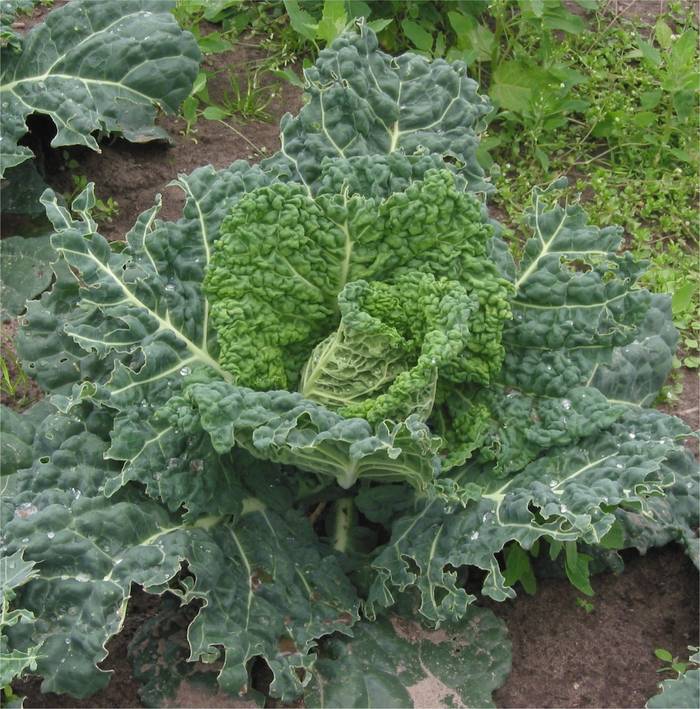
Rasbak · CC BY-SA 3.0
Savoy cabbage
Plant·Brassica oleracea var. sabauda
Part shade to full sun
Sun
Moist soil
Water
Well-drained soil
Drainage
Not recorded
Hardiness
Coverage · 91 fields
No obvious inconsistencies found.
Growth and size10 fields
Plant type
Plant
AI estimate100 % agree
Spread
90 cm
AI estimate58 % agree
Height at age
—
empty
Spacing
45 cm (at least 30 cm)
AI estimate55 % agree
Growth rate
—
empty
Habit
—
empty
Root depth
Shallow“The root pattern is flat with shallow roots forming a plate near the soil surface”
Forest garden layer
Herb layer
AI estimate90 % agree
Lifespan
~2 years
AI estimatenot measured yet
Roots6 fields
Root form
Plate root (shallow)“The root pattern is flat with shallow roots forming a plate near the soil surface”
Storage organ
None“It does not multiply vegetatively: it has no rhizomes, runners, suckers or offspring bulbs or tubers.”
Spreads
No“It does not multiply vegetatively: it has no rhizomes, runners, suckers or offspring bulbs or tubers.”
Lateral spread in cm
—
empty
Root depth in cm
—
empty
Mycorrhiza
Non-mycorrhizal
AI estimatenot measured yet
Light, water and soil9 fields
Sun
Hours of sun
6–8 h
AI estimatenot measured yet
Drought tolerant
—
empty
Tolerates waterlogging
—
empty
Soil type
pH
6–7.5 · best 6–7“The plant is tolerant of a variety of soil conditions between pH 6.0 and 7.5”PFAF“Suitable pH: mildly acid, neutral and basic (mildly alkaline) soils.”
Compacted soil
Copes badly
AI estimatenot measured yet
Climate5 fields
Hardiness
—
empty
Killing frost
—
empty
Growing temperature
5–25 °C · optimal 15–20 °C
AI estimatenot measured yet
Chill hours
0 h
AI estimatenot measured yet
Native range
—
empty
Care (becomes tasks in Manage)5 fields
Planting out
After the last frost · 14 days after · lasts 14 days
AI estimatenot measured yet
Watering
June · lasts 90 days
AI estimatenot measured yet
Feeding
After the previous stage · 30 days after · a balanced fertiliser
AI estimatenot measured yet
Protection
May · lasts 120 days · insects
AI estimatenot measured yet
Through the year3 fields
Flowering
May · lasts 123 days“It is in flower from May to August, and the seeds ripen from July to September.”
Harvest
January · lasts 365 days“The plant can usually be harvested all year round, though there will be little to pick in very cold winters”
Edible parts and pollination3 fields
Ecology5 fields
Attracts
Bees“The species is hermaphrodite (has both male and female organs) and is pollinated by Bees.”
Pests
Cabbage worms, aphids, flea beetles, cabbage loopers, harlequin bugs, caterpillars, pigeons“Savoy can be difficult to grow as it is vulnerable to caterpillars, pigeons, and club root disease.”
Diseases
Downy mildew, club root“The plant can grow in partial shade, but care must be taken to provide sufficient ventilation, as this reduces the prevalence of downy mildew.”Wikipedia“Savoy can be difficult to grow as it is vulnerable to caterpillars, pigeons, and club root disease.”
Takes up
Sulfur, calcium, potassium
AI estimatenot measured yet
Fixes nitrogen
No
AI estimatenot measured yet
Propagation and names4 fields
Methods
Difficulty
1 / 5
AI estimatenot measured yet
Seed
none
AI estimatenot measured yet
Not sorted yet41 fields
Fields the parser stores that this page has no row for yet. They show up here automatically, so nothing is hidden.
forage.DK.local_name
savojkaal
AI estimatenot measured yet
forage.DK.prep_cautions
Many people find finely shredded raw leaves indigestible, Older leaves are quite tough; younger leaves are best cooked“Finely shredded, they can be used in salads, though many people find them indigestible this way.”PFAF“They are delicious cooked, especially the younger leaves since the older ones can be quite tough[K].”
forage.DK.edibility_basis
inferred
AI estimatenot measured yet
forage.DK.foraging_months.notes
Usually available from autumn until spring, depending on variety selection“Through careful selection of varieties, they are usually available from the autumn until the spring[K].”
forage.DK.foraging_months.months
10, 11, 12, 1, 2, 3, 4, 5
AI estimatenot measured yet
forage.DK.foraging_months.year_round
false
AI estimatenot measured yet
ornamental.basis
documented
AI estimatenot measured yet
ornamental.fragrance.source
none
AI estimate100 % agree
ornamental.fragrance.intensity
subtle
AI estimatenot measured yet
ornamental.confidence
high
AI estimatenot measured yet
ornamental.fall_interest
false
AI estimatenot measured yet
ornamental.flower_colour
yellow“In its second year, a woody spike grows up to 1.5 metres (5 ft) tall, from which branch off stems with long clusters of four-petaled yellow flowers.”
ornamental.evidence_quote
Cabbage (Brassica oleracea) typically produces yellow flowers. Its foliage is green to blue-green and it does not exhibit significant autumn foliage color change. It has a medium foliage texture. There is no notable fall interest or winter structure, and it is not known for fragrance.
AI estimatenot measured yet
ornamental.foliage_texture
medium“Wild Brassica oleracea is a tall biennial or perennial plant that forms a stout rosette of large leaves in its first year.”
Wikipediapartly
ornamental.winter_structure
none“In its second year, a woody spike grows up to 1.5 metres (5 ft) tall, from which branch off stems with long clusters of four-petaled yellow flowers.”
Wikipediapartly
ornamental.autumn_foliage_colour
none
AI estimatenot measured yet
care_regime
light
AI estimatenot measured yet
propagation.self_seeding
light
AI estimate20 % agree
propagation.establishment_years
0
AI estimate40 % agree
spatial_profile.canopy_density
dense
AI estimatenot measured yet
function_profile.biomass_return.confidence
high“A dynamic accumulator gathering minerals or nutrients from the soil and storing them in a more bioavailable form - used as fertilizer or to improve mulch.”
function_profile.nutrient_flows.consumes
[{"basis":"documented","demand":"high","nutrient":"nitrogen","confidence":"medium","evidence_quote":"The plant is tolerant of a variety of soil conditions between pH 6.0 and 7.5, but grows particularly well in alkalin…“The plant is tolerant of a variety of soil conditions between pH 6.0 and 7.5, but grows particularly well in alkaline soils in full sunlight, with good drainage and high amounts of nitrogen.”
function_profile.nutrient_flows.provides
[{"basis":"inferred","nutrient":"sulfur","mechanism":"biomass_return","confidence":"low"},{"basis":"inferred","nutrient":"calcium","mechanism":"biomass_return","confidence":"low"},{"basis":"inferred","nutrient":"potas…“A dynamic accumulator gathering minerals or nutrients from the soil and storing them in a more bioavailable form - used as fertilizer or to improve mulch.”
PFAFpartly
function_profile.biotic_interactions
[{"taxa":["bees"],"basis":"documented","valence":"beneficial","relation":"attracts","confidence":"high","evidence_quote":"is pollinated by Bees","organism_group":"pollinator","ecological_function":"pollination"},{"tax…“is pollinated by Bees”Wikipedia“Savoy can be difficult to grow as it is vulnerable to caterpillars, pigeons, and club root disease.”
function_profile.aromatic_pest_effect.value
false
AI estimate80 % agree
function_profile.aromatic_pest_effect.confidence
high
AI estimatenot measured yet
function_profile.structural_interfaces.provides_shelter.basis
inferred
AI estimatenot measured yet
function_profile.structural_interfaces.provides_shelter.confidence
low
AI estimatenot measured yet
function_profile.structural_interfaces.requires_shelter.basis
inferred
AI estimatenot measured yet
function_profile.structural_interfaces.requires_shelter.confidence
medium
AI estimatenot measured yet
function_profile.structural_interfaces.provides_physical_support.basis
inferred
AI estimatenot measured yet
function_profile.structural_interfaces.provides_physical_support.confidence
low
AI estimatenot measured yet
function_profile.structural_interfaces.requires_physical_support.basis
taxonomic
AI estimatenot measured yet
function_profile.structural_interfaces.requires_physical_support.confidence
high
AI estimatenot measured yet
climate_tolerance.photoperiod_response
long_day
AI estimatenot measured yet
soil_interactions.organic_matter_contribution
medium
AI estimatenot measured yet
component_metadata.growth_cycle
biennial“Brassica oleracea is a BIENNIAL/PERENNIAL growing to 1.2 m (4ft).”
PFAFpartly
resource_interfaces.inputs
resource_interfaces.outputs
[{"resource":"seeds","quantity_description":"seeds ripen from July to September"}]“the seeds ripen from July to September”