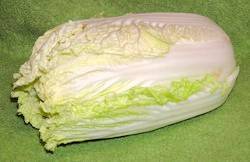
Jamie Nettles · CC BY-SA 3.0
Napa cabbage
Plant·Brassica rapa subsp. pekinensis
Part shade to full sun
Sun
Moist soil
Water
Well-drained soil
Drainage
Not recorded
Hardiness
Coverage · 99 fields
Growth and size10 fields
Plant type
Plant
AI estimate100 % agree
Spread
30 cm
AI estimate58 % agree
Height at age
—
empty
Spacing
30 cm (at least 25 cm)“with a row width of 40 to 45 cm (16 to 18 in) and 25 to 30 cm (9.8 to 11.8 in) distance between the seeds”
Growth rate
Fast“A fast growing plant, it can take less than ten weeks from sowing to harvesting.”
Habit
—
empty
Forest garden layer
Herb layer
AI estimate90 % agree
Lifespan
~1 years
AI estimatenot measured yet
Roots6 fields
Root form
Taproot“The species was actually named for the cultivated garden turnip with its edible swollen tap root.”
Storage organ
None“It does not multiply vegetatively: it has no rhizomes, runners, suckers or offspring bulbs or tubers.”
Spreads
No“It does not multiply vegetatively: it has no rhizomes, runners, suckers or offspring bulbs or tubers.”
Lateral spread in cm
—
empty
Root depth in cm
—
empty
Mycorrhiza
Non-mycorrhizal
AI estimatenot measured yet
Light, water and soil9 fields
Sun
Full sun, light shade, part shade · best: full sun“Although it grows best in full sun, it can also succeed in moderate shade.”PFAF“It can grow in semi-shade (light woodland) or no shade.”
Hours of sun
6–8 h
AI estimatenot measured yet
Drought tolerant
—
empty
Tolerates waterlogging
—
empty
Soil type
pH
Compacted soil
Copes badly
AI estimatenot measured yet
Climate5 fields
Hardiness
—
empty
Killing frost
—
empty
Growing temperature
5–25 °C · optimal 10–18 °C
AI estimatenot measured yet
Chill hours
0 h
AI estimatenot measured yet
Native range
—
empty
Care (becomes tasks in Manage)9 fields
Sowing
After the last frost · lasts 180 days“sow in situ from early spring to late summer”
Sowing appears 3 times with different timing.
PFAFpartly
Sowing
May · lasts 120 days“The seeds should be deposited 1 to 2 cm (0.39 to 0.79 in) deep, with a row width of 40 to 45 cm (16 to 18 in) and 25 to 30 cm (9.8 to 11.8 in) distance between the seeds.”PFAFpartly“Seed - it can be sown from late May to September in situ.”
Sowing appears 3 times with different timing.
Sowing
July · lasts 62 days“The latest sowings for winter use can be made in mid to late summer”
Sowing appears 3 times with different timing.
PFAFpartly
Watering
After the previous stage“the soil is not allowed to dry out”
Watering appears 2 times with different timing.
PFAFpartly
Watering
May · lasts 120 days
Watering appears 2 times with different timing.
AI estimatenot measured yet
Weeding
After the previous stage · 14 days after · lasts 60 days
AI estimatenot measured yet
Feeding
After the previous stage · synthetic nitrogen fertiliser“Synthetic N fertilizer should be applied in three equal doses.”
Feeding appears 2 times with different timing.
Protection
After the first frost · -14 days after · lasts 60 days · frost
AI estimatenot measured yet
Feeding
May · organic fertiliser“Organic fertilizer must be applied before sowing due to the short cultivation time of napa cabbage and the slow availability of organic fertilizers.”Wikipediapartly“The last application must happen before two thirds of the cultivation time is over to avoid quality losses during storage.”Wikipediapartly“Synthetic N fertilizer should be applied in three equal doses.”
Feeding appears 2 times with different timing.
Through the year5 fields
Leafing out
Above 18 °C · 3 days after · lasts 1 days“Seed usually germinates within 3 - 4 days.”PFAF“If seedlings are germinated at a temperature of 18 - 20°c and then grown on at this temperature for their first few weeks, they are then less likely to bolt.”
Harvest
After the previous stage · 55 days after“Plants take from 55 - 100 days from sowing to maturity, depending on variety, the loose-headed forms are usually 2 - 3 weeks faster than compact-headed forms.”
Edible parts and pollination5 fields
The leaves
Raw or cooked; best eaten raw in salads“Edible Parts: Flowers Leaves Shoots”PFAFpartly“Leaves - raw or cooked.”
PFAFpartly
Flowering shoots
Young seedlings
Eaten as a young seedling, or left to grow into a mature plant“The plant can be eaten as a young seedling, or left to grow into a mature plant.”
Pollination
Self-fertile · hermaphrodite“The species is hermaphrodite (has both male and female organs) and is pollinated by Bees.”PFAF“The plant is self-fertile.”
Pollinated by
Bees“The species is hermaphrodite (has both male and female organs) and is pollinated by Bees.”
Ecology5 fields
Attracts
Bees, flies, butterflies“The species is hermaphrodite (has both male and female organs) and is pollinated by Bees.”Wikipedia“Numerous pollinators are attracted to its bright yellow flowers, including bees, flies, and butterflies.”
Pests
Small white butterfly (pieris rapae), slugs, large white butterfly (pieris brassicae), cabbage root fly (delia radicum), cabbage seed weevil (ceutorhynchus assimilis), cabbage looper, cabbage beetle (colaphellus bowringi), diamondback moth, cucumber beetles, vegetable weevils, mole crickets“A common visitor, the small white butterfly (Pieris rapae) uses the plant both as a nectar source and as a host for larval feeding.”PFAF“However, they can be troubled by slugs and other creatures so it is often better to harvest them in late autumn or early winter and store them in a cool but frost-free place.”Wikipedia“large white butterfly (Pieris brassicae)”Wikipedia“cabbage root fly (Delia radicum)”Wikipedia“cabbage seed weevil (Ceutorhynchus assimilis)”Wikipedia“cabbage looper”Wikipedia“cabbage beetle (Colaphellus bowringi)”Wikipedia“diamondback moth”Wikipedia“cucumber beetles”Wikipedia“Vegetable weevils”Wikipedia“Mole crickets”
Diseases
Clubroot, downy mildew, alternaria brassicae, alternaria brassicicola, colletotrichum higginsianum, aphanomyces raphani, plasmodiophora brassicae, hyaloperonospora brassicae, sclerotinia sclerotiorum, rhizoctonia solani, xanthomonas campestris pv. campestris, turnip mosaic virus“Alternaria diseases are caused by the organisms Alternaria brassicae, Alternaria brassicicola and Alternaria japonica.”Wikipedia“Anhracnose is a brassica disease caused by Colletotrichum higginsianum that is especially damaging on napa cabbage, pak choi, turnip, rutabaga and tender green mustard.”Wikipedia“It caused by the fungus Aphanomyces raphani.”Wikipedia“clubroot: Plasmodiophora brassicae”Wikipedia“Downy mildew: Hyaloperonospora brassicae”Wikipedia“Sclerotinia sclerotiorum”Wikipedia“Rhizoctonia solani”Wikipedia“Black rot, the most important disease of vegetable brassicas, is caused by Xanthomonas campestris pv. campestris.”Wikipedia“Turnip mosaic virus”
Takes up
Sulfur, calcium, potassium
AI estimatenot measured yet
Fixes nitrogen
No
AI estimatenot measured yet
Propagation and names4 fields
Methods
Seed
—
empty
Not sorted yet41 fields
Fields the parser stores that this page has no row for yet. They show up here automatically, so nothing is hidden.
forage.DK.local_name
kinakaal
AI estimatenot measured yet
forage.DK.prep_cautions
The flavour is quickly ruined by prolonged cooking., Fresh leaves do not store well and are best used within a day or two of harvesting.“The flavour is quickly ruined by prolonged cooking.”PFAF“Fresh leaves do not store well and are best used within a day or two of harvesting.”
forage.DK.edibility_basis
inferred
AI estimatenot measured yet
forage.DK.foraging_months.notes
Harvest 8–12 weeks after sowing; a late summer sowing under protection can provide leaves in winter.“Napa cabbage can be harvested 8–12 weeks after sowing.”
Wikipediapartly
forage.DK.foraging_months.year_round
false
AI estimatenot measured yet
forage.US.edible_parts
[{"part":"leaves","caution":null,"preparation":"raw or cooked; best eaten raw in salads"},{"part":"flowering shoots","caution":null,"preparation":"raw or cooked; sweet and tender"},{"part":"young seedlings","caution":…“Flowering shoots - raw or cooked.”PFAF“The plant can be eaten as a young seedling, or left to grow into a mature plant.”PFAFpartly“Edible Parts: Flowers Leaves Shoots”PFAFpartly“Leaves - raw or cooked.”PFAFpartly“Sweet and tender.”
forage.US.prep_cautions
The flavour is quickly ruined by prolonged cooking., Fresh leaves do not store well and are best used within a day or two of harvesting.“The flavour is quickly ruined by prolonged cooking.”PFAF“Fresh leaves do not store well and are best used within a day or two of harvesting.”
forage.US.edibility_basis
inferred
AI estimatenot measured yet
forage.US.foraging_months.notes
Harvest 8–12 weeks after sowing; a late summer sowing under protection can provide leaves in winter.“Napa cabbage can be harvested 8–12 weeks after sowing.”
Wikipediapartly
forage.US.foraging_months.year_round
false
AI estimatenot measured yet
ornamental.basis
documented
AI estimatenot measured yet
ornamental.fragrance.source
none
AI estimate100 % agree
ornamental.fragrance.intensity
subtle
AI estimatenot measured yet
ornamental.confidence
high
AI estimatenot measured yet
ornamental.fall_interest
false
AI estimatenot measured yet
ornamental.flower_colour
yellow“Numerous pollinators are attracted to its bright yellow flowers, including bees, flies, and butterflies.”
ornamental.evidence_quote
Turnip (Brassica rapa) produces yellow flowers and green foliage. It does not have significant autumn foliage color or winter structure.
AI estimatenot measured yet
ornamental.foliage_colour
green
AI estimate82 % agree
ornamental.foliage_texture
medium
AI estimatenot measured yet
ornamental.winter_structure
none
AI estimatenot measured yet
ornamental.autumn_foliage_colour
none
AI estimatenot measured yet
care_regime
routine
AI estimatenot measured yet
propagation.establishment_years
0
AI estimate40 % agree
sun_requirement.best
full_sun“Although it grows best in full sun, it can also succeed in moderate shade.”
forage_proposals.DK.edibility_tier.confidence
medium
AI estimatenot measured yet
forage_proposals.DK.edibility_tier.evidence_quote
Leaves - raw or cooked.
AI estimatenot measured yet
forage_proposals.US.edibility_tier.confidence
medium
AI estimatenot measured yet
forage_proposals.US.edibility_tier.evidence_quote
Leaves - raw or cooked.
AI estimatenot measured yet
function_profile.biomass_return.confidence
medium
AI estimatenot measured yet
function_profile.nutrient_flows.consumes
[{"basis":"documented","demand":"high","nutrient":"nitrogen","confidence":"high"},{"basis":"documented","demand":"high","nutrient":"phosphorus","confidence":"high"},{"basis":"documented","demand":"high","nutrient":"po…“The nutrient removal of napa cabbage is high:”Wikipediapartly“150–200 kg N per hectare”Wikipediapartly“80–120 kg P2O5 per hectare”Wikipediapartly“180–250 kg K2O per hectare”Wikipediapartly“110–150 kg Ca per hectare”Wikipediapartly“20–40 kg Mg per hectare”
function_profile.biotic_interactions
[{"taxa":["bees"],"basis":"documented","valence":"beneficial","relation":"attracts","confidence":"high","organism_group":"pollinator","ecological_function":"pollination"},{"taxa":["large white butterfly (Pieris brassi…“is pollinated by Bees”Wikipedia“large white butterfly (Pieris brassicae)”Wikipedia“cabbage root fly (Delia radicum)”Wikipedia“cabbage seed weevil (Ceutorhynchus assimilis)”Wikipedia“cabbage looper”Wikipedia“cabbage beetle (Colaphellus bowringi)”Wikipedia“diamondback moth”Wikipedia“small white butterfly (Pieris rapae)”Wikipedia“cucumber beetles”Wikipedia“Alternaria diseases are caused by the organisms Alternaria brassicae, Alternaria brassicicola and Alternaria japonica.”Wikipedia“Anhracnose is a brassica disease caused by Colletotrichum higginsianum that is especially damaging on napa cabbage, pak choi, turnip, rutabaga and tender green mustard.”Wikipedia“It caused by the fungus Aphanomyces raphani.”Wikipedia“clubroot: Plasmodiophora brassicae”Wikipedia“Downy mildew: Hyaloperonospora brassicae”Wikipedia“Sclerotinia sclerotiorum”Wikipedia“Rhizoctonia solani”Wikipedia“Black rot, the most important disease of vegetable brassicas, is caused by Xanthomonas campestris pv. campestris.”Wikipedia“Turnip mosaic virus”Wikipedia“Vegetable weevils”Wikipedia“Mole crickets”
function_profile.aromatic_pest_effect.value
false
AI estimate80 % agree
function_profile.aromatic_pest_effect.confidence
low
AI estimatenot measured yet
climate_tolerance.photoperiod_response
day_neutral
AI estimatenot measured yet
soil_interactions.organic_matter_contribution
medium
AI estimatenot measured yet
component_metadata.growth_cycle
annual“Brassica rapa pekinensis is a ANNUAL growing to 0.5 m (1ft 8in).”
resource_interfaces.inputs
[{"resource":"light","quantity_description":"full sun"},{"resource":"wind_shelter","quantity_description":"a sheltered position"},{"resource":"shade","quantity_description":"semi-shade or no shade"},{"resource":"water…“Prefers full sun and a sheltered position.”PFAF“It can grow in semi-shade (light woodland) or no shade.”Wikipedia“Napa cabbage needs much water during the whole growth period.”
resource_interfaces.outputs
[{"resource":"pollinator_services","quantity_description":"a good bee plant"}]“A good bee plant.”