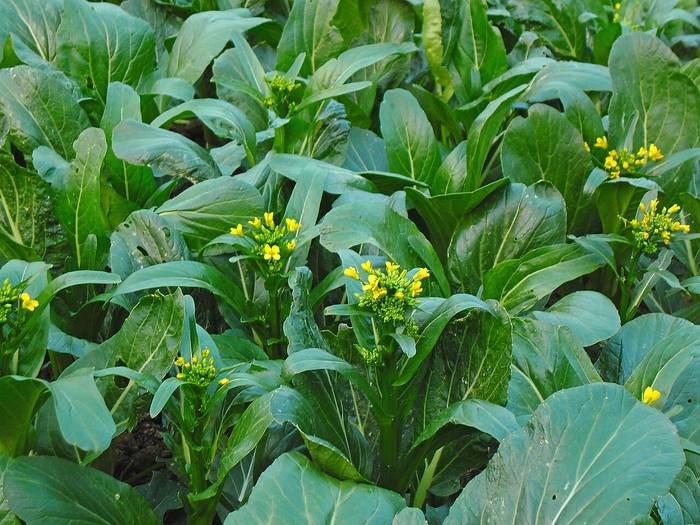
Choy sum
Choy sum (Brassica rapa var. parachinensis) is a plant. It grows best in full sun and has moderate water needs.
About Choy sum
Choy sum is a biennial plant that grows 30 cm tall.[1] It grows fast.[1] It is self-fertile, so you only need one.[1]
The flowers attract pollinators.[1]
How to plant choy sum
Choy sum does best in full sun, but also copes with part shade.[1][2] It grows in sandy soil, loam and clay, as long as the soil is well drained.[1] It does best at a pH of 5.5–7.[1] In a forest garden it belongs in the herb layer.
Plant plants 10 cm apart, at least 5 cm. It struggles in compacted soil, so keep the soil loose. It can be propagated from seed.[1]
A year with Choy sum
Spring. Water during dry spells in March.[1] Sow seed in April–September.[1] Keep the ground around it weed-free in April and May. Feed it in April. Use a balanced fertiliser. It has yellow flowers in May.[1][2] Water during dry spells in May–September.[1]
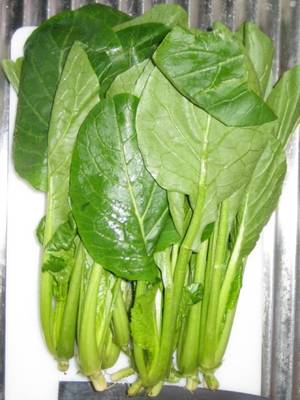
Summer. Harvest falls in June.[1] The leaves can be eaten.[1] The flowers can be eaten too.[1] The flowering shoots can be eaten too.[1] The seeds can be eaten too.[1] Recorded from the source text, not a safety check. Confirm with a trusted guide before eating anything.
Autumn. Protect it from frost and cold in September–November. Harvest falls in November and December.[1]
Pests and diseases
Choy sum can be attacked by small white butterfly (pieris rapae) and slugs.[1][2] Diseases include clubroot and downy mildew.
Companions and wildlife
Choy sumThe family
Choy sum is a variety of Turnip, in the genus Brassica. Open a species to see what lies under it.


 Choy sumvar. parachinensisThis page
Sources
- Plants For A Future — Brassica rapa var. parachinensis · CC BY 4.0
- Wikipedia — Brassica rapa · CC BY-SA 4.0
- Wikipedia — Choy sum · CC BY-SA 4.0
- CLO-PLA (clonal growth) · Klimešová et al. 2017
Added to the wiki 12 October 2026
Plan your garden with perma
Open app