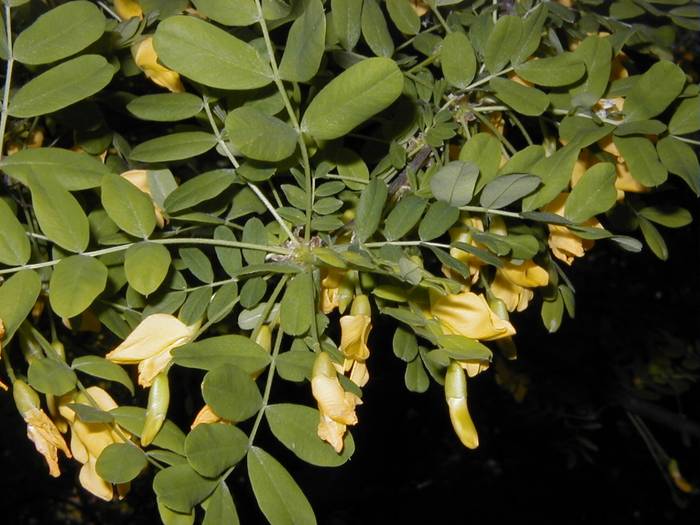
A. Barra · CC BY 3.0
Siberian pea shrub
Shrub·Caragana arborescens
Full sun
Sun
Dry to moist soil
Water
Well-drained soil
Drainage
Zones 2–8
Hardiness
Coverage · 119 fields
- Parser flag (layer_mismatch): The category is 'tree' but the layer is 'shrub'. While Caragana arborescens can be tree-like, 'tree' and 'shrub' are distinct categories in the layer schema.
Growth and size10 fields
Plant type
Deciduous shrub“Caragana arborescens is a deciduous Shrub growing to 6 m (19ft) by 4 m (13ft) at a fast rate.”
Height
600 cm · the source gives 200–600 cm“It is a perennial shrub or small tree growing 2–6 m (6 ft 7 in – 19 ft 8 in) tall.”PFAF“Caragana arborescens is a deciduous Shrub growing to 6 m (19ft) by 4 m (13ft) at a fast rate.”
Spread
400 cm“Caragana arborescens is a deciduous Shrub growing to 6 m (19ft) by 4 m (13ft) at a fast rate.”
Height at age
—
empty
Spacing
200 cm (at least 100 cm)
AI estimate55 % agree
Habit
Vase-shaped
AI estimate50 % agree
Root depth
Medium
AI estimate63 % agree
Forest garden layer
Shrub layer
AI estimate90 % agree
Roots6 fields
Root form
—
empty
Storage organ
None
AI estimate100 % agree
Spreads
—
empty
Lateral spread in cm
—
empty
Root depth in cm
—
empty
Mycorrhiza
Arbuscular (AM)
AI estimatenot measured yet
Light, water and soil9 fields
Sun
Full sun“Succeeds in most well-drained soils, preferring full sun and a light sandy dry or well-drained soil.”PFAF“It cannot grow in the shade.”
Hours of sun
6 h
AI estimatenot measured yet
Tolerates waterlogging
—
empty
Soil type
Sand, loam · best: sand“Succeeds in most well-drained soils, preferring full sun and a light sandy dry or well-drained soil.”PFAF“Suitable for: light (sandy) and medium (loamy) soils, prefers well-drained soil and can grow in nutritionally poor soil.”
pH
6–9 · best 6.5–8.5“Suitable pH: mildly acid, neutral and basic (mildly alkaline) soils and can grow in very alkaline soils.”
Drainage
Well drained“Suitable for: light (sandy) and medium (loamy) soils, prefers well-drained soil and can grow in nutritionally poor soil.”
Compacted soil
Copes well
AI estimatenot measured yet
Climate5 fields
Hardiness
Zone 2–8
AI estimatenot measured yet
Killing frost
0 °C“Killing temp. early growth: 0”EcoCrop's figure is frost during early growth (spring frost on new shoots), not winter cold.
Growing temperature
10–36 °C · optimal 14–28 °C“Temperature absolute min: 10 · Temperature absolute max: 36 · Temperature optimal min: 14 · Temperature optimal max: 28”
Chill hours
400 h
AI estimatenot measured yet
Care (becomes tasks in Manage)2 fields
Pruning
February · lasts 28 days · dead, damaged, or crossing branches, and to maintain shape
AI estimatenot measured yet
Watering
After rain · lasts 90 days
AI estimatenot measured yet
Through the year5 fields
Leafing out
After the last frost“The young growth in spring, even on mature plants, is frost-tender”
Dormant
After the first frost“Caragana arborescens is a deciduous Shrub growing to 6 m (19ft) by 4 m (13ft) at a fast rate.”
PFAFpartly
Dying back
After the first frost · lasts 30 days
AI estimatenot measured yet
Edible parts and pollination4 fields
The seeds
Pollination
Self-fertile · hermaphrodite“The species is hermaphrodite (has both male and female organs) and is pollinated by Bees.”PFAF“The plant is self-fertile.”
Pollinated by
Bees“The species is hermaphrodite (has both male and female organs) and is pollinated by Bees.”
Ecology5 fields
Attracts
Bees and other pollinators, pollen-consuming animals, small mammals“Yes – Caragana species produce flowers that are rich in nectar and pollen, attracting bees and other pollinators.”Wikipedia“The plant is not a preferred food for browsing animals, but its fragrant flowers attract many pollen-consuming animals.”PFAF“Yes, the seeds and pods of Caragana species can provide food for birds and small mammals.”
Pests
Aphids
AI estimatenot measured yet
Diseases
—
empty
Takes up
Nitrogen
AI estimatenot measured yet
Propagation and names4 fields
Methods
Difficulty
2 / 5
AI estimatenot measured yet
Seed
requires cold stratification for 60-90 days
AI estimatenot measured yet
Not sorted yet69 fields
Fields the parser stores that this page has no row for yet. They show up here automatically, so nothing is hidden.
forage.DK.local_name
Sibirisk ærtebusk
AI estimatenot measured yet
forage.DK.prep_cautions
Cook seeds before eating. How much raw seed is safe to eat is uncertain.“The seeds are edible by humans and chickens, but should be cooked before being consumed by people.”PFAF“The raw seed has a mild pea-like flavour, though we are not sure if it should be eaten in quantity when raw”
forage.DK.edibility_basis
inferred
AI estimatenot measured yet
forage.DK.foraging_months.notes
Seeds mature in late summer, flowers in late spring/early summer, and young pods in early summer.
AI estimatenot measured yet
forage.DK.foraging_months.months
5, 6, 7, 8“The fruits are legumes which contain many seeds, and ripen in July.”
Wikipediapartly
forage.DK.foraging_months.year_round
false
AI estimatenot measured yet
forage.DK.habitat_affinity
riverbank, woodland“River banks, pebbles, sands, open forests and forest edges, gully slopes and stony slopes.”
forage.US.local_name
Siberian pea shrub
AI estimatenot measured yet
forage.US.edible_parts
[{"part":"seed","caution":"Cook before eating.","preparation":"cooked","season_months":[7]},{"part":"young pods","preparation":"cooked and used as a vegetable"}]“Edible Parts: Oil Seed Seedpod”PFAF“Young pods - cooked and used as a vegetable.”Wikipedia“The seeds are edible by humans and chickens, but should be cooked before being consumed by people.”PFAF“Seed - cooked.”Wikipediapartly“The fruits are legumes which contain many seeds, and ripen in July.”
forage.US.prep_cautions
Cook seeds before eating. How much raw seed is safe to eat is uncertain.“The seeds are edible by humans and chickens, but should be cooked before being consumed by people.”PFAF“The raw seed has a mild pea-like flavour, though we are not sure if it should be eaten in quantity when raw”
forage.US.edibility_basis
inferred
AI estimatenot measured yet
forage.US.foraging_months.notes
Seeds mature in late summer, flowers in late spring/early summer, and young pods in early summer.
AI estimatenot measured yet
forage.US.foraging_months.months
7, 9“The fruits are legumes which contain many seeds, and ripen in July.”
Wikipediapartly
forage.US.foraging_months.year_round
false
AI estimatenot measured yet
forage.US.habitat_affinity
riverbank, woodland“River banks, pebbles, sands, open forests and forest edges, gully slopes and stony slopes.”
forage.TROPICAL.edible_parts
[{"part":"seeds","caution":"must be cooked to remove toxins","preparation":"cooked","season_months":[7,8]},{"part":"flowers","caution":null,"preparation":"raw","season_months":[5,6]}]
AI estimatenot measured yet
forage.TROPICAL.prep_cautions
seeds must be cooked to remove toxins
AI estimatenot measured yet
forage.TROPICAL.edibility_basis
inferred
AI estimatenot measured yet
forage.TROPICAL.foraging_months.notes
Not typically found or foraged in tropical regions.
AI estimatenot measured yet
forage.TROPICAL.foraging_months.months
5, 6, 7, 8
AI estimatenot measured yet
forage.TROPICAL.foraging_months.year_round
false
AI estimatenot measured yet
forage.TROPICAL.habitat_affinity
disturbed_ground
AI estimatenot measured yet
ornamental.basis
documented
AI estimatenot measured yet
ornamental.fragrance.source
flower“Small, yellow fragrant flowers bloom in early summer with pod fruits, containing many seeds, ripening in mid summer.”
ornamental.fragrance.intensity
subtle
AI estimatenot measured yet
ornamental.confidence
high
AI estimatenot measured yet
ornamental.fall_interest
true
AI estimatenot measured yet
ornamental.evidence_quote
The Siberian pea shrub (Caragana arborescens) has small, yellow, pea-like flowers in spring. Its fine-textured green foliage turns yellow-green in autumn, and its architectural skeleton provides winter interest.
AI estimatenot measured yet
ornamental.foliage_colour
green, dark_green“The leaves vary from light green to dark green, and are alternate and compound with many small leaflets.”
ornamental.foliage_texture
fine“Leaves are alternate and compound with small leaflets and can be light to dark green.”
ornamental.winter_structure
architectural_skeleton
AI estimatenot measured yet
ornamental.autumn_foliage_colour
yellow_green
AI estimatenot measured yet
care_regime
none
AI estimatenot measured yet
propagation.self_seeding
moderate
AI estimate20 % agree
propagation.division_season
spring_or_autumn
AI estimatenot measured yet
propagation.establishment_years
2
AI estimate40 % agree
spatial_profile.canopy_density
dense
AI estimatenot measured yet
sun_requirement.best
full_sun“Succeeds in most well-drained soils, preferring full sun and a light sandy dry or well-drained soil.”
forage_proposals.DK.edibility_tier.confidence
high
AI estimatenot measured yet
forage_proposals.DK.edibility_tier.evidence_quote
The seeds are edible when cooked, roasted, or sprouted. Young pods can be eaten cooked, and flowers are edible raw.
AI estimatenot measured yet
forage_proposals.US.edibility_tier.confidence
high
AI estimatenot measured yet
forage_proposals.US.edibility_tier.evidence_quote
The seeds are edible when cooked, roasted, or sprouted. Young pods can be eaten cooked, and flowers are edible raw.
AI estimatenot measured yet
forage_proposals.TROPICAL.edibility_tier.confidence
low
AI estimatenot measured yet
function_profile.biomass_return.confidence
high
AI estimatenot measured yet
function_profile.nutrient_flows.consumes
[{"basis":"documented","demand":"moderate","nutrient":"nitrogen","confidence":"high"},{"basis":"inferred","demand":"moderate","nutrient":"phosphorus","confidence":"medium"},{"basis":"inferred","demand":"moderate","nut…
AI estimatenot measured yet
function_profile.nutrient_flows.provides
[{"basis":"documented","nutrient":"nitrogen","mechanism":"fixation","confidence":"high","evidence_quote":"This species has a symbiotic relationship with certain soil bacteria, these bacteria form nodules on the roots …“This species has a symbiotic relationship with certain soil bacteria, these bacteria form nodules on the roots and fix atmospheric nitrogen.”
function_profile.biotic_interactions
[{"taxa":["bees","other pollinators"],"basis":"documented","valence":"beneficial","relation":"attracts","confidence":"high","evidence_quote":"Yes – Caragana species produce flowers that are rich in nectar and pollen, …“Yes – Caragana species produce flowers that are rich in nectar and pollen, attracting bees and other pollinators.”Wikipedia“The plant is not a preferred food for browsing animals, but its fragrant flowers attract many pollen-consuming animals.”Wikipedia“C. arborescens is used for nesting by several songbirds but its seeds are rarely eaten by them.”PFAF“Yes, the seeds and pods of Caragana species can provide food for birds and small mammals.”PFAF“Yes – Caragana’s dense growth can provide shelter for invertebrates, and its leaf litter can create overwintering sites for beneficial insects.”
function_profile.aromatic_pest_effect.value
false“No – Caragana species do not have a strong scent that would act as a pest confuser.”
function_profile.aromatic_pest_effect.confidence
low
AI estimatenot measured yet
function_profile.structural_interfaces.provides_shelter.basis
documented“It is quite wind-resistant and can also be planted in a shelterbelt.”
function_profile.structural_interfaces.provides_shelter.kinds
wind“It is quite wind-resistant and can also be planted in a shelterbelt.”Wikipedia“Caragana arborescens can be grown as an ornamental plant and has been extensively used in windbreaks.”
function_profile.structural_interfaces.provides_shelter.confidence
high“It is quite wind-resistant and can also be planted in a shelterbelt.”
function_profile.structural_interfaces.provides_shelter.evidence_quote
It is quite wind-resistant and can also be planted in a shelterbelt.“It is quite wind-resistant and can also be planted in a shelterbelt.”
function_profile.structural_interfaces.requires_shelter.basis
documented“The young growth in spring, even on mature plants, is frost-tender and so it is best to grow the plants in a position sheltered from the early morning sun[K].”
function_profile.structural_interfaces.requires_shelter.kinds
frost“The young growth in spring, even on mature plants, is frost-tender and so it is best to grow the plants in a position sheltered from the early morning sun[K].”
function_profile.structural_interfaces.requires_shelter.confidence
medium“The young growth in spring, even on mature plants, is frost-tender and so it is best to grow the plants in a position sheltered from the early morning sun[K].”
function_profile.structural_interfaces.requires_shelter.evidence_quote
The young growth in spring, even on mature plants, is frost-tender and so it is best to grow the plants in a position sheltered from the early morning sun[K].“The young growth in spring, even on mature plants, is frost-tender and so it is best to grow the plants in a position sheltered from the early morning sun[K].”
function_profile.structural_interfaces.provides_physical_support.basis
inferred
AI estimatenot measured yet
function_profile.structural_interfaces.provides_physical_support.confidence
low
AI estimatenot measured yet
function_profile.structural_interfaces.requires_physical_support.basis
inferred
AI estimatenot measured yet
function_profile.structural_interfaces.requires_physical_support.confidence
low
AI estimatenot measured yet
climate_tolerance.photoperiod_response
day_neutral
AI estimatenot measured yet
soil_interactions.organic_matter_contribution
medium
AI estimatenot measured yet
component_metadata.growth_cycle
perennial“It is a perennial shrub or small tree growing 2–6 m (6 ft 7 in – 19 ft 8 in) tall.”
Wikipediapartly
resource_interfaces.inputs
[{"resource":"light","quantity_description":"full sun"},{"resource":"water","quantity_description":"prefers dry or moist soil; tolerates drought"},{"resource":"pollination","quantity_description":"pollinated by bees; …“Succeeds in most well-drained soils, preferring full sun and a light sandy dry or well-drained soil.”PFAF“It prefers dry or moist soil and can tolerate drought.”PFAFpartly“The species is hermaphrodite (has both male and female organs) and is pollinated by Bees.”
resource_interfaces.outputs
[{"resource":"nectar","quantity_description":"flowers rich in nectar"},{"resource":"pollen","quantity_description":"flowers rich in pollen"},{"resource":"pollinator_services","quantity_description":"a good bee plant"}…“Yes – Caragana species produce flowers that are rich in nectar and pollen, attracting bees and other pollinators.”PFAF“A good bee plant.”Wikipedia“The fruits are legumes which contain many seeds, and ripen in July.”PFAF“Yes – Caragana’s dense growth can provide shelter for invertebrates, and its leaf litter can create overwintering sites for beneficial insects.”PFAF“The dense shrub structure offers shelter, nesting, and roosting sites for birds and insects.”PFAF“It is quite wind-resistant and can also be planted in a shelterbelt.”PFAFpartly“There are approximately 40,000 seeds per kilo.”PFAFpartly“This species has also been recommended as a nitrogen-fixing windbreak and ground cover plant that binds the soil and produces fibre and dye stuffs.”