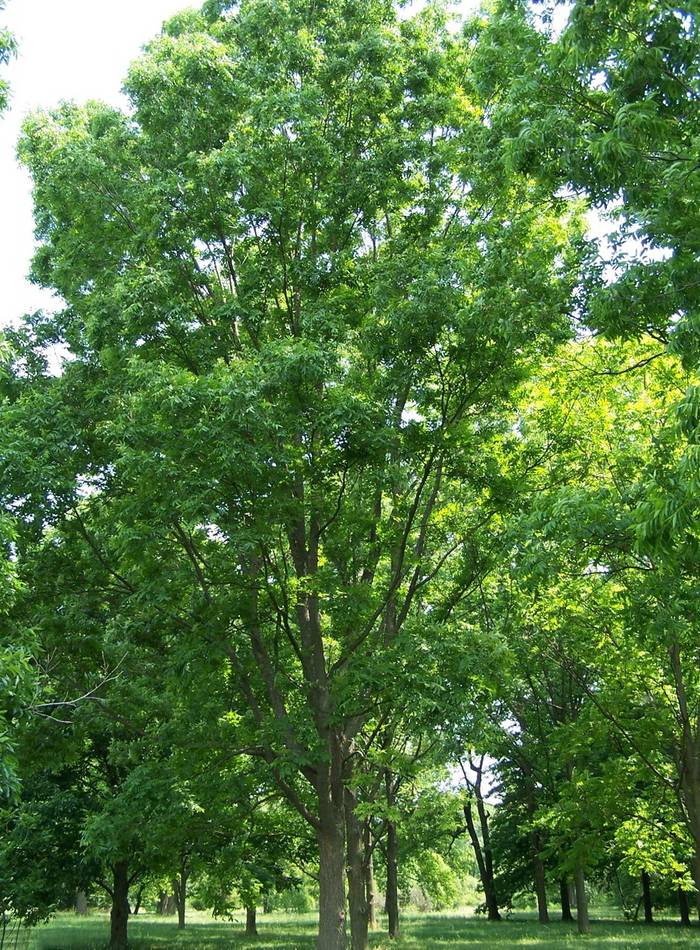
Bruce Marlin · CC BY 3.0
Pecan
Tree·Carya illinoinensis
Full sun
Sun
Moist soil
Water
Not recorded
Drainage
Zones 5–9
Hardiness
Coverage · 128 fields
- Parser flag (climate_tolerance_low_confidence): Climate tolerance values are LLM-extracted (no authoritative EcoCrop match found). EcoCrop covers ~2,568 food-crop taxa; ornamental/native/medicinal species rely on LLM extraction.
- Killing frost (-12 °C) doesn't fit hardiness zone 5, which survives far lower temperatures.
- Pruning appears 2 times with different timing.
- Feeding appears 2 times with different timing.
- Watering appears 3 times with different timing.
- Planting out appears 2 times with different timing.
- Height (1200 cm) differs from PFAF (50 m).
Growth and size10 fields
Plant type
Deciduous tree“The pecan tree is a large deciduous tree”PFAF“Carya illinoinensis is a deciduous Tree growing to 50 m (164ft 1in) at a medium rate.”
Height
1,200 cm · other sources: 5,000 cm, 4,000 cm“Grafted trees can yield a valuable nut crop within 3 – 4 years of planting and grow to a height of 12m (40ft).”PFAF“Carya illinoinensis is a deciduous Tree growing to 50 m (164ft 1in) at a medium rate.”Wikipedia“The pecan tree is a large deciduous tree, growing to 20–40 m (66–131 ft) in height, rarely to 44 m (144 ft).”
Height (1200 cm) differs from PFAF (50 m).
Spread
2,300 cm · the source gives 1,200–2,300 cm“It typically has a spread of 12–23 m (39–75 ft) with a trunk up to 2 m (6 ft 7 in) diameter.”
Height at age
500 cm after 10 years“A 10-year-old sapling grown in optimal conditions will stand about 5 m (16 ft) tall.”
Spacing
1,500 cm (at least 1,000 cm)
AI estimate55 % agree
Growth rate
Medium“Carya illinoinensis is a deciduous Tree growing to 50 m (164ft 1in) at a medium rate.”
Habit
Vase-shaped“The tree requires little pruning because it naturally forms a vase-shaped canopy”
Root depth
Taproot“The root pattern is a tap root similar to a carrot going directly down [1-2].”
Forest garden layer
Canopy
AI estimate90 % agree
Lifespan
~300 years
AI estimatenot measured yet
Roots6 fields
Storage organ
None
AI estimate100 % agree
Lateral spread in cm
—
empty
Root depth in cm
—
empty
Mycorrhiza
—
empty
Light, water and soil9 fields
Hours of sun
6 h
AI estimatenot measured yet
Water
Moist · best: moist · Medium“It prefers moist soil.”Wikipediapartly“Pecan trees require large quantities of water during the growing”
Drought tolerant
—
empty
Tolerates waterlogging
No
AI estimatenot measured yet
Soil type
Sand, loam, clay · best: loam“Prefers a deep moisture-retentive loam in a sunny sheltered position, requiring a good summer for best development.”PFAF“Suitable for: light (sandy), medium (loamy) and heavy (clay) soils.”
pH
4.5–8.3“Tolerates a pH in the range 4.5 to 8.3.”PFAF“Suitable pH: mildly acid, neutral and basic (mildly alkaline) soils and can grow in very acid and very alkaline soils.”
Drainage
Moist, well-drained“C. illinoinensis grows on soils that are not subject to frequent flooding, preferring moist, well-drained, rich soils.”
Compacted soil
Copes badly
AI estimatenot measured yet
Climate5 fields
Hardiness
Zone 5–9“They can be grown from USDA hardiness zones approximately 5 to 9”
Killing frost (-12 °C) doesn't fit hardiness zone 5, which survives far lower temperatures.
Killing frost
-12 °C“Trees are said to be hardy to about -12°c”
Killing frost (-12 °C) doesn't fit hardiness zone 5, which survives far lower temperatures.
Growing temperature
10–35 °C · optimal 24–30 °C“In the wild, trees grow best in areas where summer temperatures average 24 - 30°c and the humidity is high.”
Chill hours
400 h
AI estimatenot measured yet
Care (becomes tasks in Manage)13 fields
Pruning
After the previous stage · diseased, broken, or dead limbs“The tree requires little pruning because it naturally forms a vase-shaped canopy; the only pruning necessary is to remove diseased, broken, or dead limbs.”
Pruning appears 2 times with different timing.
Wikipediapartly
Feeding
After the last frost · lasts 120 days · zinc sulfate“This can be compensated for by spraying the foliage with zinc sulfate every 2-4 weeks in spring and early summer.”
Feeding appears 2 times with different timing.
Wikipediapartly
Watering
After the previous stage · lasts 150 days“Pecan trees require large quantities of water during the growing season”
Watering appears 3 times with different timing.
Wikipediapartly
Protection
After the first frost · lasts 150 days · frost“Put the plants into their permanent positions as soon as possible, preferably in their first summer, and give them some protection from the cold for at least the first winter[78, K].”
Planting out
June · lasts 92 days“Put the plants into their permanent positions as soon as possible, preferably in their first summer, and give them some protection from the cold for at least the first winter[78, K].”
Planting out appears 2 times with different timing.
PFAFpartly
Watering
After rain
Watering appears 3 times with different timing.
AI estimatenot measured yet
Planting out
After the previous stage
Planting out appears 2 times with different timing.
AI estimatenot measured yet
Protection
After the previous stage · rodents
AI estimatenot measured yet
Watering
June · lasts 90 days
Watering appears 3 times with different timing.
AI estimatenot measured yet
Feeding
March · lasts 30 days · a balanced fertiliser (e.g., 10-10-10)
Feeding appears 2 times with different timing.
AI estimatenot measured yet
Pruning
January · lasts 60 days · dead, diseased, or crossing branches, and to maintain a strong central leader
Pruning appears 2 times with different timing.
AI estimatenot measured yet
Mulching
April · lasts 30 days
AI estimatenot measured yet
Through the year6 fields
Leafing out
May · 20 days after · lasts 40 days“Trees are late coming into leaf (usually late May to June) and lose their leaves early in the autumn (usually in October).”
Flowering
April · lasts 61 days“It is in leaf from June to October, in flower from April to May, and the seeds ripen in October.”
Fruiting
October“It is in leaf from June to October, in flower from April to May, and the seeds ripen in October.”
Harvest
October · 14 days after“The nut harvest for growers is typically around mid-October.”
Dying back
October · lasts 30 days“Trees are late coming into leaf (usually late May to June) and lose their leaves early in the autumn (usually in October).”
Dormant
After the first frost · 30 days after · lasts 150 days
AI estimatenot measured yet
Edible parts and pollination5 fields
The seeds
Eaten fresh or roasted, or used in cooking · October“Pecan seeds are edible, with a rich, buttery flavor.”Wikipedia“They can be eaten fresh or roasted, or used in cooking, particularly in sweet desserts, such as pecan pie, a traditional Southern U.S. dish.”Wikipediapartly“The nut harvest for growers is typically around mid-October.”
Pollination
Partially self fertile · monoecious“The species is monoecious (individual flowers are either male or female, but both sexes can be found on the same plant) and is pollinated by Wind.”PFAF“Trees are self-fertile but larger crops of better quality seeds are produced if cross-pollination takes place.”
Pollinated by
Wind“The species is monoecious (individual flowers are either male or female, but both sexes can be found on the same plant) and is pollinated by Wind.”
Ecology6 fields
Pests
Ambrosia beetles, twig girdlers, pecan nut casebearer, hickory shuckworm, phylloxera, curculio, weevils, aphid species“Various insects feed on the leaves, stems, and developing nuts. These include ambrosia beetles, twig girdlers, pecan nut casebearer, hickory shuckworm, phylloxera, curculio, weevils, and several aphid species.”
Diseases
Pecan scab, canker disease, shuck decline complex“Pecans are prone to infection by bacteria and fungi such as pecan scab, especially in humid conditions.”Wikipedia“Various other disorders are documented, including canker disease and shuck decline complex.”
Takes up
Potassium, zinc
AI estimatenot measured yet
Fixes nitrogen
No
AI estimatenot measured yet
Mycorrhiza
Yes
AI estimatenot measured yet
Propagation and names4 fields
Methods
Seed sown in a cold frame, seed sown in situ“It is best sown in a cold frame as soon as it is ripe.”PFAF“Sowing in situ would be the best method so long as the seed could be protected from mice.”
Difficulty
3 / 5
AI estimatenot measured yet
Not sorted yet64 fields
Fields the parser stores that this page has no row for yet. They show up here automatically, so nothing is hidden.
forage.US.local_name
Pecan
AI estimatenot measured yet
forage.US.prep_cautions
eat immediately or store in a cool place in the shell for up to six months“Harvest in late autumn; eat immediately or store in a cool place in the shell for up to six months.”
forage.US.edibility_basis
inferred
AI estimatenot measured yet
forage.US.foraging_months.notes
Pecans typically ripen and fall from the trees in the autumn months.
AI estimatenot measured yet
forage.US.foraging_months.months
10“The nut harvest for growers is typically around mid-October.”
forage.US.foraging_months.year_round
false
AI estimatenot measured yet
forage.US.habitat_affinity
woodland, riverbank, disturbed_ground“C. illinoinensis is found in bottomlands, suburban woodlands, disturbed areas, and along forest edges; it commonly naturalizes near where cultivated trees are located.”PFAFpartly“Rich moist soils of bottomlands, especially along the sides of streams.”
forage.TROPICAL.local_name
Pecan
AI estimatenot measured yet
forage.TROPICAL.edible_parts
[{"part":"nut","caution":null,"preparation":"raw or cooked","season_months":[9,10,11]}]
AI estimatenot measured yet
forage.TROPICAL.prep_cautions
Ensure nuts are fully mature and free from mold or insect damage., Shelling can be labor-intensive.
AI estimatenot measured yet
forage.TROPICAL.edibility_basis
inferred
AI estimatenot measured yet
forage.TROPICAL.foraging_months.notes
Pecans typically ripen and fall from the trees in the autumn months.
AI estimatenot measured yet
forage.TROPICAL.foraging_months.months
9, 10, 11
AI estimatenot measured yet
forage.TROPICAL.foraging_months.year_round
false
AI estimatenot measured yet
forage.TROPICAL.habitat_affinity
woodland, riverbank
AI estimatenot measured yet
ornamental.basis
documented
AI estimatenot measured yet
ornamental.fragrance.source
none
AI estimate100 % agree
ornamental.fragrance.intensity
subtle
AI estimatenot measured yet
ornamental.confidence
high
AI estimatenot measured yet
ornamental.evidence_quote
Pecan trees have inconspicuous flowers, green foliage that turns yellow-green in autumn, and a medium foliage texture. They offer fall interest with their autumn color and winter structure from their architectural skeleton.
AI estimatenot measured yet
ornamental.foliage_colour
green
AI estimate82 % agree
ornamental.foliage_texture
medium
AI estimatenot measured yet
ornamental.winter_structure
architectural_skeleton
AI estimatenot measured yet
ornamental.autumn_foliage_colour
yellow_green
AI estimatenot measured yet
care_regime
routine
AI estimatenot measured yet
propagation.self_seeding
light
AI estimate20 % agree
propagation.division_season
not applicable
AI estimatenot measured yet
propagation.establishment_years
5
AI estimate40 % agree
sun_requirement.best
full_sun“Prefers a deep moisture-retentive loam in a sunny sheltered position, requiring a good summer for best development.”
forage_proposals.US.edibility_tier.tier
choice
AI estimatenot measured yet
forage_proposals.US.edibility_tier.confidence
high
AI estimatenot measured yet
forage_proposals.US.edibility_tier.evidence_quote
Pecan nuts are widely consumed and highly valued for their flavor and nutritional content, used in various culinary applications from baking to savory dishes.
AI estimatenot measured yet
forage_proposals.TROPICAL.edibility_tier.tier
choice
AI estimatenot measured yet
forage_proposals.TROPICAL.edibility_tier.confidence
high
AI estimatenot measured yet
forage_proposals.TROPICAL.edibility_tier.evidence_quote
Pecan nuts are widely consumed and highly valued for their flavor and nutritional content, used in various culinary applications from baking to savory dishes.
AI estimatenot measured yet
function_profile.biomass_return.confidence
high
AI estimatenot measured yet
function_profile.nutrient_flows.consumes
[{"basis":"documented","demand":"moderate","nutrient":"zinc","confidence":"medium","evidence_quote":"Similarly, zinc deficiency causes rosetting of the leaves."}]“Similarly, zinc deficiency causes rosetting of the leaves.”
Wikipediapartly
function_profile.nutrient_flows.provides
[{"basis":"inferred","nutrient":"potassium","mechanism":"biomass_return","confidence":"medium"},{"basis":"documented","nutrient":"zinc","mechanism":"mineral_extraction","confidence":"medium"}]
AI estimatenot measured yet
function_profile.biotic_interactions
[{"taxa":["wildlife"],"basis":"documented","valence":"beneficial","relation":"attracts","confidence":"medium","evidence_quote":"It is noted for attracting wildlife.","organism_group":"wildlife","ecological_function":"…“It is noted for attracting wildlife.”Wikipedia“Various insects feed on the leaves, stems, and developing nuts. These include ambrosia beetles, twig girdlers, pecan nut casebearer, hickory shuckworm, phylloxera, curculio, weevils, and several aphid species.”Wikipedia“Pecans are prone to infection by bacteria and fungi such as pecan scab, especially in humid conditions.”Wikipedia“Various other disorders are documented, including canker disease and shuck decline complex.”
function_profile.aromatic_pest_effect.value
false
AI estimate80 % agree
function_profile.aromatic_pest_effect.confidence
low
AI estimatenot measured yet
function_profile.structural_interfaces.provides_shelter.basis
documented
AI estimatenot measured yet
function_profile.structural_interfaces.provides_shelter.kinds
shade“During this time they cast a heavy shade.”
function_profile.structural_interfaces.provides_shelter.confidence
high
AI estimatenot measured yet
function_profile.structural_interfaces.provides_shelter.evidence_quote
The large canopy of a mature pecan tree provides significant shade.
AI estimatenot measured yet
function_profile.structural_interfaces.requires_shelter.basis
documented
AI estimatenot measured yet
function_profile.structural_interfaces.requires_shelter.kinds
frost“Put the plants into their permanent positions as soon as possible, preferably in their first summer, and give them some protection from the cold for at least the first winter[78, K].”
function_profile.structural_interfaces.requires_shelter.stage
establishment
AI estimatenot measured yet
function_profile.structural_interfaces.requires_shelter.confidence
high
AI estimatenot measured yet
function_profile.structural_interfaces.requires_shelter.evidence_quote
give them some protection from the cold for at least the first winter[78, K].
AI estimatenot measured yet
function_profile.structural_interfaces.provides_physical_support.form
trunk“The plant growth habit is a standard with a non-suckering single trunk [1-2].”
function_profile.structural_interfaces.provides_physical_support.basis
taxonomic
AI estimatenot measured yet
function_profile.structural_interfaces.provides_physical_support.confidence
high
AI estimatenot measured yet
function_profile.structural_interfaces.provides_physical_support.evidence_quote
The plant growth habit is a standard with a non-suckering single trunk [1-2].
AI estimatenot measured yet
function_profile.structural_interfaces.requires_physical_support.basis
taxonomic
AI estimatenot measured yet
function_profile.structural_interfaces.requires_physical_support.confidence
high
AI estimatenot measured yet
climate_tolerance.photoperiod_response
day_neutral
AI estimatenot measured yet
soil_interactions.organic_matter_contribution
high
AI estimatenot measured yet
component_metadata.growth_cycle
perennial
AI estimate100 % agree
resource_interfaces.inputs
[{"resource":"light","quantity_description":"sunny position; cannot grow in shade"},{"resource":"water","quantity_description":"large quantities of water during the growing season; prefers moist soil"},{"resource":"sp…“It cannot grow in the shade.”Wikipedia“Pecan trees require large quantities of water during the growing season”Wikipedia“It typically has a spread of 12–23 m (39–75 ft) with a trunk up to 2 m (6 ft 7 in) diameter.”PFAF“The species is monoecious (individual flowers are either male or female, but both sexes can be found on the same plant) and is pollinated by Wind.”
resource_interfaces.outputs
[{"resource":"shade","quantity_description":"heavy shade in leaf"},{"resource":"seeds","quantity_description":"edible nut; often cultivated"},{"resource":"timber","quantity_description":"wood used for furniture and wo…“During this time they cast a heavy shade.”PFAF“Often cultivated for its edible seed, there are some named varieties.”Wikipedia“Pecan wood is used in making furniture and wood flooring, as well as flavoring fuel for smoking meats, giving grilled foods a sweet and nutty flavor stronger than many fruit woods.”PFAF“It is noted for attracting wildlife.”PFAF“Trees are late coming into leaf (usually late May to June) and lose their leaves early in the autumn (usually in October).”