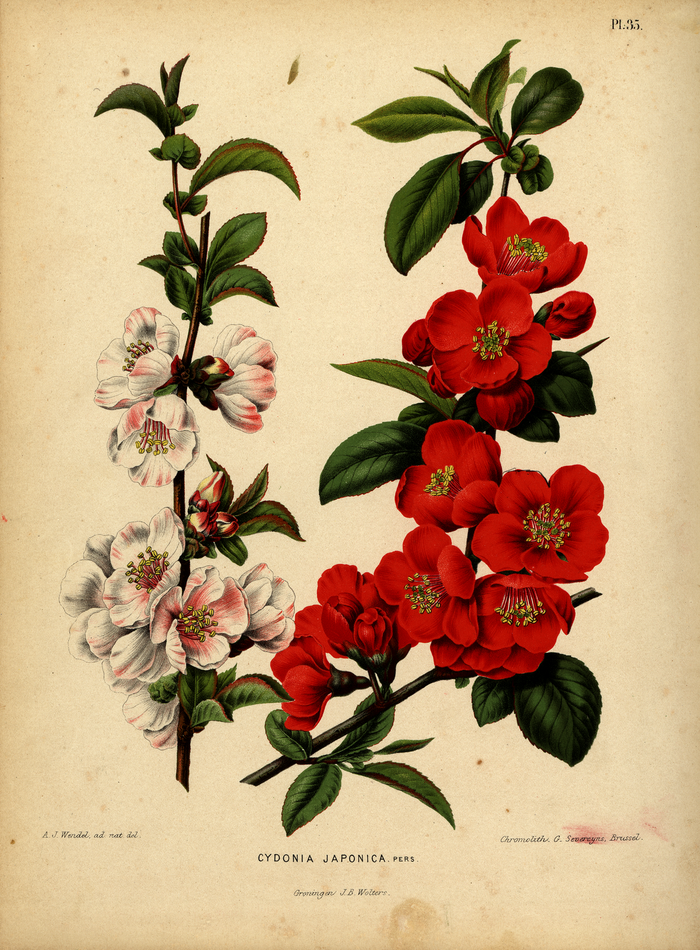
Flowering quince
Shrub·Chaenomeles speciosa
Shade to full sun
Sun
Moist soil
Water
Well-drained soil
Drainage
Zones 5–9
Hardiness
Coverage · 123 fields
- Parser flag (climate_tolerance_low_confidence): Climate tolerance values are LLM-extracted (no authoritative EcoCrop match found). EcoCrop covers ~2,568 food-crop taxa; ornamental/native/medicinal species rely on LLM extraction.
Growth and size10 fields
Plant type
Deciduous shrub“Chaenomeles speciosa is a deciduous Shrub growing to 3 m (9ft) by 5 m (16ft) at a medium rate.”
Height
300 cm · other sources: 200 cm“Chaenomeles speciosa is a deciduous Shrub growing to 3 m (9ft) by 5 m (16ft) at a medium rate.”Wikipedia“It is taller than another commonly cultivated species, C. japonica, usually growing to about 2 m (6 ft 7 in).”
Spread
500 cm“Chaenomeles speciosa is a deciduous Shrub growing to 3 m (9ft) by 5 m (16ft) at a medium rate.”
Height at age
—
empty
Spacing
200 cm (at least 150 cm)
AI estimate55 % agree
Growth rate
Medium“Chaenomeles speciosa is a deciduous Shrub growing to 3 m (9ft) by 5 m (16ft) at a medium rate.”
Habit
Spreading
AI estimate50 % agree
Root depth
Medium
AI estimate63 % agree
Forest garden layer
Shrub layer“Chaenomeles speciosa is a deciduous Shrub growing to 3 m (9ft) by 5 m (16ft) at a medium rate.”
Lifespan
~50 years
AI estimatenot measured yet
Roots6 fields
Root form
Heart root“The root pattern is branching: a heart root, dividing from the crown into several primary roots going down and out [2-1].”
Storage organ
None“No clonal growth organ is recorded: it does not spread vegetatively (no suckers, no rhizomes).”
Spreads
No“No clonal growth organ is recorded: it does not spread vegetatively (no suckers, no rhizomes).”
Lateral spread in cm
—
empty
Root depth in cm
—
empty
Mycorrhiza
—
empty
Light, water and soil9 fields
Sun
Full sun, light shade, part shade, shade · best: full sun“It can grow in full shade (deep woodland) semi-shade (light woodland) or no shade.”PFAF“Tolerates full shade but requires a sunny position for best fruit production.”
Hours of sun
6–12 h
AI estimatenot measured yet
Drought tolerant
—
empty
Tolerates waterlogging
—
empty
Soil type
Sand, loam, clay · best: loam“Prefers a deep moist well-drained loam.”PFAF“Suitable for: light (sandy), medium (loamy) and heavy (clay) soils, prefers well-drained soil and can grow in heavy clay soil.”
Drainage
Well drained“Suitable for: light (sandy), medium (loamy) and heavy (clay) soils, prefers well-drained soil and can grow in heavy clay soil.”
Compacted soil
Copes fairly well
AI estimatenot measured yet
Climate5 fields
Hardiness
Zone 5–9
AI estimatenot measured yet
Growing temperature
5–30 °C · optimal 15–25 °C
AI estimatenot measured yet
Chill hours
400 h
AI estimatenot measured yet
Care (becomes tasks in Manage)7 fields
Sowing
After the previous stage“best sown as soon as it is ripe in a sheltered position outdoors or in a cold frame.”
Protection
After the first frost · lasts 120 days“give them some protection in their first winter”
PFAFpartly
Pruning
After the previous stage · 30 days after · lasts 30 days · dead, damaged, or crossing branches, and to shape the plant
AI estimatenot measured yet
Mulching
March · lasts 30 days
AI estimatenot measured yet
Feeding
March · a balanced granular fertiliser
AI estimatenot measured yet
Through the year6 fields
Flowering
February · lasts 150 days“It is in flower from February to June, and the seeds ripen in October.”
Fruiting
October · lasts 31 days“It is in flower from February to June, and the seeds ripen in October.”
Leafing out
After the last frost · lasts 45 days
AI estimatenot measured yet
Dying back
After the first frost · lasts 60 days
AI estimatenot measured yet
Dormant
After the first frost · 30 days after · lasts 150 days
AI estimatenot measured yet
First harvest
2–3 years after plantingSource is a small fruit/nut tree nursery (Zero Fox Tree Crops), not an extension service. Wording already counts from planting (not from seed), matching the field convention directly.
Edible parts and pollination4 fields
The fruit
Pollination
Self-fertile · hermaphrodite“The species is hermaphrodite (has both male and female organs) and is pollinated by Bees.”
Pollinated by
Bees“The species is hermaphrodite (has both male and female organs) and is pollinated by Bees.”
Ecology6 fields
Attracts
Bees, wildlife“The species is hermaphrodite (has both male and female organs) and is pollinated by Bees.”PFAF“It is noted for attracting wildlife.”
Pests
Aphids, scale insects
AI estimatenot measured yet
Diseases
Fire blight
AI estimatenot measured yet
Takes up
Potassium, calcium
AI estimatenot measured yet
Fixes nitrogen
No
AI estimatenot measured yet
Mycorrhiza
Yes
AI estimatenot measured yet
Propagation and names4 fields
Methods
Seed, half-ripe wood cuttings, mature wood cuttings, layering“Seed - best sown as soon as it is ripe in a sheltered position outdoors or in a cold frame.”PFAF“Cuttings of half-ripe wood, July/August in a frame.”PFAF“Cuttings of mature wood of the current year's growth, November in a cold frame.”PFAF“Layering in late spring or in autumn.”
Difficulty
3 / 5
AI estimatenot measured yet
Seed
requires cold stratification for 60-90 days
AI estimatenot measured yet
Not sorted yet66 fields
Fields the parser stores that this page has no row for yet. They show up here automatically, so nothing is hidden.
forage.DK.local_name
Kvæde (blomstrende)
AI estimatenot measured yet
forage.DK.prep_cautions
Very harsh and acid raw“Very harsh and acid raw but fragrant when cooked.”
forage.DK.edibility_basis
inferred
AI estimatenot measured yet
forage.DK.foraging_months.notes
Fruit ripens in autumn.
AI estimatenot measured yet
forage.DK.foraging_months.months
9, 10
AI estimatenot measured yet
forage.DK.foraging_months.year_round
false
AI estimatenot measured yet
forage.DK.habitat_affinity
hedgerow, woodland
AI estimatenot measured yet
forage.US.local_name
Flowering quince
AI estimatenot measured yet
forage.US.edible_parts
[{"part":"fruit","caution":"Very harsh and acid raw but fragrant when cooked.","preparation":"cooked, for jams and jellies or as a flavouring with cooked apples"}]“Edible Parts: Fruit”PFAF“Very harsh and acid raw but fragrant when cooked.”PFAF“Used for jams, jellies etc and as a flavouring with cooked apples”
forage.US.prep_cautions
Very harsh and acid raw“Very harsh and acid raw but fragrant when cooked.”
forage.US.edibility_basis
inferred
AI estimatenot measured yet
forage.US.foraging_months.notes
Fruit ripens in autumn.
AI estimatenot measured yet
forage.US.foraging_months.months
9, 10
AI estimatenot measured yet
forage.US.foraging_months.year_round
false
AI estimatenot measured yet
forage.US.habitat_affinity
hedgerow, woodland
AI estimatenot measured yet
forage.TROPICAL.edibility_basis
inferred
AI estimatenot measured yet
forage.TROPICAL.foraging_months.notes
Not typically found or foraged in tropical regions.
AI estimatenot measured yet
forage.TROPICAL.foraging_months.year_round
false
AI estimatenot measured yet
ornamental.basis
documented
AI estimatenot measured yet
ornamental.fragrance.source
fruit
AI estimate100 % agree
ornamental.fragrance.intensity
subtle
AI estimatenot measured yet
ornamental.confidence
high
AI estimatenot measured yet
ornamental.fall_interest
true
AI estimatenot measured yet
ornamental.flower_colour
red, pink, white, green
AI estimate67 % agree
ornamental.evidence_quote
Chaenomeles speciosa, commonly known as flowering quince, is a deciduous shrub with showy flowers that can be red, pink, white, or orange. Its foliage is green, turning yellow-green in autumn. The plant produces small, apple-like fruits that persist into winter, providing some winter interest.
AI estimatenot measured yet
ornamental.foliage_colour
green
AI estimate82 % agree
ornamental.foliage_texture
medium
AI estimatenot measured yet
ornamental.winter_structure
persistent_fruit
AI estimatenot measured yet
ornamental.autumn_foliage_colour
yellow_green
AI estimatenot measured yet
care_regime
light
AI estimatenot measured yet
propagation.self_seeding
light
AI estimate20 % agree
propagation.division_season
late winter to early spring
AI estimatenot measured yet
propagation.establishment_years
2
AI estimate40 % agree
sun_requirement.best
full_sun“Tolerates full shade but requires a sunny position for best fruit production.”
sun_requirement.best_for
fruit“Tolerates full shade but requires a sunny position for best fruit production.”
forage_proposals.DK.edibility_tier.tier
edible“Fruit - cooked. Very harsh and acid raw but fragrant when cooked.”
forage_proposals.DK.edibility_tier.confidence
high
AI estimatenot measured yet
forage_proposals.DK.edibility_tier.evidence_quote
The fruit of Chaenomeles speciosa is edible when cooked, often used in jams, jellies, and pies due to its high pectin content and tart flavor.
AI estimatenot measured yet
forage_proposals.US.edibility_tier.tier
edible“Fruit - cooked. Very harsh and acid raw but fragrant when cooked.”
forage_proposals.US.edibility_tier.confidence
high
AI estimatenot measured yet
forage_proposals.US.edibility_tier.evidence_quote
Flowering quince fruit is edible after cooking, commonly used for preserves and baking, similar to true quince.
AI estimatenot measured yet
forage_proposals.TROPICAL.edibility_tier.confidence
low
AI estimatenot measured yet
function_profile.biomass_return.confidence
medium
AI estimatenot measured yet
function_profile.nutrient_flows.consumes
[{"basis":"inferred","demand":"moderate","nutrient":"nitrogen","confidence":"medium"},{"basis":"inferred","demand":"moderate","nutrient":"phosphorus","confidence":"medium"},{"basis":"inferred","demand":"moderate","nut…
AI estimatenot measured yet
function_profile.nutrient_flows.provides
[{"basis":"inferred","nutrient":"potassium","mechanism":"biomass_return","confidence":"medium"},{"basis":"inferred","nutrient":"calcium","mechanism":"biomass_return","confidence":"medium"}]
AI estimatenot measured yet
function_profile.biotic_interactions
[{"taxa":["bees"],"basis":"documented","valence":"beneficial","relation":"attracts","confidence":"high","evidence_quote":"A good bee plant, flowering early in the year and providing pollen and nectar.","organism_group…“A good bee plant, flowering early in the year and providing pollen and nectar.”PFAF“It is noted for attracting wildlife.”
function_profile.aromatic_pest_effect.value
false
AI estimate80 % agree
function_profile.aromatic_pest_effect.confidence
high
AI estimatenot measured yet
function_profile.structural_interfaces.provides_shelter.basis
taxonomic
AI estimatenot measured yet
function_profile.structural_interfaces.provides_shelter.kinds
wind
AI estimatenot measured yet
function_profile.structural_interfaces.provides_shelter.confidence
medium
AI estimatenot measured yet
function_profile.structural_interfaces.provides_shelter.evidence_quote
Its dense growth habit can provide some windbreak.
AI estimatenot measured yet
function_profile.structural_interfaces.requires_shelter.basis
inferred
AI estimatenot measured yet
function_profile.structural_interfaces.requires_shelter.kinds
frost
AI estimatenot measured yet
function_profile.structural_interfaces.requires_shelter.stage
establishment
AI estimatenot measured yet
function_profile.structural_interfaces.requires_shelter.confidence
low
AI estimatenot measured yet
function_profile.structural_interfaces.provides_physical_support.form
dense_thicket
AI estimatenot measured yet
function_profile.structural_interfaces.provides_physical_support.basis
taxonomic
AI estimatenot measured yet
function_profile.structural_interfaces.provides_physical_support.confidence
high
AI estimatenot measured yet
function_profile.structural_interfaces.requires_physical_support.basis
inferred
AI estimatenot measured yet
function_profile.structural_interfaces.requires_physical_support.confidence
low
AI estimatenot measured yet
climate_tolerance.photoperiod_response
day_neutral
AI estimatenot measured yet
soil_interactions.organic_matter_contribution
medium
AI estimatenot measured yet
component_metadata.growth_cycle
perennial
AI estimate100 % agree
resource_interfaces.inputs
[{"resource":"light","quantity_description":"Tolerates full shade but requires a sunny position for best fruit production."},{"resource":"shade","quantity_description":"Can grow in full shade (deep woodland), semi-sha…“Tolerates full shade but requires a sunny position for best fruit production.”PFAF“It can grow in full shade (deep woodland) semi-shade (light woodland) or no shade.”PFAF“It prefers moist soil.”PFAF“The species is hermaphrodite (has both male and female organs) and is pollinated by Bees.”
resource_interfaces.outputs
[{"resource":"pollinator_services","quantity_description":"A good bee plant, flowering early in the year, providing pollen and nectar."},{"resource":"nectar","quantity_description":"Provides nectar, flowering early in…“A good bee plant, flowering early in the year and providing pollen and nectar.”PFAF“It is noted for attracting wildlife.”PFAF“It is in flower from February to June, and the seeds ripen in October.”PFAF“Some cultivars, such as 'Jet Trail' are suitable for ground cover.”PFAFpartly“Edible Parts: Fruit”