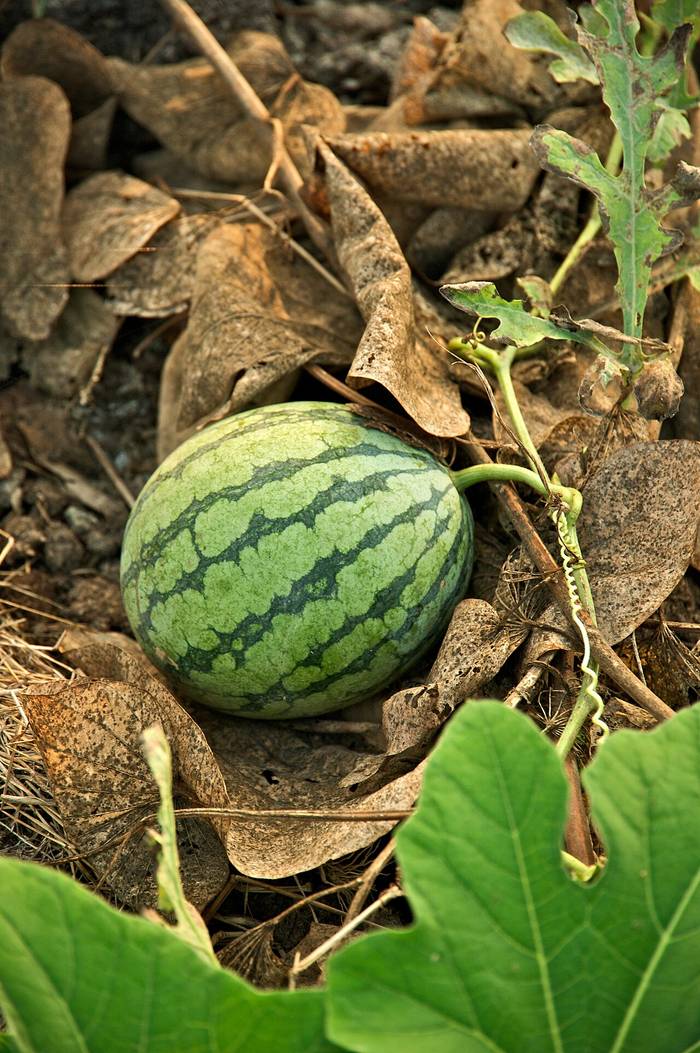
Fred Hsu ( Wikipedia:User:Fred Hsu on en.wikipedia ) · CC BY-SA 3.0
Watermelon
Plant·Citrullus lanatus
Full sun
Sun
Dry to moist soil
Water
Well-drained soil
Drainage
Zones 2–11
Hardiness
Coverage · 122 fields
Growth and size10 fields
Plant type
Plant
AI estimate100 % agree
Height at age
—
empty
Spacing
180 cm (at least 120 cm)
AI estimate55 % agree
Growth rate
—
empty
Root depth
Medium
AI estimate63 % agree
Forest garden layer
Ground cover
AI estimate90 % agree
Lifespan
~1 years
AI estimatenot measured yet
Roots6 fields
Root form
Taproot
AI estimate43 % agree
Storage organ
None
AI estimate100 % agree
Spreads
No
AI estimate75 % agree
Lateral spread in cm
—
empty
Root depth in cm
—
empty
Mycorrhiza
Arbuscular (AM)
AI estimatenot measured yet
Light, water and soil9 fields
Sun
Hours of sun
6–12 h
AI estimatenot measured yet
Tolerates waterlogging
No“A drought resistant plant once established, it is intolerant of wet soils.”
Soil type
Sand, loam · best: loam“Prefers a rich sandy loam and a very sunny position.”PFAF“Suitable for: light (sandy) and medium (loamy) soils and prefers well-drained soil.”
pH
Drainage
Well drained“Suitable for: light (sandy) and medium (loamy) soils and prefers well-drained soil.”
Compacted soil
Copes badly
AI estimatenot measured yet
Climate5 fields
Hardiness
Zone 2–11
AI estimatenot measured yet
Killing frost
0 °C
AI estimatenot measured yet
Growing temperature
15–40 °C · optimal 20–35 °C“Temperature absolute min: 15 · Temperature absolute max: 40 · Temperature optimal min: 20 · Temperature optimal max: 35”Wikipediapartly“Watermelons grow in tropical to temperate climates, needing temperatures higher than 25 °C (77 °F) to thrive.”
Chill hours
0 h
AI estimatenot measured yet
Care (becomes tasks in Manage)9 fields
Starting indoors
After the last frost · -28 days after“Seed - sow spring in a rich compost in a greenhouse.”
Starting indoors appears 2 times with different timing.
PFAFpartly
Protection
After the previous stage“Give them some protection, such as a cloche or a frame, at least until they are growing away vigorously.”
PFAFpartly
Planting out
After the last frost“Grow them on fast and, if trying them outside, plant out after the last expected frosts.”
PFAFpartly
Protection
After the last frost · frost
AI estimatenot measured yet
Sowing
April · lasts 30 days
AI estimatenot measured yet
Starting indoors
March · lasts 30 days
Starting indoors appears 2 times with different timing.
AI estimatenot measured yet
Watering
After the previous stage · lasts 120 days
AI estimatenot measured yet
Feeding
After the previous stage · lasts 60 days · a balanced liquid fertiliser
AI estimatenot measured yet
Mulching
After the previous stage · 14 days after
AI estimatenot measured yet
Through the year3 fields
Harvest
After the last frost · 85 days after“Watermelons have a longer growing period than other melons and can often take 85 days or more from the time of transplanting for the fruit to mature.”
Dying back
After the first frost
AI estimatenot measured yet
Edible parts and pollination3 fields
The fruit
Raw · July–September
AI estimatenot measured yet
Pollination
Self-fertile · monoecious“The species is monoecious (individual flowers are either male or female, but both sexes can be found on the same plant)”PFAF“The species is monoecious (individual flowers are either male or female, but both sexes can be found on the same plant) and is pollinated by Insects.”PFAF“The plant is self-fertile.”
Pollinated by
Insects“The species is monoecious (individual flowers are either male or female, but both sexes can be found on the same plant) and is pollinated by Insects.”
Ecology5 fields
Attracts
Insects, honeybees“The species is monoecious (individual flowers are either male or female, but both sexes can be found on the same plant) and is pollinated by Insects.”Wikipediapartly“The United States Department of Agriculture recommends using at least one beehive per acre (4,000 m2 per hive) for pollination of conventional, seeded varieties for commercial plantings.”
Pests
Aphids, fruit flies, root-knot nematodes“Major pests of the watermelon include aphids, fruit flies, and root-knot nematodes.”
Diseases
Powdery mildew, mosaic virus, fusarium wilt“In conditions of high humidity, the plants are prone to plant diseases such as powdery mildew and mosaic virus.”Wikipedia“Some varieties often grown in Japan and other parts of the Far East are susceptible to fusarium wilt.”
Takes up
—
empty
Fixes nitrogen
No
AI estimatenot measured yet
Propagation and names4 fields
Difficulty
2 / 5
AI estimatenot measured yet
Seed
—
empty
Not sorted yet68 fields
Fields the parser stores that this page has no row for yet. They show up here automatically, so nothing is hidden.
forage.DK.local_name
Vandmelon
AI estimatenot measured yet
forage.DK.edibility_basis
inferred
AI estimatenot measured yet
forage.DK.foraging_months.notes
Watermelon is typically harvested in late summer in temperate climates.
AI estimatenot measured yet
forage.DK.foraging_months.months
7, 8, 9
AI estimatenot measured yet
forage.DK.foraging_months.year_round
false
AI estimatenot measured yet
forage.DK.habitat_affinity
disturbed_ground
AI estimatenot measured yet
forage.US.local_name
Watermelon
AI estimatenot measured yet
forage.US.edible_parts
[{"part":"fruit","caution":null,"preparation":"raw","season_months":[7,8,9]}]
AI estimatenot measured yet
forage.US.edibility_basis
inferred
AI estimatenot measured yet
forage.US.foraging_months.notes
Watermelon is typically harvested in late summer in temperate climates.
AI estimatenot measured yet
forage.US.foraging_months.months
7, 8, 9
AI estimatenot measured yet
forage.US.foraging_months.year_round
false
AI estimatenot measured yet
forage.US.habitat_affinity
disturbed_ground
AI estimatenot measured yet
forage.TROPICAL.edible_parts
[{"part":"fruit","caution":null,"preparation":"raw"},{"part":"leaves","caution":null,"preparation":"cooked"},{"part":"seed","caution":null,"preparation":"raw or cooked; roasted or ground into a powder for bread, cakes…“Fruit - raw. A very refreshing fruit, it has a delicate sweetness with an extremely high water content, the fruit is often used as a refreshing drink.”PFAF“Leaves - cooked.”PFAF“Seed - raw or cooked. They can be roasted or ground into a powder and used with cereal flours when making bread, cakes etc, or added to soups and stews.”PFAF“An edible oil is obtained from the seed.”
forage.TROPICAL.prep_cautions
The sprouting seed produces a toxic substance in its embryo.“The sprouting seed produces a toxic substance in its embryo.”
forage.TROPICAL.edibility_basis
inferred
AI estimatenot measured yet
forage.TROPICAL.foraging_months.notes
In tropical regions, watermelon can be grown and harvested year-round, depending on local climate and rainfall patterns.
AI estimatenot measured yet
forage.TROPICAL.foraging_months.year_round
true
AI estimatenot measured yet
forage.TROPICAL.habitat_affinity
verge, disturbed_ground“A weed of roadsides and open ground in desert areas.”
ornamental.basis
documented
AI estimatenot measured yet
ornamental.fragrance.source
none
AI estimate100 % agree
ornamental.fragrance.intensity
subtle
AI estimatenot measured yet
ornamental.confidence
high
AI estimatenot measured yet
ornamental.fall_interest
false
AI estimatenot measured yet
ornamental.flower_colour
white, yellow“Plants have unisexual male or female flowers that are white or yellow and borne on 40-millimetre-long (1+1⁄2 in) hairy stalks.”
ornamental.evidence_quote
Watermelon flowers are typically yellow. The foliage is green and there is no significant autumn foliage color change. The plant is an annual and does not have winter structure.
AI estimatenot measured yet
ornamental.foliage_colour
green
AI estimate82 % agree
ornamental.foliage_texture
medium
AI estimatenot measured yet
ornamental.winter_structure
none
AI estimatenot measured yet
ornamental.autumn_foliage_colour
none
AI estimatenot measured yet
care_regime
routine
AI estimatenot measured yet
propagation.self_seeding
none
AI estimate20 % agree
propagation.establishment_years
1
AI estimate40 % agree
forage_proposals.DK.edibility_tier.tier
edible
AI estimatenot measured yet
forage_proposals.DK.edibility_tier.confidence
high
AI estimatenot measured yet
forage_proposals.DK.edibility_tier.evidence_quote
Watermelon (Citrullus lanatus) is widely cultivated and consumed globally for its sweet, juicy fruit. It is a common summer fruit.
AI estimatenot measured yet
forage_proposals.US.edibility_tier.tier
edible
AI estimatenot measured yet
forage_proposals.US.edibility_tier.confidence
high
AI estimatenot measured yet
forage_proposals.US.edibility_tier.evidence_quote
Watermelon (Citrullus lanatus) is a popular fruit consumed fresh, known for its high water content and sweet taste.
AI estimatenot measured yet
forage_proposals.TROPICAL.edibility_tier.tier
edible
AI estimatenot measured yet
forage_proposals.TROPICAL.edibility_tier.confidence
high
AI estimatenot measured yet
forage_proposals.TROPICAL.edibility_tier.evidence_quote
Citrullus lanatus, commonly known as watermelon, is a staple fruit in tropical diets, eaten fresh and used in various beverages.
AI estimatenot measured yet
function_profile.biomass_return.confidence
medium
AI estimatenot measured yet
function_profile.nutrient_flows.consumes
[{"basis":"documented","demand":"heavy","nutrient":"nitrogen","confidence":"high"},{"basis":"documented","demand":"moderate","nutrient":"phosphorus","confidence":"high"},{"basis":"documented","demand":"heavy","nutrien…
AI estimatenot measured yet
function_profile.biotic_interactions
[{"taxa":["insects"],"basis":"documented","valence":"beneficial","relation":"attracts","confidence":"high","evidence_quote":"The species is monoecious (individual flowers are either male or female, but both sexes can …“The species is monoecious (individual flowers are either male or female, but both sexes can be found on the same plant) and is pollinated by Insects.”Wikipedia“In conditions of high humidity, the plants are prone to plant diseases such as powdery mildew and mosaic virus.”Wikipedia“Some varieties often grown in Japan and other parts of the Far East are susceptible to fusarium wilt.”Wikipediapartly“The United States Department of Agriculture recommends using at least one beehive per acre (4,000 m2 per hive) for pollination of conventional, seeded varieties for commercial plantings.”Wikipediapartly“Major pests of the watermelon include aphids, fruit flies, and root-knot nematodes.”
function_profile.aromatic_pest_effect.value
false
AI estimate80 % agree
function_profile.aromatic_pest_effect.confidence
high
AI estimatenot measured yet
function_profile.structural_interfaces.provides_shelter.basis
inferred
AI estimatenot measured yet
function_profile.structural_interfaces.provides_shelter.kinds
shade
AI estimatenot measured yet
function_profile.structural_interfaces.provides_shelter.confidence
low
AI estimatenot measured yet
function_profile.structural_interfaces.provides_shelter.evidence_quote
The broad leaves can provide some shade to the soil, helping to retain moisture.
AI estimatenot measured yet
function_profile.structural_interfaces.requires_shelter.basis
documented
AI estimatenot measured yet
function_profile.structural_interfaces.requires_shelter.kinds
frost“It is hardy to UK zone 9 and is frost tender.”
function_profile.structural_interfaces.requires_shelter.stage
establishment“Give them some protection, such as a cloche or a frame, at least until they are growing away vigorously.”
function_profile.structural_interfaces.requires_shelter.confidence
high
AI estimatenot measured yet
function_profile.structural_interfaces.requires_shelter.evidence_quote
Young watermelon plants are sensitive to strong winds and frost.
AI estimatenot measured yet
function_profile.structural_interfaces.provides_physical_support.basis
inferred
AI estimatenot measured yet
function_profile.structural_interfaces.provides_physical_support.confidence
medium
AI estimatenot measured yet
function_profile.structural_interfaces.requires_physical_support.basis
documented
AI estimatenot measured yet
function_profile.structural_interfaces.requires_physical_support.mechanism
tendril“Like all but one species in the genus Citrullus, watermelon has branching tendrils.”
function_profile.structural_interfaces.requires_physical_support.confidence
medium
AI estimatenot measured yet
function_profile.structural_interfaces.requires_physical_support.evidence_quote
Watermelon vines can sprawl extensively and may benefit from trellising or support to keep fruit off the ground, though they are not true climbers.
AI estimatenot measured yet
climate_tolerance.photoperiod_response
day_neutral
AI estimatenot measured yet
soil_interactions.organic_matter_contribution
medium
AI estimatenot measured yet
component_metadata.growth_cycle
annual“Citrullus lanatus is a ANNUAL growing to 0.5 m (1ft 8in) by 2 m (6ft).”
resource_interfaces.inputs
[{"resource":"light","quantity_description":"very sunny position"},{"resource":"water","quantity_description":"drought tolerant once established; intolerant of wet soils"},{"resource":"pollination","quantity_descripti…“Prefers a rich sandy loam and a very sunny position.”PFAF“A drought resistant plant once established, it is intolerant of wet soils.”PFAFpartly“The species is monoecious (individual flowers are either male or female, but both sexes can be found on the same plant) and is pollinated by Insects.”
resource_interfaces.outputs
[{"resource":"fruit","quantity_description":"up to 1 m long and 40 cm wide, varies by cultivar"},{"resource":"seeds","quantity_description":"about 30% protein and 20-40% oil"},{"resource":"ground_cover","quantity_desc…“The fruit varies considerably in size from cultivar to cultivar, but can be up to 1 metre long and 40cm wide.”PFAF“The seed contains about 30% protein, 20 - 40% oil.”Wikipediapartly“The watermelon is an annual that has a prostrate or climbing habit.”