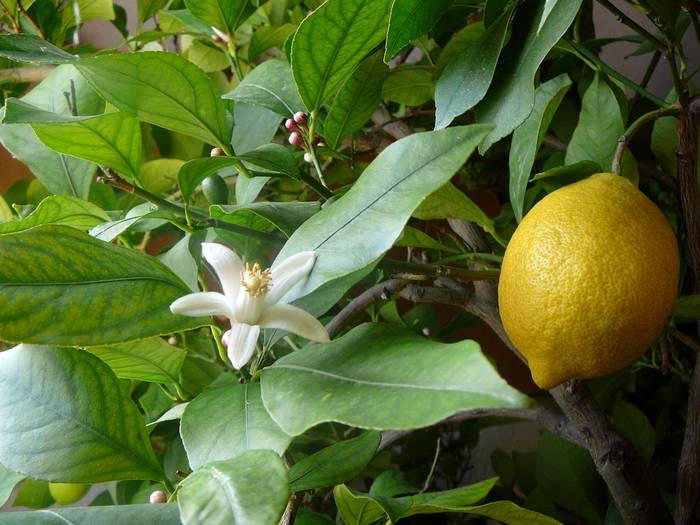
Elena Chochkova · CC BY-SA 4.0
Lemon
Tree·Citrus × limon
Full sun
Sun
Dry to moist soil
Water
Well-drained soil
Drainage
Zones 9–11
Hardiness
Coverage · 118 fields
Growth and size10 fields
Plant type
Evergreen tree“Citrus limon is an evergreen Shrub growing to 3 m (9ft) by 1 m (3ft 3in) at a medium rate.”Wikipediapartly“The lemon (Citrus × limon) is a species of small evergreen tree in the Citrus genus of the flowering plant family Rutaceae.”
Height
300 cm · the source gives 300–900 cm“They can reach a height of 10 to 30 feet (3 to 9 meters), with some dwarf varieties available for smaller spaces.”PFAF“Citrus limon is an evergreen Shrub growing to 3 m (9ft) by 1 m (3ft 3in) at a medium rate.”
Spread
100 cm“Citrus limon is an evergreen Shrub growing to 3 m (9ft) by 1 m (3ft 3in) at a medium rate.”
Height at age
—
empty
Spacing
400 cm (at least 300 cm)
AI estimate55 % agree
Growth rate
Medium“Citrus limon is an evergreen Shrub growing to 3 m (9ft) by 1 m (3ft 3in) at a medium rate.”
Habit
Spreading
AI estimate50 % agree
Root depth
Medium
AI estimate63 % agree
Forest garden layer
Lower tree layer
AI estimate90 % agree
Lifespan
~50 years
AI estimatenot measured yet
Roots6 fields
Root form
Fibrous roots
AI estimate43 % agree
Storage organ
None
AI estimate100 % agree
Spreads
No
AI estimate75 % agree
Lateral spread in cm
—
empty
Root depth in cm
—
empty
Mycorrhiza
Arbuscular (AM)
AI estimatenot measured yet
Light, water and soil9 fields
Hours of sun
6–12 h
AI estimatenot measured yet
Drought tolerant
—
empty
Soil type
Loam, clay · best: loam“Prefers a moderately heavy loam with a generous amount of compost and sand added and a very sunny position.”PFAF“Suitable for: medium (loamy) and heavy (clay) soils and prefers well-drained soil.”
pH
Drainage
Well drained“Suitable for: medium (loamy) and heavy (clay) soils and prefers well-drained soil.”
Compacted soil
Copes badly
AI estimatenot measured yet
Climate5 fields
Hardiness
Zone 9–11
AI estimatenot measured yet
Killing frost
-2 °C“Dormant plants can withstand temperatures down to about -6°c so long as this is preceded by a spell of 2 - 3 weeks of cool weather to allow the plant to acclimatize.”
PFAFpartly
Growing temperature
12–36 °C · optimal 15–28 °C“Lemons need a minimum temperature of around 7 °C (45 °F), so they are not hardy year-round in temperate climates, but become hardier as they mature.”
Wikipediapartly
Chill hours
0 h
AI estimatenot measured yet
Native range
—
empty
Care (becomes tasks in Manage)12 fields
Protection
After the first frost · frost“In Britain it can be grown in a pot that is placed outdoors in the summer and brought into a greenhouse for the winter.”
PFAFpartly
Protection
After the last frost · frost“The young growth in spring, even on mature plants, is frost-tender and so it is best to grow the plants in a position sheltered from the early morning sun”
Protection
After the first frost · frost“give them some protection from the cold for their first few winters outdoors”
Pruning
After the last frost · overcrowded branches“Citrus require minimal pruning by trimming overcrowded branches, with the tallest branch cut back to encourage bushy growth.”
Pruning appears 2 times with different timing.
Pruning
July · tips of the most vigorous growth“Throughout summer, pinching back tips of the most vigorous growth assures more abundant canopy development.”
Pruning appears 2 times with different timing.
Watering
After the last frost
Watering appears 2 times with different timing.
AI estimatenot measured yet
Starting indoors
After the previous stage
Starting indoors appears 2 times with different timing.
AI estimatenot measured yet
Starting indoors
March · lasts 31 days
Starting indoors appears 2 times with different timing.
AI estimatenot measured yet
Watering
After rain · lasts 365 days
Watering appears 2 times with different timing.
AI estimatenot measured yet
Feeding
March · lasts 30 days · a balanced citrus fertiliser
AI estimatenot measured yet
Mulching
April · lasts 30 days
AI estimatenot measured yet
Through the year3 fields
Flowering
After the last frost · lasts 30 days
AI estimatenot measured yet
Harvest
November · lasts 120 days
AI estimatenot measured yet
Leafing out
After the last frost · lasts 30 days
AI estimatenot measured yet
Edible parts and pollination2 fields
Pollination
Self-fertile · hermaphrodite“The species is hermaphrodite (has both male and female organs) and is pollinated by Apomictic (reproduce by seeds formed without sexual fusion), insects.”PFAF“The plant is self-fertile.”
Pollinated by
Insects“The species is hermaphrodite (has both male and female organs) and is pollinated by Apomictic (reproduce by seeds formed without sexual fusion), insects.”
Ecology5 fields
Attracts
Pollinators, beneficial insects, birds, mammals, wildlife“Citrus flowers are rich in nectar and pollen, making them highly attractive to pollinators like bees.”PFAF“They also improve biodiversity by attracting pollinators and beneficial insects.”PFAF“The fruits are a food source for various wildlife, including birds and mammals.”PFAF“It is noted for attracting wildlife.”
Pests
Citrus leafminer, aphids, scale insects, mealybugs
AI estimatenot measured yet
Diseases
Citrus canker, citrus greening disease
AI estimatenot measured yet
Takes up
—
empty
Fixes nitrogen
No
AI estimatenot measured yet
Propagation and names4 fields
Methods
Difficulty
2 / 5
AI estimatenot measured yet
Seed
not required
AI estimatenot measured yet
Not sorted yet62 fields
Fields the parser stores that this page has no row for yet. They show up here automatically, so nothing is hidden.
forage.DK.edibility_basis
inferred
AI estimatenot measured yet
forage.DK.foraging_months.year_round
false
AI estimatenot measured yet
forage.US.edible_parts
[{"part":"fruit","caution":null,"preparation":"raw, juiced, zested, cooked","season_months":[1,2,3,4,5,6,7,8,9,10,11,12]},{"part":"leaves","caution":null,"preparation":"used as a flavoring, brewed for tea","season_mon…
AI estimatenot measured yet
forage.US.edibility_basis
inferred
AI estimatenot measured yet
forage.US.foraging_months.notes
Lemons can fruit year-round in suitable climates, with peak seasons varying by cultivar and region.
AI estimatenot measured yet
forage.US.foraging_months.year_round
true
AI estimatenot measured yet
forage.US.habitat_affinity
disturbed_ground
AI estimatenot measured yet
forage.TROPICAL.local_name
Lemon
AI estimatenot measured yet
forage.TROPICAL.edible_parts
[{"part":"fruit","caution":null,"preparation":"Eaten raw or cooked; mainly used as a drink and as a flavouring, and the juice helps set jam.","season_months":[11,12,1,2,3]},{"part":"flowers","caution":null,"preparatio…“The flowers are eaten in ice creams, fritters, jams etc.”PFAF“The dried leaves are sometimes mixed with tea leaves for use as a flavouring.”PFAF“The dried rind of the fruit is often used as a flavouring in cakes etc.”PFAF“Citrus fruits are generally harvested in late autumn to early spring, depending on the specific variety and local climate.”PFAFpartly“Fruit - raw or cooked.”PFAFpartly“Mainly used as a drink and as a flavouring.”
forage.TROPICAL.prep_cautions
The rind may contain pesticides if not organically grown; wash thoroughly or use organic lemons for zest.
AI estimatenot measured yet
forage.TROPICAL.edibility_basis
inferred
AI estimatenot measured yet
forage.TROPICAL.foraging_months.notes
Harvest timing varies by variety and local climate.
AI estimatenot measured yet
forage.TROPICAL.foraging_months.months
11, 12, 1, 2, 3“Citrus fruits are generally harvested in late autumn to early spring, depending on the specific variety and local climate.”
forage.TROPICAL.foraging_months.year_round
true
AI estimatenot measured yet
forage.TROPICAL.habitat_affinity
disturbed_ground
AI estimatenot measured yet
ornamental.basis
documented
AI estimatenot measured yet
ornamental.fragrance.intensity
strong
AI estimatenot measured yet
ornamental.confidence
high
AI estimatenot measured yet
ornamental.fall_interest
false
AI estimatenot measured yet
ornamental.flower_colour
white
AI estimate67 % agree
ornamental.evidence_quote
Lemon trees have fragrant white flowers and dark green, evergreen foliage. The fruit persists on the tree, providing winter interest.
AI estimatenot measured yet
ornamental.foliage_colour
dark_green
AI estimate82 % agree
ornamental.foliage_texture
medium
AI estimatenot measured yet
ornamental.winter_structure
evergreen_form, persistent_fruit“Citrus limon is an evergreen Shrub growing to 3 m (9ft) by 1 m (3ft 3in) at a medium rate.”
PFAFpartly
ornamental.autumn_foliage_colour
none
AI estimatenot measured yet
care_regime
routine
AI estimatenot measured yet
propagation.self_seeding
none
AI estimate20 % agree
propagation.division_season
not applicable
AI estimatenot measured yet
propagation.establishment_years
3“grow them on in the greenhouse for at least three growing seasons before trying them outdoors”
spatial_profile.canopy_density
dense
AI estimatenot measured yet
sun_requirement.best
full_sun“Prefers a moderately heavy loam with a generous amount of compost and sand added and a very sunny position.”
PFAFpartly
forage_proposals.DK.edibility_tier.confidence
low
AI estimatenot measured yet
forage_proposals.US.edibility_tier.tier
choice
AI estimatenot measured yet
forage_proposals.US.edibility_tier.confidence
high
AI estimatenot measured yet
forage_proposals.US.edibility_tier.evidence_quote
The fruit of the lemon tree is widely consumed for its juice and zest, and the leaves are also used for flavoring and tea.
AI estimatenot measured yet
forage_proposals.TROPICAL.edibility_tier.evidence_quote
Fruit - raw or cooked.“Fruit - raw or cooked.”
function_profile.biomass_return.confidence
medium
AI estimatenot measured yet
function_profile.nutrient_flows.consumes
[{"basis":"documented","demand":"heavy","nutrient":"nitrogen","confidence":"high"},{"basis":"documented","demand":"moderate","nutrient":"phosphorus","confidence":"high"},{"basis":"documented","demand":"heavy","nutrien…
AI estimatenot measured yet
function_profile.nutrient_flows.provides
[{"basis":"inferred","nutrient":"nitrogen","mechanism":"biomass_return","confidence":"low","evidence_quote":null}]
AI estimatenot measured yet
function_profile.biotic_interactions
[{"taxa":["bees"],"basis":"documented","valence":"beneficial","relation":"attracts","confidence":"high","evidence_quote":"Citrus flowers are rich in nectar and pollen, making them highly attractive to pollinators like…“Citrus flowers are rich in nectar and pollen, making them highly attractive to pollinators like bees.”PFAF“They also improve biodiversity by attracting pollinators and beneficial insects.”PFAF“The dense leaf litter under citrus trees can offer overwintering sites for invertebrates, and the rough bark of mature trees can be used by beneficial insects.”PFAF“The fruits are a food source for various wildlife, including birds and mammals.”PFAF“The dense foliage of citrus trees can also provide shelter for nesting and roosting birds.”PFAF“It is noted for attracting wildlife.”
function_profile.aromatic_pest_effect.value
true“The strong citrus scent from the leaves and fruit can act as a natural pest deterrent, helping to confuse or repel certain insects.”
function_profile.aromatic_pest_effect.confidence
medium
AI estimatenot measured yet
function_profile.structural_interfaces.provides_shelter.basis
inferred
AI estimatenot measured yet
function_profile.structural_interfaces.provides_shelter.kinds
shade“Citrus species can be used in agroforestry systems as shade trees, providing dappled light for understory crops.”
function_profile.structural_interfaces.provides_shelter.confidence
medium
AI estimatenot measured yet
function_profile.structural_interfaces.provides_shelter.evidence_quote
As a small tree, it can provide moderate shade.
AI estimatenot measured yet
function_profile.structural_interfaces.requires_shelter.basis
documented
AI estimatenot measured yet
function_profile.structural_interfaces.requires_shelter.kinds
frost“Plant them out in the summer and give them some protection from the cold for their first few winters outdoors.”
PFAFpartly
function_profile.structural_interfaces.requires_shelter.stage
permanent
AI estimatenot measured yet
function_profile.structural_interfaces.requires_shelter.confidence
high
AI estimatenot measured yet
function_profile.structural_interfaces.requires_shelter.evidence_quote
Lemon trees are sensitive to strong winds and frost, requiring protection in colder climates.
AI estimatenot measured yet
function_profile.structural_interfaces.provides_physical_support.form
trunk
AI estimatenot measured yet
function_profile.structural_interfaces.provides_physical_support.basis
taxonomic
AI estimatenot measured yet
function_profile.structural_interfaces.provides_physical_support.confidence
high
AI estimatenot measured yet
climate_tolerance.photoperiod_response
day_neutral“It is in leaf all year, in flower all year.”
PFAFpartly
soil_interactions.organic_matter_contribution
medium
AI estimatenot measured yet
component_metadata.growth_cycle
perennial
AI estimate100 % agree
resource_interfaces.inputs
[{"resource":"light","quantity_description":"a very sunny position"},{"resource":"water","quantity_description":"dry or moist soil"},{"resource":"pollination","quantity_description":"self-fertile; cross-pollination ca…“Prefers a moderately heavy loam with a generous amount of compost and sand added and a very sunny position.”PFAF“It prefers dry or moist soil.”PFAF“Most Citrus species are self-fertile, meaning they can produce fruit without needing another plant for cross-pollination, though cross-pollination can improve fruit set in some varieties.”PFAF“Plants are intolerant of water logging.”
resource_interfaces.outputs
[{"resource":"shade","quantity_description":"dappled light for understory crops"},{"resource":"leaf_litter","quantity_description":"dense leaf litter under the tree"},{"resource":"habitat","quantity_description":"nest…“Citrus species can be used in agroforestry systems as shade trees, providing dappled light for understory crops.”PFAF“The dense leaf litter under citrus trees can offer overwintering sites for invertebrates, and the rough bark of mature trees can be used by beneficial insects.”PFAF“The dense foliage of citrus trees can also provide shelter for nesting and roosting birds.”PFAF“Citrus flowers are rich in nectar and pollen, making them highly attractive to pollinators like bees.”PFAF“Additionally, the fruits can be a valuable cash crop.”PFAF“An essential oil from the peel is used as a food flavouring and also in perfumery and medicines.”PFAF“Wood - nicely veined, it takes a beautiful polish.”PFAF“A semi-drying oil obtained from the seed is used in soap making.”PFAF“They also improve biodiversity by attracting pollinators and beneficial insects.”