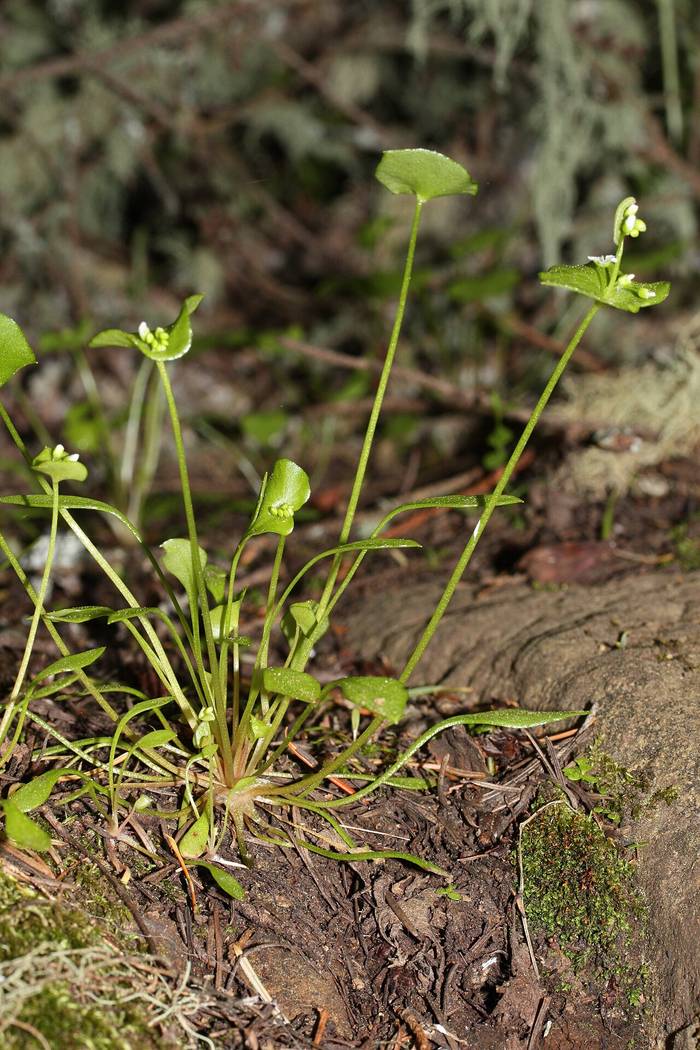
Walter Siegmund (talk) · CC BY-SA 3.0
miner's lettuce
Plant·Claytonia perfoliata
Shade to full sun
Sun
Dry to moist soil
Water
Well-drained soil
Drainage
Zones 6–9
Hardiness
Coverage · 108 fields
No obvious inconsistencies found.
Growth and size10 fields
Plant type
Plant“Claytonia perfoliata, commonly known as miner's lettuce or winter purslane, is a flowering plant in the family Montiaceae.”
Height
20 cm · other sources: 30 cm“Claytonia perfoliata is a ANNUAL growing to 0.2 m (0ft 8in).”Wikipedia“tender rosette-forming plant that grows to some 30 centimetres (12 inches) in height, but mature plants can be as short as 1 cm (3⁄8 in).”
Spread
30 cm
AI estimate58 % agree
Height at age
—
empty
Spacing
15 cm (at least 10 cm)
AI estimate55 % agree
Growth rate
—
empty
Root depth
Shallow
AI estimate63 % agree
Forest garden layer
Ground cover
AI estimate90 % agree
Lifespan
~1 years
AI estimatenot measured yet
Roots6 fields
Root form
Fibrous roots“The root pattern is fibrous dividing into a large number of fine roots [1-2].”
Storage organ
None“It does not multiply vegetatively: it has no rhizomes, runners, suckers or offspring bulbs or tubers.”
Spreads
No“It does not multiply vegetatively: it has no rhizomes, runners, suckers or offspring bulbs or tubers.”
Lateral spread in cm
—
empty
Root depth in cm
—
empty
Mycorrhiza
—
empty
Light, water and soil9 fields
Sun
Shade, part shade, light shade, full sun · best: part shade“Disturbed and waste ground, moist banks and slopes, often in partial shade, especially on light soils.”PFAF“It can grow in full shade (deep woodland) semi-shade (light woodland) or no shade.”
Hours of sun
2–6 h
AI estimatenot measured yet
Water
Drought tolerant
—
empty
Tolerates waterlogging
—
empty
Soil type
Sand, loam, clay, peat · best: peat“Prefers a moist peaty soil.”PFAF“Suitable for: light (sandy), medium (loamy) and heavy (clay) soils, prefers well-drained soil and can grow in nutritionally poor soil.”
Compacted soil
Copes fairly well
AI estimatenot measured yet
Climate5 fields
Hardiness
Zone 6–9
AI estimatenot measured yet
Killing frost
-10 °C
AI estimatenot measured yet
Growing temperature
0–25 °C · optimal 5–18 °C
AI estimatenot measured yet
Chill hours
0 h
AI estimatenot measured yet
Native range
—
empty
Through the year4 fields
Leafing out
After rain“The plant first appears in sunlit areas after the first heavy rains of the year, though the best stands are found in shaded areas, especially in the uplands, into early summer.”
Harvest
April · lasts 61 days“It is in season in April and May, and can be eaten as a leaf vegetable.”
Dying back
Once it is warm enough“As the days get hotter and drier, the leaves turn a deep red color as they dry out.”
Edible parts and pollination4 fields
The leaves
Raw or cooked · April–May“Edible Parts: Flowers Leaves Root”Wikipedia“Caution should be used because wild C. perfoliata can sometimes accumulate toxic amounts of sodium oxalate (as can happen in spinach).”PFAF“Leaves - raw or cooked.”Wikipedia“It is in season in April and May, and can be eaten as a leaf vegetable.”
Stalks and flowers
Pollination
Self-fertile · hermaphrodite“The species is hermaphrodite (has both male and female organs) and is pollinated by Flies.”PFAF“The plant is self-fertile.”
Pollinated by
Flies“The species is hermaphrodite (has both male and female organs) and is pollinated by Flies.”
Ecology6 fields
Attracts
Flies“The species is hermaphrodite (has both male and female organs) and is pollinated by Flies.”
Pests
—
empty
Diseases
—
empty
Takes up
Calcium, magnesium
AI estimatenot measured yet
Fixes nitrogen
No
AI estimatenot measured yet
Mycorrhiza
No
AI estimatenot measured yet
Propagation and names3 fields
Seed
—
empty
Not sorted yet61 fields
Fields the parser stores that this page has no row for yet. They show up here automatically, so nothing is hidden.
forage.DK.local_name
Vinterportulak
AI estimatenot measured yet
forage.DK.prep_cautions
Use the young leaves; older leaves can turn bitter, especially in summer or in a hot dry position., The roots are not eaten.“The young leaves are best, older leaves can turn bitter especially in the summer and if the plant is growing in a hot dry position[K].”Wikipedia“The entire plant is edible, except the roots, and it provides vitamin C.”
forage.DK.edibility_basis
inferred
AI estimatenot measured yet
forage.DK.foraging_months.notes
Can be found year-round in mild climates, but typically thrives in cooler months.“It's main value is as a reliable producer of leaves in the winter, though it can provide leaves all year round.”
PFAFpartly
forage.DK.foraging_months.months
4, 5“It is in season in April and May, and can be eaten as a leaf vegetable.”
forage.DK.foraging_months.year_round
false
AI estimatenot measured yet
forage.DK.habitat_affinity
disturbed_ground“Disturbed and waste ground, moist banks and slopes, often in partial shade, especially on light soils.”
forage.US.local_name
Miner's Lettuce
AI estimatenot measured yet
forage.US.edible_parts
[{"part":"leaves","caution":"Wild plants can sometimes accumulate toxic amounts of sodium oxalate, as can happen in spinach; use caution.","preparation":"raw or cooked","season_months":[4,5]},{"part":"stalks and flowe…“Edible Parts: Flowers Leaves Root”Wikipedia“Caution should be used because wild C. perfoliata can sometimes accumulate toxic amounts of sodium oxalate (as can happen in spinach).”PFAF“Leaves - raw or cooked.”PFAF“Stalks and flowers - raw. A nice addition to the salad bowl[K].”Wikipedia“It is in season in April and May, and can be eaten as a leaf vegetable.”PFAFpartly“It is in leaf all year, in flower from May to July.”
forage.US.prep_cautions
Use the young leaves; older leaves can turn bitter, especially in summer or in a hot dry position., The roots are not eaten.“The young leaves are best, older leaves can turn bitter especially in the summer and if the plant is growing in a hot dry position[K].”Wikipedia“The entire plant is edible, except the roots, and it provides vitamin C.”
forage.US.edibility_basis
inferred
AI estimatenot measured yet
forage.US.foraging_months.notes
Can be found year-round in mild climates, but typically thrives in cooler months.“It's main value is as a reliable producer of leaves in the winter, though it can provide leaves all year round.”
PFAFpartly
forage.US.foraging_months.months
4, 5“It is in season in April and May, and can be eaten as a leaf vegetable.”
forage.US.foraging_months.year_round
false
AI estimatenot measured yet
forage.US.habitat_affinity
disturbed_ground“Disturbed and waste ground, moist banks and slopes, often in partial shade, especially on light soils.”
forage.TROPICAL.edible_parts
[{"part":"leaves","caution":null,"preparation":"raw or cooked","season_months":[1,2,3,4,5,6,7,8,9,10,11,12]},{"part":"stems","caution":null,"preparation":"raw or cooked","season_months":[1,2,3,4,5,6,7,8,9,10,11,12]}]
AI estimatenot measured yet
forage.TROPICAL.edibility_basis
inferred
AI estimatenot measured yet
forage.TROPICAL.foraging_months.notes
Thrives in cooler, shaded areas within tropical zones.
AI estimatenot measured yet
forage.TROPICAL.foraging_months.months
1, 2, 3, 4, 5, 6, 7, 8, 9, 10, 11, 12
AI estimatenot measured yet
forage.TROPICAL.foraging_months.year_round
true
AI estimatenot measured yet
forage.TROPICAL.habitat_affinity
woodland, disturbed_ground
AI estimatenot measured yet
ornamental.basis
documented
AI estimatenot measured yet
ornamental.fragrance.source
none
AI estimate100 % agree
ornamental.confidence
high
AI estimatenot measured yet
ornamental.fall_interest
false
AI estimatenot measured yet
ornamental.evidence_quote
Winter purslane has small white flowers and green foliage. It is an annual and does not have significant autumn color or winter structure.
AI estimatenot measured yet
ornamental.foliage_colour
red“As the days get hotter and drier, the leaves turn a deep red color as they dry out.”
ornamental.foliage_texture
medium
AI estimatenot measured yet
ornamental.winter_structure
evergreen_form“It's main value is as a reliable producer of leaves in the winter, though it can provide leaves all year round.”
PFAFpartly
care_regime
none
AI estimatenot measured yet
propagation.self_seeding
moderate“Although only an annual, it usually self-sows when well sited.”
propagation.establishment_years
1
AI estimate40 % agree
sun_requirement.best
part_shade“Plants grow well the dappled shade of trees, producing a better quality crop in such a situation.”
forage_proposals.DK.edibility_tier.tier
caution“Caution should be used because wild C. perfoliata can sometimes accumulate toxic amounts of sodium oxalate (as can happen in spinach).”
forage_proposals.DK.edibility_tier.confidence
high
AI estimatenot measured yet
forage_proposals.DK.edibility_tier.evidence_quote
Claytonia perfoliata is widely consumed as a salad green and potherb, particularly in cooler months. It has a mild flavor and is rich in vitamins.
AI estimatenot measured yet
forage_proposals.US.edibility_tier.tier
caution“Caution should be used because wild C. perfoliata can sometimes accumulate toxic amounts of sodium oxalate (as can happen in spinach).”
forage_proposals.US.edibility_tier.confidence
high
AI estimatenot measured yet
forage_proposals.US.edibility_tier.evidence_quote
Known as Miner's Lettuce, Claytonia perfoliata was a vital fresh green for miners during the California Gold Rush, preventing scurvy. It is commonly eaten raw or cooked.
AI estimatenot measured yet
forage_proposals.TROPICAL.edibility_tier.confidence
low
AI estimatenot measured yet
function_profile.biomass_return.confidence
high
AI estimatenot measured yet
function_profile.nutrient_flows.consumes
[{"basis":"documented","demand":"moderate","nutrient":"nitrogen","confidence":"high"},{"basis":"documented","demand":"moderate","nutrient":"phosphorus","confidence":"high"},{"basis":"documented","demand":"moderate","n…“can grow in nutritionally poor soil”
PFAFpartly
function_profile.nutrient_flows.provides
[{"basis":"inferred","nutrient":"calcium","mechanism":"biomass_return","confidence":"low"},{"basis":"inferred","nutrient":"magnesium","mechanism":"biomass_return","confidence":"low"}]
AI estimatenot measured yet
function_profile.biotic_interactions
[{"taxa":["flies"],"basis":"documented","valence":"beneficial","relation":"attracts","confidence":"high","evidence_quote":"The species is hermaphrodite (has both male and female organs) and is pollinated by Flies.","o…“The species is hermaphrodite (has both male and female organs) and is pollinated by Flies.”
function_profile.aromatic_pest_effect.value
false
AI estimate80 % agree
function_profile.aromatic_pest_effect.confidence
high
AI estimatenot measured yet
function_profile.structural_interfaces.provides_shelter.basis
documented
AI estimatenot measured yet
function_profile.structural_interfaces.provides_shelter.kinds
shade
AI estimatenot measured yet
function_profile.structural_interfaces.provides_shelter.confidence
medium
AI estimatenot measured yet
function_profile.structural_interfaces.provides_shelter.evidence_quote
Its dense ground cover can provide some shade for the soil and other small plants.
AI estimatenot measured yet
function_profile.structural_interfaces.requires_shelter.basis
documented
AI estimatenot measured yet
function_profile.structural_interfaces.requires_shelter.kinds
shade“Plants grow well the dappled shade of trees, producing a better quality crop in such a situation.”
function_profile.structural_interfaces.requires_shelter.confidence
high
AI estimatenot measured yet
function_profile.structural_interfaces.requires_shelter.evidence_quote
Plants grow well the dappled shade of trees, producing a better quality crop in such a situation.
AI estimatenot measured yet
climate_tolerance.photoperiod_response
long_day
AI estimatenot measured yet
soil_interactions.organic_matter_contribution
medium
AI estimatenot measured yet
component_metadata.growth_cycle
annual“Claytonia perfoliata is a ANNUAL growing to 0.2 m (0ft 8in).”
resource_interfaces.inputs
[{"resource":"light","quantity_description":"full shade, semi-shade, or no shade"},{"resource":"water","quantity_description":"prefers dry or moist soil"},{"resource":"shade","quantity_description":"grows well in the …“It can grow in full shade (deep woodland) semi-shade (light woodland) or no shade.”PFAF“It prefers dry or moist soil.”PFAF“Plants grow well the dappled shade of trees, producing a better quality crop in such a situation.”PFAF“The species is hermaphrodite (has both male and female organs) and is pollinated by Flies.”
resource_interfaces.outputs
[{"resource":"ground_cover","quantity_description":"excellent ground cover in a cool acid soil under trees"},{"resource":"seeds","quantity_description":"usually self-sows when well sited"}]“Although only an annual, this species makes an excellent ground cover in a cool acid soil under trees.”PFAF“Although only an annual, it usually self-sows when well sited.”