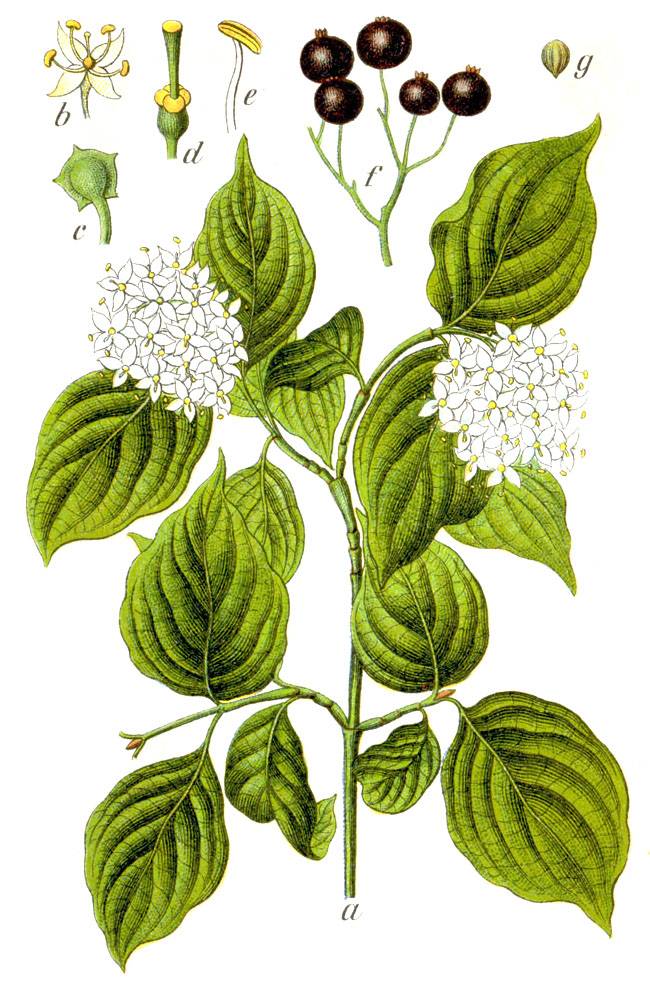
Common dogwood
Shrub·Cornus sanguinea
Part shade to full sun
Sun
Moist soil
Water
Not recorded
Drainage
Zones 4–8
Hardiness
Coverage · 82 fields
- Parser flag (edibility_basis_unverified): forage.DK.edible_parts lists fruit as edible (raw/cooked) and seed oil as edible when refined, but edibility_basis for DK is not confirmed as curated; the foraging claim must be audited as inferred-only.
Growth and size10 fields
Spread
400 cm
AI estimate58 % agree
Height at age
—
empty
Spacing
300 cm (at least 150 cm)
AI estimate55 % agree
Growth rate
—
empty
Root depth
Medium
AI estimate63 % agree
Forest garden layer
Shrub layer
AI estimate90 % agree
Lifespan
—
empty
Roots6 fields
Root form
Fibrous roots
AI estimate43 % agree
Storage organ
None
AI estimate100 % agree
Lateral spread in cm
—
empty
Root depth in cm
—
empty
Mycorrhiza
—
empty
Light, water and soil9 fields
Sun
Full sun, light shade, part shade · best: full sun“It can grow in semi-shade (light woodland) or no shade.”PFAFpartly“Plants are relatively shade tolerant, though they are not happy when growing in dense shade.”
Hours of sun
—
empty
Drought tolerant
—
empty
Tolerates waterlogging
—
empty
Soil type
Sand, loam, clay“Suitable for: light (sandy), medium (loamy) and heavy (clay) soils and can grow in heavy clay soil.”
pH
6–8.5 · best 6.5–8“Suitable pH: mildly acid, neutral and basic (mildly alkaline) soils and can grow in very alkaline soils.”PFAFpartly“An easily grown plant, it succeeds in any soil of good or moderate fertility, ranging from acid to shallow chalk.”
Compacted soil
Copes fairly well
AI estimatenot measured yet
Climate5 fields
Hardiness
Zone 4–8
AI estimatenot measured yet
Growing temperature
—
empty
Chill hours
—
empty
Native range
AD, AL, AM, AZ, BA, BE, BG, BY, CH, CZ, DE, DK, EE, ES, FR, GB, GE, GG, GI, GR, HR, HU, IE, IT, JE, LB, LI, LT, LU, LV, MC, MD, ME, MK, MT, NL, NO, PL, PT, RO, RS, RU, SE, SI, SK, SM, SY, TR, UA, VA, XK
Through the year5 fields
Flowering
June · lasts 61 days“It is in flower from June to July, and the seeds ripen in September.”
Fruiting
September · lasts 30 days“It is in flower from June to July, and the seeds ripen in September.”
Leafing out
After the last frost · lasts 30 days
AI estimatenot measured yet
Dying back
After the first frost · lasts 30 days
AI estimatenot measured yet
Dormant
After the first frost · 30 days after · lasts 150 days
AI estimatenot measured yet
Edible parts and pollination4 fields
The fruit
Raw or cooked; bitter flavour“Fruit - raw or cooked.”PFAF“A bitter flavour, it can also have an emetic effect on the body.”
Seed oil
Oil obtained from the seed, edible when refined“An oil is obtained from the seed, it is edible when refined.”
Pollination
Hermaphrodite“The species is hermaphrodite (has both male and female organs) and is pollinated by Insects.”
Pollinated by
Insects“The species is hermaphrodite (has both male and female organs) and is pollinated by Insects.”
Ecology6 fields
Attracts
Pests
—
empty
Diseases
—
empty
Takes up
—
empty
Fixes nitrogen
No
AI estimatenot measured yet
Mycorrhiza
—
empty
Propagation and names4 fields
Methods
Seed, half-ripe side-shoot cuttings, hardwood cuttings, layering“Seed - best sown as soon as it is ripe in a cold frame or in an outdoors seedbed if there is sufficient seed.”PFAF“Cuttings of half-ripe side shoots, July/August in a frame.”PFAF“Cuttings of mature wood of the current year's growth, taken with a heel if possible, autumn in a cold frame.”PFAF“Layering of new growth in June/July.”
Difficulty
1 / 5
AI estimatenot measured yet
Seed
Stored seed should be cold stratified for 3 - 4 months and sown as early as possible in the year.“Stored seed should be cold stratified for 3 - 4 months and sown as early as possible in the year.”
Not sorted yet33 fields
Fields the parser stores that this page has no row for yet. They show up here automatically, so nothing is hidden.
forage.DK.local_name
Rød kornel
AI estimatenot measured yet
forage.DK.warnings_da
Bladene kan irritere huden hos følsomme personer.
AI estimatenot measured yet
forage.DK.warnings_en
The leaves can irritate the skin of sensitive people.
AI estimatenot measured yet
forage.DK.prep_cautions
Leaves can cause skin irritation in sensitive people; the fruit is not poisonous.“Contrary to some reports, the fruit is not poisonous, but the leaves can cause skin irritations to sensitive people.”
forage.DK.edibility_basis
inferred
AI estimatenot measured yet
forage.DK.foraging_months.notes
seeds ripen in September
AI estimatenot measured yet
forage.DK.foraging_months.months
9“It is in flower from June to July, and the seeds ripen in September.”
PFAFpartly
forage.DK.foraging_months.year_round
false
AI estimatenot measured yet
forage.DK.habitat_affinity
hedgerow, woodland, riverbank“Mixed woods, scrub and hedgerows, especially on calcareous soils.”Wikipedia“It is especially abundant in riversides, especially in shady areas and ravines.”
ornamental.basis
documented
AI estimatenot measured yet
ornamental.fragrance.source
flower“The flowers have a rather unpleasant smell to most people, though they are attractive to insects.”
PFAFpartly
ornamental.confidence
high
AI estimatenot measured yet
ornamental.fall_interest
true“Garden varieties are often called "winter fire" because the leaves turn orange-yellow in autumn and then fall to reveal striking red winter stems.”
ornamental.flower_colour
white, cream“The hermaphrodite flowers are small, 5–10 millimetres (0.2–0.4 in) diameter, with four creamy white petals, produced in clusters 3–5 centimetres (1–2 in) diameter, and are insect pollinated.”
ornamental.evidence_quote
The hermaphrodite flowers are small, 5–10 millimetres (0.2–0.4 in) diameter, with four creamy white petals, produced in clusters 3–5 centimetres (1–2 in) diameter, and are insect pollinated.
AI estimatenot measured yet
ornamental.foliage_colour
green“The leaves are opposite, 4–8 centimetres (2–3 in) long and 2–4 centimetres (0.8–1.6 in) broad, with an ovate to oblong shape and an entire margin; they are green above, slightly paler below, and rough with short stiff pubescence.”
ornamental.winter_structure
coloured_stems“Garden varieties are often called "winter fire" because the leaves turn orange-yellow in autumn and then fall to reveal striking red winter stems.”
care_regime
none
AI estimatenot measured yet
propagation.establishment_years
2
AI estimate40 % agree
function_profile.biomass_return.confidence
medium
AI estimatenot measured yet
function_profile.nutrient_flows.consumes
[{"basis":"inferred","demand":"moderate","nutrient":"nitrogen","confidence":"low","evidence_quote":null}]
AI estimatenot measured yet
function_profile.nutrient_flows.provides
[{"basis":"inferred","nutrient":"nitrogen","mechanism":"biomass_return","confidence":"low","evidence_quote":null}]
AI estimatenot measured yet
function_profile.biotic_interactions
[{"taxa":["insects"],"basis":"documented","valence":"beneficial","relation":"attracts","confidence":"high","evidence_quote":"The species is hermaphrodite (has both male and female organs) and is pollinated by Insects.…“The species is hermaphrodite (has both male and female organs) and is pollinated by Insects.”Wikipedia“even frugivorous birds will hunt pest insects during the breeding season, as their young require much protein to grow.”Wikipedia“Many frugivorous passerines find them simply irresistible, and prefer them over fruits grown by humans.”Wikipedia“Dogberries are eaten by some mammals and many birds.”Wikipedia“The leaves provide food for some animals, including Lepidoptera such as the case-bearer moth Coleophora anatipennella.”
function_profile.aromatic_pest_effect.value
false
AI estimate80 % agree
function_profile.aromatic_pest_effect.confidence
medium
AI estimatenot measured yet
function_profile.structural_interfaces.provides_physical_support.form
dense_thicket“Plants have a suckering habit and can quickly form dense thickets.”
function_profile.structural_interfaces.provides_physical_support.basis
documented
AI estimatenot measured yet
function_profile.structural_interfaces.provides_physical_support.confidence
medium
AI estimatenot measured yet
function_profile.structural_interfaces.provides_physical_support.evidence_quote
Plants have a suckering habit and can quickly form dense thickets.
AI estimatenot measured yet
soil_interactions.organic_matter_contribution
low
AI estimatenot measured yet
component_metadata.growth_cycle
perennial
AI estimate100 % agree
resource_interfaces.inputs
[{"resource":"light","quantity_description":"semi-shade (light woodland) to full light"},{"resource":"water","quantity_description":"moist soil"},{"resource":"shade","quantity_description":"tolerates partial shade but…“It can grow in semi-shade (light woodland) or no shade.”PFAF“It prefers moist soil.”PFAF“Plants are relatively shade tolerant, though they are not happy when growing in dense shade.”
resource_interfaces.outputs
[{"resource":"fruit","quantity_description":"globose black berries about 5-8 mm in diameter, each with one seed"},{"resource":"timber","quantity_description":"tough, hard wood for small items such as tool handles and …“The fruit is a globose black berry 5–8 millimetres (0.2–0.3 in) diameter, containing a single seed.”PFAF“Wood - tough, hard. Used for small items such as tool handles, turnery etc.”PFAFpartly“The flowers have a rather unpleasant smell to most people, though they are attractive to insects.”