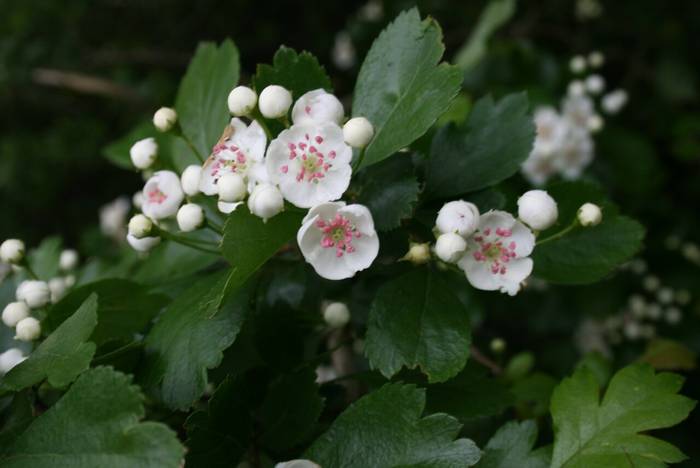
Sten Porse · CC BY-SA 3.0
Midland hawthorn
Tree·Crataegus laevigata
Shade to full sun
Sun
Moist to wet soil
Water
Not recorded
Drainage
Zones 4–8
Hardiness
Coverage · 81 fields
- Parser flag (climate_tolerance_low_confidence): climate_tolerance is an empty object {} although hardiness_zones 4-8 are listed; no climate data was extracted for a tree that should have climate tolerance data.
Growth and size10 fields
Plant type
Deciduous tree“Crataegus laevigata is a deciduous Shrub growing to 6 m (19ft) by 6 m (19ft) at a medium rate.”
Height
600 cm · other sources: 800 cm“Crataegus laevigata is a deciduous Shrub growing to 6 m (19ft) by 6 m (19ft) at a medium rate.”Wikipedia“It is a large shrub or small tree growing to 8 m (26 ft) or rarely to 12 m (39 ft) tall, with a dense crown.”
Spread
600 cm“Crataegus laevigata is a deciduous Shrub growing to 6 m (19ft) by 6 m (19ft) at a medium rate.”
Height at age
—
empty
Spacing
300 cm (at least 200 cm)
AI estimate55 % agree
Growth rate
Medium“Crataegus laevigata is a deciduous Shrub growing to 6 m (19ft) by 6 m (19ft) at a medium rate.”
Habit
—
empty
Root depth
Medium
AI estimate63 % agree
Forest garden layer
Lower tree layer
AI estimate90 % agree
Lifespan
—
empty
Roots6 fields
Root form
—
empty
Storage organ
None“No clonal growth organ is recorded: it does not spread vegetatively (no suckers, no rhizomes).”
Spreads
No“No clonal growth organ is recorded: it does not spread vegetatively (no suckers, no rhizomes).”
Lateral spread in cm
—
empty
Root depth in cm
—
empty
Mycorrhiza
—
empty
Light, water and soil9 fields
Sun
Full sun, light shade, part shade, shade · best: full sun“It can grow in full shade (deep woodland) semi-shade (light woodland) or no shade.”PFAF“A true woodland species, it grows well in quite dense shade.”
Hours of sun
—
empty
Water
Moist, wet · Medium“It prefers moist or wet soil and can tolerate drought.”PFAF“Once established, it succeeds in excessively moist soils and also tolerates drought.”
Tolerates waterlogging
—
empty
Soil type
Sand, loam, clay · best: loam“A very easily grown plant, it prefers a well-drained moisture retentive loamy soil but is not at all fussy.”PFAF“Suitable for: light (sandy), medium (loamy) and heavy (clay) soils and can grow in heavy clay soil.”
pH
5.5–8.5“Suitable pH: mildly acid, neutral and basic (mildly alkaline) soils and can grow in very alkaline soils.”
Drainage
Well-drained but moisture retentive“A very easily grown plant, it prefers a well-drained moisture retentive loamy soil but is not at all fussy.”
Compacted soil
Copes fairly well
AI estimatenot measured yet
Climate5 fields
Hardiness
Zone 4–8
AI estimatenot measured yet
Killing frost
—
empty
Growing temperature
—
empty
Chill hours
—
empty
Native range
AD, AT, BA, BE, BY, CH, CZ, DE, DK, EE, ES, FR, GB, GG, GI, HR, HU, IT, JE, LI, LT, LU, LV, MC, MD, ME, MK, MT, NL, NO, PL, RO, RS, RU, SE, SI, SK, SM, UA, VA, XK
Through the year6 fields
Harvest
August · lasts 61 days“Hawthorn berries are typically harvested in late Summer to early Autumn.”
Leafing out
After the last frost · lasts 30 days
AI estimatenot measured yet
Dying back
After the first frost · lasts 30 days
AI estimatenot measured yet
Dormant
After the first frost · 30 days after · lasts 150 days
AI estimatenot measured yet
Edible parts and pollination6 fields
The fruit
Raw or cooked; used for jams and preserves; dried pulp ground into meal and mixed with flour for bread · September–November“Edible Parts: Fruit Leaves Shoots”PFAF“A dry and mealy texture, they are not very appetizing”PFAF“Fruit - raw or cooked.”PFAF“The fruit pulp can be dried, ground into a meal and mixed with flour in making bread etc.”PFAF“the seeds ripen from September to November”
The leaves
The young shoots
Young shoots eaten raw, as a tasty nibble or in salad“Edible Parts: Fruit Leaves Shoots”PFAF“Young leaves and young shoots - raw.”
Ecology6 fields
Attracts
Midges, bees, flies, butterflies, birds, small mammals, beneficial insects“This attracts midges which are the main means of fertilization.”PFAF“Yes – Hawthorn flowers are rich in nectar and pollen, making them highly attractive to pollinators such as bees, flies, and butterflies.”PFAF“Yes – Hawthorn provides food for wildlife, including birds and small mammals, through its fruit (haws) and seeds.”
Pests
Dasineura crataegi“The hawthorn button-top gall on Midland hawthorn is caused by the dipteran gall-midge Dasineura crataegi.”
Diseases
—
empty
Takes up
—
empty
Fixes nitrogen
No
AI estimatenot measured yet
Mycorrhiza
—
empty
Propagation and names4 fields
Methods
Seed“Seed - this is best sown as soon as it is ripe in the autumn in a cold frame, some of the seed will germinate in the spring, though most will probably take another year.”
Difficulty
1 / 5“A very easily grown plant, it prefers a well-drained moisture retentive loamy soil but is not at all fussy.”
PFAFpartly
Seed
Stored seed: warm stratify 3 months at 15°C, then cold stratify 3 months at 4°C“Stored seed can be very slow and erratic to germinate, it should be warm stratified for 3 months at 15°c and then cold stratified for another 3 months at 4°c.”
Not sorted yet29 fields
Fields the parser stores that this page has no row for yet. They show up here automatically, so nothing is hidden.
forage.DK.local_name
Almindelig hvidtjørn
AI estimatenot measured yet
forage.DK.edibility_basis
inferred
AI estimatenot measured yet
forage.DK.foraging_months.notes
Fruit (haws) timing from the C. laevigata seed ripening window; leaf and shoot timing is not dated in the sources.
AI estimatenot measured yet
forage.DK.foraging_months.year_round
false
AI estimatenot measured yet
forage.DK.habitat_affinity
woodland, hedgerow“Woods, hedges, thickets etc on clays and heavy loams, especially in E. Britain.”Wikipedia“where it is typically found in ancient woodland and old hedgerows”
ornamental.basis
documented
AI estimatenot measured yet
ornamental.fragrance.source
flower“When freshly open, the flowers have more pleasant scent with balsamic undertones.”
ornamental.confidence
medium
AI estimatenot measured yet
ornamental.evidence_quote
The flowers are usually white, but can be pink.
AI estimatenot measured yet
care_regime
none
AI estimatenot measured yet
propagation.establishment_years
5
AI estimate40 % agree
spatial_profile.canopy_density
dense“It is a large shrub or small tree growing to 8 m (26 ft) or rarely to 12 m (39 ft) tall, with a dense crown.”
sun_requirement.best
full_sun
AI estimatenot measured yet
sun_requirement.best_for
fruit
AI estimatenot measured yet
function_profile.biomass_return.confidence
medium
AI estimatenot measured yet
function_profile.nutrient_flows.consumes
[{"basis":"inferred","demand":"low","nutrient":"nitrogen","confidence":"low"}]
AI estimatenot measured yet
function_profile.biotic_interactions
[{"taxa":["midges"],"basis":"documented","valence":"beneficial","relation":"attracts","confidence":"high","organism_group":"pollinator","ecological_function":"pollination"},{"taxa":["bees","flies","butterflies"],"basi…“This attracts midges which are the main means of fertilization.”PFAF“Yes – Hawthorn flowers are rich in nectar and pollen, making them highly attractive to pollinators such as bees, flies, and butterflies.”PFAF“Yes – Hawthorn provides food for wildlife, including birds and small mammals, through its fruit (haws) and seeds.”PFAF“The dense, thorny branches offer excellent shelter, and the tree can be used for nesting and roosting by birds.”PFAF“Fallen leaf litter creates a habitat for soil organisms and shelter for beneficial insects.”Wikipedia“The hawthorn button-top gall on Midland hawthorn is caused by the dipteran gall-midge Dasineura crataegi.”
function_profile.aromatic_pest_effect.value
false“No – Hawthorn does not have a strong scent that confuses pests.”
function_profile.aromatic_pest_effect.confidence
high
AI estimatenot measured yet
function_profile.structural_interfaces.provides_shelter.basis
documented
AI estimatenot measured yet
function_profile.structural_interfaces.provides_shelter.kinds
wind“Hawthorn is often used as a hedge or windbreak, providing habitat for wildlife.”
PFAFpartly
function_profile.structural_interfaces.provides_shelter.confidence
medium
AI estimatenot measured yet
trouble_names_da.dasineura crataegi
galmyg
AI estimatenot measured yet
soil_interactions.organic_matter_contribution
medium
AI estimatenot measured yet
component_metadata.growth_cycle
perennial
AI estimate100 % agree
resource_interfaces.inputs
[{"resource":"light","quantity_description":"best in full sun for fruit; succeeds in semi-shade with lower fruit yield and quality"},{"resource":"water","quantity_description":"prefers moist or wet soil and tolerates …“A position in full sun is best when plants are grown for their fruit; they also succeed in semi-shade, though fruit yields and quality will be lower.”PFAF“It can grow in full shade (deep woodland) semi-shade (light woodland) or no shade.”PFAFpartly“It prefers moist or wet soil and can tolerate drought.”PFAFpartly“The species is hermaphrodite (has both male and female organs) and is pollinated by Midges.”
resource_interfaces.outputs
[{"resource":"habitat","quantity_description":"hedge or windbreak providing habitat for wildlife"},{"resource":"nectar","quantity_description":"flowers rich in nectar"},{"resource":"pollen","quantity_description":"flo…“Hawthorn is often used as a hedge or windbreak, providing habitat for wildlife.”PFAF“Yes – Hawthorn flowers are rich in nectar and pollen, making them highly attractive to pollinators such as bees, flies, and butterflies.”PFAF“It also attracts pollinators and beneficial insects.”PFAF“Yes – Hawthorn provides food for wildlife, including birds and small mammals, through its fruit (haws) and seeds.”PFAF“Fallen leaf litter creates a habitat for soil organisms and shelter for beneficial insects.”PFAF“Wood - very hard and tough but difficult to work.”PFAF“A good hedge plant, it is very tolerant of neglect and is able to regenerate if cut back severely, it makes a good thorny stock-proof barrier and resists very strong winds.”PFAFpartly“Fruit - raw or cooked.”