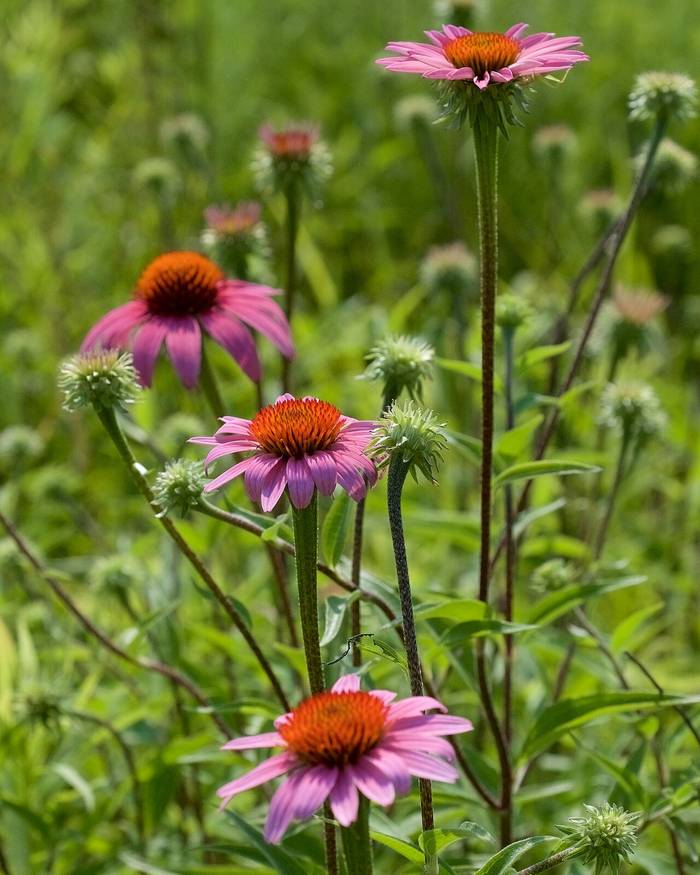
Eric Hunt · CC BY-SA 4.0
Purple coneflower
Plant·Echinacea purpurea
Part shade to full sun
Sun
Dry to moist soil
Water
Well-drained soil
Drainage
Zones 3–9
Hardiness
Coverage · 118 fields
Growth and size10 fields
Height
120 cm“Echinacea purpurea is a PERENNIAL growing to 1.2 m (4ft) by 0.5 m (1ft 8in) at a medium rate.”
Spread
50 cm · other sources: 25 cm“Echinacea purpurea is a PERENNIAL growing to 1.2 m (4ft) by 0.5 m (1ft 8in) at a medium rate.”Wikipedia“Echinacea purpurea is an herbaceous perennial up to 120 centimeters (47 inches) tall by 25 cm (10 in) wide at maturity.”
Height at age
—
empty
Spacing
45 cm (at least 30 cm)
AI estimate55 % agree
Growth rate
Medium“Echinacea purpurea is a PERENNIAL growing to 1.2 m (4ft) by 0.5 m (1ft 8in) at a medium rate.”
Habit
Vase-shaped
AI estimate50 % agree
Root depth
Taproot“The root pattern is a tap root similar to a carrot going directly down [1-2].”
Forest garden layer
Herb layer“Echinacea purpurea is an herbaceous perennial up to 120 centimeters (47 inches) tall by 25 cm (10 in) wide at maturity.”
Lifespan
~10 years
AI estimatenot measured yet
Roots6 fields
Storage organ
None
AI estimate100 % agree
Lateral spread in cm
—
empty
Root depth in cm
—
empty
Mycorrhiza
Arbuscular (AM)
AI estimatenot measured yet
Light, water and soil9 fields
Sun
Full sun, part shade, light shade · best: full sun“The plant prefers well-drained soils in full sun.”Wikipedia“The plant grows in sun or light shade.”
Hours of sun
6–12 h
AI estimatenot measured yet
Water
Dry, moist · Low · 2–4 l/day“It prefers dry or moist soil and can tolerate drought.”Wikipedia“It thrives in either dry or moist soil and can tolerate drought once established.”
Tolerates waterlogging
—
empty
Soil type
Sand, loam · best: loam“Prefers a deep rich loam with plenty of leafmold and a sunny position.”PFAF“Suitable for: light (sandy) and medium (loamy) soils and prefers well-drained soil.”
Compacted soil
Copes fairly well
AI estimatenot measured yet
Climate5 fields
Hardiness
Zone 3–9
AI estimatenot measured yet
Killing frost
0 °C“Killing temp. early growth: 0”EcoCrop's figure is frost during early growth (spring frost on new shoots), not winter cold.
Growing temperature
10–36 °C · optimal 18–24 °C“Temperature absolute min: 10 · Temperature absolute max: 36 · Temperature optimal min: 18 · Temperature optimal max: 24”
Chill hours
0 h
AI estimatenot measured yet
Care (becomes tasks in Manage)9 fields
Protection
After the last frost · lasts 365 days · slugs“give them some protection from slugs at least until they are established”
PFAFpartly
Starting indoors
March · lasts 61 days
AI estimatenot measured yet
Planting out
After the last frost
AI estimatenot measured yet
Protection
After the previous stage · slugs
AI estimatenot measured yet
Dividing
After the last frost · After the first frost · break clumps into smaller bunches
Dividing appears 2 times with different timing.
AI estimatenot measured yet
Watering
July · lasts 60 days
AI estimatenot measured yet
Feeding
April · lasts 30 days · compost
AI estimatenot measured yet
Pruning
After the previous stage · 60 days after · lasts 30 days
AI estimatenot measured yet
Dividing
March · lasts 30 days · lift and split with a spade
Dividing appears 2 times with different timing.
AI estimatenot measured yet
Through the year5 fields
Harvest
September · lasts 91 days“Echinacea roots are typically harvested in late autumn (September to November)”
Harvest
After the previous stage · lasts 62 days“the flowers can be harvested in summer when they are fully open”
Leafing out
After the last frost · lasts 30 days
AI estimatenot measured yet
Dying back
After the first frost · lasts 30 days
AI estimatenot measured yet
Edible parts and pollination3 fields
The roots
Tea, tincture · September–October
AI estimatenot measured yet
Ecology5 fields
Attracts
Bees, butterflies, beneficial insects, parasitic wasps, finches“Bees that are attracted to the flowers include bumblebees, sweat bees, honey bees, the sunflower leafcutter bee, and the mining bee Andrena helianthiformis.”Wikipedia“Butterflies that visit include monarchs, swallowtail butterflies, and sulphur butterflies.”Wikipedia“Birds, particularly finches, eat the seeds and disperse them through their droppings.”PFAFpartly“Echinacea attracts butterflies and beneficial insects, including parasitic wasps.”
Pests
Slugs, rabbits, gophers“Slugs and rabbits will also eat the foliage when young, or shortly after emerging in the spring.”Wikipedia“Additionally, roots can be damaged and eaten by gophers.”
Diseases
Aster yellows, powdery mildew
AI estimatenot measured yet
Takes up
Potassium, calcium
AI estimatenot measured yet
Fixes nitrogen
No
AI estimatenot measured yet
Propagation and names4 fields
Methods
Seed, division, root cuttings, basal cuttings“Seed - sow March/April in a greenhouse and only just cover the seed”PFAF“Division in spring or autumn.”PFAF“Root cuttings, October in a frame.”Wikipedia“Cuttings of basal shoots in the spring may be rooted when treated with rooting hormones, such as IBA at 1000 ppm.”
Difficulty
2 / 5
AI estimatenot measured yet
Seed
daily temperature fluctuations or stratification“Seed germination occurs best with daily temperature fluctuations or after stratification, which help to end dormancy.”
Not sorted yet62 fields
Fields the parser stores that this page has no row for yet. They show up here automatically, so nothing is hidden.
forage.DK.local_name
Purpur solhat
AI estimatenot measured yet
forage.DK.warnings_da
Vær sikker på artsbestemmelsen, da der findes lignende planter.
AI estimatenot measured yet
forage.DK.warnings_en
Be sure of the identification, as there are lookalike plants.
AI estimatenot measured yet
forage.DK.prep_cautions
Avoid harvesting from polluted areas., Ensure positive identification as lookalikes may exist.
AI estimatenot measured yet
forage.DK.edibility_basis
inferred
AI estimatenot measured yet
forage.DK.foraging_months.notes
Roots are best harvested in autumn after the plant has flowered.
AI estimatenot measured yet
forage.DK.foraging_months.months
9, 10
AI estimatenot measured yet
forage.DK.foraging_months.year_round
false
AI estimatenot measured yet
forage.DK.habitat_affinity
woodland, verge, disturbed_ground
AI estimatenot measured yet
forage.US.local_name
Purple coneflower
AI estimatenot measured yet
forage.US.prep_cautions
Possible suppression of immunity with habitual use., High doses over 1000 mg may cause dizziness., Use of herb for 10-14 days recommended followed by a short break.“Possible suppression of immunity with habitual use.”PFAF“High doses over 1000 mg may cause dizziness.”PFAF“Use of herb for 10-14 days recommended followed by a short break.”
forage.US.edibility_basis
inferred
AI estimatenot measured yet
forage.US.foraging_months.notes
Leaves and flowers are best in spring and summer, roots in fall.
AI estimatenot measured yet
forage.US.foraging_months.months
4, 5, 6, 7, 8, 9, 10
AI estimatenot measured yet
forage.US.foraging_months.year_round
false
AI estimatenot measured yet
forage.US.habitat_affinity
woodland“Its habitats include dry open woods, prairies, and barrens.”
forage.TROPICAL.edibility_basis
inferred
AI estimatenot measured yet
forage.TROPICAL.foraging_months.notes
Echinacea purpurea is not native to tropical regions and typically does not thrive there.
AI estimatenot measured yet
forage.TROPICAL.foraging_months.year_round
false
AI estimatenot measured yet
ornamental.basis
documented
AI estimatenot measured yet
ornamental.fragrance.source
flower
AI estimate100 % agree
ornamental.fragrance.intensity
subtle
AI estimatenot measured yet
ornamental.confidence
high
AI estimatenot measured yet
ornamental.fall_interest
true“Depending on the climate, it blooms throughout summer into autumn.”
Wikipediapartly
ornamental.flower_colour
pink, purple, red, white, yellow“These are surrounded by a ring of pink or purple ligulate florets.”PFAF“Bloom Color: Pink, Purple, Red, White.”Wikipediapartly“The inflorescence is a capitulum, 7 to 15 cm (3 to 6 in) in diameter, formed by a prominent domed central protuberance consisting of multiple small yellow florets.”
ornamental.evidence_quote
Echinacea purpurea, commonly known as purple coneflower, features prominent purple to pink ray flowers and a central cone. Its foliage is green, and it does not typically display significant autumn color. The plant retains attractive seed heads through winter, providing architectural interest. The flowers have a subtle fragrance.
AI estimatenot measured yet
ornamental.foliage_colour
green
AI estimate82 % agree
ornamental.foliage_texture
medium
AI estimatenot measured yet
ornamental.winter_structure
seed_heads, architectural_skeleton
AI estimatenot measured yet
ornamental.autumn_foliage_colour
none
AI estimatenot measured yet
care_regime
light
AI estimatenot measured yet
propagation.self_seeding
moderate
AI estimate20 % agree
propagation.establishment_years
1
AI estimate40 % agree
forage_proposals.DK.edibility_tier.tier
caution
AI estimatenot measured yet
forage_proposals.DK.edibility_tier.confidence
high
AI estimatenot measured yet
forage_proposals.DK.edibility_tier.evidence_quote
Echinacea purpurea is widely used in herbal medicine, with roots, leaves, and flowers being utilized. However, some sources advise caution for pregnant or breastfeeding individuals, and those with autoimmune conditions.
AI estimatenot measured yet
forage_proposals.US.edibility_tier.confidence
high
AI estimatenot measured yet
forage_proposals.US.edibility_tier.evidence_quote
All parts of Echinacea purpurea are traditionally used for medicinal purposes, particularly for immune support. While generally considered safe, allergic reactions can occur, and caution is advised for certain health conditions.
AI estimatenot measured yet
forage_proposals.TROPICAL.edibility_tier.confidence
low
AI estimatenot measured yet
function_profile.biomass_return.confidence
medium
AI estimatenot measured yet
function_profile.nutrient_flows.consumes
[{"basis":"documented","demand":"moderate","nutrient":"nitrogen","confidence":"high"},{"basis":"documented","demand":"moderate","nutrient":"phosphorus","confidence":"high"},{"basis":"documented","demand":"moderate","n…
AI estimatenot measured yet
function_profile.nutrient_flows.provides
[{"basis":"documented","nutrient":"potassium","mechanism":"biomass_return","confidence":"medium"},{"basis":"documented","nutrient":"calcium","mechanism":"biomass_return","confidence":"medium"}]
AI estimatenot measured yet
function_profile.biotic_interactions
[{"taxa":["bees"],"basis":"documented","valence":"beneficial","relation":"attracts","confidence":"high","evidence_quote":"Bees that are attracted to the flowers include bumblebees, sweat bees, honey bees, the sunflowe…“Bees that are attracted to the flowers include bumblebees, sweat bees, honey bees, the sunflower leafcutter bee, and the mining bee Andrena helianthiformis.”Wikipedia“Butterflies that visit include monarchs, swallowtail butterflies, and sulphur butterflies.”PFAF“Echinacea can provide overwintering sites for beneficial insects in its leaf litter.”Wikipedia“Slugs and rabbits will also eat the foliage when young, or shortly after emerging in the spring.”Wikipedia“Additionally, roots can be damaged and eaten by gophers.”PFAFpartly“Echinacea attracts butterflies and beneficial insects, including parasitic wasps.”Wikipediapartly“Birds, particularly finches, eat the seeds and disperse them through their droppings.”
function_profile.aromatic_pest_effect.value
false“No – Echinacea does not have a strong aromatic quality that would effectively confuse pests.”
function_profile.aromatic_pest_effect.confidence
high
AI estimatenot measured yet
function_profile.structural_interfaces.provides_shelter.basis
inferred
AI estimatenot measured yet
function_profile.structural_interfaces.provides_shelter.confidence
low
AI estimatenot measured yet
function_profile.structural_interfaces.requires_shelter.basis
inferred
AI estimatenot measured yet
function_profile.structural_interfaces.requires_shelter.confidence
low
AI estimatenot measured yet
function_profile.structural_interfaces.provides_physical_support.basis
inferred
AI estimatenot measured yet
function_profile.structural_interfaces.provides_physical_support.confidence
low
AI estimatenot measured yet
function_profile.structural_interfaces.requires_physical_support.basis
inferred
AI estimatenot measured yet
function_profile.structural_interfaces.requires_physical_support.confidence
low
AI estimatenot measured yet
climate_tolerance.photoperiod_response
day_neutral
AI estimatenot measured yet
soil_interactions.organic_matter_contribution
medium
AI estimatenot measured yet
component_metadata.growth_cycle
perennial“Echinacea purpurea is a PERENNIAL growing to 1.2 m (4ft) by 0.5 m (1ft 8in) at a medium rate.”
resource_interfaces.inputs
[{"resource":"light","quantity_description":"full sun preferred"},{"resource":"water","quantity_description":"tolerates dry or moist soil; drought-tolerant once established"},{"resource":"pollination","quantity_descri…“The plant prefers well-drained soils in full sun.”PFAF“Once established, this species can tolerate prolonged dry conditions.”Wikipedia“It is pollinated by butterflies and bees.”
resource_interfaces.outputs
[{"resource":"nectar","quantity_description":"flowers rich in nectar"},{"resource":"pollen","quantity_description":"flowers rich in pollen"},{"resource":"pollinator_services","quantity_description":"nectar for pollina…“Yes – Echinacea flowers are rich in nectar and pollen, making them attractive to a variety of pollinators, including bees and butterflies.”PFAF“Echinacea can be used as a pollinator plant, providing nectar for beneficial insects.”PFAF“The seeds of Echinacea are eaten by birds and other wildlife.”PFAF“Echinacea can provide overwintering sites for beneficial insects in its leaf litter.”PFAF“The plant also provides cover and habitat for beneficial insects.”