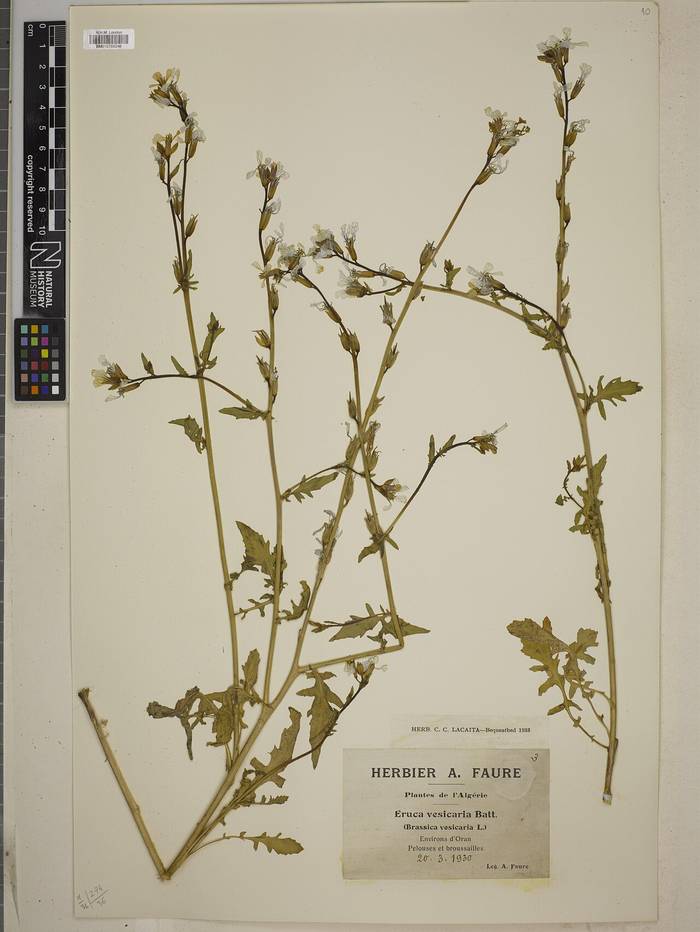
Rocket
Plant·Eruca vesicaria
Part shade to full sun
Sun
Dry to moist soil
Water
Well-drained soil
Drainage
Zones 3–11
Hardiness
Coverage · 110 fields
- Parser flag (climate_tolerance_low_confidence): Climate tolerance values are LLM-extracted (no authoritative EcoCrop match found). EcoCrop covers ~2,568 food-crop taxa; ornamental/native/medicinal species rely on LLM extraction.
- Sowing appears 3 times with different timing.
Growth and size10 fields
Plant type
Plant
AI estimate100 % agree
Height
60 cm“Rocket is a fast-growing, erect, branched annual plant, reaching a height of about 60cm.”
Spread
30 cm“Eruca vesicaria is a ANNUAL growing to 0.6 m (2ft) by 0.3 m (1ft in) at a fast rate.”
Height at age
—
empty
Spacing
15 cm (at least 10 cm)
AI estimate55 % agree
Growth rate
Fast“Eruca vesicaria is a ANNUAL growing to 0.6 m (2ft) by 0.3 m (1ft in) at a fast rate.”
Habit
Mounding
AI estimate50 % agree
Root depth
Shallow
AI estimate63 % agree
Forest garden layer
Herb layer
AI estimate90 % agree
Lifespan
~1 years
AI estimatenot measured yet
Roots6 fields
Root form
—
empty
Storage organ
None
AI estimate100 % agree
Spreads
No
AI estimate75 % agree
Lateral spread in cm
—
empty
Root depth in cm
—
empty
Mycorrhiza
Non-mycorrhizal
AI estimatenot measured yet
Light, water and soil9 fields
Sun
Full sun, light shade, part shade · best: full sun“Succeeds in full sun but prefers some shade from the hottest sun.”PFAF“It can grow in semi-shade (light woodland) or no shade.”
Hours of sun
6–8 h
AI estimatenot measured yet
Tolerates waterlogging
—
empty
Soil type
Sand, loam, clay · best: sand“A very easily grown and fast-maturing plant, it succeeds in most soils and conditions, though it prefers sandy and sandy loam soils.”PFAF“Suitable for: light (sandy), medium (loamy) and heavy (clay) soils and prefers well-drained soil.”
pH
6–8.5 · best 7–8“Prefers a pH range of 7 - 8, tolerating 6 - 8.5.”PFAF“Suitable pH: mildly acid, neutral and basic (mildly alkaline) soils and can grow in very alkaline soils.”
Drainage
Well drained“Suitable for: light (sandy), medium (loamy) and heavy (clay) soils and prefers well-drained soil.”
Compacted soil
Copes badly
AI estimatenot measured yet
Climate5 fields
Hardiness
Zone 3–11
AI estimatenot measured yet
Killing frost
-5 °C
AI estimatenot measured yet
Growing temperature
8–29 °C · optimal 15–25 °C“It grows best in areas where annual daytime temperatures are within the range of 15 - 25°c but can tolerate 8 - 29°c.”
Chill hours
0 h
AI estimatenot measured yet
Care (becomes tasks in Manage)6 fields
Sowing
After the last frost“Seed - sow in situ.”
Sowing appears 3 times with different timing.
PFAFpartly
Sowing
March · lasts 30 days
Sowing appears 3 times with different timing.
AI estimatenot measured yet
Sowing
September · lasts 30 days
Sowing appears 3 times with different timing.
AI estimatenot measured yet
Watering
After the previous stage · lasts 90 days
AI estimatenot measured yet
Weeding
After the previous stage · 7 days after · lasts 60 days
AI estimatenot measured yet
Through the year3 fields
Leafing out
Above 25 °C · lasts 1 days“Germination is usually very quick and free, taking just 24 hours at 25°c.”
Harvest
After the previous stage · 40 days after“Plants can be ready for harvest within 40 days of sowing the seed.”
Flowering
Set by day length
AI estimatenot measured yet
Edible parts and pollination6 fields
Young leaves
Raw or cooked“Young leaves - raw or cooked.”PFAF“A few leaves added to a salad are acceptable though the flavour is too strong for many tastes”
Seed (mustard)
Ecology5 fields
Takes up
Sulfur, potassium
AI estimatenot measured yet
Fixes nitrogen
No
AI estimatenot measured yet
Propagation and names4 fields
Difficulty
1 / 5“Germination is usually very quick and free, taking just 24 hours at 25°c.”
PFAFpartly
Seed
—
empty
Names
66 names in 27 languagesAlmindelig boghvede, Rucola, Slangeurt, Syren-pileurt, Tatarisk boghvede
Not sorted yet56 fields
Fields the parser stores that this page has no row for yet. They show up here automatically, so nothing is hidden.
forage.DK.local_name
Salat-rucola
AI estimatenot measured yet
forage.DK.prep_cautions
A few leaves added to a salad are acceptable though the flavour is too strong for many tastes, Older leaves that have become too hot to eat on their own can be pureed and added to soups, Mixing with hot water or vinegar, or adding salt, inhibits the enzyme and produces a mild bitter mustard“A few leaves added to a salad are acceptable though the flavour is too strong for many tastes”PFAF“Older leaves that have become too hot to eat on their own can be pureed and added to soups etc.”PFAF“Mixing with hot water or vinegar, or adding salt, inhibits the enzyme and produces a mild bitter mustard.”
forage.DK.edibility_basis
inferred
AI estimatenot measured yet
forage.DK.foraging_months.notes
Young leaves are best for flavor; older leaves can become bitter.“Plants can be ready for harvest within 40 days of sowing the seed.”
PFAFpartly
forage.DK.foraging_months.months
4, 5, 6, 7, 8, 9, 10
AI estimatenot measured yet
forage.DK.foraging_months.year_round
false
AI estimatenot measured yet
forage.DK.habitat_affinity
disturbed_ground“Waste ground, fields, olive groves, stony hills, tracksides etc.”
forage.US.local_name
Arugula
AI estimatenot measured yet
forage.US.edible_parts
[{"part":"young leaves","caution":"A few leaves added to a salad are acceptable though the flavour is too strong for many tastes","preparation":"raw or cooked"},{"part":"flowers","caution":null,"preparation":"raw"},{"…“Young leaves - raw or cooked.”PFAF“Flowers - raw[52}.”PFAF“A few leaves added to a salad are acceptable though the flavour is too strong for many tastes”PFAF“Mixing with hot water or vinegar, or adding salt, inhibits the enzyme and produces a mild bitter mustard.”PFAF“Its use as a salad or cooking oil is limited because of its initial acridity”PFAFpartly“A mustard is obtained from the seed.”PFAFpartly“The seed yields a semi-drying oil.”PFAFpartly“The pungency of mustard develops when cold water is added to the ground-up seed”PFAFpartly“this acridity disappears after storing the oil for 6 months, it is then suitable for edible purposes”
forage.US.prep_cautions
A few leaves added to a salad are acceptable though the flavour is too strong for many tastes, Older leaves that have become too hot to eat on their own can be pureed and added to soups, Mixing with hot water or vinegar, or adding salt, inhibits the enzyme and produces a mild bitter mustard“A few leaves added to a salad are acceptable though the flavour is too strong for many tastes”PFAF“Older leaves that have become too hot to eat on their own can be pureed and added to soups etc.”PFAF“Mixing with hot water or vinegar, or adding salt, inhibits the enzyme and produces a mild bitter mustard.”
forage.US.edibility_basis
inferred
AI estimatenot measured yet
forage.US.foraging_months.notes
Young leaves are best for flavor; older leaves can become bitter.“Plants can be ready for harvest within 40 days of sowing the seed.”
PFAFpartly
forage.US.foraging_months.months
4, 5, 6, 7, 8, 9, 10
AI estimatenot measured yet
forage.US.foraging_months.year_round
false
AI estimatenot measured yet
forage.US.habitat_affinity
disturbed_ground“Waste ground, fields, olive groves, stony hills, tracksides etc.”
forage.TROPICAL.local_name
Rocket
AI estimatenot measured yet
forage.TROPICAL.edible_parts
[{"part":"leaves","caution":null,"preparation":"raw or cooked","season_months":[1,2,3,4,5,6,7,8,9,10,11,12]},{"part":"flowers","caution":null,"preparation":"raw","season_months":[1,2,3,4,5,6,7,8,9,10,11,12]}]
AI estimatenot measured yet
forage.TROPICAL.edibility_basis
inferred
AI estimatenot measured yet
forage.TROPICAL.foraging_months.notes
Can be grown year-round in tropical climates, though may bolt quickly in high heat.
AI estimatenot measured yet
forage.TROPICAL.foraging_months.year_round
true
AI estimatenot measured yet
forage.TROPICAL.habitat_affinity
disturbed_ground
AI estimatenot measured yet
ornamental.basis
documented
AI estimatenot measured yet
ornamental.fragrance.source
flower
AI estimate100 % agree
ornamental.fragrance.intensity
subtle
AI estimatenot measured yet
ornamental.confidence
high
AI estimatenot measured yet
ornamental.fall_interest
false
AI estimatenot measured yet
ornamental.flower_colour
white, yellow
AI estimate67 % agree
ornamental.evidence_quote
Eruca vesicaria, commonly known as arugula or rocket, produces small, four-petaled flowers that are typically white or pale yellow. The foliage is green and does not exhibit significant autumn color change as it is an annual. The leaves have a medium texture. The flowers have a subtle, peppery fragrance.
AI estimatenot measured yet
ornamental.foliage_colour
green
AI estimate82 % agree
ornamental.foliage_texture
medium
AI estimatenot measured yet
ornamental.winter_structure
none
AI estimatenot measured yet
ornamental.autumn_foliage_colour
none
AI estimatenot measured yet
care_regime
light
AI estimatenot measured yet
propagation.self_seeding
moderate“Plants usually self-sow freely if the ground is disturbed, such as by hoeing”
PFAFpartly
propagation.establishment_years
0
AI estimate40 % agree
spatial_profile.canopy_density
light
AI estimatenot measured yet
forage_proposals.DK.edibility_tier.tier
edible
AI estimatenot measured yet
forage_proposals.DK.edibility_tier.confidence
high
AI estimatenot measured yet
forage_proposals.DK.edibility_tier.evidence_quote
Eruca vesicaria, commonly known as arugula or rocket, is widely cultivated and consumed as a leafy green vegetable in salads and cooked dishes. Its peppery flavor is highly valued.
AI estimatenot measured yet
forage_proposals.US.edibility_tier.tier
edible
AI estimatenot measured yet
forage_proposals.US.edibility_tier.confidence
high
AI estimatenot measured yet
forage_proposals.US.edibility_tier.evidence_quote
Arugula (Eruca vesicaria) is a popular salad green in the United States, known for its distinctive pungent taste. It is readily available in grocery stores and farmers' markets.
AI estimatenot measured yet
forage_proposals.TROPICAL.edibility_tier.tier
edible
AI estimatenot measured yet
forage_proposals.TROPICAL.edibility_tier.confidence
high
AI estimatenot measured yet
forage_proposals.TROPICAL.edibility_tier.evidence_quote
Rocket is consumed globally, including in tropical regions, where it is used in various culinary applications. It is generally considered safe and nutritious.
AI estimatenot measured yet
function_profile.biomass_return.confidence
medium
AI estimatenot measured yet
function_profile.nutrient_flows.consumes
[{"basis":"documented","demand":"moderate","nutrient":"nitrogen","confidence":"medium","evidence_quote":"High nitrogen levels in the soil can increase the yield of leaves by up to 50%."}]“High nitrogen levels in the soil can increase the yield of leaves by up to 50%.”
function_profile.nutrient_flows.provides
[{"basis":"inferred","nutrient":"sulfur","mechanism":"biomass_return","confidence":"low"},{"basis":"inferred","nutrient":"potassium","mechanism":"biomass_return","confidence":"low"}]
AI estimatenot measured yet
function_profile.biotic_interactions
[{"taxa":["insects"],"basis":"documented","valence":"beneficial","relation":"attracts","confidence":"high","evidence_quote":"The flowers are pollinated by Insects.","organism_group":"pollinator","ecological_function":…“The flowers are pollinated by Insects.”
function_profile.aromatic_pest_effect.value
false
AI estimate80 % agree
function_profile.aromatic_pest_effect.confidence
low
AI estimatenot measured yet
climate_tolerance.photoperiod_response
long_day
AI estimatenot measured yet
soil_interactions.organic_matter_contribution
medium
AI estimatenot measured yet
component_metadata.growth_cycle
annual“Eruca vesicaria is a ANNUAL growing to 0.6 m (2ft) by 0.3 m (1ft in) at a fast rate.”
resource_interfaces.inputs
[{"resource":"light","quantity_description":"Succeeds in full sun but prefers some shade from the hottest sun."},{"resource":"water","quantity_description":"Prefers a mean annual rainfall of 500 - 900mm but tolerates …“Succeeds in full sun but prefers some shade from the hottest sun.”PFAF“It prefers a mean annual rainfall of 500 - 900mm but tolerates 300 - 1,100mm.”
resource_interfaces.outputs
[{"resource":"seeds","quantity_description":"seed yields a semi-drying oil"}]“The seed yields a semi-drying oil.”
PFAFpartly