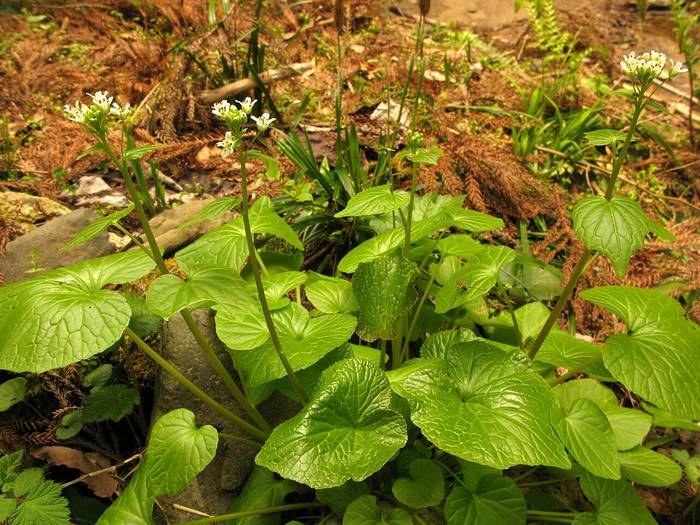
Qwert1234 · CC BY-SA 3.0
Wasabi
Plant·Eutrema japonicum
Part shade to full sun
Sun
Wet to boggy soil
Water
Not recorded
Drainage
Zones 7–10
Hardiness
Coverage · 120 fields
- Parser flag (climate_tolerance_low_confidence): Climate tolerance values are LLM-extracted (no authoritative EcoCrop match found). EcoCrop covers ~2,568 food-crop taxa; ornamental/native/medicinal species rely on LLM extraction.
Growth and size10 fields
Height at age
—
empty
Spacing
30 cm (at least 20 cm)
AI estimate55 % agree
Growth rate
—
empty
Habit
Mounding
AI estimate50 % agree
Root depth
Shallow
AI estimate63 % agree
Forest garden layer
Herb layer
AI estimate90 % agree
Lifespan
~5 years
AI estimatenot measured yet
Roots6 fields
Root form
—
empty
Storage organ
Rhizome“Wasabi is grown for its rhizomes, which are ground into a paste as a pungent condiment for sushi and other foods.”
Spreads
—
empty
Lateral spread in cm
—
empty
Root depth in cm
—
empty
Mycorrhiza
Non-mycorrhizal
AI estimatenot measured yet
Light, water and soil9 fields
Sun
Light shade, part shade, full sun · best: part shade“It can grow in semi-shade (light woodland) or no shade.”
Hours of sun
2–6 h
AI estimatenot measured yet
Water
Wet, standing water · best: wet · High · 2–5 l/day“It prefers wet soil and can grow in water.”
Drought tolerant
—
empty
Tolerates waterlogging
—
empty
Compacted soil
Copes badly
AI estimatenot measured yet
Climate5 fields
Hardiness
Zone 7–10
AI estimatenot measured yet
Killing frost
-5 °C
AI estimatenot measured yet
Growing temperature
5–25 °C · optimal 8–18 °C“The optimal air temperature is in the range 8 °C - 18 °C, with some studies citing 12 °C - 15 °C as the ideal range.”
Chill hours
0 h
AI estimatenot measured yet
Care (becomes tasks in Manage)8 fields
Starting indoors
After the last frost
AI estimatenot measured yet
Planting out
After the last frost · lasts 60 days
AI estimatenot measured yet
Dividing
After the previous stage
AI estimatenot measured yet
Watering
June · lasts 90 days
AI estimatenot measured yet
Feeding
April · lasts 30 days · a balanced liquid feed
AI estimatenot measured yet
Mulching
May · lasts 30 days
AI estimatenot measured yet
Protection
After the first frost · -30 days after · lasts 60 days · frost
AI estimatenot measured yet
Weeding
May · lasts 120 days
AI estimatenot measured yet
Through the year3 fields
Leafing out
February · Once the chill need is met“In nature the cold winter temperatures break their dormancy, with sprouting beginning in February.”
Flowering
January · Once the chill need is met · lasts 151 days“Wasabi begins to flower in January, as cold temperatures cause vernalization (induction of flowering).”
Wikipediapartly
Fruiting
After the previous stage · 50 days after · lasts 10 days“Seed pods mature 50–60 days after flowering.”
Edible parts and pollination6 fields
Rhizome (root)
The leaves
Cooked, or eaten raw“Fresh wasabi leaves can be eaten raw, having a spicy flavor, but a common side effect is diarrhea.”PFAFpartly“Leaves, flowers and petioles - cooked.”
The flowers
Cooked · April–May“It is in flower from April to May.”PFAFpartly“Leaves, flowers and petioles - cooked.”
Pollinated by
—
empty
Ecology5 fields
Attracts
—
empty
Pests
Slugs, snails, aphids
AI estimatenot measured yet
Diseases
Soft rot (erwinia sp.)“Air temperatures above 28 °C lead to heat damage of the wasabi plant and soft rot (Erwinia sp.), while cold temperatures below 8 °C can inhibit plant growth.”
Takes up
—
empty
Fixes nitrogen
No
AI estimatenot measured yet
Propagation and names4 fields
Methods
Seed, division“Seed - sow spring in a greenhouse and keep the seed permanently moist.”PFAF“Division in spring as the plant comes into growth.”
Difficulty
3 / 5
AI estimatenot measured yet
Seed
cold winter period breaks seed dormancy in nature“In nature the cold winter temperatures break their dormancy, with sprouting beginning in February.”
Not sorted yet64 fields
Fields the parser stores that this page has no row for yet. They show up here automatically, so nothing is hidden.
forage.DK.local_name
Wasabi
AI estimatenot measured yet
forage.DK.prep_cautions
fresh paste loses its flavour quickly if left uncovered, roots of plants 15-24 months old are best“Fresh wasabi paste loses its flavor quickly if left uncovered, and so the paste is grated on the spot in some high-end restaurants.”PFAF“Roots of plants 15 - 24 months old are best.”
forage.DK.edibility_basis
inferred
AI estimatenot measured yet
forage.DK.foraging_months.notes
Wasabi can be harvested year-round, but the rhizome takes 2-3 years to mature.
AI estimatenot measured yet
forage.DK.foraging_months.months
1, 2, 3, 4, 5, 6, 7, 8, 9, 10, 11, 12
AI estimatenot measured yet
forage.DK.foraging_months.year_round
true
AI estimatenot measured yet
forage.DK.habitat_affinity
riverbank, coast“Wet places and by streams, in lowland and mountain areas.”PFAF“Usually found near the coast.”
forage.US.local_name
Wasabi
AI estimatenot measured yet
forage.US.edible_parts
[{"part":"rhizome (root)","caution":"pungency fades rapidly once the root is cut","preparation":"finely grated into a fresh green paste used as a condiment","season_months":[]},{"part":"leaves","caution":"a common sid…“Root - a horseradish substitute.”PFAF“The pungency rapidly deteriorates once the root has been cut.”Wikipedia“Fresh wasabi leaves can be eaten raw, having a spicy flavor, but a common side effect is diarrhea.”PFAF“The fleshy rhizomes are finely grated and prepared into an attractive fresh green paste which is much used as a condiment in Japan.”PFAF“It is in flower from April to May.”PFAFpartly“Leaves, flowers and petioles - cooked.”
forage.US.prep_cautions
fresh paste loses its flavour quickly if left uncovered, roots of plants 15-24 months old are best“Fresh wasabi paste loses its flavor quickly if left uncovered, and so the paste is grated on the spot in some high-end restaurants.”PFAF“Roots of plants 15 - 24 months old are best.”
forage.US.edibility_basis
inferred
AI estimatenot measured yet
forage.US.foraging_months.notes
Wasabi can be harvested year-round, but the rhizome takes 2-3 years to mature.
AI estimatenot measured yet
forage.US.foraging_months.months
1, 2, 3, 4, 5, 6, 7, 8, 9, 10, 11, 12
AI estimatenot measured yet
forage.US.foraging_months.year_round
true
AI estimatenot measured yet
forage.US.habitat_affinity
riverbank, coast“Wet places and by streams, in lowland and mountain areas.”PFAF“Usually found near the coast.”
forage.TROPICAL.local_name
Wasabi
AI estimatenot measured yet
forage.TROPICAL.edible_parts
[{"part":"rhizome","caution":null,"preparation":"raw, grated","season_months":[1,2,3,4,5,6,7,8,9,10,11,12]},{"part":"leaves","caution":null,"preparation":"raw, cooked","season_months":[1,2,3,4,5,6,7,8,9,10,11,12]}]
AI estimatenot measured yet
forage.TROPICAL.prep_cautions
Ensure proper identification as false wasabi (Cardamine diphylla) is similar but less pungent.
AI estimatenot measured yet
forage.TROPICAL.edibility_basis
inferred
AI estimatenot measured yet
forage.TROPICAL.foraging_months.notes
Wasabi can be harvested year-round, but the rhizome takes 2-3 years to mature.
AI estimatenot measured yet
forage.TROPICAL.foraging_months.months
1, 2, 3, 4, 5, 6, 7, 8, 9, 10, 11, 12
AI estimatenot measured yet
forage.TROPICAL.foraging_months.year_round
true
AI estimatenot measured yet
forage.TROPICAL.habitat_affinity
riverbank
AI estimatenot measured yet
ornamental.basis
documented
AI estimatenot measured yet
ornamental.fragrance.source
none
AI estimate100 % agree
ornamental.confidence
high
AI estimatenot measured yet
ornamental.fall_interest
false
AI estimatenot measured yet
ornamental.flower_colour
white
AI estimate67 % agree
ornamental.evidence_quote
Eutrema japonicum, commonly known as Wasabi, produces small white flowers. Its foliage is green and it does not exhibit significant autumn color change. The foliage texture is medium. It does not have notable fall interest or winter structure.
AI estimatenot measured yet
ornamental.foliage_colour
green
AI estimate82 % agree
ornamental.foliage_texture
medium
AI estimatenot measured yet
ornamental.winter_structure
none
AI estimatenot measured yet
ornamental.autumn_foliage_colour
none
AI estimatenot measured yet
care_regime
routine
AI estimatenot measured yet
propagation.self_seeding
none
AI estimate20 % agree
propagation.division_season
spring as the plant comes into growth“Division in spring as the plant comes into growth.”
propagation.establishment_years
1
AI estimate40 % agree
spatial_profile.canopy_density
medium
AI estimatenot measured yet
forage_proposals.DK.edibility_tier.tier
choice
AI estimatenot measured yet
forage_proposals.DK.edibility_tier.confidence
high
AI estimatenot measured yet
forage_proposals.DK.edibility_tier.evidence_quote
The rhizome is highly prized as a condiment, especially in Japanese cuisine, and the leaves are also edible.
AI estimatenot measured yet
forage_proposals.US.edibility_tier.tier
choice
AI estimatenot measured yet
forage_proposals.US.edibility_tier.confidence
high
AI estimatenot measured yet
forage_proposals.US.edibility_tier.evidence_quote
The rhizome is highly prized as a condiment, especially in Japanese cuisine, and the leaves are also edible.
AI estimatenot measured yet
forage_proposals.TROPICAL.edibility_tier.tier
choice
AI estimatenot measured yet
forage_proposals.TROPICAL.edibility_tier.confidence
high
AI estimatenot measured yet
forage_proposals.TROPICAL.edibility_tier.evidence_quote
The rhizome is highly prized as a condiment, especially in Japanese cuisine, and the leaves are also edible.
AI estimatenot measured yet
function_profile.biomass_return.confidence
medium
AI estimatenot measured yet
function_profile.nutrient_flows.consumes
[{"basis":"documented","demand":"low","nutrient":"nitrogen","confidence":"medium","evidence_quote":"Overall, wasabi is considered ammonium-sensitive and nitrate-preferring, with a relatively low nutrient demand."},{"b…“Overall, wasabi is considered ammonium-sensitive and nitrate-preferring, with a relatively low nutrient demand.”Wikipediapartly“Optimal wasabi growth has been documented with combined nitrogen supplementation with lower amounts of sulfur.”
function_profile.biotic_interactions
[{"taxa":["Erwinia sp."],"basis":"documented","valence":"harmful","relation":"hosts","confidence":"high","evidence_quote":"Air temperatures above 28 °C lead to heat damage of the wasabi plant and soft rot (Erwinia sp.…
AI estimatenot measured yet
function_profile.aromatic_pest_effect.value
false
AI estimate80 % agree
function_profile.aromatic_pest_effect.confidence
low
AI estimatenot measured yet
function_profile.structural_interfaces.provides_shelter.basis
inferred
AI estimatenot measured yet
function_profile.structural_interfaces.provides_shelter.confidence
low
AI estimatenot measured yet
function_profile.structural_interfaces.requires_shelter.basis
documented
AI estimatenot measured yet
function_profile.structural_interfaces.requires_shelter.kinds
shade“it is quite intolerant of direct sunlight”
function_profile.structural_interfaces.requires_shelter.stage
permanent
AI estimatenot measured yet
function_profile.structural_interfaces.requires_shelter.confidence
high
AI estimatenot measured yet
function_profile.structural_interfaces.requires_shelter.evidence_quote
Wasabi thrives in cool, shaded conditions, often grown under a canopy or shade cloth.
AI estimatenot measured yet
climate_tolerance.photoperiod_response
day_neutral
AI estimatenot measured yet
soil_interactions.organic_matter_contribution
medium
AI estimatenot measured yet
component_metadata.growth_cycle
perennial“Eutrema wasabi is a PERENNIAL growing to 0.3 m (1ft) by 0.2 m (0ft 8in).”
resource_interfaces.inputs
[{"resource":"water","quantity_description":"prefers wet soil or shallow water"},{"resource":"light","quantity_description":"semi-shade (light woodland) or no shade"},{"resource":"shade","quantity_description":"intole…“It prefers wet soil and can grow in water.”PFAF“It can grow in semi-shade (light woodland) or no shade.”Wikipedia“it is quite intolerant of direct sunlight”Wikipedia“Roots require sufficient oxygenation with levels above 9 ppm for good growing conditions.”
resource_interfaces.outputs
[{"resource":"aromatic_compounds","quantity_description":"volatile allyl isothiocyanate released when the plant is damaged"}]
AI estimatenot measured yet