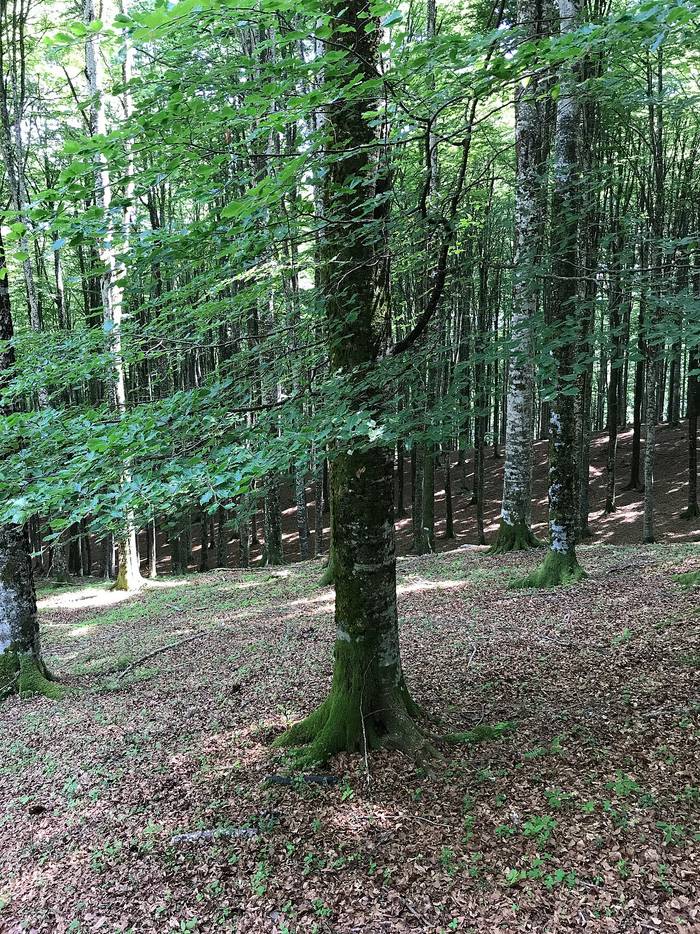
European beech
European beech (Fagus sylvatica) is a tree. It grows best in shade to full sun and has low water needs. It grows well with common hornbeam.
About European beech
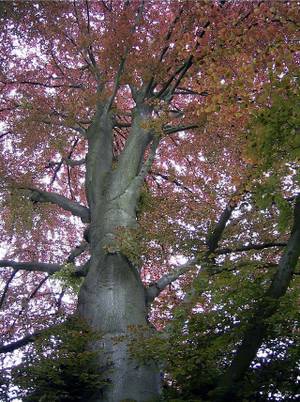
European beech is a perennial, deciduous tree that grows 30 m tall.[1][2] It needs another plant of its kind to pollinate it, so plant at least two. It can live for around 300 years.[2] European beech grows wild in Denmark. In autumn the leaves turn bronze.
Mammals and birds eat the fruit and spread the seeds.[3]
The young leaves can be eaten.[1] The seeds can be eaten too.[1] Recorded from the source text, not a safety check. Confirm with a trusted guide before eating anything.
How to plant european beech
European beech does best in full sun, but also copes with shade.[1] It grows in sandy soil, loam and clay, as long as the soil is well drained.[1] It does best at a pH of 5–7.[1][3] In a forest garden it belongs in the canopy.[1]
Plant trees 15 m apart, at least 10 m. It struggles in compacted soil, so keep the soil loose.[3] It is well established after about 3 years. It can be propagated from seed.[1]
A year with European beech
Spring. It comes into leaf in March and April.[1][2] Protect it from frost and cold in April. Plant out in April. It has small, inconspicuous flowers in May and June.[1]
Summer. Prune it in August.[1] Take a little off to tidy the shape. Less than you think.[1]
Autumn. Protect it from frost and cold in September. Sow seed in September.
Winter. It rests through the winter. It needs around 1,000 hours of winter cold to crop well.
Pests and diseases
European beech can be attacked by woolly aphid, large pine weevil (hylobius abietis), short-snouted weevils (strophosoma melanogrammum, otiorhynchus scaber), deer and squirrels.[3] Diseases include biscogniauxia nummularia, ganoderma applanatum and phytophthora ramorum.[2][3]
Companions and wildlife
European beechThe family
European beech belongs to the genus Fagus. Open a species to see what lies under it.
Sources
- Plants For A Future — Fagus sylvatica · CC BY 4.0, Plants For A Future
- Wikipedia — Fagus sylvatica · CC BY-SA 4.0
- JRC forest tree atlas · CC BY 4.0
- CLO-PLA (clonal growth) · Klimešová et al. 2017
- Berlin tree register · DL-DE-Zero-2.0
Added to the wiki 17 May 2026
Plan your garden with perma
Open app