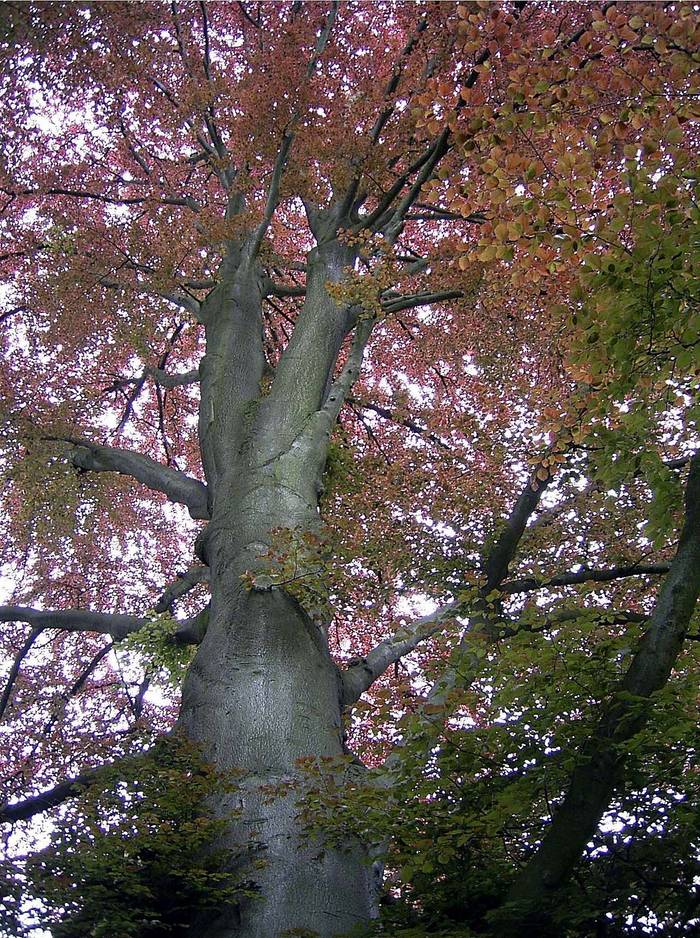
Tortuosa · CC BY-SA 3.0
Copper beech
Tree·Fagus sylvatica f. purpurea
Shade to full sun
Sun
Dry to moist soil
Water
Well-drained soil
Drainage
Not recorded
Hardiness
Coverage · 90 fields
No obvious inconsistencies found.
Growth and size11 fields
Plant type
Deciduous tree“Fagus sylvatica, the European beech or common beech, is a species of tree in the flowering plant family Fagaceae.”PFAF“Fagus sylvatica is a deciduous Tree growing to 30 m (98ft) by 15 m (49ft) at a medium rate.”
Height
3,000 cm · other sources: 5,000 cm“Fagus sylvatica is a deciduous Tree growing to 30 m (98ft) by 15 m (49ft) at a medium rate.”Wikipedia“Fagus sylvatica is a large tree, capable of reaching heights of up to 50 metres (160 feet) tall and 3 m (10 ft) trunk diameter, though more typically 25–35 m (82–115 ft) tall and up to 1.5 m (5 ft) trunk diameter.”
Spread
1,500 cm“Fagus sylvatica is a deciduous Tree growing to 30 m (98ft) by 15 m (49ft) at a medium rate.”
Height at age
400 cm after 10 years“A 10-year-old sapling will stand about 4 m (13 ft) tall.”
Size after planting
4 yrs: 5 m tall, 1 m crown · 12 yrs: 6 m tall, 3 m crown · 17 yrs: 9 m tall, 4 m crown · 35 yrs: 12 m tall, 6 m crown · 74 yrs: 22 m tall, 12 m crown“Berlin tree register: 4349 trees of this species measured with years since planting, height and crown diameter; median crown 12.0 m and height 22.0 m at 60–100 years after planting (1915 trees).”Median of 4,349 measured trees in Berlin. Years count from planting nursery stock, so a small tree reaches each size later.
Spacing
1,500 cm (at least 1,000 cm)
AI estimate55 % agree
Growth rate
Medium“Fagus sylvatica is a deciduous Tree growing to 30 m (98ft) by 15 m (49ft) at a medium rate.”
Habit
—
empty
Forest garden layer
Canopy
AI estimate90 % agree
Lifespan
~300 years“Undisturbed, the European beech has a lifespan of 300 years; one tree at the Valle Cervara site was more than 500 years old, the oldest known in the northern hemisphere.”
Roots6 fields
Root form
Plate root (shallow)“The root system is shallow, even superficial, with large roots spreading out in all directions.”
Wikipediapartly
Storage organ
None“No clonal growth organ is recorded: it does not spread vegetatively (no suckers, no rhizomes).”
Spreads
No“No clonal growth organ is recorded: it does not spread vegetatively (no suckers, no rhizomes).”
Lateral spread in cm
—
empty
Root depth in cm
—
empty
Mycorrhiza
Ectomycorrhizal (EcM)“European beech forms ectomycorrhizas with a range of fungi including many Russula species, as well as Laccaria amethystina, and with the species Ramaria flavosaponaria.”
Light, water and soil9 fields
Sun
Full sun, light shade, part shade, shade · best: full sun“It can grow in full shade (deep woodland) semi-shade (light woodland) or no shade.”
Hours of sun
6–12 h
AI estimatenot measured yet
Tolerates waterlogging
No“On the contrary, it does not thrive on sites that are regularly flooded or which have stagnant water, since it needs good drainage and will not tolerate waterlogged or compacted soils.”
Soil type
Sand, loam, clay“Suitable for: light (sandy), medium (loamy) and heavy (clay) soils and prefers well-drained soil.”
pH
3.5–8.5 · best 5–7“It is not particularly soilsensitive and grows on a wide variety of soils with a pH range from 3.5 to 8.5, although it cannot tolerate the most acidic conditions.”PFAF“Suitable pH: mildly acid, neutral and basic (mildly alkaline) soils and can grow in very acid and very alkaline soils.”
Drainage
Well drained“Suitable for: light (sandy), medium (loamy) and heavy (clay) soils and prefers well-drained soil.”
Compacted soil
Copes badly“it needs good drainage and will not tolerate waterlogged or compacted soils”
Climate5 fields
Hardiness
—
empty
Killing frost
—
empty
Growing temperature
5–30 °C · optimal 10–25 °C
AI estimatenot measured yet
Chill hours
1,000 h
AI estimatenot measured yet
Native range
—
empty
Care (becomes tasks in Manage)5 fields
Pruning
August“Plants are very tolerant of light pruning however and if this is carried out in late summer the plants will retain their dead leaves over winter.”PFAFpartly“Plants are very tolerant of light pruning”
Protection
After the last frost · frost
AI estimatenot measured yet
Sowing
After the previous stage
AI estimatenot measured yet
Protection
After the previous stage · rodents
AI estimatenot measured yet
Planting out
After the last frost
AI estimatenot measured yet
Through the year4 fields
Leafing out
Set by day length · Once it is warm enough · lasts 21 days“Spring leaf budding by the European beech is triggered by a combination of day length and temperature.”Wikipediapartly“Bud break each year is from the middle of April to the beginning of May”
Edible parts and pollination2 fields
Pollination
Needs a partner · monoecious“The species is monoecious (individual flowers are either male or female, but both sexes can be found on the same plant) and is pollinated by Wind.”
Pollinated by
Wind“The species is monoecious (individual flowers are either male or female, but both sexes can be found on the same plant) and is pollinated by Wind.”
Ecology5 fields
Attracts
Wildlife, caterpillars, squirrels, jays, woodpigeons, woodpeckers“It is noted for attracting wildlife.”PFAF“An important food plant for many caterpillars, it has 64 species of associated insects.”JRC forest tree atlas“The beech nuts are an important source of food for several animals and birds including squirrels, woodpigeons, woodpeckers and jays; they also play a major part in seed dispersal by hiding the seeds and failing to retrieve all of them.”
Pests
Woolly aphid, large pine weevil (hylobius abietis), short-snouted weevils (strophosoma melanogrammum, otiorhynchus scaber), deer, squirrels“Young beech trees are susceptible to woolly aphid”JRC forest tree atlas“The large pine weevil (Hylobius abietis) is harmful for beech and markedly coexists with part of its natural niche.”JRC forest tree atlas“Herbivory by short-snouted weevils (Strophosoma melanogrammum Forst. and Otiorhynchus scaber) is another threat to beech.”JRC forest tree atlas“The presence of deer is a limiting factor because they eat young stands.”JRC forest tree atlas“and gnawing by squirrels and other mammals”
Diseases
Biscogniauxia nummularia, ganoderma applanatum, phytophthora ramorum“Biscogniauxia nummularia (beech tarcrust) is an ascomycete primary pathogen of beech trees, causing strip-canker and wood rot.”JRC forest tree atlas“mature trees can suffer internal rot by the fungus Ganoderma applanatum”JRC forest tree atlas“Beech is among the susceptible hosts to Phytophthora ramorum”
Takes up
Calcium, potassium
AI estimatenot measured yet
Fixes nitrogen
No
AI estimatenot measured yet
Propagation and names3 fields
Methods
Seed“Seed - the seed has a short viability and is best sown as soon as it is ripe in the autumn in a cold frame.”
Difficulty
3 / 5
AI estimatenot measured yet
Seed
requires cold stratification for 3-4 months
AI estimatenot measured yet
Not sorted yet40 fields
Fields the parser stores that this page has no row for yet. They show up here automatically, so nothing is hidden.
ornamental.basis
documented
AI estimatenot measured yet
ornamental.fragrance.source
none
AI estimate100 % agree
ornamental.confidence
high
AI estimatenot measured yet
ornamental.fall_interest
true
AI estimatenot measured yet
ornamental.evidence_quote
Fagus sylvatica, commonly known as European Beech, has insignificant flowers. Its summer foliage is green, turning to yellow-green and bronze in autumn, providing significant fall interest. The tree offers ornamental bark and an architectural skeleton in winter. It is not noted for any significant fragrance.
AI estimatenot measured yet
ornamental.foliage_colour
dark_green“The leaves are typically 10 × 7 cm, dark and shiny green.”
ornamental.foliage_texture
medium
AI estimatenot measured yet
ornamental.winter_structure
ornamental_bark, architectural_skeleton
AI estimatenot measured yet
ornamental.autumn_foliage_colour
yellow_green, bronze
AI estimatenot measured yet
care_regime
light
AI estimatenot measured yet
propagation.self_seeding
moderate
AI estimate20 % agree
propagation.division_season
not applicable
AI estimatenot measured yet
propagation.establishment_years
3
AI estimate40 % agree
size_at_age.v
1
AI estimatenot measured yet
size_at_age.basis
years_after_planting
AI estimatenot measured yet
spatial_profile.canopy_density
dense
AI estimatenot measured yet
function_profile.biomass_return.confidence
high“Beech furthers soil conservation due to its production of a large quantity of litter (around 900 g/m² per year).”
JRC forest tree atlaspartly
function_profile.nutrient_flows.consumes
[{"basis":"documented","demand":"moderate","nutrient":"nitrogen","confidence":"high"},{"basis":"documented","demand":"moderate","nutrient":"phosphorus","confidence":"high"},{"basis":"documented","demand":"moderate","n…
AI estimatenot measured yet
function_profile.nutrient_flows.provides
[{"basis":"documented","nutrient":"potassium","mechanism":"biomass_return","confidence":"medium","evidence_quote":"Owing to the capacity of its root system for assisting in the circulation of air throughout the soil, …“Owing to the capacity of its root system for assisting in the circulation of air throughout the soil, and the amount of potash in its leaves, Beech trees conserve the productive capacity of the soil better than many other species.”
function_profile.biotic_interactions
[{"taxa":["wildlife"],"basis":"documented","valence":"beneficial","relation":"attracts","confidence":"medium","evidence_quote":"It is noted for attracting wildlife.","organism_group":"wildlife","ecological_function":"…“It is noted for attracting wildlife.”PFAF“An important food plant for many caterpillars, it has 64 species of associated insects.”JRC forest tree atlas“The beech nuts are an important source of food for several animals and birds including squirrels, woodpigeons, woodpeckers and jays; they also play a major part in seed dispersal by hiding the seeds and failing to retrieve all of them.”JRC forest tree atlas“and gnawing by squirrels and other mammals”JRC forest tree atlas“The presence of deer is a limiting factor because they eat young stands.”JRC forest tree atlas“Young beech trees are susceptible to woolly aphid”JRC forest tree atlas“The large pine weevil (Hylobius abietis) is harmful for beech and markedly coexists with part of its natural niche.”JRC forest tree atlas“Herbivory by short-snouted weevils (Strophosoma melanogrammum Forst. and Otiorhynchus scaber) is another threat to beech.”Wikipedia“Biscogniauxia nummularia (beech tarcrust) is an ascomycete primary pathogen of beech trees, causing strip-canker and wood rot.”JRC forest tree atlas“mature trees can suffer internal rot by the fungus Ganoderma applanatum”JRC forest tree atlas“Beech is among the susceptible hosts to Phytophthora ramorum”
function_profile.aromatic_pest_effect.value
false
AI estimate80 % agree
function_profile.aromatic_pest_effect.confidence
high
AI estimatenot measured yet
function_profile.structural_interfaces.provides_shelter.basis
documented
AI estimatenot measured yet
function_profile.structural_interfaces.provides_shelter.kinds
shade
AI estimatenot measured yet
function_profile.structural_interfaces.provides_shelter.confidence
high
AI estimatenot measured yet
function_profile.structural_interfaces.requires_shelter.basis
documented
AI estimatenot measured yet
function_profile.structural_interfaces.requires_shelter.kinds
frost
AI estimatenot measured yet
function_profile.structural_interfaces.requires_shelter.stage
establishment
AI estimatenot measured yet
function_profile.structural_interfaces.requires_shelter.confidence
medium
AI estimatenot measured yet
function_profile.structural_interfaces.provides_physical_support.form
trunk
AI estimatenot measured yet
function_profile.structural_interfaces.provides_physical_support.basis
taxonomic
AI estimatenot measured yet
function_profile.structural_interfaces.provides_physical_support.confidence
high
AI estimatenot measured yet
function_profile.structural_interfaces.requires_physical_support.basis
taxonomic
AI estimatenot measured yet
function_profile.structural_interfaces.requires_physical_support.confidence
high
AI estimatenot measured yet
climate_tolerance.photoperiod_response
day_neutral
AI estimatenot measured yet
soil_interactions.organic_matter_contribution
high“Beech furthers soil conservation due to its production of a large quantity of litter (around 900 g/m² per year).”
component_metadata.growth_cycle
perennial
AI estimate100 % agree
resource_interfaces.inputs
[{"resource":"water","quantity_description":"humid atmosphere with precipitation well distributed throughout the year and a well-drained soil"},{"resource":"shade","quantity_description":"tolerates very shady situatio…“beech requires a humid atmosphere with precipitation well distributed throughout the year and a well-drained soil”JRC forest tree atlas“It tolerates very shady situations (it is the most shade-tolerant broadleaved tree in its range)”
resource_interfaces.outputs
[{"resource":"shade","quantity_description":"heavy canopy casting dense shade"},{"resource":"leaf_litter","quantity_description":"around 900 g/m² per year"},{"resource":"seeds","quantity_description":"beechnuts eaten …“Trees have a heavy canopy and cast a dense shade”JRC forest tree atlas“Beech furthers soil conservation due to its production of a large quantity of litter (around 900 g/m² per year).”JRC forest tree atlas“The beech nuts are an important source of food for several animals and birds including squirrels, woodpigeons, woodpeckers and jays; they also play a major part in seed dispersal by hiding the seeds and failing to retrieve all of them.”Wikipedia“The trees are used for timber, such as the making of furniture.”PFAFpartly“It is noted for attracting wildlife.”PFAFpartly“A dynamic accumulator gathering minerals or nutrients from the soil and storing them in a more bioavailable form - used as fertilizer or to improve mulch.”