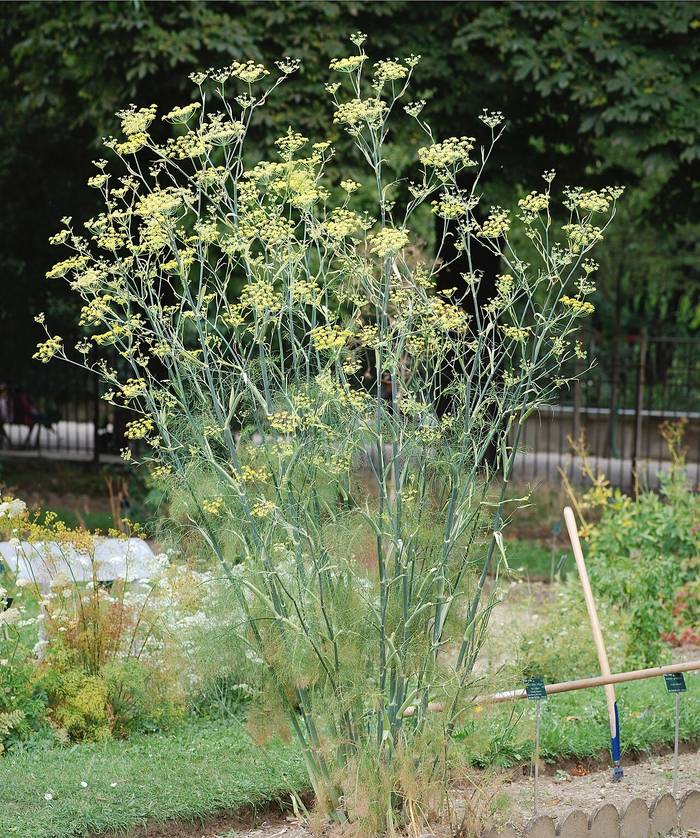
Alvesgaspar · CC BY-SA 3.0
Fennel
Plant·Foeniculum vulgare
Full sun
Sun
Dry to moist soil
Water
Well-drained soil
Drainage
Zones 4–9
Hardiness
Coverage · 131 fields
Growth and size10 fields
Height
150 cm · other sources: 210 cm“Foeniculum vulgare is an evergreen Perennial growing to 1.5 m (5ft) by 1 m (3ft 3in) at a medium rate.”Wikipedia“The stem is hollow, erect, and glaucous green, and it can grow up to 2.1 meters (7 feet) tall.”
Spread
100 cm“Foeniculum vulgare is an evergreen Perennial growing to 1.5 m (5ft) by 1 m (3ft 3in) at a medium rate.”
Height at age
—
empty
Spacing
30 cm (at least 20 cm)
AI estimate55 % agree
Forest garden layer
Herb layer
AI estimate90 % agree
Lifespan
~2 years
AI estimatenot measured yet
Roots6 fields
Root form
Taproot
AI estimate43 % agree
Storage organ
None“It does not multiply vegetatively: it has no rhizomes, runners, suckers or offspring bulbs or tubers.”
Spreads
No“It does not multiply vegetatively: it has no rhizomes, runners, suckers or offspring bulbs or tubers.”
Lateral spread in cm
—
empty
Root depth in cm
—
empty
Mycorrhiza
Arbuscular (AM)
AI estimatenot measured yet
Light, water and soil9 fields
Hours of sun
6–12 h
AI estimatenot measured yet
Tolerates waterlogging
No“Although hardy in most parts of Britain, plants are liable to die out over the winter if the soil is not well-drained or the weather is persistently cold and wet.”
PFAFpartly
Soil type
Sand, loam, clay“It grows well in sandy soils and is drought tolerant once established.”PFAF“Suitable for: light (sandy), medium (loamy) and heavy (clay) soils and prefers well-drained soil.”
Drainage
Well drained“Suitable for: light (sandy), medium (loamy) and heavy (clay) soils and prefers well-drained soil.”
Compacted soil
Copes badly
AI estimatenot measured yet
Climate5 fields
Hardiness
Zone 4–9
AI estimatenot measured yet
Killing frost
-2 °C“Killing temp. early growth: -2”EcoCrop's figure is frost during early growth (spring frost on new shoots), not winter cold.
Growing temperature
6–32 °C · optimal 15–25 °C“Temperature absolute min: 6 · Temperature absolute max: 32 · Temperature optimal min: 15 · Temperature optimal max: 25”
Chill hours
0 h
AI estimatenot measured yet
Native range
AD, AE, AF, AL, AM, AZ, BA, BG, BH, CY, DZ, EG, ER, ES, ET, FR, GE, GI, GR, HR, IL, IN, IQ, IR, IT, JO, LB, LY, MA, MC, ME, MK, MT, NP, PK, PT, QA, RS, RU, SA, SI, SM, SY, TJ, TM, TN, TR, UZ, VA, XK, YE
Care (becomes tasks in Manage)9 fields
Pruning
After the last frost · a few plants“It is best to cut a few plants back to ground level occasionally during the growing season, thus ensuring a constant supply of fresh young shoots.”
PFAFpartly
Watering
After rain“In a dry summer make sure that you water the cut-down clump or it might not regrow that year”
Watering appears 2 times with different timing.
PFAFpartly
Dividing
March · lasts 31 days“Division in March as the new growth appears.”
Dividing appears 2 times with different timing.
Sowing
After the last frost“Seed - best sown in early spring in situ.”
Sowing appears 3 times with different timing.
PFAFpartly
Sowing
After the first frost“The seed can also be sown in situ in the autumn.”
Sowing appears 3 times with different timing.
Dividing
March · After the previous stage
Dividing appears 2 times with different timing.
AI estimatenot measured yet
Sowing
March
Sowing appears 3 times with different timing.
AI estimatenot measured yet
Watering
July · lasts 60 days
Watering appears 2 times with different timing.
AI estimatenot measured yet
Support
After the previous stage · -14 days after · lasts 30 days
AI estimatenot measured yet
Through the year3 fields
Flowering
August · lasts 92 days“It is in leaf all year, in flower from August to October, and the seeds ripen from September to October.”
Fruiting
September · lasts 61 days“It is in leaf all year, in flower from August to October, and the seeds ripen from September to October.”
Harvest
August · lasts 92 days“Fennel bulbs are usually harvested in late summer to early autumn (August to October), while the seeds are harvested in late summer.”
Edible parts and pollination8 fields
The leaves
The flowers
The seeds
Flavouring in cakes, bread, stuffings · September–October“The aromatic seeds are used as a flavouring in cakes, bread, stuffings etc.”PFAF“It is in leaf all year, in flower from August to October, and the seeds ripen from September to October.”PFAFpartly“Edible Parts: Flowers Leaves Oil Root Seed Stem”
Essential oil
Food flavouring from the fully ripened, dried seed“Edible Parts: Flowers Leaves Oil Root Seed Stem”PFAF“Ingestion of the oil can cause vomiting, seizures and pulmonary oedema.”PFAF“An essential oil from the fully ripened and dried seed is used as a food flavouring in similar ways to the whole seed.”
Ecology5 fields
Attracts
Bees, parasitic wasps, tachinid flies, hoverflies, wildlife“However, the flowering plant attracts beneficial insects such as bees, parasitic wasps, tachinid flies and hoverflies to the garden.”PFAF“It is noted for attracting wildlife.”
Pests
—
empty
Diseases
—
empty
Takes up
Potassium, calcium, sulfur
AI estimatenot measured yet
Fixes nitrogen
No
AI estimatenot measured yet
Propagation and names4 fields
Methods
Seed, division“Seed - best sown in early spring in situ.”PFAF“Division in March as the new growth appears.”
Difficulty
2 / 5
AI estimatenot measured yet
Seed
—
empty
Not sorted yet72 fields
Fields the parser stores that this page has no row for yet. They show up here automatically, so nothing is hidden.
forage.DK.local_name
Fennikel
AI estimatenot measured yet
forage.DK.warnings_da
Saften kan give udslæt på huden i sollys.
AI estimatenot measured yet
forage.DK.warnings_en
The sap can cause a skin rash in sunlight.
AI estimatenot measured yet
forage.DK.prep_cautions
Skin contact with sap or essential oil may cause photosensitivity or dermatitis in some people., Avoid for small children., Avoid if cirrhosis/liver disorders., Diabetics should check the sugar content of preparations.“Skin contact with the sap or essential oil is said to cause photo-sensitivity and/or dermatitis in some people.”PFAF“Avoid for small children.”PFAF“Avoid if cirrhosis/liver disorders.”PFAF“Diabetics check sugar content of preparation .”
forage.DK.edibility_basis
inferred
AI estimatenot measured yet
forage.DK.foraging_months.notes
Leaves can often be harvested all year round, especially in a warm, sheltered position; bulbs, flower heads and seeds are late summer to autumn.“they can often be harvested all year round, especially if the plants are in a warm, sheltered position”
PFAFpartly
forage.DK.foraging_months.months
8, 9, 10“It is in leaf all year, in flower from August to October, and the seeds ripen from September to October.”
forage.DK.foraging_months.year_round
false
AI estimatenot measured yet
forage.DK.habitat_affinity
coast, verge“Found most often in dry stony calcareous soils near the sea.”Wikipedia“Fennel has become naturalized along roadsides, in pastures, and in other open sites in many regions, including northern Europe, the United States, southern Canada, and much of Asia and Australia.”
forage.US.local_name
Fennel
AI estimatenot measured yet
forage.US.edible_parts
[{"part":"foliage","preparation":"garnish, salads, sauces, soups and fish sauce"},{"part":"bulb","preparation":"sautéed, stewed, braised, grilled, roasted or eaten raw"},{"part":"fruits","preparation":"cookery and swe…“The bulb, foliage, and fruits of the fennel plant are used in many of the culinary traditions of the world.”Wikipedia“Tender young leaves are used for garnishes, as a salad, to add flavor to salads, to flavor sauces to be served with puddings, and in soups and fish sauce.”Wikipedia“The bulb is a crisp vegetable that can be sautéed, stewed, braised, grilled, roasted or eaten raw.”Wikipedia“The fruits are used in cookery and sweet desserts.”
forage.US.prep_cautions
Some plants in the Apiaceae family are poisonous and often difficult to identify.“Some plants in the Apiaceae family are poisonous and often difficult to identify.”
forage.US.edibility_basis
inferred
AI estimatenot measured yet
forage.US.foraging_months.notes
Availability varies by region; generally spring through autumn.
AI estimatenot measured yet
forage.US.foraging_months.months
4, 5, 6, 7, 8, 9, 10
AI estimatenot measured yet
forage.US.foraging_months.year_round
false
AI estimatenot measured yet
forage.US.habitat_affinity
verge, riverbank, coast“Fennel has become naturalized along roadsides, in pastures, and in other open sites in many regions, including northern Europe, the United States, southern Canada, and much of Asia and Australia.”Wikipedia“It is indigenous to the shores of the Mediterranean but has become widely naturalized in many parts of the world, especially on dry soils near the sea coast and on riverbanks.”
forage.TROPICAL.local_name
Fennel
AI estimatenot measured yet
forage.TROPICAL.edible_parts
[{"part":"leaves","preparation":"cooked as a leafy green vegetable"},{"part":"seeds","preparation":"cooked as a spice"}]“Fennel leaves are used in some parts of India as leafy green vegetables either by themselves or mixed with other vegetables, cooked to be served and consumed as part of a meal.”Wikipedia“Many cultures in South Asia, Afghanistan, and West Asia use fennel fruits in cooking.”
forage.TROPICAL.prep_cautions
Ensure correct identification, as some lookalikes may exist.
AI estimatenot measured yet
forage.TROPICAL.edibility_basis
inferred
AI estimatenot measured yet
forage.TROPICAL.foraging_months.notes
In tropical climates, fennel can grow year-round, with continuous harvesting of leaves and stems. Seeds may be produced seasonally depending on local conditions.
AI estimatenot measured yet
forage.TROPICAL.foraging_months.year_round
true
AI estimatenot measured yet
forage.TROPICAL.habitat_affinity
disturbed_ground, verge
AI estimatenot measured yet
ornamental.basis
documented
AI estimatenot measured yet
ornamental.fragrance.source
foliage“Fennel has aromatic and flavorful leaves, stalks, flowers, seeds, and roots, all of which are edible.”
PFAFpartly
ornamental.fragrance.intensity
strong
AI estimatenot measured yet
ornamental.confidence
high
AI estimatenot measured yet
ornamental.fall_interest
false
AI estimatenot measured yet
ornamental.flower_colour
yellow“It is a hardy, perennial herb with yellow flowers and feathery leaves.”
ornamental.evidence_quote
Fennel has delicate, feathery, blue-green foliage and produces umbels of small yellow flowers. The foliage has a strong, distinctive anise-like fragrance. After flowering, it forms attractive seed heads. It does not typically have significant autumn foliage color.
AI estimatenot measured yet
ornamental.foliage_colour
blue_green
AI estimate82 % agree
ornamental.foliage_texture
fine“The leaves grow up to 40 centimeters (16 inches) long; they are finely dissected, with the ultimate segments filiform (threadlike), about 0.5 millimeters (1⁄64 in) wide.”
ornamental.winter_structure
evergreen_form“Foeniculum vulgare is an evergreen Perennial growing to 1.5 m (5ft) by 1 m (3ft 3in) at a medium rate.”
ornamental.autumn_foliage_colour
none
AI estimatenot measured yet
care_regime
light
AI estimatenot measured yet
propagation.division_season
March as the new growth appears“Division in March as the new growth appears.”
propagation.establishment_years
1
AI estimate40 % agree
forage_proposals.DK.edibility_tier.tier
edible“The young leaves are good raw or cooked due to their aniseed flavour.”
forage_proposals.DK.edibility_tier.confidence
high
AI estimatenot measured yet
forage_proposals.DK.edibility_tier.evidence_quote
Fennel (Foeniculum vulgare) is widely cultivated and consumed as a vegetable and herb. All parts of the plant, including the bulb, stalks, leaves, and seeds, are edible.
AI estimatenot measured yet
forage_proposals.US.edibility_tier.tier
edible“The bulb, foliage, and fruits of the fennel plant are used in many of the culinary traditions of the world.”
forage_proposals.US.edibility_tier.confidence
high
AI estimatenot measured yet
forage_proposals.US.edibility_tier.evidence_quote
Fennel (Foeniculum vulgare) is widely cultivated and consumed as a vegetable and herb. All parts of the plant, including the bulb, stalks, leaves, and seeds, are edible.
AI estimatenot measured yet
forage_proposals.TROPICAL.edibility_tier.tier
edible“Fennel leaves are used in some parts of India as leafy green vegetables either by themselves or mixed with other vegetables, cooked to be served and consumed as part of a meal.”
forage_proposals.TROPICAL.edibility_tier.confidence
high
AI estimatenot measured yet
forage_proposals.TROPICAL.edibility_tier.evidence_quote
Fennel (Foeniculum vulgare) is widely cultivated and consumed as a vegetable and herb. All parts of the plant, including the bulb, stalks, leaves, and seeds, are edible.
AI estimatenot measured yet
function_profile.biomass_return.confidence
medium
AI estimatenot measured yet
function_profile.nutrient_flows.consumes
[{"basis":"documented","demand":"moderate","nutrient":"nitrogen","confidence":"high"},{"basis":"documented","demand":"moderate","nutrient":"phosphorus","confidence":"high"},{"basis":"documented","demand":"moderate","n…
AI estimatenot measured yet
function_profile.nutrient_flows.provides
[{"basis":"inferred","nutrient":"potassium","mechanism":"mineral_extraction","confidence":"low"},{"basis":"inferred","nutrient":"calcium","mechanism":"mineral_extraction","confidence":"low"},{"basis":"inferred","nutri…
AI estimatenot measured yet
function_profile.biotic_interactions
[{"taxa":["bees"],"basis":"documented","valence":"beneficial","relation":"attracts","confidence":"high","evidence_quote":"Fennel can attract beneficial insects, including pollinators, and can also be used as a compani…“Fennel attracts beneficial insects such as bees, hoverflies, and parasitic wasps, which help control garden pests naturally.”PFAFpartly“Fennel can attract beneficial insects, including pollinators, and can also be used as a companion plant to deter pests.”PFAFpartly“The dried plant is an insect repellent, the crushed leaves are effective for keeping dogs free of fleas.”
function_profile.aromatic_pest_effect.value
true“The dried plant is an insect repellent, the crushed leaves are effective for keeping dogs free of fleas.”
PFAFpartly
function_profile.aromatic_pest_effect.confidence
high
AI estimatenot measured yet
function_profile.structural_interfaces.provides_shelter.basis
inferred
AI estimatenot measured yet
function_profile.structural_interfaces.provides_shelter.confidence
low
AI estimatenot measured yet
function_profile.structural_interfaces.requires_shelter.basis
documented
AI estimatenot measured yet
function_profile.structural_interfaces.requires_shelter.kinds
wind
AI estimatenot measured yet
function_profile.structural_interfaces.requires_shelter.stage
establishment
AI estimatenot measured yet
function_profile.structural_interfaces.requires_shelter.confidence
medium
AI estimatenot measured yet
function_profile.structural_interfaces.requires_shelter.evidence_quote
Young fennel plants can benefit from some wind protection during establishment.
AI estimatenot measured yet
function_profile.structural_interfaces.provides_physical_support.basis
inferred
AI estimatenot measured yet
function_profile.structural_interfaces.provides_physical_support.confidence
low
AI estimatenot measured yet
function_profile.structural_interfaces.requires_physical_support.basis
inferred
AI estimatenot measured yet
function_profile.structural_interfaces.requires_physical_support.confidence
low
AI estimatenot measured yet
climate_tolerance.photoperiod_response
long_day
AI estimatenot measured yet
soil_interactions.organic_matter_contribution
medium
AI estimatenot measured yet
resource_interfaces.inputs
[{"resource":"light","quantity_description":"prefers a sunny dry position"},{"resource":"water","quantity_description":"prefers dry or moist soil; tolerates drought"},{"resource":"pollination","quantity_description":"…“An easily grown plant, it succeeds in most soils but prefers a sunny dry position.”PFAF“It prefers dry or moist soil and can tolerate drought.”PFAF“The plant growth habit is a clumper with limited spread [1-2].”PFAFpartly“The species is hermaphrodite (has both male and female organs) and is pollinated by Insects.”
resource_interfaces.outputs
[{"resource":"pollinator_services","quantity_description":"attracts bees, hoverflies and parasitic wasps"},{"resource":"habitat","quantity_description":"noted for attracting wildlife"},{"resource":"aromatic_compounds"…“Fennel attracts beneficial insects such as bees, hoverflies, and parasitic wasps, which help control garden pests naturally.”PFAF“It is noted for attracting wildlife.”PFAF“The seed yields up to 5% of an essential oil.”PFAF“It is in leaf all year, in flower from August to October, and the seeds ripen from September to October.”