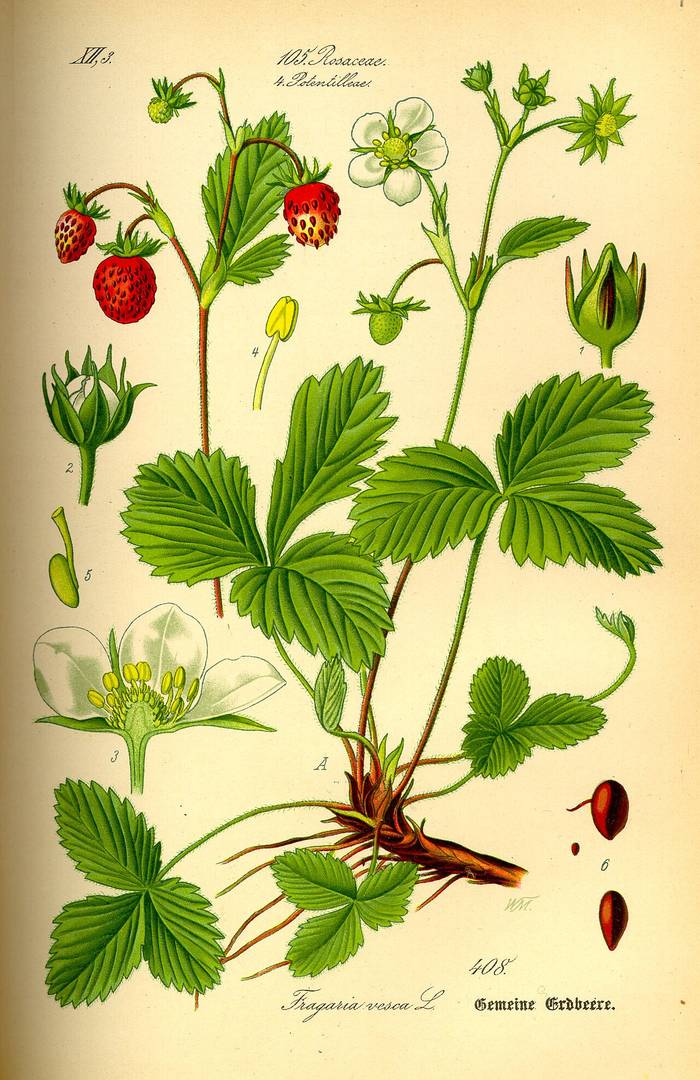
Woodland strawberry
Plant·Fragaria vesca
Part shade to full sun
Sun
Moist soil
Water
Well-drained soil
Drainage
Zones 3–9
Hardiness
Coverage · 114 fields
No obvious inconsistencies found.
Growth and size10 fields
Spread
40 cm
AI estimate58 % agree
Height at age
—
empty
Spacing
20 cm (at least 15 cm)
AI estimate55 % agree
Growth rate
—
empty
Root depth
Shallow
AI estimate63 % agree
Forest garden layer
Ground cover
AI estimate90 % agree
Lifespan
~3 years
AI estimatenot measured yet
Roots6 fields
Root form
Fibrous roots
AI estimate43 % agree
Storage organ
None
AI estimate100 % agree
Spreads
By runners“It spreads by runners: horizontal stems creeping over the ground that root at the nodes.”
Lateral spread in cm
22.4 cm“Its clonal growth organs spread 22.4 cm sideways.”
Root depth in cm
—
empty
Mycorrhiza
Arbuscular (AM)
AI estimatenot measured yet
Light, water and soil9 fields
Sun
Full sun, light shade, part shade · best: full sun“It can grow in semi-shade (light woodland) or no shade.”
PFAFpartly
Hours of sun
4–6 h
AI estimatenot measured yet
Drought tolerant
—
empty
Tolerates waterlogging
—
empty
Soil type
Sand, loam, clay“Suitable for: light (sandy), medium (loamy) and heavy (clay) soils and prefers well-drained soil.”
Drainage
Well drained“Suitable for: light (sandy), medium (loamy) and heavy (clay) soils and prefers well-drained soil.”
Compacted soil
Copes badly
AI estimatenot measured yet
Climate5 fields
Hardiness
Zone 3–9
AI estimatenot measured yet
Killing frost
-25 °C
AI estimatenot measured yet
Growing temperature
5–28 °C · optimal 12–20 °C“Temperature absolute min: 5 · Temperature absolute max: 28 · Temperature optimal min: 12 · Temperature optimal max: 20”
Chill hours
0 h
AI estimatenot measured yet
Native range
AD, AL, AM, AT, AZ, BA, BE, BG, BY, CA, CH, CN, CZ, DE, DK, EE, ES, FI, FR, GB, GE, GG, GI, GR, GT, HR, HU, IE, IR, IS, IT, JE, KG, KZ, LB, LI, LT, LU, LV, MC, MD, ME, MK, MT, MX, NL, NO, PL, PM, PT, RO, RS, RU, SE, SI, SK, SM, SY, TR, UA, US, VA, XK
Care (becomes tasks in Manage)6 fields
Dividing
July · lasts 62 days“Division of runners, preferably done in July/August in order to allow the plants to become established for the following years crop.”
Starting indoors
March · lasts 30 days
AI estimatenot measured yet
Planting out
June · lasts 92 days
AI estimatenot measured yet
Watering
After rain · lasts 180 days
AI estimatenot measured yet
Mulching
April · lasts 30 days
AI estimatenot measured yet
Weeding
May · lasts 120 days
AI estimatenot measured yet
Through the year3 fields
Edible parts and pollination5 fields
The leaves
Fresh or dried, brewed as tea“The fresh or dried leaves are used to brew an excellent tea.”
Pollination
Self-fertile · hermaphrodite“The species is hermaphrodite (has both male and female organs) and is pollinated by Insects.”
Pollinated by
Insects“The species is hermaphrodite (has both male and female organs) and is pollinated by Insects.”
Ecology5 fields
Attracts
Insect pollinators, mammals, birds“The species is hermaphrodite (has both male and female organs) and is pollinated by Insects.”Wikipedia“Its leaves serve as significant food source for a variety of ungulates, such as mule deer and elk, and the fruit are eaten by a variety of mammals and birds that also help to distribute the seeds in their droppings.”
Pests
Slugs, snails, strawberry weevil
AI estimatenot measured yet
Diseases
Viral diseases“Plants tend to lose vigour after a few years due to their abundant fruiting and flowering with final decline caused by viral diseases.”
Takes up
Potassium, phosphorus
AI estimatenot measured yet
Fixes nitrogen
No
AI estimatenot measured yet
Propagation and names4 fields
Methods
Seed, division of runners, runners planted out direct“Seed - sow early spring in a greenhouse.”PFAF“Division of runners, preferably done in July/August in order to allow the plants to become established for the following years crop.”PFAF“The runners can be planted out direct into their permanent positions.”
Difficulty
2 / 5
AI estimatenot measured yet
Seed
cold_moist
AI estimatenot measured yet
Not sorted yet61 fields
Fields the parser stores that this page has no row for yet. They show up here automatically, so nothing is hidden.
forage.DK.local_name
Skovjordbær
AI estimatenot measured yet
forage.DK.edibility_basis
inferred
AI estimatenot measured yet
forage.DK.foraging_months.notes
Peak fruiting in summer months.
AI estimatenot measured yet
forage.DK.foraging_months.months
6, 7, 8
AI estimatenot measured yet
forage.DK.foraging_months.year_round
false
AI estimatenot measured yet
forage.DK.habitat_affinity
woodland, verge“Shaded, fairly damp places in woodland.”Wikipedia“Typical habitat is along trails and roadsides, embankments, hillsides, stone- and gravel-laid paths and roads, meadows, young woodlands, sparse forest, woodland edges, and clearings.”
forage.US.local_name
Wild Strawberry
AI estimatenot measured yet
forage.US.edible_parts
[{"part":"fruit","preparation":"raw","season_months":[6,7]},{"part":"leaves","preparation":"fresh or dried, brewed as tea"}]“The fresh or dried leaves are used to brew an excellent tea.”PFAFpartly“Aromatic, sweet and succulent.”
forage.US.edibility_basis
inferred
AI estimatenot measured yet
forage.US.foraging_months.notes
Fruiting season varies by region, generally late spring to late summer.
AI estimatenot measured yet
forage.US.foraging_months.months
5, 6, 7
AI estimatenot measured yet
forage.US.foraging_months.year_round
false
AI estimatenot measured yet
forage.US.habitat_affinity
woodland, verge“Shaded, fairly damp places in woodland.”Wikipedia“Typical habitat is along trails and roadsides, embankments, hillsides, stone- and gravel-laid paths and roads, meadows, young woodlands, sparse forest, woodland edges, and clearings.”
forage.TROPICAL.edible_parts
[{"part":"fruit","caution":null,"preparation":"raw","season_months":[1,2,3,4,5,6,7,8,9,10,11,12]}]
AI estimatenot measured yet
forage.TROPICAL.edibility_basis
inferred
AI estimatenot measured yet
forage.TROPICAL.foraging_months.notes
May fruit year-round in suitable tropical highland climates.
AI estimatenot measured yet
forage.TROPICAL.foraging_months.year_round
true
AI estimatenot measured yet
forage.TROPICAL.habitat_affinity
woodland, disturbed_ground
AI estimatenot measured yet
ornamental.basis
documented
AI estimatenot measured yet
ornamental.fragrance.source
fruit
AI estimate100 % agree
ornamental.fragrance.intensity
subtle
AI estimatenot measured yet
ornamental.confidence
high
AI estimatenot measured yet
ornamental.fall_interest
true
AI estimatenot measured yet
ornamental.flower_colour
white“Five to eleven soft, hairy white flowers are borne on a green, soft fresh-hairy 3–15 centimetres (1–6 in) stalk that usually lifts them above the leaves.”
ornamental.evidence_quote
Fragaria vesca, commonly known as wild strawberry or woodland strawberry, produces small white flowers and has green foliage that remains evergreen in milder climates. The flowers have a subtle fragrance.
AI estimatenot measured yet
ornamental.foliage_colour
green“The light-green leaves are trifoliate (in threes) with toothed margins.”
ornamental.foliage_texture
medium
AI estimatenot measured yet
ornamental.winter_structure
evergreen_form
AI estimatenot measured yet
ornamental.autumn_foliage_colour
none
AI estimatenot measured yet
care_regime
light
AI estimatenot measured yet
propagation.self_seeding
moderate
AI estimate20 % agree
propagation.division_season
July/August“Division of runners, preferably done in July/August in order to allow the plants to become established for the following years crop.”
propagation.establishment_years
1
AI estimate40 % agree
sun_requirement.best
full_sun“Prefers a fertile, well-drained, moisture retentive soil in a sunny position.”
forage_proposals.DK.edibility_tier.evidence_quote
Edible Parts: Fruit Leaves“Aromatic, sweet and succulent.”
PFAFpartly
forage_proposals.US.edibility_tier.evidence_quote
Edible Parts: Fruit Leaves“Aromatic, sweet and succulent.”
PFAFpartly
forage_proposals.TROPICAL.edibility_tier.confidence
low
AI estimatenot measured yet
forage_proposals.TROPICAL.edibility_tier.evidence_quote
Fragaria vesca is native to the Northern Hemisphere and is not typically found in tropical regions. Therefore, its edibility in tropical contexts is not applicable.
AI estimatenot measured yet
function_profile.biomass_return.confidence
medium
AI estimatenot measured yet
function_profile.nutrient_flows.consumes
[{"basis":"documented","demand":"moderate","nutrient":"nitrogen","confidence":"high"},{"basis":"documented","demand":"moderate","nutrient":"phosphorus","confidence":"high"},{"basis":"documented","demand":"moderate","n…
AI estimatenot measured yet
function_profile.nutrient_flows.provides
[{"basis":"inferred","nutrient":"potassium","mechanism":"biomass_return","confidence":"low"},{"basis":"inferred","nutrient":"phosphorus","mechanism":"biomass_return","confidence":"low"}]
AI estimatenot measured yet
function_profile.biotic_interactions
[{"taxa":["insects"],"basis":"documented","valence":"beneficial","relation":"attracts","confidence":"high","evidence_quote":"The species is hermaphrodite (has both male and female organs) and is pollinated by Insects.…“The species is hermaphrodite (has both male and female organs) and is pollinated by Insects.”Wikipedia“Its leaves serve as significant food source for a variety of ungulates, such as mule deer and elk, and the fruit are eaten by a variety of mammals and birds that also help to distribute the seeds in their droppings.”Wikipedia“It is a larval host to the two-banded checkered skipper.”Wikipedia“Plants tend to lose vigour after a few years due to their abundant fruiting and flowering with final decline caused by viral diseases.”
function_profile.aromatic_pest_effect.value
false
AI estimate80 % agree
function_profile.aromatic_pest_effect.confidence
high
AI estimatenot measured yet
function_profile.structural_interfaces.provides_shelter.basis
inferred
AI estimatenot measured yet
function_profile.structural_interfaces.provides_shelter.kinds
shade
AI estimatenot measured yet
function_profile.structural_interfaces.provides_shelter.confidence
medium
AI estimatenot measured yet
function_profile.structural_interfaces.requires_shelter.basis
inferred
AI estimatenot measured yet
function_profile.structural_interfaces.requires_shelter.kinds
wind
AI estimatenot measured yet
function_profile.structural_interfaces.requires_shelter.stage
establishment
AI estimatenot measured yet
function_profile.structural_interfaces.requires_shelter.confidence
medium
AI estimatenot measured yet
climate_tolerance.photoperiod_response
day_neutral
AI estimatenot measured yet
soil_interactions.organic_matter_contribution
medium
AI estimatenot measured yet
resource_interfaces.inputs
[{"resource":"light","quantity_description":"prefers a sunny position"},{"resource":"shade","quantity_description":"grows in semi-shade or no shade; fruit production is reduced in semi-shade"},{"resource":"water","qua…“Prefers a fertile, well-drained, moisture retentive soil in a sunny position.”PFAF“The species is hermaphrodite (has both male and female organs) and is pollinated by Insects.”PFAFpartly“It can grow in semi-shade (light woodland) or no shade.”PFAFpartly“It prefers moist soil.”
resource_interfaces.outputs
[{"resource":"ground_cover","quantity_description":"spreads rapidly by runners that root at the nodes"},{"resource":"fruit","quantity_description":"fruit about 15 mm in diameter, aromatic, sweet and succulent"},{"reso…“It bears an average of 46.8 seeds per fruit”PFAFpartly“A vigorous plant, spreading rapidly by means of runners.”PFAFpartly“The fruit is about 15mm in diameter.”