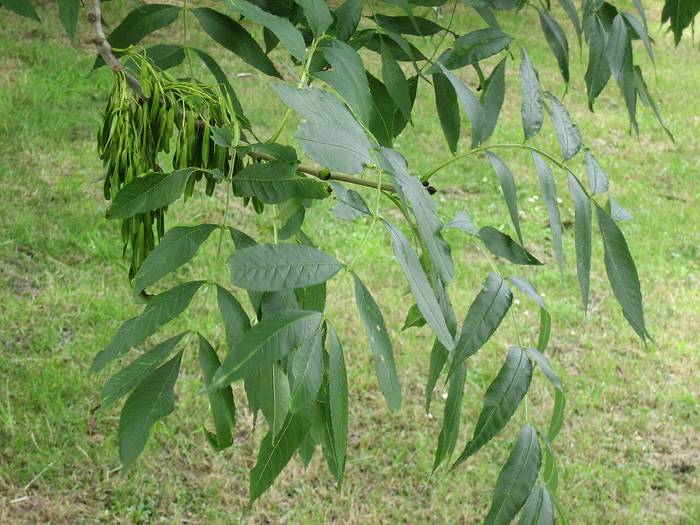
No machine-readable author provided. MPF assumed (based on copyright claims). · CC BY 2.5
Common ash
Tree·Fraxinus excelsior
Full sun
Sun
Moist to wet soil
Water
Moist soil
Drainage
Zones 4–8
Hardiness
Coverage · 120 fields
No obvious inconsistencies found.
Growth and size11 fields
Plant type
Deciduous tree“Fraxinus excelsior is a deciduous Tree growing to 30 m (98ft) by 20 m (65ft) at a fast rate.”
Height
3,000 cm“Fraxinus excelsior is a deciduous Tree growing to 30 m (98ft) by 20 m (65ft) at a fast rate.”
Spread
2,000 cm“Fraxinus excelsior is a deciduous Tree growing to 30 m (98ft) by 20 m (65ft) at a fast rate.”
Height at age
—
empty
Size after planting
6 yrs: 5 m tall, 2 m crown · 12 yrs: 7 m tall, 2 m crown · 17 yrs: 8 m tall, 4 m crown · 34 yrs: 12 m tall, 6 m crown · 71 yrs: 18 m tall, 10 m crown“Berlin tree register: 15094 trees of this species measured with years since planting, height and crown diameter; median crown 10.0 m and height 18.0 m at 60–100 years after planting (1905 trees).”Median of 15,094 measured trees in Berlin. Years count from planting nursery stock, so a small tree reaches each size later.
Spacing
1,000 cm (at least 500 cm)
AI estimate55 % agree
Growth rate
Fast“Fraxinus excelsior is a deciduous Tree growing to 30 m (98ft) by 20 m (65ft) at a fast rate.”
Habit
Vase-shaped
AI estimate50 % agree
Root depth
Deep
AI estimate63 % agree
Forest garden layer
Canopy
AI estimate90 % agree
Roots6 fields
Root form
Heart root“The root pattern is branching: a heart root, dividing from the crown into several primary roots going down and out”
Storage organ
None
AI estimate100 % agree
Lateral spread in cm
—
empty
Root depth in cm
—
empty
Mycorrhiza
Arbuscular (AM)“F. excelsior mycorrhizae are of the internal arbuscular mycorrhizal type, in which the fungus grows within the tissues of the root and forms branched, tree-like structures within the cells of the root cortex.”
Light, water and soil9 fields
Sun
Full sun“It cannot grow in the shade.”JRC forest tree atlaspartly“It is a strong light-demander in its mature stages, but its seedlings can be shade-tolerant for the first years.”
Hours of sun
6 h
AI estimatenot measured yet
Soil type
Sand, loam, clay · best: loam“Prefers a deep loamy soil, even if it is on the heavy side.”PFAF“Suitable for: light (sandy), medium (loamy) and heavy (clay) soils.”
pH
4.5–8.5 · best 5.5–8“Tolerates a pH as low as 4.5, but prefers a base-rich soil above 5.5.”JRC forest tree atlas“The species grows best on fertile soils where soil pH exceeds 5.5.”PFAF“Suitable pH: mildly acid, neutral and basic (mildly alkaline) soils and can grow in very acid soils.”
Compacted soil
Copes fairly well
AI estimatenot measured yet
Climate5 fields
Hardiness
Zone 4–8
AI estimatenot measured yet
Killing frost
-1 °C“Killing temp. early growth: -1”EcoCrop's figure is frost during early growth (spring frost on new shoots), not winter cold.
Growing temperature
5–33 °C · optimal 8–20 °C“Temperature absolute min: 5 · Temperature absolute max: 33 · Temperature optimal min: 8 · Temperature optimal max: 20”
Chill hours
1,000 h
AI estimatenot measured yet
Native range
AD, AM, AT, AZ, BA, BE, BG, BY, CH, CZ, DE, DK, EE, ES, FI, FR, GB, GE, GG, GI, GR, HR, HU, IE, IR, IT, JE, LB, LI, LT, LU, LV, MC, MD, ME, MK, MT, NL, NO, PL, RO, RS, RU, SE, SI, SK, SM, SY, TR, UA, VA, XK
Care (becomes tasks in Manage)1 fields
Pruning
November · lasts 60 days · healthy structural branches · dead, diseased, or crossing branches
AI estimatenot measured yet
Through the year5 fields
Flowering
April · lasts 61 days“It is in leaf from May to October, in flower from April to May, and the seeds ripen from September to January.”
Leafing out
May · lasts 184 days“It is in leaf from May to October, in flower from April to May, and the seeds ripen from September to January.”
Fruiting
September · lasts 153 days“It is in leaf from May to October, in flower from April to May, and the seeds ripen from September to January.”
Dying back
After the first frost“The leaves are often among the last to open in spring, and the first to fall in autumn if an early frost strikes; they often fall dull green or develop a bright yellow autumn colour.”
Wikipediapartly
Dormant
After the first frost · 30 days after · lasts 150 days
AI estimatenot measured yet
Edible parts and pollination6 fields
Immature seed
Pickled by steeping in salt and vinegar, then used as a condiment for other foods“Immature seed - usually pickled by steeping in salt and vinegar, and then used as a condiment for other foods.”PFAF“Poisonous to ruminants, it has also caused dermatitis in some people.”
Seed oil
Edible oil obtained from the seed, similar to sunflower oil“An edible oil similar to sunflower (Helianthus annuus) oil is obtained from the seed.”
The leaves
Sometimes used as an adulterant for tea“The leaves are sometimes used as an adulterant for tea.”
Pollination
Needs a partner · a male plant · dioecious“The species is dioecious”JRC forest tree atlas“Common ash is wind pollinated.”PFAF“The plant is not self-fertile.”PFAF“so both male and female plants must be grown if seed is required”
Ecology5 fields
Pests
Emerald ash borer (agrilus planipennis), gracillaria syringella, centre-barred sallow (atethmia centrago)“While its adults graze on ash leaves, the emerald ash borer larvae feed on the phloem, which can kill the tree.”Wikipedia“A common moth which causes the browning of ash leaves, as well as garden privet and lilac, is Gracillaria syringella.”Wikipedia“One example of an ash-specific feeding moth is the centre-barred sallow (Atethmia centrago).”
Diseases
Ash dieback (hymenoscyphus fraxineus)“Ash dieback is caused by the fungus Hymenoscyphus fraxineus which was previously known as Chalara fraxinea.”
Takes up
—
empty
Fixes nitrogen
No
AI estimatenot measured yet
Propagation and names4 fields
Methods
Seed sowing, cuttings of mature wood“The seed is best harvested green - as soon as it is fully developed but before it has fully dried on the tree - and can then be sown immediately in a cold frame.”PFAF“Cuttings of mature wood, placed in a sheltered outdoor bed in the winter, sometimes strike.”
Difficulty
3 / 5
AI estimatenot measured yet
Seed
Stored seed requires a period of cold stratification.“Stored seed requires a period of cold stratification and is best sown as soon as possible in a cold frame.”
Not sorted yet68 fields
Fields the parser stores that this page has no row for yet. They show up here automatically, so nothing is hidden.
forage.DK.local_name
Almindelig ask
AI estimatenot measured yet
forage.DK.warnings_da
Kan give udslæt på huden hos nogle.
AI estimatenot measured yet
forage.DK.warnings_en
Can cause a skin rash in some people.
AI estimatenot measured yet
forage.DK.prep_cautions
Poisonous to ruminants; it has also caused dermatitis in some people.“Poisonous to ruminants, it has also caused dermatitis in some people.”
forage.DK.edibility_basis
inferred
AI estimatenot measured yet
forage.DK.foraging_months.notes
The seeds ripen from September to January.“the seeds ripen from September to January”
forage.DK.foraging_months.year_round
false
AI estimatenot measured yet
forage.DK.habitat_affinity
woodland, hedgerow“Forming woods on calcareous soils in the wetter parts of Britain, also in oakwoods, scrub, hedges etc.”
forage.US.local_name
European ash
AI estimatenot measured yet
forage.US.edible_parts
[{"part":"leaves","caution":"older leaves become bitter and fibrous","preparation":"young leaves can be eaten raw in salads or cooked","season_months":[4,5]},{"part":"seeds (keys)","caution":"mature seeds are very bit…
AI estimatenot measured yet
forage.US.prep_cautions
Older leaves and mature seeds are bitter and not palatable.
AI estimatenot measured yet
forage.US.edibility_basis
inferred
AI estimatenot measured yet
forage.US.foraging_months.notes
Young leaves in spring, young seeds in early summer.
AI estimatenot measured yet
forage.US.foraging_months.months
4, 5, 6, 7
AI estimatenot measured yet
forage.US.foraging_months.year_round
false
AI estimatenot measured yet
forage.US.habitat_affinity
woodland, hedgerow, verge
AI estimatenot measured yet
forage.TROPICAL.edibility_basis
inferred
AI estimatenot measured yet
forage.TROPICAL.foraging_months.year_round
false
AI estimatenot measured yet
ornamental.basis
documented
AI estimatenot measured yet
ornamental.fragrance.source
none
AI estimate100 % agree
ornamental.fragrance.intensity
subtle
AI estimatenot measured yet
ornamental.confidence
high
AI estimatenot measured yet
ornamental.fall_interest
true“they often fall dull green or develop a bright yellow autumn colour”
ornamental.flower_colour
purple, green“Bloom Color: Green.”Wikipediapartly“The female flowers are somewhat longer than the male flowers, dark purple, without petals, and are wind-pollinated.”
ornamental.evidence_quote
Fraxinus excelsior has inconspicuous green flowers, medium-textured green foliage that turns yellow-green in autumn, and a strong architectural skeleton in winter. The flowers are not fragrant.
AI estimatenot measured yet
ornamental.foliage_colour
green“they often fall dull green or develop a bright yellow autumn colour”
Wikipediapartly
ornamental.foliage_texture
medium“Common ash (Fraxinus excelsior L.) is a medium-sized deciduous tree with large compound leaves that develop relatively late in spring.”
JRC forest tree atlaspartly
ornamental.autumn_foliage_colour
yellow_green
AI estimatenot measured yet
care_regime
none
AI estimatenot measured yet
propagation.self_seeding
moderate
AI estimate20 % agree
propagation.division_season
not applicable
AI estimatenot measured yet
propagation.establishment_years
3
AI estimate40 % agree
size_at_age.v
1
AI estimatenot measured yet
size_at_age.basis
years_after_planting
AI estimatenot measured yet
sun_requirement.best
full_sun“full overhead light is necessary for developing vigorous plants”
forage_proposals.DK.edibility_tier.tier
edible
AI estimatenot measured yet
forage_proposals.DK.edibility_tier.confidence
high
AI estimatenot measured yet
forage_proposals.DK.edibility_tier.evidence_quote
The young leaves and immature seeds (known as 'ash keys') of Fraxinus excelsior are edible. Young leaves can be used in salads or cooked, while the green, unripe seeds are traditionally pickled.
AI estimatenot measured yet
forage_proposals.US.edibility_tier.tier
edible
AI estimatenot measured yet
forage_proposals.US.edibility_tier.confidence
high
AI estimatenot measured yet
forage_proposals.US.edibility_tier.evidence_quote
The young leaves and immature seeds (known as 'ash keys') of Fraxinus excelsior are edible. Young leaves can be used in salads or cooked, while the green, unripe seeds are traditionally pickled.
AI estimatenot measured yet
forage_proposals.TROPICAL.edibility_tier.confidence
low
AI estimatenot measured yet
function_profile.biomass_return.confidence
high
AI estimatenot measured yet
function_profile.nutrient_flows.consumes
[{"basis":"documented","demand":"high","nutrient":"nitrogen","confidence":"high"},{"basis":"inferred","demand":"moderate","nutrient":"phosphorus","confidence":"medium"},{"basis":"inferred","demand":"moderate","nutrien…“Most members of this genus are gross feeders and require a rich soil.”JRC forest tree atlaspartly“This ash grows best on rich soils with high clay or silt fractions, adequate nitrogen, calcium, magnesium, and phosphorus content, and where soil pH exceeds 5.5.”
PFAFpartly
function_profile.nutrient_flows.provides
[{"basis":"inferred","nutrient":"calcium","mechanism":"mineral_extraction","confidence":"medium"},{"basis":"inferred","nutrient":"potassium","mechanism":"mineral_extraction","confidence":"medium"},{"basis":"inferred",…
AI estimatenot measured yet
function_profile.biotic_interactions
[{"taxa":["wildlife"],"basis":"documented","valence":"beneficial","relation":"attracts","confidence":"medium","evidence_quote":"It is noted for attracting wildlife.","organism_group":"wildlife","ecological_function":"…“It is noted for attracting wildlife.”Wikipedia“A common moth which causes the browning of ash leaves, as well as garden privet and lilac, is Gracillaria syringella.”Wikipedia“One example of an ash-specific feeding moth is the centre-barred sallow (Atethmia centrago).”JRC forest tree atlas“While its adults graze on ash leaves, the emerald ash borer larvae feed on the phloem, which can kill the tree.”Wikipedia“Ash dieback is caused by the fungus Hymenoscyphus fraxineus which was previously known as Chalara fraxinea.”Wikipediapartly“The Biological Records Centre of the UK records 111 species of insects and mites using ash as a food plant, of which 29 are specific to ash.”
function_profile.aromatic_pest_effect.value
false
AI estimate80 % agree
function_profile.aromatic_pest_effect.confidence
low
AI estimatenot measured yet
function_profile.structural_interfaces.provides_shelter.basis
documented“it can be grown as a shelterbelt tree”
function_profile.structural_interfaces.provides_shelter.kinds
wind“it can be grown as a shelterbelt tree”
function_profile.structural_interfaces.provides_shelter.confidence
medium“it can be grown as a shelterbelt tree”
function_profile.structural_interfaces.provides_shelter.evidence_quote
it can be grown as a shelterbelt tree“it can be grown as a shelterbelt tree”
function_profile.structural_interfaces.requires_shelter.basis
documented“the young growth in spring, even on mature plants, is frost-tender”
function_profile.structural_interfaces.requires_shelter.kinds
frost“the young growth in spring, even on mature plants, is frost-tender”
function_profile.structural_interfaces.requires_shelter.confidence
medium“the young growth in spring, even on mature plants, is frost-tender”
function_profile.structural_interfaces.requires_shelter.evidence_quote
the young growth in spring, even on mature plants, is frost-tender“the young growth in spring, even on mature plants, is frost-tender”
function_profile.structural_interfaces.provides_physical_support.form
trunk
AI estimatenot measured yet
function_profile.structural_interfaces.provides_physical_support.basis
taxonomic
AI estimatenot measured yet
function_profile.structural_interfaces.provides_physical_support.confidence
high
AI estimatenot measured yet
function_profile.structural_interfaces.requires_physical_support.basis
taxonomic
AI estimatenot measured yet
function_profile.structural_interfaces.requires_physical_support.confidence
high
AI estimatenot measured yet
climate_tolerance.photoperiod_response
long_day
AI estimatenot measured yet
soil_interactions.organic_matter_contribution
high
AI estimatenot measured yet
component_metadata.growth_cycle
perennial
AI estimate100 % agree
resource_interfaces.inputs
[{"resource":"light","quantity_description":"full overhead light needed for vigorous growth; a strong light-demander in maturity"},{"resource":"water","quantity_description":"prefers moist or wet soil"},{"resource":"s…“Young trees show a very rapid growth, although full overhead light is necessary for developing vigorous plants.”PFAF“It prefers moist or wet soil.”JRC forest tree atlas“It is a strong light-demander in its mature stages, but its seedlings can be shade-tolerant for the first years.”
resource_interfaces.outputs
[{"resource":"shade","quantity_description":"light canopy that casts little shade"},{"resource":"wind_shelter","quantity_description":"can be grown as a shelterbelt tree, often windshaped in exposed positions"},{"reso…“Trees have a light canopy and cast little shade.”PFAF“it can be grown as a shelterbelt tree”PFAF“A very valuable wood, it is much used for tool handles, oars, furniture, posts etc.”Wikipedia“The fruit is a samara 2.5–4.5 cm (0.98–1.77 in) long and 5–8 mm (0.20–0.31 in) broad, often hanging in bunches through the winter”PFAFpartly“A food plant for many insect species, there are 41 associated insect species.”