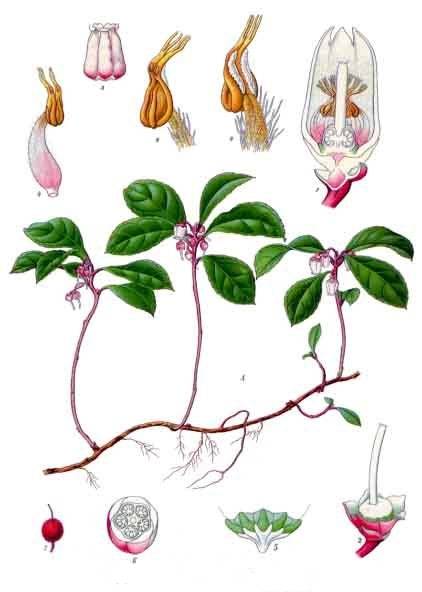
Eastern teaberry
Plant·Gaultheria procumbens
Shade to part sun
Sun
Dry to moist soil
Water
Not recorded
Drainage
Zones 3–8
Hardiness
Coverage · 110 fields
No obvious inconsistencies found.
Growth and size10 fields
Height
20 cm · other sources: 10 cm, 15 cm“Gaultheria procumbens is an evergreen Shrub growing to 0.2 m (0ft 8in) by 1 m (3ft 3in) at a medium rate.”Wikipedia“typically reaching 10–15 cm (4–6 in) tall”
Spread
100 cm“Gaultheria procumbens is an evergreen Shrub growing to 0.2 m (0ft 8in) by 1 m (3ft 3in) at a medium rate.”
Height at age
—
empty
Root depth
Shallow“The root pattern is flat with shallow roots forming a plate near the soil surface”
Forest garden layer
Ground cover
AI estimate90 % agree
Lifespan
~10 years
AI estimatenot measured yet
Roots6 fields
Root form
Plate root (shallow)“The root pattern is flat with shallow roots forming a plate near the soil surface”
Lateral spread in cm
—
empty
Root depth in cm
—
empty
Mycorrhiza
Ericoid (ErM)
AI estimatenot measured yet
Light, water and soil9 fields
Sun
Light shade, part shade, shade · best: part shade“It can grow in full shade (deep woodland) or semi-shade (light woodland).”
Hours of sun
3–6 h
AI estimatenot measured yet
Water
Dry, moist · best: moist · Medium · 2–4 l/day“Prefers a moist but not boggy humus rich soil in shade or semi-shade.”PFAF“It prefers dry or moist soil and can tolerate drought.”
Drought tolerant
Yes“Succeeds in dry soils once it is well established and tolerates considerable drought.”
Tolerates waterlogging
—
empty
Soil type
Sand, loam, peat“light (sandy) and medium (loamy) soils”PFAF“A peat and moisture loving species, it requires a lime-free soil.”
Compacted soil
Copes badly
AI estimatenot measured yet
Climate5 fields
Hardiness
Zone 3–8
AI estimatenot measured yet
Killing frost
-35 °C
AI estimatenot measured yet
Growing temperature
0–25 °C · optimal 10–20 °C
AI estimatenot measured yet
Chill hours
0 h
AI estimatenot measured yet
Care (becomes tasks in Manage)3 fields
Weeding
After the previous stage · lasts 365 days
AI estimatenot measured yet
Mulching
April · lasts 30 days
AI estimatenot measured yet
Watering
After rain · lasts 180 days
AI estimatenot measured yet
Through the year3 fields
Harvest
After the first frost · lasts 180 days
AI estimatenot measured yet
Edible parts and pollination4 fields
The berries
Raw or cooked
AI estimatenot measured yet
The leaves
Tea
AI estimatenot measured yet
Ecology5 fields
Attracts
Insect pollinators, white-tailed deer, wild turkey, sharp-tailed grouse, northern bobwhite, ring-necked pheasant, black bear, white-footed mouse, red fox, eastern chipmunk“is pollinated by Insects”Wikipedia“White-tailed deer browse wintergreen throughout its range”Wikipedia“Other animals that eat wintergreen are wild turkey, sharp-tailed grouse, northern bobwhite, ring-necked pheasant, black bear, white-footed mouse, and red fox.”Wikipedia“Wintergreen is a favorite food of the eastern chipmunk”
Pests
White-tailed deer
AI estimatenot measured yet
Diseases
—
empty
Takes up
Organic matter
AI estimatenot measured yet
Fixes nitrogen
No
AI estimatenot measured yet
Propagation and names4 fields
Methods
Difficulty
2 / 5“Very easy, larger clumps can be replanted direct into their permanent positions”
PFAFpartly
Seed
Pre-chill for 4 - 10 weeks before surface sowing in lime-free compost“Pre-chill for 4 - 10 weeks and then surface sow in a lime-free compost in a shady part of the greenhouse and keep the compost moist.”
Not sorted yet61 fields
Fields the parser stores that this page has no row for yet. They show up here automatically, so nothing is hidden.
forage.DK.local_name
Nedliggende bjergte
AI estimatenot measured yet
forage.DK.prep_cautions
Leaves contain methyl salicylate, which can be toxic in large doses. Use in moderation.
AI estimatenot measured yet
forage.DK.edibility_basis
inferred
AI estimatenot measured yet
forage.DK.foraging_months.notes
Berries persist through winter; leaves are evergreen.
AI estimatenot measured yet
forage.DK.foraging_months.year_round
false
AI estimatenot measured yet
forage.DK.habitat_affinity
woodland
AI estimatenot measured yet
forage.US.local_name
Wintergreen
AI estimatenot measured yet
forage.US.edible_parts
[{"part":"fruit","caution":null,"preparation":"Raw or cooked; used in pies or made into jams. Best after a frost.","season_months":[10,11,12,1,2,3,4]},{"part":"leaves","caution":"Contains methyl salicylate, closely re…“The berries and leaves contain methyl salicylate, a compound that is closely related to aspirin.”PFAFpartly“Edible Parts: Fruit Leaves”PFAFpartly“Young leaves - raw.”PFAFpartly“Fruit - raw or cooked.”PFAFpartly“A very agreeable tea is made from the fresh leaves.”
forage.US.prep_cautions
The pure distilled essential oil is toxic in large doses., Do not use if allergic to aspirin., Known hazards advise avoiding it if under 12., Berries and leaves contain methyl salicylate, closely related to aspirin.“The pure distilled essential oil is toxic in large doses.”PFAF“Do not use if allergic to aspirin.”Wikipedia“The berries and leaves contain methyl salicylate, a compound that is closely related to aspirin.”PFAFpartly“Avoid if under 12.”
forage.US.edibility_basis
inferred
AI estimatenot measured yet
forage.US.foraging_months.notes
Fruit hangs on the plant until spring if not eaten by birds; the plant is in leaf all year.“Best after a frost, the fruit hangs onto the plant until spring if it is not eaten by birds etc”
forage.US.foraging_months.months
1, 2, 3, 4, 5, 6, 7, 8, 9, 10, 11, 12
AI estimatenot measured yet
forage.US.foraging_months.year_round
true“It is in leaf all year, in flower from July to August, and the seeds ripen from October to December.”
forage.TROPICAL.edibility_basis
inferred
AI estimatenot measured yet
forage.TROPICAL.foraging_months.year_round
false
AI estimatenot measured yet
ornamental.basis
documented
AI estimatenot measured yet
ornamental.fragrance.intensity
strong
AI estimatenot measured yet
ornamental.confidence
high
AI estimatenot measured yet
ornamental.fall_interest
true
AI estimatenot measured yet
ornamental.evidence_quote
Wintergreen (Gaultheria procumbens) is known for its fragrant, dark green leaves that turn reddish in autumn, and its persistent red berries, providing winter interest. The flowers are typically white to pale pink.
AI estimatenot measured yet
ornamental.foliage_colour
dark_green
AI estimate82 % agree
ornamental.foliage_texture
medium
AI estimatenot measured yet
ornamental.winter_structure
persistent_fruit, evergreen_form“Its fruit persists through the winter”PFAFpartly“Gaultheria procumbens is an evergreen Shrub growing to 0.2 m (0ft 8in) by 1 m (3ft 3in) at a medium rate.”
ornamental.autumn_foliage_colour
red
AI estimatenot measured yet
care_regime
none
AI estimatenot measured yet
propagation.self_seeding
moderate
AI estimate20 % agree
propagation.division_season
Works best in the spring just before new growth begins“Division can be carried out at almost any time of the year, but works best in the spring just before new growth begins”
propagation.establishment_years
1“A good ground-cover plant for shady positions though it requires weeding for the first year or so.”
PFAFpartly
forage_proposals.DK.edibility_tier.tier
caution
AI estimatenot measured yet
forage_proposals.DK.edibility_tier.confidence
low
AI estimatenot measured yet
forage_proposals.DK.edibility_tier.evidence_quote
The berries are edible raw or cooked, and the leaves can be used to make a tea, but in large quantities, the leaves can be toxic due to methyl salicylate.
AI estimatenot measured yet
forage_proposals.US.edibility_tier.tier
edible“The fruits of G. procumbens, considered its actual "teaberries", are edible”
forage_proposals.US.edibility_tier.confidence
high
AI estimatenot measured yet
forage_proposals.US.edibility_tier.evidence_quote
The leaves and berries of Gaultheria procumbens are edible, but the leaves contain methyl salicylate, which can be toxic in large quantities. It is best used in moderation as a flavoring or for tea.
AI estimatenot measured yet
forage_proposals.TROPICAL.edibility_tier.confidence
low
AI estimatenot measured yet
function_profile.nutrient_flows.consumes
[{"basis":"inferred","demand":"low","nutrient":"nitrogen","confidence":"medium"},{"basis":"inferred","demand":"low","nutrient":"phosphorus","confidence":"medium"},{"basis":"inferred","demand":"low","nutrient":"potassi…
AI estimatenot measured yet
function_profile.biotic_interactions
[{"taxa":["insects"],"basis":"documented","valence":"beneficial","relation":"attracts","confidence":"high","evidence_quote":"is pollinated by Insects","organism_group":"pollinator","ecological_function":"pollination"}…“is pollinated by Insects”Wikipedia“White-tailed deer browse wintergreen throughout its range”Wikipediapartly“Wintergreen is a favorite food of the eastern chipmunk”Wikipediapartly“Other animals that eat wintergreen are wild turkey, sharp-tailed grouse, northern bobwhite, ring-necked pheasant, black bear, white-footed mouse, and red fox.”
function_profile.aromatic_pest_effect.value
true
AI estimate80 % agree
function_profile.aromatic_pest_effect.confidence
medium
AI estimatenot measured yet
function_profile.structural_interfaces.provides_shelter.basis
inferred
AI estimatenot measured yet
function_profile.structural_interfaces.provides_shelter.kinds
shade
AI estimatenot measured yet
function_profile.structural_interfaces.provides_shelter.confidence
low
AI estimatenot measured yet
function_profile.structural_interfaces.provides_shelter.evidence_quote
Gaultheria procumbens forms a dense groundcover, providing shade to the soil beneath.
AI estimatenot measured yet
function_profile.structural_interfaces.requires_shelter.basis
documented
AI estimatenot measured yet
function_profile.structural_interfaces.requires_shelter.kinds
shade“Grows well under the thin shade of deciduous shrubs or evergreens.”
PFAFpartly
function_profile.structural_interfaces.requires_shelter.stage
permanent
AI estimatenot measured yet
function_profile.structural_interfaces.requires_shelter.confidence
medium
AI estimatenot measured yet
function_profile.structural_interfaces.requires_shelter.evidence_quote
Prefers a moist but not boggy humus rich soil in shade or semi-shade.
AI estimatenot measured yet
function_profile.structural_interfaces.provides_physical_support.basis
inferred
AI estimatenot measured yet
function_profile.structural_interfaces.provides_physical_support.confidence
medium
AI estimatenot measured yet
function_profile.structural_interfaces.requires_physical_support.basis
inferred
AI estimatenot measured yet
function_profile.structural_interfaces.requires_physical_support.confidence
medium
AI estimatenot measured yet
climate_tolerance.photoperiod_response
day_neutral
AI estimatenot measured yet
soil_interactions.organic_matter_contribution
medium
AI estimatenot measured yet
resource_interfaces.inputs
[{"resource":"shade","quantity_description":"full shade (deep woodland) or semi-shade (light woodland)"},{"resource":"water","quantity_description":"dry or moist soil; tolerates drought"},{"resource":"pollination","qu…“It can grow in full shade (deep woodland) or semi-shade (light woodland).”PFAF“It prefers dry or moist soil and can tolerate drought.”PFAF“is pollinated by Insects”PFAF“should be spaced about 45cm apart each way”
resource_interfaces.outputs
[{"resource":"ground_cover","quantity_description":"dense tuft-like carpet that roots as it spreads"},{"resource":"fruit","quantity_description":"up to 15 mm in diameter; persists through winter"},{"resource":"seeds",…“the seeds ripen from October to December”PFAF“used as fertilizer or to improve mulch”PFAFpartly“Landscape Uses:Ground cover, Massing, Rock garden, Woodland garden”PFAFpartly“The fruit is up to 15mm in diameter.”PFAFpartly“All parts of the plant are aromatic”